FCA contract certainty requirements are not one rule but several. No provision in the FCA Handbook is titled contract certainty; the expectation that terms are agreed by inception and documents follow promptly rests on the FCA's Principles for Businesses, on the insurance conduct sourcebook (ICOBS), which says firms should provide evidence of cover "promptly after inception of a policy", and on the duty to act in the customer's best interests. Since 9 December 2025 most of ICOBS has not applied to business with larger commercial customers or to specialist risks such as ships and aircraft, but the Principles and the evidence-of-cover expectation still do. Behind all of it sits the FSA's 2004 challenge to end "deal now, detail later", which the market answered with its own definition and code of practice. Botminds' Contract Certainty Management produces the evidence a supervisor can ask for: every bound risk counted under a written definition, every uncertain contract named, and every chaser, clearance and wording agreement made by a named person and logged.
The rules are quoted from the FCA Handbook and the PRA Rulebook as they stand on 27 October 2026, from the FCA's December 2025 policy statement and from the FSA's own 2004 texts. The product examples come from a fictional London market insurer, Marlowgate Specialty, in the solution's sample market. This is a map of the rules, not legal advice.
Where contract certainty sits in the FCA and PRA rules in 2026
| Rule | What it says | What it means for certainty |
|---|---|---|
| FCA Principle 3 | "A firm must take reasonable care to organise and control its affairs responsibly and effectively, with adequate risk management systems." | Knowing which contracts are not agreed is part of controlling the firm |
| FCA Principle 7 | "A firm must pay due regard to the information needs of its clients, and communicate information to them in a way which is clear, fair and not misleading." | Evidence of cover that matches what was agreed |
| FCA Principle 12 | "A firm must act to deliver good outcomes for retail customers." | Applies where the customer is a retail customer |
| ICOBS 1 Annex 1, 2.2G | Evidence of cover should be provided "promptly after inception of a policy" | Applies even where most of ICOBS is switched off |
| ICOBS 6.1.5R and 6.1.6G | Appropriate information "in good time", at every stage including "post-conclusion" | For customers within ICOBS 6 |
| ICOBS 2.5.-1R | "A firm must act honestly, fairly and professionally in accordance with the best interests of its customer." | Applies to every customer ICOBS reaches |
| PRA Fundamental Rule 3 | "A firm must act in a prudent manner." | Uncertain contracts are unpriced exposure for an insurer |
Does the FCA require contract certainty?
Not by that name, and not as a test at inception. The FCA expects firms to control their affairs, to communicate clearly with customers and to give evidence of cover promptly after inception; a firm that cannot say which of its contracts are agreed will find those expectations hard to meet. What the FCA does not do is set a certainty rate, define "certain" or require every term to be agreed before inception.
That is a deliberate inheritance. When the FSA, the body renamed the Financial Conduct Authority by the Financial Services Act 2012, opened the subject in 2004, it chose a market-led route. The record of its meeting with the industry reads: "The FSA has no preference for the solution reached, provided that it deliver the aims and outcomes," and places the work "within the FSA's strategic aim of promoting efficient, orderly and fair markets, working with the grain of the market wherever possible" (FSA, record of the industry meeting of 20 December 2004).
What did the FSA contract certainty challenge require?
A market-built solution within two years, with regulation held in reserve. The same record set out the reserve: "Regulatory tools could range from operational risk charges, other capital charges and specific rules." It defined the target in outline, a wording agreed by inception and the policy issued a set number of days after it, and asked the market to propose governance by the end of January 2005.
From the FSA's challenge to the 2026 rules
| When | What changed | Where it is set out |
|---|---|---|
| December 2004 | FSA challenge: a market solution within two years, deadline December 2006 | FSA meeting record and 2006 briefing notice |
| January 2008 | Earliest effective dates shown on ICOBS provisions | FCA Handbook, ICOBS |
| 12 August 2016 | Insurance Act 2015 in force | Insurance Act 2015, s.23 |
| 1 October 2018 | Best-interests rule from the Insurance Distribution Directive | ICOBS 2.5.-1R |
| 31 July 2023 | Consumer Duty: Principle 12 | PRIN 2.1.1R |
| 9 December 2025 | Specialist risks contracts and larger commercial customers carved out of most of ICOBS | FCA PS25/21 |
| 26 June 2026 | Current text of the evidence-of-cover guidance | ICOBS 6.1.11G |
The market responded with a definition, a governance structure and a code of practice of its own; the industry's January 2007 submission to the FSA measured how many firms' boards had certified adopting the code. The result is the present arrangement: firms are measured against general rules, and the market's own standards describe what good looks like. A firm that wants to show it meets those general rules needs its own written definition of certain, its own clocks and its own evidence.
Does ICOBS apply to commercial insurance?
Partly, and much less since December 2025. The FCA's policy statement PS25/21 replaced the old "contract of large risks" category with two: specialist risks contracts, which it describes as "contracts of insurance covering railway rolling stock, aircraft, ships, goods in transit, aircraft liability and liability of ships", plus some credit and suretyship; and larger commercial customers, "commercial customers of any general insurance product who exceed the thresholds which we have aligned with DISP" (FCA PS25/21, December 2025). The instrument came into force on 9 December 2025.
How ICOBS applies after PS25/21, by customer and contract
Consumers and smaller commercial customers: ICOBS does not apply if the business is distributed to larger commercial customers or is a specialist risk; otherwise the normal rules
Larger commercial customers, and specialist risks for any commercial customer: ICOBS does not apply
Consumers and smaller commercial customers: ICOBS applies, including ICOBS 6 product information and the evidence-of-cover guidance in 6.1.11G
Larger commercial customers, and specialist risks for any commercial customer: Only ICOBS 2, 6A.3 and 6A.7 apply
Consumers and smaller commercial customers: "promptly after inception" (ICOBS 6.1.11G)
Larger commercial customers, and specialist risks for any commercial customer: "promptly after inception" (ICOBS 1 Annex 1, 2.2G), as the FCA’s view of what the Principles require
Consumers and smaller commercial customers: ICOBS 2.5.-1R applies
Larger commercial customers, and specialist risks for any commercial customer: ICOBS 2.5.-1R applies (it sits in ICOBS 2)
Consumers and smaller commercial customers: All apply; Principle 12 for retail customers
Larger commercial customers, and specialist risks for any commercial customer: All apply; Principle 7 where the Consumer Duty does not
Three exclusions matter for a London market certainty team. "This sourcebook does not apply to activities carried on in relation to a reinsurance contract." It "does not apply to the Society" of Lloyd's, although its references to an insurer "apply equally to a managing agent unless the context requires otherwise". And for risks located outside the UK, ICOBS does not apply to larger commercial customers or specialist risks "irrespective of whether the customer is a consumer, commercial customer or larger commercial customer" (ICOBS 1 Annex 1). The policy statement also said the FCA would be "reviewing some of our core definitions (e.g. retail customer) in 2026", so the boundaries may move again.
What does ICOBS say about evidence of cover?
That it should come promptly after inception, and that this holds even where most of ICOBS has been switched off. For business inside ICOBS 6, the guidance reads that a firm should "provide evidence of cover promptly after inception of a policy, taking into account the type of customer and the effect of other information requirements", and adds: "Under the Consumer Duty, a firm should provide evidence of cover promptly after inception of a policy" (ICOBS 6.1.11G, updated June 2026).
For larger commercial customers and specialist risks, the annex reminds firms of "their obligations under Principle 12 and PRIN 2A (the Consumer Duty) or Principle 7 (as applicable)", and gives the FCA's view that, to comply with them, a firm should provide evidence of cover promptly after inception to its customer (ICOBS 1 Annex 1, 2.2G). The word that does the work, "promptly", is not defined. A firm has to define it for itself, write it down and measure against it.
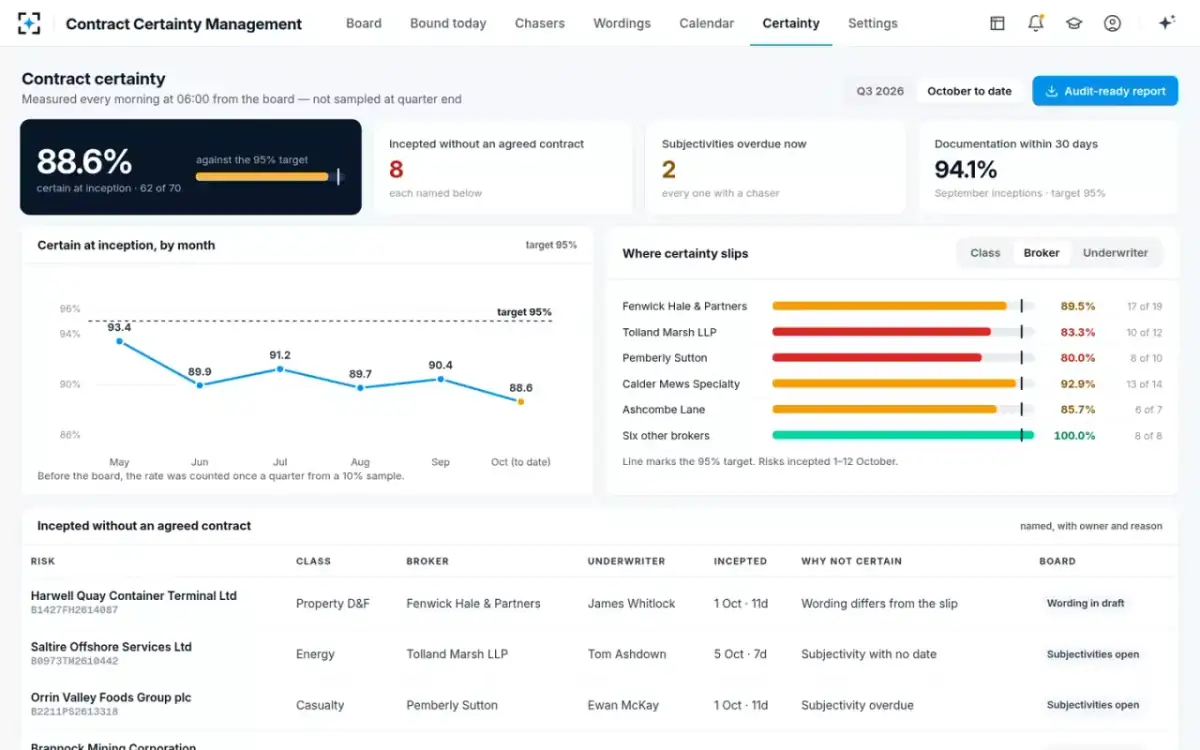
The market has a reference point. In 2005 the London Market Reform Group agreed, and reported to the FSA, that "Appropriate evidence of cover to be issued within 30 days of inception". Marlowgate's sample setting uses the same 30 days and calls it "Marlowgate's reading of 'promptly'", and its certainty screen reports 94.1% of September inceptions documented within that period.
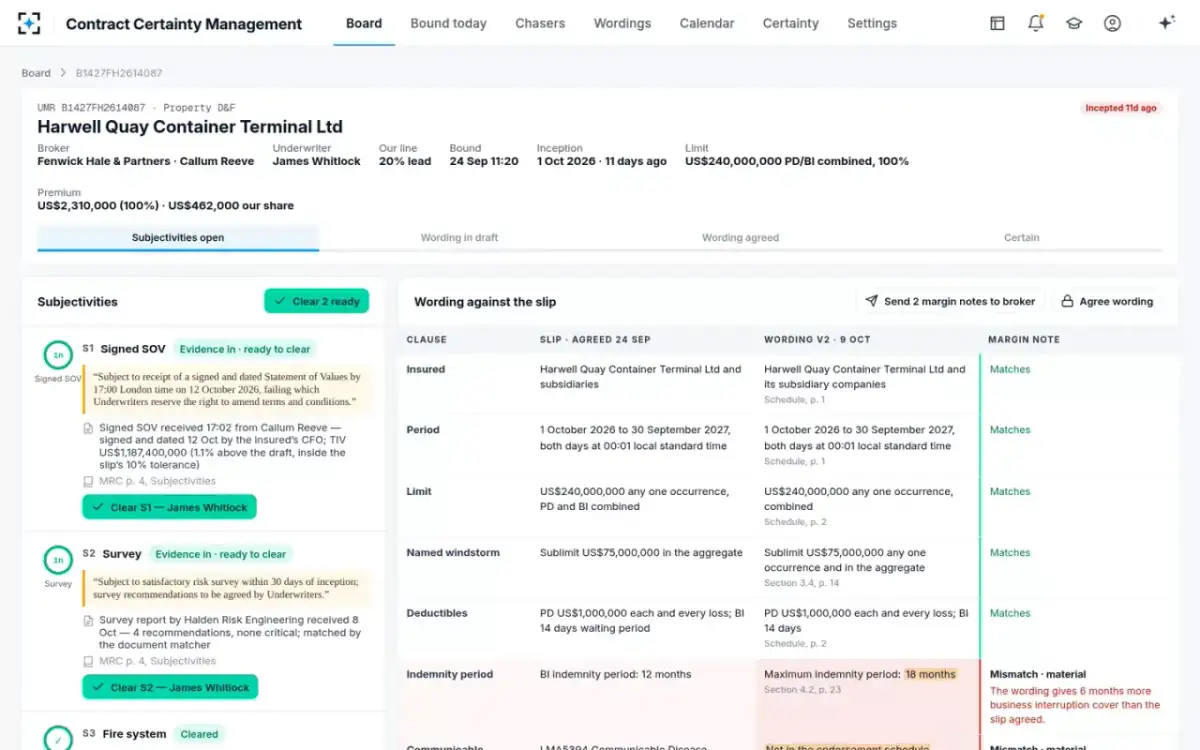
Each risk's evidence and status, traceable to the slip
When is contract certainty not required?
In regulatory terms, it is never required as such, and some business sits outside the conduct rules that come closest to it. Reinsurance falls outside ICOBS. Risks located outside the UK, when placed with larger commercial customers or as specialist risks, fall outside it too. And for a UK risk with a larger commercial customer, only ICOBS 2 and two cross-selling and disclosure sections apply.
None of that makes an uncertain contract safe. The Principles still apply to every regulated firm, the PRA's rules still apply to every insurer it supervises, and the law of contract still decides what was agreed when a claim comes in. An insurer outside ICOBS for a given risk has fewer conduct rules about documents, but exactly the same exposure to terms it never agreed.
What does the PRA expect on contract certainty?
The PRA does not address contract certainty by name either; its Fundamental Rules cover it in general terms. "A firm must act in a prudent manner" (Fundamental Rule 3), must "have effective risk strategies and risk management systems" (Fundamental Rule 5) and must "organise and control its affairs responsibly and effectively" (Fundamental Rule 6) (PRA Rulebook, Fundamental Rules).
The prudential angle is the one the FSA raised in 2004 when it mentioned operational risk charges. An insurer that does not know its signed line, or whose wording gives more cover than it priced, holds exposure its capital model never saw. The sample Harwell Quay wording would have given six months more business interruption cover than the slip agreed. For a prudential supervisor, that is the cost of uncertainty in one sentence.
What a supervisor can ask to see
A supervisor reviewing how a firm controls its contracts will ask for evidence, not assurances. The list below is what a firm should be able to produce on any day, for any period, from the documents themselves.
Evidence a firm should be able to show on contract certainty
- The definition of certain at inception, with its history
What counts, since when, and who approved each change.
- The rate for any period, counted from every incepted risk
Not a sample, with the definition in force for that period.
- Every risk not certain, named
With class, broker, underwriter, inception date and reason.
- Evidence of cover timing against the firm’s reading of "promptly"
For each risk, the inception date and the issue date.
- For each subjectivity, the slip text, deadline, evidence and who cleared it
A signature that records what clearing meant.
- For each wording, the differences from the slip and who agreed it
With both texts for every material difference.
- Every chaser, who released it and what it quoted
Nothing sent to the market without a named person.
- The run log of every step by software and people
So the firm can explain what a tool did on a given risk.
The rate, the trend and every uncertain risk, ready for the audit file
Where Contract Certainty Management fits in a compliance file
It does not make a firm compliant; it produces the evidence that the firm's controls work. Agents read every bound slip, count each subjectivity down, draft chasers, compare each wording with its slip, and mark each incepted risk certain or not every morning under the firm's definition. People release every chaser, the class underwriter clears subjectivities and agrees wordings with a signature, and the head of underwriting operations signs the report and approves any change to the definition or the clocks. Every step is on the risk's run log.
That division is also the answer to the question a supervisor now asks about any software in a regulated process: who decided? Nothing in the sample setup changes a contract or speaks to the market without a named person. How the head of operations runs that seat is set out in the head of underwriting operations guide, and the deadlines a firm sets for itself, alongside the ones the law sets, in contract certainty deadlines.
Questions people ask
Is the contract certainty code of practice an FCA rule?
It is a market document, written by the industry after the FSA's 2004 challenge; the industry's January 2007 report to the FSA tracked how many firms' boards had certified adopting it. The FCA's expectations come through its Principles and ICOBS, and firms should read the code's current version from the body that publishes it.
How promptly must evidence of cover be issued?
The FCA says "promptly after inception" and does not give a number. The London Market Reform Group agreed 30 days from inception in 2005; whatever a firm chooses should be written down and measured. Marlowgate's sample setting is 30 days.
Does the Consumer Duty apply to London market business?
Principle 12 applies where the customer is a retail customer. ICOBS 1 Annex 1 refers firms to Principle 12 and the Consumer Duty "or Principle 7 (as applicable)", so for larger commercial customers and specialist risks the communication principle carries the evidence-of-cover expectation. The FCA said in PS25/21 it would review core definitions such as retail customer during 2026.
Does the FCA regulate Lloyd's contract certainty?
ICOBS states that it "does not apply to the Society" of Lloyd's, but its references to an insurer "apply equally to a managing agent unless the context requires otherwise". Lloyd's also sets requirements for its market, which it publishes itself.
What changed for commercial insurance in December 2025?
PS25/21 replaced the "contract of large risks" category with specialist risks contracts and larger commercial customers, and switched off most of ICOBS for both, keeping ICOBS 2, 6A.3 and 6A.7. The evidence-of-cover expectation sits as guidance in ICOBS 1 Annex 1, 2.2G, tied to Principles 7 and 12.