Binding subjectivities are the conditions an underwriter attaches when binding a risk: the insurer agrees to be on risk now, subject to the insured providing something later, such as a signed statement of values, a survey or a questionnaire, by a stated date. They let business be written on time, and they have a price that rarely appears anywhere. Every day a binding subjectivity stays open after inception, the insurer carries its full line on values it has not confirmed, earns premium on a rating base it has not checked, and loses some of its leverage to act on the answer. Botminds' Contract Certainty Management counts each subjectivity down from the slip, drafts the chaser the moment one lapses and gets the evidence to the underwriter to clear, so the meter on each one runs for days rather than for the rest of the policy year.
The worked example is a fictional risk from the solution's sample London market, Harwell Quay Container Terminal, insured by the fictional Marlowgate Specialty. The cost model is ours and every input is stated, so a reader can replace it with their own figures.
What one open day of a binding subjectivity costs on the sample risk
Exposure on unconfirmed terms
Our line × limit
20% × US$240,000,000 = US$48,000,000 carried every day the signed values are missing
Underwriter
Premium earned on an unchecked base
Our premium ÷ 365
US$462,000 ÷ 365 ≈ US$1,266 a day, earned on values the insured has not signed
Finance
Pricing gap if the values move
Change in values × our premium
1.1% higher signed values ≈ US$5,100 of our premium; at the slip’s 10% tolerance, US$46,200
Underwriter
Handling
Hours chasing × cost per hour
Botminds estimates 1.5 hours of chasers per risk by hand, about 0.3 with agents
Operations
What is a binding subjectivity?
A binding subjectivity is a condition that the insurer accepts being open when it binds: cover is agreed, and the insured owes something by a date. It differs from a condition the insurer insists on before it will bind at all, which is met or the risk is not written. On a London market slip both sit in the subjectivities section, and the words decide which is which: "prior to inception" sets one that must be met before cover starts; "within 14 days of inception" sets one the insurer carries after cover begins.
The sample risk shows the post-inception kind. Harwell Quay was bound on 24 September and incepted on 1 October with a subjectivity requiring "a signed and dated Statement of Values by 17:00 London time on 12 October 2026, failing which Underwriters reserve the right to amend terms and conditions." For eleven days and seventeen hours after inception, Marlowgate was on risk for 20% of a US$240 million limit on values the insured had not signed.
Is cover in force before subjectivities are met?
It depends on what the slip says happens if the subjectivity is not met. The consequence clause is the only part that answers the question, and it comes in three broad shapes.
Three ways a subjectivity's wording decides whether cover is in force
| Wording | Cover while it is open | Example in the sample market |
|---|---|---|
| "failing which Underwriters reserve the right to amend terms and conditions" | In force on the terms bound; the insurer gains an option after the deadline | Harwell Quay S1, the signed statement of values |
| "failing which the [extension] shall not attach" | In force, minus one piece of cover if the condition is not met | Dunmore Port Authority S2, a survey of the quay cranes before inception |
| Worded as a warranty | In force until a breach; then no liability for losses until the breach is remedied (Insurance Act 2015, s.10) | None on the sample slips |
The warranty row is the one with teeth. For contracts made since the Insurance Act 2015 took effect, a breach of warranty no longer discharges the insurer for good (s.10(1)). Cover is suspended instead, and returns once the breach is remedied; the guide to Insurance Act 2015 warranties reads the section clause by clause. For a subjectivity worded as a warranty with a deadline, an open day after the deadline is a day the insured may have no cover at all, which is a cost to the insured and, through the broker, a dispute waiting for the insurer.
The US position is set by each contract and state law rather than one statute, but the structure of the risk is the same. In the World Trade Center litigation the Second Circuit, quoting New York's Court of Appeals, described a binder as interim insurance that "terminates when a policy is either issued or refused", and read each insurer's obligations from what it had bound on, not from the policy that came later (345 F.3d 154, 2003). What is open at binding stays open, on the binder's terms, until someone closes it.
How long can a subjectivity stay open?
As long as the slip allows, and no law in the UK sets a general limit. The sample slips use 14 days after inception, 30 days after inception and "prior to inception". What does vary by stage is what the insurer can still do about an open one, and that is where the cost hides.
One subjectivity's life, and the insurer's leverage at each stage
- Bound, not on risk: can still decline or re-price24 Sep–1 Oct
- On risk, before the deadline: values unconfirmed1–12 Oct 17:00
- Lapsed: chased12–14 Oct
Before inception, an unmet condition costs nothing but attention, and the insurer's leverage is at its highest: it is not yet on risk. After inception, exposure starts and the leverage drops, because amending terms mid-term on a risk already running is harder than setting them at the start. After a loss, leverage for that loss is gone, and the insurer's position depends entirely on the consequence wording above.
What does an open subjectivity cost? Pricing the meter
Four costs run while a subjectivity is open after inception, and three of them can be put in money on any risk. Exposure is the insurer's share of the limit carried on unconfirmed terms: on Harwell Quay, 20% of US$240 million, or US$48 million, every day. Premium earned is the share of the year's premium earned on a rating base that has not been confirmed: US$462,000 a year for Marlowgate's line is about US$1,266 a day, so the eleven days and seventeen hours to the deadline earned about US$14,800 on values nobody had signed.
The pricing gap is the part that moves. The signed statement that arrived on 12 October showed total insured values of US$1,187,400,000, 1.1% above the draft of 2 October. If premium tracks declared values, Marlowgate's share was under-priced by about US$5,100 for the year, inside the slip's 10% tolerance and so absorbed. At the tolerance limit the gap would have been US$46,200, and beyond it the slip's right to amend terms was the only remedy, worth less every day it went unused.
Handling is the fourth. Botminds estimates about an hour and a half of chasing per bound open-market risk when the work is done by hand, falling to about 0.3 hours when agents draft the chasers and a person releases them. On a book binding 70 risks a month, that difference alone is roughly 84 hours a month, our arithmetic on our estimate.
What happens at the subjectivity deadline?
Nothing happens on its own, which is the problem. The slip says what the insurer may do; somebody has to notice the deadline passed, find out whether the evidence came in, and either chase or act. In a spreadsheet that depends on someone opening the file. In the sample setup the subjectivity tracker marks the item overdue the moment it lapses with no matching evidence, the chaser writer drafts the broker email within seconds, and the analyst releases it.
Look ahead seven days: what will lapse, lit up
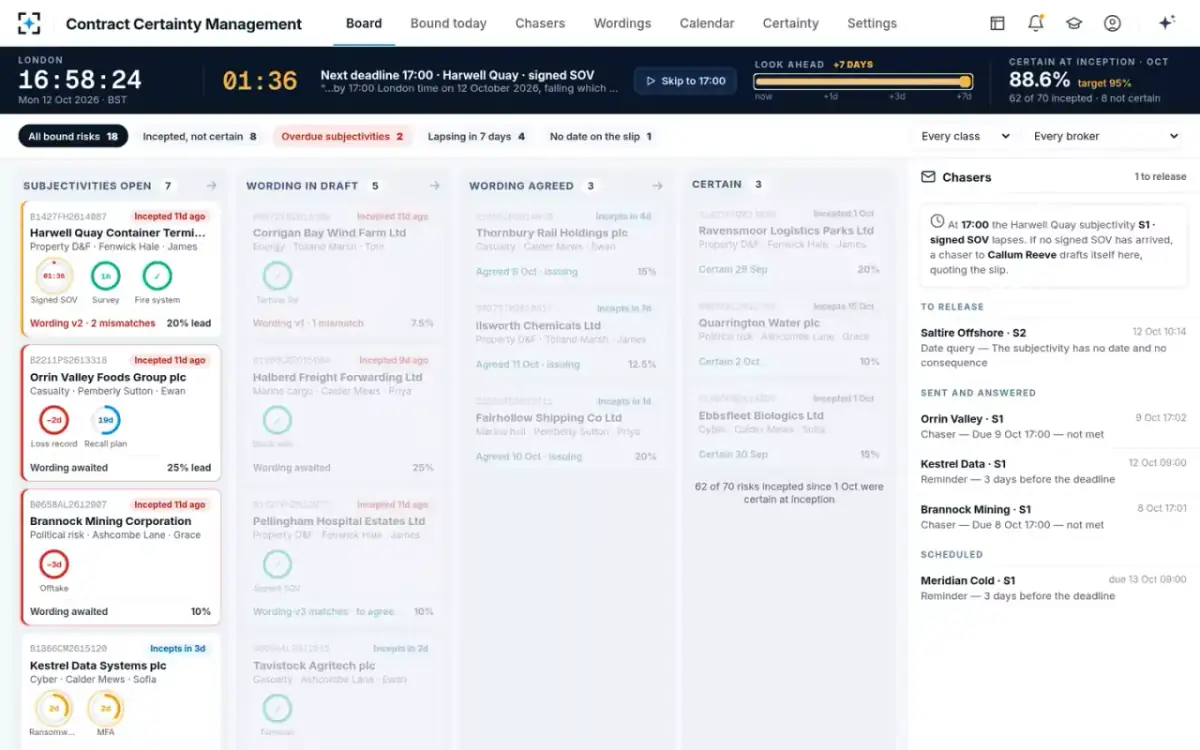
The deadline is also where the insurer's choice is made, sometimes by default. If nobody acts on "Underwriters reserve the right to amend terms", the right is not lost on the day, but a right exercised three months later, after the insured has relied on the cover as bound, is a harder conversation than one exercised the next morning. The escalation clock exists so that the underwriter decides, rather than the calendar.
Can an insurer change terms for an unmet subjectivity?
If the slip reserves the right, yes, within what the slip says; if it does not, the insurer has only the remedies the general law gives it. Under English law, a term in a non-consumer contract that puts the insured in a worse position than the Insurance Act would, for example by making a breach discharge cover rather than suspend it, is of no effect unless the insurer met the Act's transparency requirements (s.16). Those require the insurer to have drawn the term to the insured's attention before the contract was entered into, and the term to be clear and unambiguous as to its effect (s.17).
That has a practical edge for subjectivities. A consequence written at binding, in plain words, does its job. A consequence added after the fact, or one that tries to do more than the Act allows without the transparency steps, may do nothing. The cheapest fix for a subjectivity is a well-drafted one, and the drafting points are set out in insurance subjectivities on a London slip.
How do you reduce open subjectivities?
Shorten the time each one is open and stop undated ones being written. The first is a matter of chasing on time; the second of catching the slip the day it is bound.
Six ways to keep the meter short
- Move evidence before binding where the broker can supply it
A survey report already on file is a condition met, not a condition carried.
- Give every subjectivity a date, a time and a consequence
The sample slip reader flags an undated one and drafts a date query the same day.
- Remind three days before, chase at the deadline
A reminder costs nothing and settles most items before they lapse.
- Quote the slip in every chaser
The broker forwards the exact words to the insured; a paraphrase invites a debate.
- Escalate on a clock, not on a feeling
Two working days to the underwriter, five to the head of operations, in the sample settings.
- Count open days by broker and class
Where subjectivities stay open longest is where the drafting or the relationship needs work.
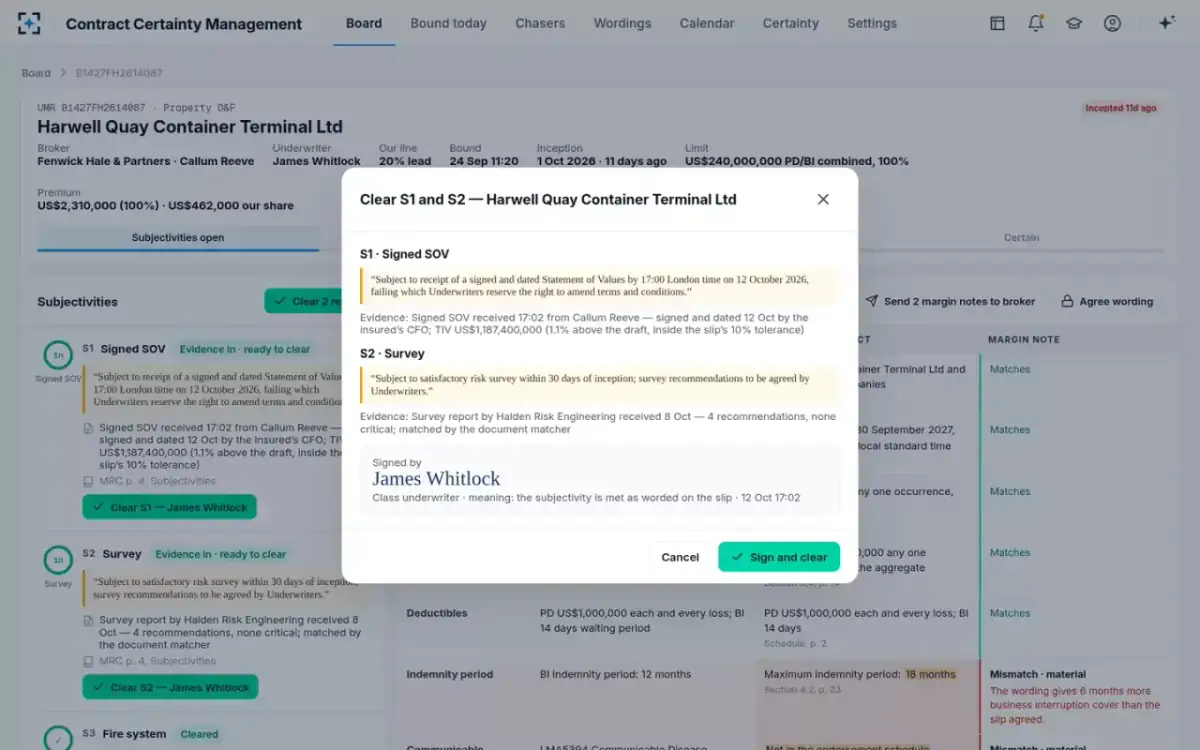
Evidence matched, cleared with a signature, meter stopped
The meter across a book, not one risk
One open subjectivity on one risk is a small number; the sum across a book is not. The useful measure is subjectivity-days after inception: for each open item, the days from inception (or the deadline, if later) to clearance, weighted by the insurer's share of the limit. It shows where exposure on unconfirmed terms concentrates, and it falls only when chasing gets faster or drafting gets better.
The sample market's October board had two subjectivities overdue at 16:58 on 12 October, at Orrin Valley Foods and Brannock Mining, and four risks with subjectivities lapsing within seven days. A head of underwriting operations looking at subjectivity-days by broker would see that both overdue items sat with brokers already below the 95% certainty target. That turns a cost into a conversation with two brokers, which is the point of measuring it. The same data feeds the certainty rate described in the contract certainty checklist.
Questions people ask
What is the difference between a pre-binding and a post-binding subjectivity?
A pre-binding subjectivity must be met before the insurer will bind, so while it is open there is no cover from that insurer. A post-binding one is carried after binding with a deadline, which can fall before inception, like the sample Dunmore crane survey, or after it, like Dunmore's signed statement of values due 14 days after inception. Only the second kind leaves the insurer on risk while it is open.
Who pays for an open subjectivity?
The insurer carries the exposure and the pricing gap; the insured carries the risk that a consequence bites at a loss; the broker carries the chasing. If the subjectivity is worded as a warranty under English law, the insured may have no cover for losses during a breach, which is why brokers have reason to chase as hard as insurers.
Should a subjectivity ever be left open for the whole policy year?
Only if it was never meant to close, which means it was really a continuing condition and should be worded as one. An item still open at renewal means nobody exercised the consequence, and the insurer renewed terms it never confirmed. The sample settings escalate any overdue subjectivity to the head of underwriting operations after five working days.
Do open subjectivities affect the certainty rate?
Under a strict definition, yes: Marlowgate's sample definition counts a risk certain at inception only if every subjectivity is cleared and the wording agreed by 00:01 on the inception date. Under a looser definition that accepts a dated subjectivity with a stated consequence, a post-binding subjectivity can be open without failing the test, which is why the definition must be stated alongside the rate.
Can agents clear subjectivities to save time?
Not in this design. Clearing decides that the condition is met as the slip words it, which is the underwriter's judgement and changes the contract. In Contract Certainty Management agents match the evidence and say why it fits; only the class underwriter clears, with a signature whose meaning is recorded.