Under the Insurance Act 2015, a breach of warranty in a UK insurance contract no longer discharges the insurer's liability for good. Section 10 abolishes that rule and replaces it with suspension: the insurer has no liability for loss occurring after the breach and before it is remedied, and is liable again once it is. Section 11 adds that where a term, warranty or not, guards against loss of a particular kind, at a particular place or at a particular time, the insurer cannot rely on its breach if the insured shows the breach could not have increased the risk of the loss that actually occurred. Section 9 abolishes "basis of the contract" clauses in business insurance. The warranty rules apply to contracts entered into from 12 August 2016 and to variations of those contracts, so a wording drafted earlier and renewed since can say more than it can now do. Botminds' Policy Wording Comparison reads broker and manuscript wordings against a carrier's approved forms and clauses; this guide shows what comparing an old wording against the Act itself involves.
The statute and Explanatory Notes are quoted from legislation.gov.uk. Clause examples are our illustrations, not any carrier's wording; the one product screen is from a fictional sample carrier.
Five kinds of pre-2016 warranty wording, and what each does under the Insurance Act 2015
The old clause, and its effect before the Act: "The proposal and declaration shall be the basis of this contract." Any inaccurate answer, however immaterial, discharged the insurer.
Its effect in a business contract from 12 August 2016: No longer converts the answers into warranties (s.9). Inaccurate answers are judged under the duty of fair presentation instead.
The old clause, and its effect before the Act: "Warranted that the intruder alarm is set whenever the premises are unattended." One breach discharged all cover from that moment, even after the alarm was set again.
Its effect in a business contract from 12 August 2016: Cover is suspended while the alarm is off and restored when it is set (s.10). A flood or a fire unrelated to the alarm may still be recoverable under s.11.
The old clause, and its effect before the Act: "Warranted that survey recommendations are completed within 30 days of inception." Missing the deadline discharged the insurer for good.
Its effect in a business contract from 12 August 2016: The breach is remedied if the work is later done (s.10(5)(a) and (6)); losses after that are covered.
The old clause, and its effect before the Act: "Warranted that the vehicle is not used for hire or reward." Breach discharged the insurer.
Its effect in a business contract from 12 August 2016: Still a warranty under s.10, but s.11 does not apply to terms defining the risk as a whole; the Notes give commercial use as an example.
The old clause, and its effect before the Act: "Any breach of any condition of this policy shall discharge the insurer from all liability."
Its effect in a business contract from 12 August 2016: Of no effect to the extent it leaves the insured worse off than the Act, unless the transparency requirements are met (ss.16 and 17).
What did the Insurance Act 2015 change about warranties?
It changed the remedy for breach, not the definition of a warranty. Before the Act, the Explanatory Notes explain, "breach of a warranty in an insurance contract discharges the insurer from liability completely from that point onwards, even if the breach is remedied", and "An insurer may also avoid liability even if the breached term would not have increased the risk of the type of loss occurring which was actually suffered" (Explanatory Notes, para 15). The Act replaced both rules.
What it left alone matters as much. "The Act does not make any change to the definition of warranty", the Notes say, and a warranty still "must be exactly complied with, whether material to the risk or not" (para 86, quoting the Marine Insurance Act 1906). Insurers can still write warranties: "It remains possible for insurers to include specific warranties within their policies" (para 84). So the question for an old wording is not whether its warranties survive. It is what they now do.
What is section 10 of the Insurance Act 2015?
Section 10 abolishes "Any rule of law that breach of a warranty (express or implied) in a contract of insurance results in the discharge of the insurer's liability under the contract" and substitutes suspension: "An insurer has no liability under a contract of insurance in respect of any loss occurring, or attributable to something happening, after a warranty (express or implied) in the contract has been breached but before the breach has been remedied" (s.10(1) and (2)).
Three details change how an old wording reads. The words "attributable to something happening" catch loss that arises from an event during the breach but is suffered after the remedy (Explanatory Notes, para 89). A breach of a deadline warranty is treated as remedied if the thing is later done, because otherwise the insured "could never cease to be in breach" (para 90). And suspension does not apply where the warranty has ceased to be applicable because circumstances changed, where compliance has become unlawful, or where the insurer waives the breach (s.10(3)). Section 10 also amended the Marine Insurance Act 1906, removing the rule that a remedied breach did not help the insured.
What is section 11 of the Insurance Act 2015?
Section 11 stops an insurer relying on a breached term to escape a loss the term had nothing to do with. It applies to a term "other than a term defining the risk as a whole, if compliance with it would tend to reduce the risk of one or more of the following— (a) loss of a particular kind, (b) loss at a particular location, (c) loss at a particular time" (s.11(1)). If the insured shows "that the non-compliance with the term could not have increased the risk of the loss which actually occurred in the circumstances in which it occurred", the insurer may not rely on it (s.11(3)).
The Explanatory Notes give the example most readers remember: where a property is damaged by flooding, an insured could show that failing to use the required type of window lock "could not have increased the risk of that loss", and "the insurer should pay out on the flood claim" (para 95). Two limits matter for wording review. Section 11 reaches beyond warranties to "conditions precedent or exclusion clauses" that relate to a particular kind, place or time of loss (para 94). And no causal link is required: "the relevant test is not whether the non-compliance actually caused or contributed to the loss" (para 96). Sections 10 and 11 can apply together when the term is a warranty (s.11(4)).
Reading one old term against the Act: four questions, in order
- 1s.9
Is it a representation dressed as a warranty?
A "basis of the contract" declaration, or a warranty that the proposal answers are true. Section 9: no effect as a warranty in a non-consumer contract.
- 2s.10
Is it a true warranty?
Breach suspends the insurer's liability from the breach until it is remedied; losses after the remedy are covered. Section 10.
- 3s.11
Does it guard against loss of a particular kind, place or time?
If so, and the insured shows the non-compliance could not have increased the risk of the loss that happened, the insurer cannot rely on it. Section 11, for warranties and other terms alike.
- 4ss.16–17
Does the wording try to contract out?
A term putting the insured in a worse position than the Act is of no effect unless the insurer drew it to the insured's attention and it is clear and unambiguous as to its effect. Sections 16 and 17.
What is a basis of the contract clause?
A declaration, usually at the foot of a proposal form or in the policy, that the insured's answers form "the basis of the contract" or are warranted true. Before the Act it turned every answer into a warranty, so that "The insurer is discharged from liability for claims if the insured made any misrepresentation, even if it was immaterial and did not induce the insurer to enter into the contract" (Explanatory Notes, para 83).
Section 9 ends that for business insurance: a representation "is not capable of being converted into a warranty by means of any provision of the non-consumer insurance contract (or of the terms of the variation), or of any other contract (and whether by declaring the representation to form the basis of the contract or otherwise)" (s.9(2)). Consumer insurance had already lost such clauses under the Consumer Insurance (Disclosure and Representations) Act 2012 (para 84). An old wording that still carries a basis clause is not unlawful; the clause simply does nothing, and its presence in a wording a carrier offers today is a sign the wording has not been re-read since 2016.
Is a breach of warranty still fatal to cover?
Not permanently, in a contract governed by the Act. Breach suspends cover; once the breach is remedied, cover resumes for later losses. The insurer is still not liable for loss occurring during the breach, or attributable to something that happened during it, which in a property, marine or cyber risk can be the loss that matters. A security warranty breached the night of a burglary still defeats the burglary claim, unless section 11 applies because the breached term could not have increased the risk of the loss that occurred.
So warranties remain powerful, but in a narrower way. A warranty that matters on the day of a loss still bites; a warranty breached and corrected months earlier no longer gives the insurer a way out of an unrelated claim. That is the shift a re-reading of old wordings has to capture: clauses that once worked as general escape routes now work only for the loss they were written about.
Can insurers contract out of the Insurance Act 2015?
Partly, and only openly. A term that would put the insured in a worse position than the Act on representations, the subject of section 9, is "to that extent of no effect" without exception (s.16(1)). For the other rules, including sections 10 and 11, a disadvantageous term works only if the insurer meets the transparency requirements: it "must take sufficient steps to draw the disadvantageous term to the insured's attention before the contract is entered into or the variation agreed", and the term "must be clear and unambiguous as to its effect" (s.17(2) and (3)).
Section 17 judges those steps against "the characteristics of insured persons of the kind in question, and the circumstances of the transaction" (s.17(4)), and an insured cannot complain of a failure to draw attention if it or its broker "had actual knowledge of the disadvantageous term" (s.17(5)). For a London market wording negotiated by a specialist broker, that knowledge is often present. The clarity requirement in s.17(3) is not waived by knowledge, so a contracting-out clause still has to say plainly what it does.
When did the Insurance Act 2015 come into force, and which wordings does it reach?
The Act received Royal Assent on 12 February 2015 (legislation.gov.uk). Its warranty rules apply "only in relation to contracts of insurance entered into after the end of the relevant period, and variations to such contracts", the relevant period being "the period of 18 months beginning with the day on which this Act is passed" (s.22(2) and (3)). In practice that means contracts entered into from 12 August 2016, and later variations to those contracts. A variation agreed today to a contract made before that date is different: it brings in the Act's duty of fair presentation, which applies to any variation agreed after that date whatever the age of the contract (s.22(1)), but not the warranty rules.
From Royal Assent to a decade in force: when the warranty rules reach a wording
- Passed, not yet applying18 months
- Applies to contracts entered into, and their variations, from 12 Aug 201610 years
- Read under the old lawto Aug 2016
- Each renewal is a new contract read under the Act, words unchangedto today
The second lane is the point of this guide. A renewed wording that was drafted before 2016 and carried forward word for word is, on each renewal, a new contract read under the Act. Its text says "warranted"; its effect is suspension and section 11. A carrier that keeps such a wording keeps clauses that no longer do what their drafters intended, and a broker comparing it with a modern form may find the old one looks stricter on paper while giving the carrier nothing extra in law.
Re-reading a pre-2016 wording: a comparison against the law
Comparing an old wording with the Act is a wording comparison in which one side is a statute. The method is the same as comparing a broker's manuscript with a carrier's form: split the wording into clauses, classify each term, then record for each what it says, what it does under the Act, and whether the carrier wants to keep, redraft or delete it. The difference is that the effect column comes from sections 9 to 11 and 16 to 17 rather than from the carrier's guidelines.
Re-reading an old wording against the Insurance Act 2015
- Find every "warranted", "warranty" and "basis of the contract"
Basis clauses do nothing in a business contract; flag them for deletion so the wording stops suggesting otherwise.
- Classify each warranty: deadline, continuing, or defining the risk as a whole
Deadline warranties are remedied by late compliance; risk-defining terms sit outside section 11.
- For each term, write down the kind, place or time of loss it guards against
That is the test section 11 applies, and the Notes say it reaches conditions precedent and exclusions too.
- Find every clause that claims discharge or forfeiture for breach
It needs the section 17 transparency steps to work at all; check that the wording and the placement record show them.
- Check the contract dates
Contracts entered into from 12 August 2016, and variations to them, fall under the warranty rules; a variation to an older contract does not. Record which applies to each wording.
- Decide keep, redraft or delete for each term, and approve the decision
A rewritten warranty is a change in cover like any other and needs the approver the authority matrix names.
Wording guidelines: the rule each clause family is tested against, and who approves a change
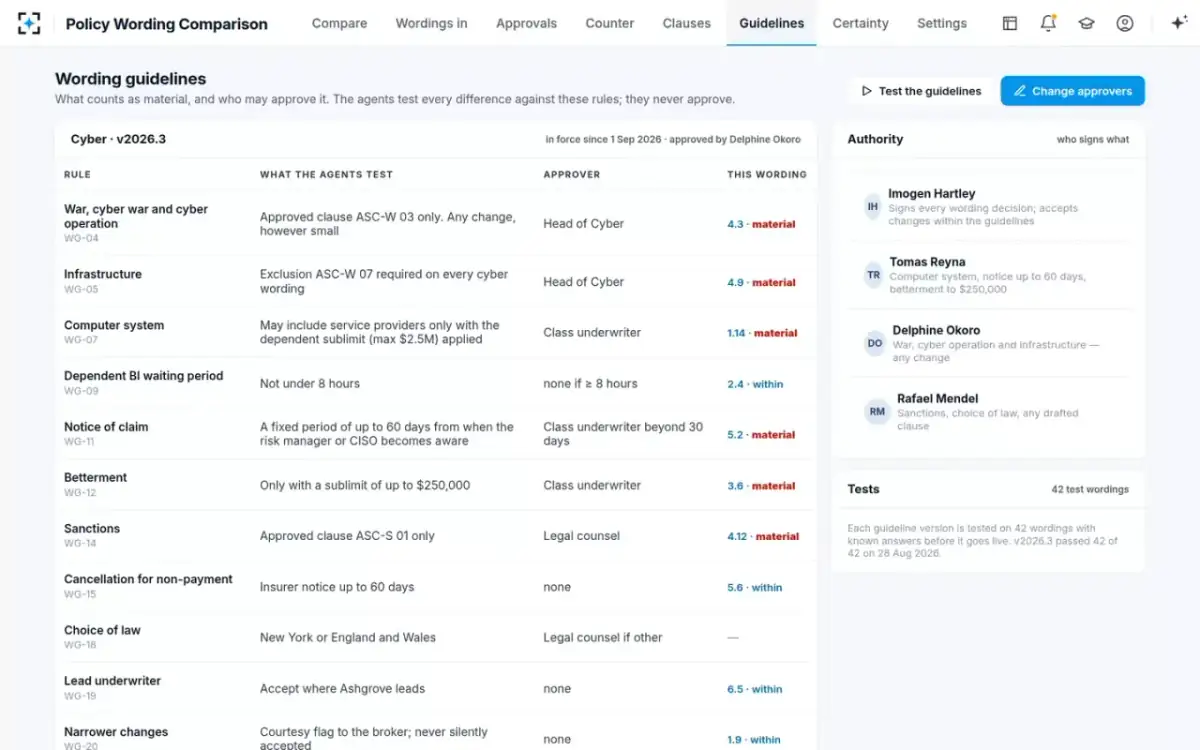
Where the solution fits is the mechanical half. Policy Wording Comparison reads a wording into clauses with page and line, pairs them with the carrier's approved forms and clauses, and routes each difference under the carrier's guidelines; a carrier whose approved library holds post-2016 warranty and condition wording will see every old variant in a broker's text reported as a change. When a market clause is updated, the solution re-checks open wordings that still use the earlier version, and never changes a bound one. It does not give a legal opinion on how sections 10 and 11 apply to a particular loss; that remains with the wordings specialist and legal counsel.
Approved clauses with their versions, and the open wordings still on an earlier one
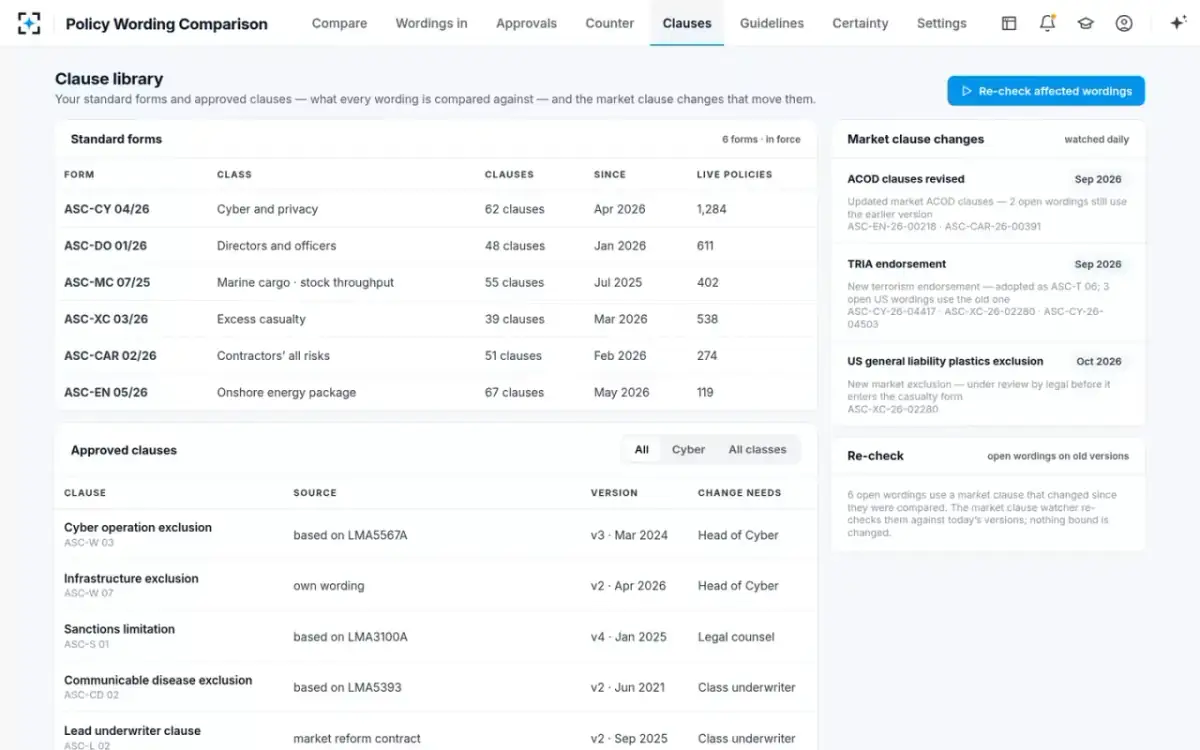
A team that wants to see what an old wording's departures look like in practice can start from six kinds of non-standard change, of which a reworded warranty is one. To see the clause library and the comparison together, start from Policy Wording Comparison.
Questions people ask
Do warranties still matter in UK insurance?
Yes. Insurers can still include specific warranties, a warranty must still be complied with exactly, and loss during an unremedied breach is still not covered. What changed is that breach suspends rather than ends cover, and that a term aimed at one kind of loss cannot defeat a claim for an unrelated one.
Does the Insurance Act 2015 apply to consumer insurance?
Sections 10 and 11 apply to contracts of insurance generally, including consumer contracts. Section 9's rule on basis clauses is for non-consumer contracts, because consumer insurance had already lost those clauses under the Consumer Insurance (Disclosure and Representations) Act 2012, as the Explanatory Notes record.
What happens to a warranty breached before a loss but remedied?
Cover resumes from the remedy. The insurer is not liable for loss occurring during the breach, or attributable to something that happened during it, but is liable for later losses. Before the Act, the insurer would have been discharged for good from the moment of breach, even after the remedy.
Does section 11 apply to exclusions?
It can. The Explanatory Notes say section 11 "does not apply only to warranties" and may catch conditions precedent or exclusion clauses, provided they relate to a particular kind of loss or to loss at a particular location or time. It does not apply to terms defining the risk as a whole.
Does the Act apply to marine insurance?
Yes. Section 10 amended the Marine Insurance Act 1906, removing the provisions under which breach discharged the insurer and a remedied breach did not help the insured, and the Notes confirm section 10 applies to the implied marine warranties in sections 39 to 41 of the 1906 Act.