A policy wording comparison template is a fixed layout for comparing one insurance wording with another, usually a broker's or manuscript wording with your standard form: one row per clause difference, with the text in both documents, the kind of change, its effect on cover, the guideline it touches, the approver and the decision. The layout is the easy half. What makes a comparison right is what it is compared against, so the real template is the set of inputs a wordings team loads before the first wording arrives: the standard forms in force, the endorsements normally attached, the approved clause library, the wording guidelines that say what is material, the authority matrix that says who decides, and a year of past wordings with the decisions taken on them. Botminds' Policy Wording Comparison runs on exactly those inputs; this guide lists the minimum set, why each matters and the order to gather them.
Examples come from a fictional sample book in the solution, Ashgrove Specialty's, with six standard forms and its own wording guidelines. They show the shape of each input, not anyone's real rules.
Seven inputs to load before the first live wording, and why each matters
- Every standard form in force, with its version and in-force date
A comparison is only as right as the form it starts from. Compare with last year's edition and you report last year's changes as the broker's.
- The endorsements you normally attach to each form
Your effective wording is form plus endorsements. A broker wording that matches the bare form may still drop what your endorsements add.
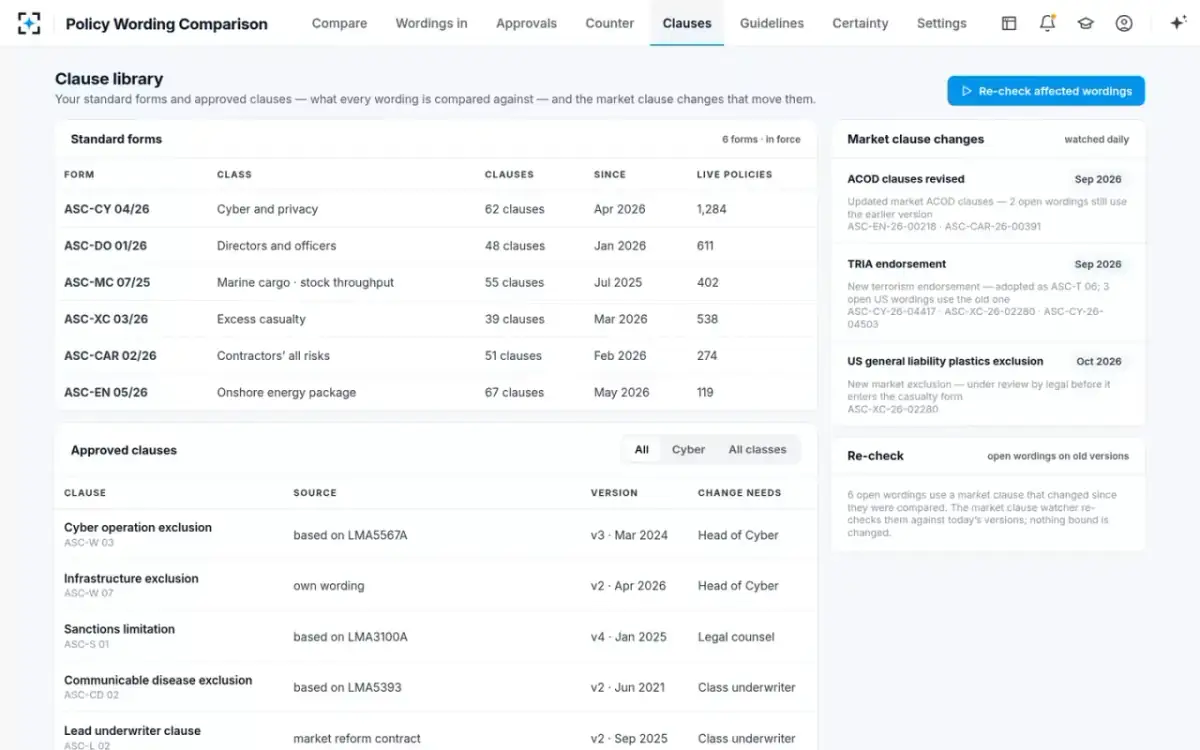
- The approved clause library, with each clause's source and version
Replacement and counter clauses must come from here, so the counter-wording is text you have already agreed to.
- Wording guidelines: what is material, clause family by clause family
Without a written rule, "material" means whatever the reader that day thinks, and routing becomes a matter of mood.
- The authority matrix: who may accept which change, and above what line size a second approver is needed
It turns a finding into a route. A material change with no named approver has nowhere to go.
- A year of past broker wordings with the decisions taken on them
They are the answer key for testing the comparison and the guidelines before any live wording depends on them.
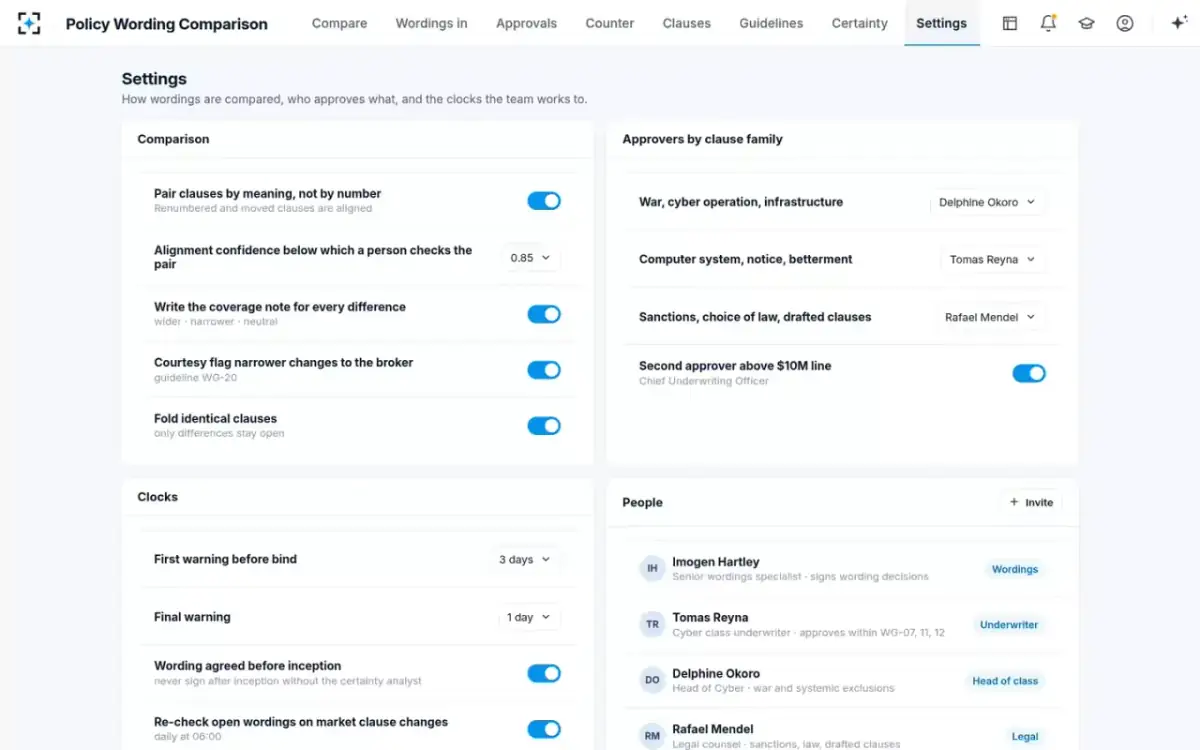
- Bind dates and the warning clocks the team works to
Ordering the queue by bind date, and warning before it, is what keeps a decision from being taken after inception.
Is there a template for comparing policy wordings?
We know of no regulator's template for comparing a broker wording with a carrier's form; teams build their own, usually as a spreadsheet or a marked-up copy of the wording. What follows is a layout that holds up under audit, because every row can be traced to both texts and to a named decision. Use it by hand, in a spreadsheet, or as the specification for any tool you evaluate.
A policy wording comparison template: one row per difference, ten columns
| Column | What goes in it | Example from the sample |
|---|---|---|
| Clause and heading | The clause in your form and its counterpart in the broker's wording, paired by meaning | 4.3 War, cyber war and cyber operation |
| Your form, with page | The exact text of your clause and where it sits | ASC-CY 04/26, page 17 |
| Broker's wording, with page | The exact text of the broker's clause and where it sits | CB CyberShield 2026, page 21 |
| Kind of change | Same, changed, missing, new; and whether moved or renumbered | Changed: "or indirectly" deleted |
| Effect on cover | Wider, narrower or neutral for the insured, and in what situation | Wider: spill-over malware from a state attack is no longer excluded |
| Guideline | The rule the change is tested against, and the result | WG-04: any change goes to the head of cyber; material |
| Approver | The person the authority matrix names | Head of cyber |
| Proposed answer | Accept, accept with a condition, or counter from the approved library | Reinstate approved clause ASC-W 03 |
| Decision, name and time | What the approver decided, and when | Declined; reinstate the standard wording |
| Courtesy flag | Narrower changes the broker should know about, even if they cost the carrier nothing | Not applicable (wider change) |
What should a wording comparison include?
Three things a quick comparison usually leaves out: the clauses that are missing, the effect of each change, and the name of whoever decided it. Missing clauses need their own row because there is no broker text to show; the row starts from your form. The effect needs its own column because "changed" tells an approver nothing about who gains. And the decision needs a name and a time because the question asked years later is not "was this reviewed?" but "who accepted it, on what authority?"
Supervisors expect that kind of record wherever automated tools are used. EIOPA's Opinion on AI governance cites the Solvency II requirement that insurers "maintain adequate and orderly records of the insurance undertaking's business and internal organisation" (EIOPA Opinion, para 3.22). A comparison that lives only in an email thread does not meet that standard, however good the reading was.
What documents are needed to compare policy wordings? Forms, endorsements, clauses
At minimum, the broker's wording and the right edition of your own form; in practice, also the endorsements you would attach and the clause library you would counter from. The sample book holds six standard forms, each with its clause count and in-force date, and every broker wording is compared with the form for its class.
The sample book's six standard forms, by share of live policies
3,228 live policies across six forms
- Cyber 1,284 · 39.8%
- D&O 611 · 18.9%
- Excess casualty 538 · 16.7%
- Marine cargo 402 · 12.5%
- CAR 274 · 8.5%
- Energy 119 · 3.6%
The live-policy counts matter for more than sizing. They tell the comparison how many bound wordings carry each clause, which is how the sample's note on the war exclusion could say that 1,284 cyber policies carry the full wording and this would be the first without it. A change that is harmless on one risk may be a book-level decision when it is the first of its kind.
The clause library: forms in force, approved clauses and the market changes that move them
What is a materiality guideline for wordings?
A materiality guideline is the carrier's written rule, clause family by clause family, for which differences need an approver and which approver. It is the most important input and the one most teams lack in writing. The sample's cyber guidelines show the form: a rule, what is tested, and who approves.
Some rules are absolute: any change to the war, cyber war and cyber operation exclusion goes to the head of cyber, "however small"; the infrastructure exclusion is required on every cyber wording; only the approved sanctions clause may be used. Some are limits: computer system may include service providers only with the dependent sublimit, at most $2.5 million; notice of claim may run up to 60 days from when the risk manager or CISO becomes aware, with the class underwriter's approval beyond 30; betterment needs a sublimit of up to $250,000. And one is a courtesy: narrower changes are flagged to the broker, never accepted silently. Write yours in that shape and the comparison can test against it; leave it in people's heads and nothing can.
The authority matrix: who approves which clause family
The matrix maps each clause family to one approver, plus any second approval above a line size. In the sample it has three rows and one rule: war, cyber operation and infrastructure to the head of cyber; computer system, notice and betterment to the cyber class underwriter; sanctions, choice of law and drafted clauses to legal counsel; and a second approver, the chief underwriting officer, above a $10 million line. Keep it short enough that everyone can recite it. A matrix with a row for every clause is a matrix nobody keeps current.
Approvers by clause family, bind clocks and the people on the team, as settings
How many past wordings are needed to start?
Enough to test every rule in your guidelines at least once, which for one class is usually dozens rather than hundreds. The sample tests each version of its cyber guidelines on 42 wordings with known answers before it goes live, and version 2026.3 passed 42 of 42 on 28 August 2026. The number is less important than the answers: a past wording is useful only with the decision taken on it, because that decision is what the comparison and the guidelines are checked against.
EIOPA's standard for test data is a fair one to borrow. It asks that data used to test an AI system be "complete (e.g. sufficient historical information), accurate (e.g. no material errors) and appropriate (e.g. consistent with the purposes for which it is to be used)", and that "Any limitations of data in this regard should be duly documented and addressed" (EIOPA Opinion, para 3.19). For a wordings team that means wordings from each broker you see often, decisions you would still stand by, and a note of the classes you have too few examples of. Planting twenty changes in one of them turns it into a test of any tool.
Can we use our own clause numbering?
Yes, and you should: the comparison reports in your numbering, against your form. Because clauses are paired by meaning rather than by number, the broker's numbering does not have to match yours; in the sample, 14 clauses were renumbered and 3 moved, and all were paired with their counterparts. What the comparison needs from you is a consistent numbering within each form edition, so that a clause cited as 4.9 today is still 4.9 in next month's comparison against the same edition.
Clause identity across editions is worth a moment's thought. If a new edition of your form renumbers its own clauses, keep the approved-clause references (such as an infrastructure exclusion identified by its library code rather than its position) stable, so guidelines that name the clause still find it.
What IT needs to know before day one
Four practical points. Wordings arrive as PDF, Word or scans, from brokers or the team, so the comparison has to read all three and keep page and line for each clause. Forms and approved clauses should come from where the wordings team already keeps them, with their versions, rather than being copied once and left to drift. Approvals need named users, because a decision without a name is not a decision. And the signed wording decisions should export to the contract certainty return, so nobody re-keys them.
None of that is unusual, but each is a common cause of a slow start. In particular, a form library that holds several unlabelled versions of the same form will produce confident comparisons against the wrong edition. Fix the labelling before the first live wording.
Spreadsheet template or a loaded comparison: what changes
A spreadsheet template and a loaded solution use the same inputs; the difference is who does the reading and whether the inputs are enforced. With a spreadsheet, the specialist reads both wordings, fills each row by hand and routes by email. With the inputs loaded into a comparison, the rows fill themselves from the reading and the guidelines, and the routing follows the matrix.
The same template, kept by hand and kept by the comparison
Spreadsheet template: By eye, in two windows; renumbered clauses matched by searching.
Inputs loaded in Policy Wording Comparison: By meaning; renumbered and moved clauses matched, pairs under 0.85 confidence sent to a person.
Spreadsheet template: Found if the reader starts from the form and notices.
Inputs loaded in Policy Wording Comparison: Every clause of the form accounted for; unpaired ones reported as missing.
Spreadsheet template: Written by the specialist, when time allows.
Inputs loaded in Policy Wording Comparison: Drafted for every difference, citing both texts; checked by the specialist.
Spreadsheet template: From memory of the guideline; routed by email.
Inputs loaded in Policy Wording Comparison: Tested against the guideline version in force; routed to the named approver with the rule.
Spreadsheet template: Initials in a cell, or a reply in a thread.
Inputs loaded in Policy Wording Comparison: Name and time on each approval; the wording decision cannot be signed with a material change open.
Where the solution does not fit: a team with no written guideline or authority matrix will find the comparison has nothing to route against, and should write those first. A team comparing only editions of its own form needs less than this. For the team in between, we run Policy Wording Comparison first on your own standard form and a broker wording you have already placed, so the first result can be checked against a decision you already know. To see the sample end to end, start from Policy Wording Comparison.
Questions people ask
How do you structure a wording review?
Start from your form, not the broker's: pair each of your clauses with its counterpart, classify every pair as same, changed, missing or new, write what each difference does to cover, test it against your guideline and route it to the named approver. Record each decision with a name and a time, and sign the overall decision only when nothing material is open.
Do we need a written materiality guideline before starting?
Yes, if the comparison is to route anything. It can be short: a rule per clause family, the test applied and the approver. The sample's cyber guideline fits on one screen, yet it decides that a neutral-looking change to the sanctions clause is material and a widening of the dependent business interruption cover is not.
Can we start with one class of business?
Yes, and most teams should: one class with its form, endorsements, guideline, matrix and a set of past wordings with decisions. The sample book compares cyber, D&O, marine cargo, excess casualty, contractors' all risks and onshore energy, but each class has its own form and guideline, so they can be added one at a time.
What if a broker's wording has no counterpart form in our library?
Then there is nothing to compare it with, and the reading is a full review rather than a comparison. Load the nearest form you would otherwise have offered; the differences will be many, but each will still be found, rated and routed rather than missed.
Who should own the inputs once loaded?
The head of wordings for forms, clauses and guidelines; the chief underwriting officer or delegate for the authority matrix; and legal counsel for what enters the approved library. In the sample, a market clause change is re-checked against open wordings every morning, but legal counsel decides whether it enters the library.