An insurance policy wording specialist is the person at a carrier, managing agent or broker who reads policy wordings for what they say, compares a broker's or manuscript wording with the carrier's own form, and makes sure every change in cover is found, explained and decided before the risk binds. The specialist rarely accepts a change in cover alone. A class underwriter accepts changes within their authority, a head of class takes the clauses the carrier treats as systemic, and legal counsel takes sanctions, governing law and any new text; the specialist signs last, attesting that nothing was missed. Botminds' Policy Wording Comparison is built around that chain: agents read and route, each material change reaches the person the authority matrix names, and every approval carries a name and a time.
The examples follow a fictional sample placement in the solution, a cyber manuscript for Halvorsen Freight Systems led by Ashgrove Specialty, and its fictional team. The regulators and statutes quoted are real.
One wording, from the broker's draft to the specialist's signature, and back when it changes
Agent
Reading and comparisonThe broker's manuscript is split into clauses, paired with the form by meaning, and each difference explained and tested against the wording guidelines.
Never: decides whether a change is acceptable
A person decides
Senior wordings specialistReviews the differences, the notes and the routes; corrects any pairing or note before anything goes to an approver.
A person decides
Class underwriter, head of class, legal counselEach approves, conditions or declines the material changes in their own clause families, with the clause and the rule that routed it in front of them.
A person decides
Chief underwriting officerGives a second approval where the carrier's rules require one, in the sample on lines above $10 million.
A person decides
Senior wordings specialistSigns the wording decision once every difference is answered and every material change approved; the counter-wording then goes to the broker.
Agent
Re-comparison after a changeAn endorsement or a broker's re-draft is compared again, and only the new differences go back round the same chain.
Never: changes a bound wording
What does an insurance policy wording specialist do?
The specialist does three things on every wording: reads it against the right standard form, records what each difference does to the cover, and makes sure each one is decided by the right person before bind. Around those sit the slower duties of the role: keeping the carrier's forms and approved clauses current, writing and revising the wording guidelines that say what is material, and answering underwriters' questions about what a clause means.
The volume is the hard part. The sample specialist, Imogen Hartley, starts her day with nine broker and manuscript wordings waiting across cyber, D&O, marine cargo, energy, construction, product recall and excess casualty, ordered by bind date. By our estimate, comparing one 38-page manuscript with the form by eye takes three to four hours before any approval is sought, so a day of nine is not a day of reading; it is a day of triage. The sample week shows 52 differences found and 17 sent to approvers across that queue.
Who approves changes to an insurance wording?
The person whose written authority covers that kind of change, which a carrier sets in an authority matrix and its wording guidelines. In the sample, war, cyber operation and infrastructure changes go to the head of cyber however small they are; computer system, notice and betterment changes go to the cyber class underwriter within stated limits; sanctions, choice of law and any newly drafted clause go to legal counsel; and lines above $10 million need a second approval from the chief underwriting officer.
In the UK the top of that chain is a regulated role. The PRA Rulebook defines the Chief Underwriting Officer function (SMF23) as "the function of having responsibility, in respect of the firm’s general insurance business, for the underwriting decisions in respect of material insurance risks" borne by the firm, or by members where the firm is a managing agent (PRA Rulebook, 9.2). Below that layer, the FCA expects certification: "we consider underwriting to be one of the most significant business units in insurers in any sector. As a result, we would generally expect that the people below the Senior Managers layer responsible for these functions will be certified" (FCA, SM&CR guide for insurers). A wording change that alters cover is an underwriting decision, so it sits inside that accountability.
Five people on the sample cyber wording: what their day held, and what they keep
Today
Read six to nine broker wordings a day in two windows, matching renumbered clauses by eye.
With agents
Starts from aligned, rated differences with a plain-words note on each.
Still theirs: The review of every note and the signature on the wording decision.
Today
Got a blackline and had to work out the cover himself.
With agents
Sees what each change does to the insured's cover, with the rule that routed it.
Still theirs: Approval of computer system, notice and betterment changes within his limits.
Today
Heard about a war or infrastructure change in an email chain, if at all.
With agents
Gets every such change, however small, with the book accumulation beside it.
Still theirs: Every decision on war, cyber operation and infrastructure wording.
Today
Was asked clause by clause whether a broker's sanctions text would do.
With agents
Receives sanctions, choice of law and drafted text only, already isolated.
Still theirs: Approval of those clauses, and what enters the approved library.
Today
Proved who approved what, and when, from spreadsheets and email.
With agents
Sees every wording agreed and signed before inception, by month.
Still theirs: The certainty return and the look-back at bound wordings.
What each signature attests, and what it does not
Each signature on a wording attests something narrower than "this wording is fine", and a team that writes down what each one means avoids the most common failure: an approver who assumes the specialist checked the commercial merits, and a specialist who assumes the approver read the whole wording.
Five signatures on one wording, and the limit of each
Senior wordings specialist
AttestsEvery difference between the broker's wording and the form has been found, answered and, where material, approved; the counter matches the decisions.
Does not attestThat any one change is commercially right: that is the approver's call.
Class underwriter
AttestsThe changes in this clause family are acceptable for this insured, within the authority the carrier gave this person.
Does not attestChanges outside the clause families or limits the matrix assigns.
Head of class
AttestsA change to a clause the carrier treats as systemic, such as war or infrastructure, is acceptable given the whole book.
Does not attestThe wording as a whole, unless also signing it.
Legal counsel
AttestsSanctions, choice of law and any newly drafted text are lawful and say what the carrier means.
Does not attestThe underwriting merits of the change.
Chief underwriting officer (above a set line size)
AttestsA second approval on large lines, as the carrier's own rules require.
Does not attestThe clause-by-clause reading below it.
What is the difference between a wordings specialist and an underwriter?
The underwriter decides whether to take the risk and on what terms; the wordings specialist makes sure the words say what was decided. The U.S. Bureau of Labor Statistics describes underwriters as the people who decide whether to accept an application and, if so, set the coverage and the premium (BLS Occupational Outlook Handbook; the cyber underwriter job description follows one such desk through a week). A wording specialist's work begins where that decision has to be turned into text, and it often runs across several underwriters' classes at once.
In practice the line blurs in both directions. A class underwriter in specialty lines often negotiates wording directly with the broker, and a senior specialist often knows which departures a class underwriter will accept. The distinction that holds is authority: the underwriter holds authority to accept risk; the specialist holds responsibility for the accuracy and completeness of the wording that records it.
How many people do this work?
No official statistic counts wordings specialists separately. The nearest is underwriting as a whole: the BLS counts about 125,600 insurance underwriter jobs in 2025 and a median annual wage of $81,370 in May 2025, and projects employment to fall 4% from 2025 to 2035, with about 6,800 openings a year from people leaving the occupation (BLS). BLS does not separate specialty, London market or wordings roles, so those figures describe the wider occupation, not this seat.
The decline matters for wordings teams more than the total does. A shrinking pool of experienced underwriters and specialists means more of the reading has to be done by fewer people, which is the case for taking the clause-matching off their desks and keeping their time for decisions.
Do wording specialists need legal training?
Not by regulation: neither the PRA's senior management rules nor the FCA's certification guidance cited above prescribes a legal qualification for wording work, and the BLS says underwriters usually enter the occupation with a bachelor's degree. Many specialists come from underwriting, broking or claims rather than law, and learn the clauses through years of reading them.
What they need is the habit of reading a policy the way a court will. English courts read a policy objectively, and "Evidence about what the parties subjectively intended or understood the contract to mean is not relevant to the court's task" ([2021] UKSC 1, para 47). A specialist who knows what the underwriter meant is not enough; the words have to say it. That is why the sample routes sanctions, choice of law and any newly drafted text to legal counsel, and why replacement clauses come only from an approved library.
What happens when a signed wording is later changed?
The change is a new decision and goes round the same chain. A mid-term endorsement or a broker's re-draft after signing is compared again with the wording as signed, and only the new differences need approvers; the earlier approvals stand for what they covered. In the sample, a market clause watcher also re-checks open wordings when a market clause changes, but never changes a bound one.
The law treats variations as contracts in their own right. In the UK, the Insurance Act 2015's duty of fair presentation applies to "variations, agreed after the end of the relevant period, to contracts of insurance entered into at any time" (s.22(1)(b)), even where the contract itself predates August 2016, and its contracting-out rules say "references to a contract include a variation" (s.16(3)). In Texas, a surplus lines agent must file with the stamping office "a copy of each endorsement of an original policy, certificate, cover note, or other confirmation of insurance delivered to an insured" (Tex. Ins. Code § 981.105). An endorsement is not paperwork after the decision; it is a decision, and someone has to sign it.
How do wording teams record approvals?
With the approver's name, the time, the clause and the rule that sent it to them, attached to the wording rather than to an email. A record that says only "approved by underwriting" cannot show, years later, that the person who approved a war exclusion change had authority to do so. The sample team's record carries each approval against its clause, with the guideline that routed it and the decision, whether approve, condition or decline.
Approved by name and time, with the activity trail of who decided what
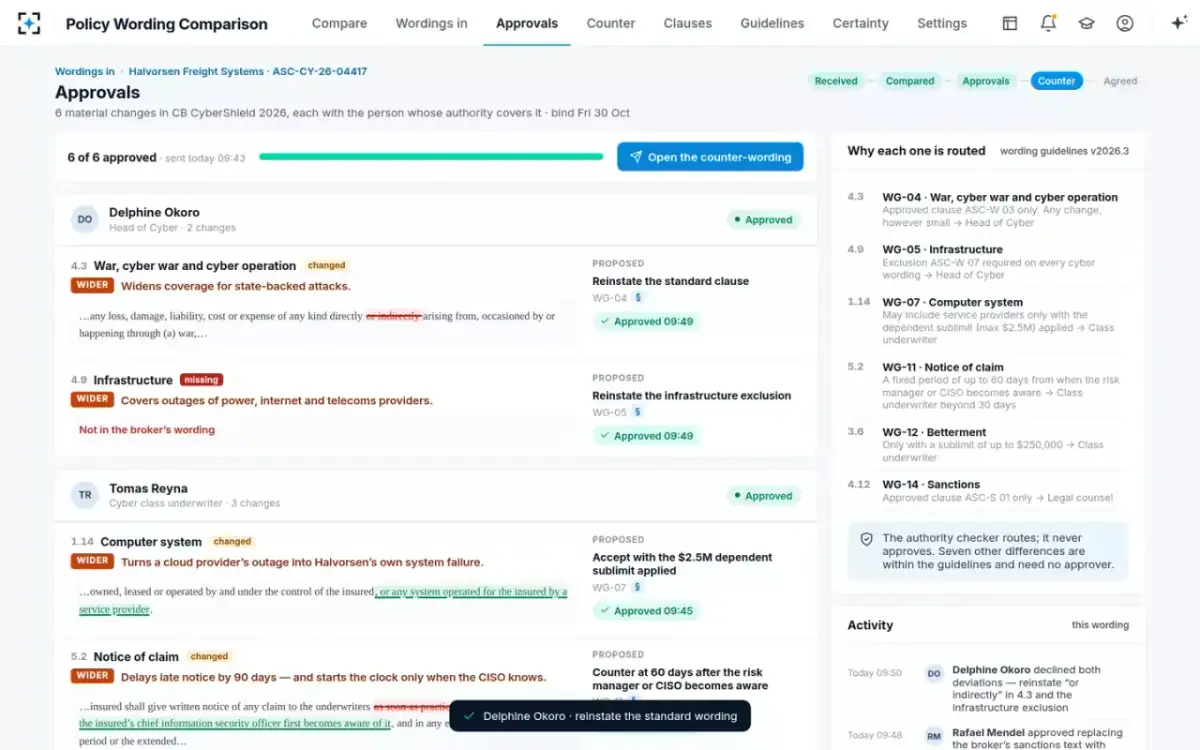
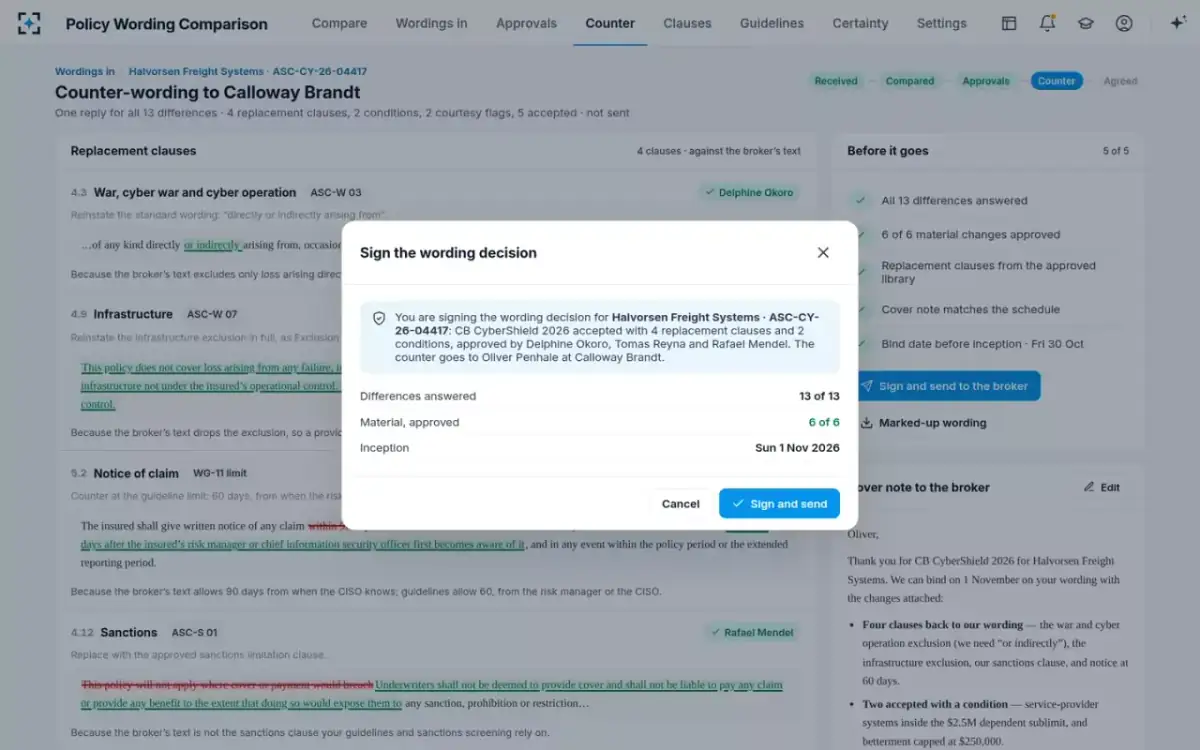
The specialist's signature closes the record. In the sample it cannot be given while a material change is open, and the dialog lists the counts it attests: thirteen of thirteen differences answered and six of six material changes approved, with the approvers named. The counter-wording goes to the broker only after it.
The wording decision: signed by the specialist with every approval on the file
Who is liable for a wording mistake?
The carrier is bound by the words it agreed, whatever its underwriter meant; that is the practical meaning of the objective reading courts apply. Internally, the question becomes who had authority over the clause that went wrong, which is why the approval record names a person and a rule rather than a team. Where a broker drafted the wording, any claim between carrier, broker and insured turns on facts and contracts this guide cannot settle; a carrier's own defence is to have read, decided and recorded every difference before bind.
The record also protects people. A specialist who can show that a missing exclusion was flagged, routed and declined, and that the counter reinstated it, is in a very different position from one who can show only that the wording was "reviewed". What a loose clause costs follows the same mistake from the desk to the court. To see the approval chain on screen, start from Policy Wording Comparison.
Questions people ask
What is a wordings manager?
A wordings manager, or head of wordings, runs the team that maintains a carrier's or managing agent's standard forms, approved clauses and wording guidelines, and reviews broker and manuscript wordings against them. The role usually owns the guideline that decides what is material and who approves it, rather than approving changes in cover itself.
Is a wording specialist a regulated role in the UK?
Not as such. The PRA's Chief Underwriting Officer function covers responsibility for underwriting decisions on material risks, and the FCA expects people below senior managers in underwriting to be certified in many insurers. A wording specialist may fall within certification depending on the firm's structure; the regulator does not name the role.
Can a wording specialist approve a change in cover?
Only where the carrier's authority matrix gives them that authority, usually for changes within the wording guidelines. In the sample, the specialist accepts changes within the guidelines and signs the overall decision, while material changes go to the class underwriter, the head of class or legal counsel.
How long does it take to review a broker wording?
By our estimate, three to four hours by eye for a 38-page manuscript against the form, before any approvals or the counter-wording. In the sample, Policy Wording Comparison read, aligned and explained the same manuscript in 3 minutes 40 seconds; the specialist's review and the approvals come on top.
What does a wording specialist sign?
A wording decision: a record that every difference between the broker's wording and the form has been answered and every material change approved by the right person, with the counter-wording that follows. It does not replace the approvers' signatures on the individual changes.