FCA v Arch Insurance (UK) Ltd [2021] UKSC 1 is the UK Supreme Court's judgment of 15 January 2021 in the business interruption test case, which the Financial Conduct Authority brought to settle whether standard business interruption policies covered losses from COVID-19 and the government's response. The court substantially allowed the FCA's appeals and dismissed the insurers', holding that disease clauses covered the effects of cases within the stated radius as part of the national response, that prevention of access clauses could respond to partial closures and to mandatory instructions without the force of law, and that trends clauses could not be used to take away cover the insuring clauses gave. It also overruled the Orient-Express Hotels decision. For a wordings team, the case is something else as well: the largest public comparison of insurance wordings ever made, with the reasoning written down. This guide reads it that way, and connects each lesson to how Botminds' Policy Wording Comparison reads a broker's wording against a carrier's form.
Everything on this page about the case comes from the judgment and the FCA's own test case page, linked where used. The one product example comes from a fictional sample carrier in the solution.
Twenty-one lead wordings from eight insurers, and the clause family each took to the Supreme Court
Arch
Argenta
Ecclesiastical
Hiscox
MS Amlin
QBE
RSA
Zurich
What was decided in FCA v Arch?
Four things, each about how particular words should be read. First, disease clauses covering an occurrence of a notifiable disease within a radius of the premises covered only cases within that radius, but each such case was a cause of the government's national response, so a business could recover if the restrictions that interrupted it responded to cases that included at least one within its radius. Second, prevention of access and hybrid clauses did not require a closure of the whole premises or an order with the force of law. Third, trends clauses, which adjust the calculation of loss for what would have happened anyway, could not strip out the pandemic itself. Fourth, the Orient-Express Hotels case, on which insurers had relied, was wrongly decided.
The practical effect, in the words of Lord Briggs, was that the insurers' reading would have made the cover "in reality illusory, just when it might have been supposed to have been most needed by policyholders" ([2021] UKSC 1, para 316). The FCA summarised the result as meaning that "many thousands of policyholders who have cover should now have their claims" for pandemic business interruption losses paid (FCA test case page).
How many policies were in the FCA test case?
Twenty-one lead wordings were tried, from eight insurers: one from Arch, one from Argenta, two from Ecclesiastical, four from Hiscox, three from MS Amlin, three from QBE, five from RSA and two from Zurich (para 40). The FCA says the Supreme Court's judgment "relates to the High Court’s interpretation of common clauses in 13 out of the 21 business interruption policies in the representative sample" (FCA).
The reach was far wider than the sample. The judgment records the estimate that, "in addition to the particular policies chosen for the test case, some 700 types of policies across over 60 different insurers and 370,000 policyholders could potentially be affected by the outcome of this litigation" (para 3). That is the logic of a test case and of a wording comparison alike: decide what a clause means once, then find every wording that carries the same clause. The judgment binds the eight insurers that agreed to take part, and the FCA describes it as providing "authoritative guidance for the interpretation of similar policy wordings and claims".
What clauses were considered in FCA v Arch? Four families
The court grouped the clauses in issue into four types "which are to be found in many of the relevant policy wordings" (para 4). Disease clauses cover interruption from a notifiable disease at or within a distance of the premises. Prevention of access clauses cover interruption from a public authority preventing or hindering access to or use of the premises. Hybrid clauses combine the two. Trends clauses adjust the loss calculation for what the business would have earned had the insured peril not occurred.
That grouping is itself the first move of any wording comparison: before asking what a clause means, decide which clauses do the same job. Insurers' wordings used different headings, numbering and sentence structures for each family; the court read across them by function. Policy Wording Comparison pairs clauses the same way, by meaning rather than by number, so that a broker's renumbered or retitled clause is compared with the carrier's counterpart rather than reported as new.
Clauses paired by function, not by number: the same first move the court made
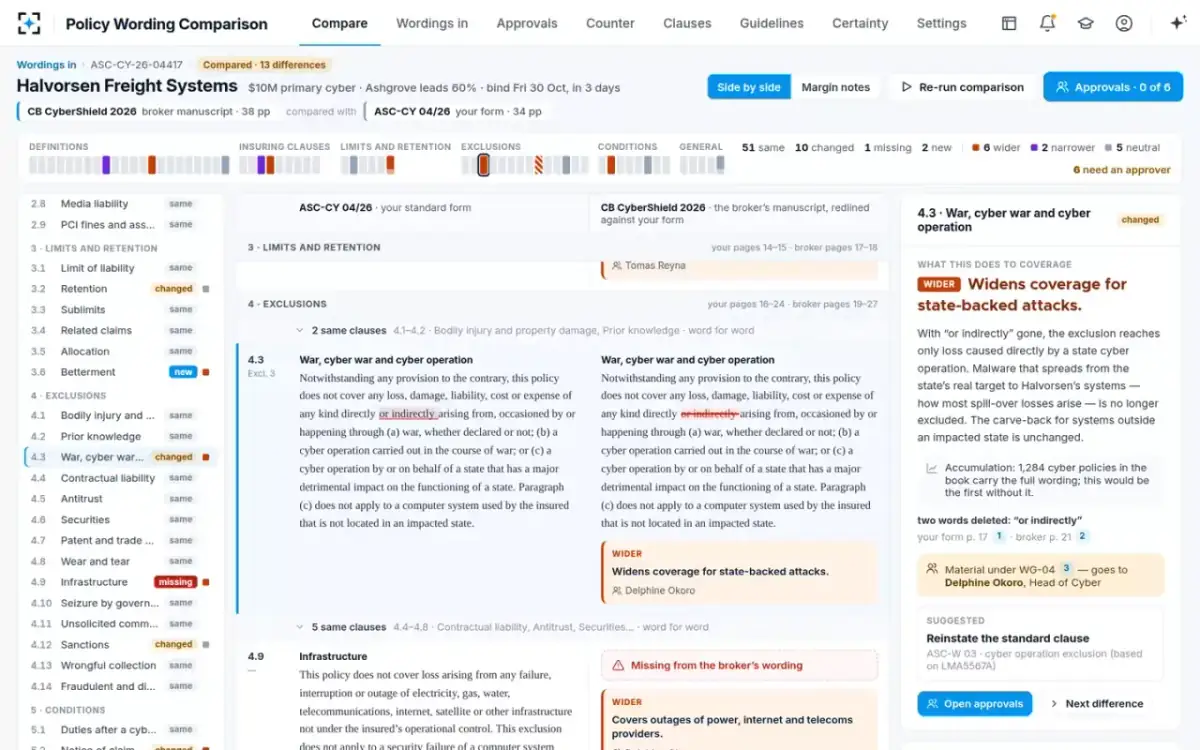
What did the Supreme Court say about disease clauses? Two wordings, one meaning
It said the radius limits the cases that count, not the causal chain. The clauses "cover only relevant effects of cases of COVID-19 that occur at or within a specified radius of the insured premises" (para 95); but each case of illness that had occurred by the time of a government measure "was a separate and equally effective cause of that action" (para 212). A business could therefore recover if the measures that interrupted it responded to cases including at least one inside its radius.
The most instructive passage for a wordings specialist is how the court treated two near-identical clauses. The High Court had read QBE 2 differently from RSA 3 because QBE 2 spoke of "events" and "incidents". The Supreme Court compared them line by line and found the wording "virtually identical to the corresponding provisions of RSA 3, save in two respects" (para 91), then concluded that neither difference changed the meaning.
RSA 3 and QBE 2: the two differences the High Court thought decisive, and the Supreme Court did not
RSA 3: Interruption "during the Indemnity Period following" any of the listed perils.
QBE 2: Loss "in consequence of any of the following events".
RSA 3: "occurrence"; the indemnity period refers to "occurrence discovery or accident".
QBE 2: "event", and in places "incident" as a synonym.
RSA 3: "occurrence of a Notifiable Disease within a radius of 25 miles of the Premises"
QBE 2: "any occurrence of a notifiable disease within a radius of 25 miles of the premises"
RSA 3: Illness sustained by any person resulting from a listed disease.
QBE 2: Identical to RSA 3, the court said (para 93).
RSA 3: Read as covering only cases within the radius, each a concurrent cause of the national measures.
QBE 2: Same meaning: "We do not perceive any difference in meaning between the terms “occurrence” and “event”" (para 93).
The court reached the same point about causal words generally. Its conclusion on disease clauses "does not depend on the particular terminology used in the clause to describe the required causal connection between the loss and the insured peril and applies equally whether the term used is “following” or some other formula such as “arising from” or “as a result of”" (para 212). For a reviewer that is a warning against two opposite mistakes: treating every textual variation as a change in cover, and assuming that identical-looking words always mean the same thing in a different clause structure.
Prevention of access and hybrid clauses, element by element
For these clauses the court did what a good comparison tool does: it broke each clause into the elements that must all be satisfied and laid them side by side in a table across insurers (para 96). Arch's clause required prevention of access due to the actions or advice of a government or local authority due to an emergency likely to endanger life; RSA 1's required closure or restrictions placed on the premises as a result of a notifiable disease within 25 miles; Hiscox's required an inability to use the premises due to restrictions imposed by a public authority following an occurrence of a notifiable disease, within one mile in Hiscox 4 only.
Three clause structures, broken into the elements the court compared
| Element | Arch (prevention of access) | RSA 1 (hybrid) | Hiscox 1 to 4 (hybrid) |
|---|---|---|---|
| What must happen to the premises | Prevention of access | Closure or restrictions placed on the premises | Inability to use the insured premises |
| Interruption required? | No separate requirement | No separate requirement | Interruption to your activities, solely and directly |
| Whose action | Actions or advice of a government or local authority | Not stated | Restrictions imposed by a public authority |
| Underlying cause | An emergency likely to endanger life or property | A notifiable disease within 25 miles | An occurrence of a notifiable infectious disease; within one mile in Hiscox 4 only |
Three readings came out of that comparison. An inability to use "has to be established; not an impairment or hindrance in use", but it need not be an inability to use the whole premises for all purposes (para 136); a restaurant forced to close its dining room while it sold takeaways had lost the use of a discrete part (para 152). A public authority's instruction can be a "restriction imposed" if "compliance with it is required, and would reasonably be understood to be required, without the need for recourse to legal powers" (para 121). And where a Hiscox clause set no distance at all, cover extended to cases wherever they occurred: the court pointed out that where insurers wanted local cover only, "they specify the requisite distance in the clause" (para 104).
"If the intention had been to restrict the scope of the clause to any occurrence(s) of disease at or near the insured premises, the clause would have said so."
FCA v Arch Insurance (UK) Ltd [2021] UKSC 1, para 104
That sentence is the case for comparing a broker's wording against the carrier's form rather than reading it alone. A limit that is not in the words is not in the contract. When a manuscript drops a radius, a carve-back or two words from an exclusion, the absence is the change, and only a comparison that starts from the carrier's form will see it.
Trends clauses, and the Orient-Express case overruled
Trends clauses adjust a business interruption loss for what would have happened had the insured peril not occurred. Insurers argued that, since the pandemic would have depressed trade anyway, the adjustment wiped out the loss. The court rejected that, holding that trends clauses "are part of the machinery contained in the policies for quantifying loss" and should, if possible, "be construed so as not to take away the cover provided by the insuring clauses", since "To do so would effectively transform quantification machinery into a form of exclusion" (paras 260 to 262). The adjustment should reflect only circumstances "unconnected with the insured peril" (para 287).
The insurers had leaned on Orient-Express Hotels v Generali, a 2010 decision on a hotel damaged by hurricane in a devastated city, in which loss was not recoverable because the city's damage would have kept guests away anyway. Two of the Supreme Court justices had been involved in that case, one as arbitrator and one as the judge on appeal; both now concluded that "it was wrongly decided and conclude that it should be overruled" (para 308). For wordings teams, the lesson is that a quantification clause written as machinery cannot be relied on as a hidden exclusion; if a carrier wants to exclude something, the place to say so is an exclusion.
How did FCA v Arch change wording practice?
It taught four reading habits that apply far beyond disease cover. Words that do the same job mean the same thing even when they differ ("occurrence" and "event"). Missing words are a change: a clause without a radius covers events anywhere. Limits belong where the cover is granted, not in calculation machinery or at the back of the policy. And the reader the court imagines matters: for policies sold mainly to small businesses, an ordinary policyholder reading conscientiously. The cost of the market learning those habits in court is set out in what a loose clause costs.
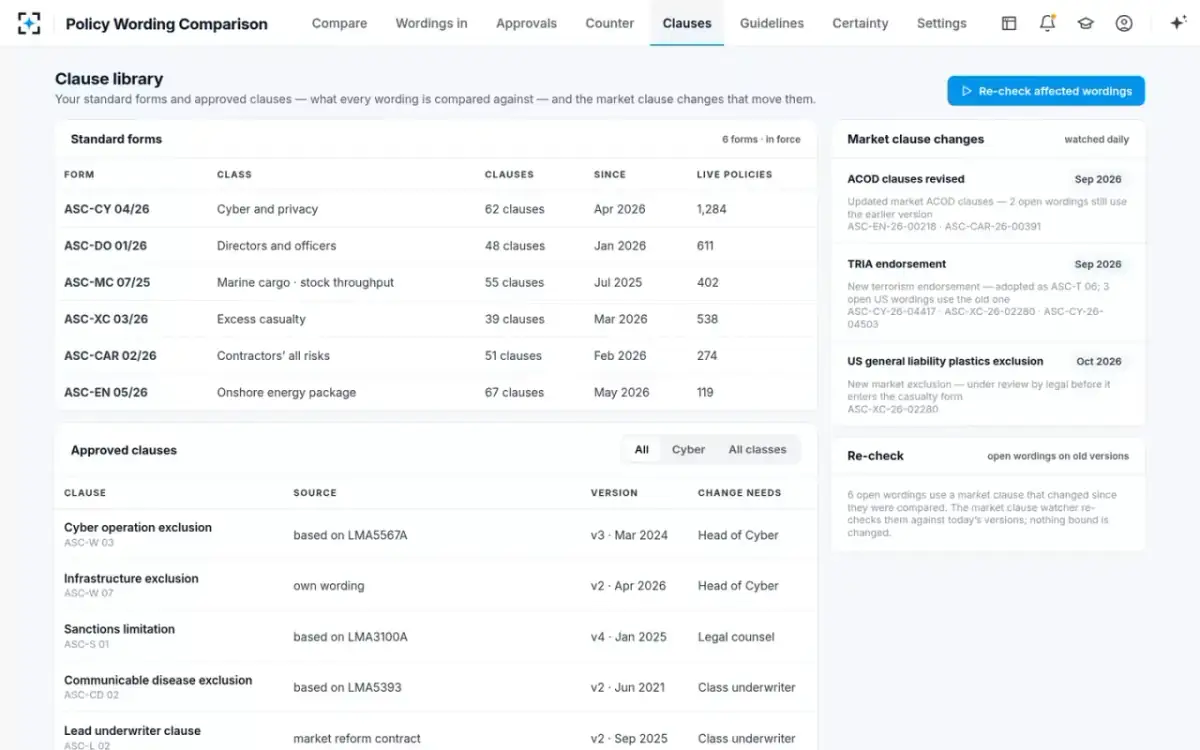
It also turned disease wording into a clause every carrier has to have decided on deliberately, whether as cover or as an exclusion, and a broker's manuscript may carry a different version from the carrier's own. The fictional sample carrier's clause library holds its own communicable disease exclusion at version 2, dated June 2021, beside the market clause it was based on; a comparison flags any broker wording that offers a different version.
The approved clause library: each clause with its source, version and the person whose approval a change needs
We have found no public regulator's count of how carriers changed their disease wording after the case, so we offer no market figure. The narrower point holds without one: a wording that carries a disease clause today should be compared clause by clause with the carrier's own, because the test case showed how much turns on a few words. Six kinds of non-standard change gives the checks that find them.
Where can I read the FCA v Arch judgment?
The full judgment is published by the Supreme Court under case number UKSC 2020/0177 (UK Supreme Court) and by BAILII as [2021] UKSC 1 (BAILII). The FCA's test case page keeps the representative sample of policy wordings with a contents page, the High Court judgment of 15 September 2020, the Supreme Court's order of 13 July 2021 varying the declarations, and a table setting out the outcome by policy type (FCA). For a wordings team, the sample wordings and the outcome table together are the best training set available for comparing clauses that look alike.
The FCA's page also notes that it stopped updating its policyholder guidance on 16 August 2021, so later court decisions on business interruption claims are not reflected there. Read the judgment for principle, and later cases for application. To see a broker's wording read against a carrier's form clause by clause, start from Policy Wording Comparison.
Questions people ask
Who were the parties in FCA v Arch?
The Financial Conduct Authority, bringing the case for the benefit of policyholders, against eight insurers: Arch, Argenta, Ecclesiastical, Hiscox, MS Amlin, QBE, RSA and Zurich. Two policyholder groups, the Hiscox Action Group and the Hospitality Insurance Group Action, were permitted to intervene.
Is FCA v Arch binding on all insurers?
The judgment is legally binding on the eight insurers that agreed to be parties. The FCA describes it as authoritative guidance for interpreting similar wordings and claims, which other courts, the Financial Ombudsman and the FCA itself can take into account.
How long did the FCA test case take?
The FCA issued its claim on 9 June 2020, trial ran from 20 to 30 July, the High Court gave judgment on 15 September, and the Supreme Court heard the appeal from 16 to 19 November and gave judgment on 15 January 2021. That is about seven months from the claim being issued to the final judgment, with the declarations varied by order in July 2021.
Did FCA v Arch decide how much each policyholder is paid?
No. It decided what the sample clauses mean and how causation works under them. As the FCA put it, "The judgment does not determine how much is payable under individual policies, but provides the basis for doing so"; each claim still had to be adjusted on its facts.
What does FCA v Arch mean for wordings outside business interruption?
Its reading principles are general English contract law applied to insurance: read objectively, read clauses by function, give missing words their effect, and do not let calculation machinery act as an exclusion. Any wordings team comparing a broker's text with its own form can apply them, whatever the line.