A policy wording analysis is a written reading of one insurance wording against another, usually a broker's or manuscript wording against the carrier's standard form, that lists every difference and says for each what changed, what it does to the cover, whether the carrier's guidelines allow it and who must decide. A good one can be checked clause by clause, because every line cites both texts. This example follows a single manuscript through Botminds' Policy Wording Comparison, where the analysis is split into four jobs: pairing the clauses, reading what each change does, testing it against the guidelines, and routing it to the person whose authority covers it. Agents do the reading. None of them may accept a change or tell the broker it is fine.
The manuscript is fictional sample data, as are the people: CB CyberShield 2026, a 38-page cyber wording from the wholesale broker Calloway Brandt, for Halvorsen Freight Systems, a trucking and freight-brokerage platform buying a $10 million primary cyber layer led by Ashgrove Specialty. The rules quoted are real and linked where they appear. This is analysis before binding, for the carrier deciding what it will agree; reading a bound policy against a loss is the claims-side job covered in insurance policy analysis on a claim.
Policy Wording Comparison reading one manuscript: six agents, three people, and what none of the agents may do
Agent
Wording readerSplits the manuscript into 63 clauses and 2 endorsements over 38 pages, and the form into 62 clauses over 34, keeping page and line for each.
Never: edits either source document
Agent
Clause alignerPairs 61 clauses by meaning, not number: 14 renumbered and 3 moved are matched; 1 is missing and 2 are new.
Never: hides a renumbered clause; pairs it is less than 0.85 sure of go to a person
Agent
Coverage effect writerWrites a plain-words note on each of the 13 differences, citing both texts: 6 wider, 2 narrower, 5 neutral for the insured.
Never: calls a change acceptable
Agent
Authority checkerTests all 13 against wording guidelines v2026.3; finds 6 material and routes them to the 3 approvers the authority matrix names.
Never: approves, or routes around the matrix
A person decides
Class underwriter, head of cyber, legal counselEach decides the changes in their own clause families, with the clause, the redline and the note in front of them.
Agent
Clause suggesterDrafts one counter-wording from the approved library: 4 replacement clauses, 2 accepted with a condition, 5 accepted, 2 courtesy flags.
Never: offers an unapproved clause; drafted text is marked "needs legal"
A person decides
Senior wordings specialistSigns the wording decision once every difference is answered and every material change approved; only then does the counter go to the broker.
How do you analyse a policy wording? Four jobs in a fixed order
Analyse a wording in four jobs, in order: pair every clause of the broker's text with its counterpart in your form, say what each difference does to the cover, test each against your guidelines, and send each material one to the person with authority to accept it. The order matters. An effect note written before the pairing is right describes the wrong clause, and routing before the effect is known sends trivial changes to senior people.
A wordings specialist reading by eye does all four at once, in two windows, which is why it takes hours and why the fourth job is often done by whoever is free rather than whoever is authorised. Splitting the jobs makes each one checkable. The pairing can be checked against the clause map, the effect against both texts, the test against the guideline, the route against the authority matrix.
Job one: what is clause alignment, and what did it find?
Clause alignment is pairing each clause of one wording with the clause in the other that does the same job, regardless of number or position. In the sample, the clause aligner paired 61 clauses by meaning, matched 14 that had been renumbered and 3 that had moved, and found one clause of the form with no counterpart in the manuscript: the infrastructure exclusion, which Ashgrove's form carries at 4.9 on page 20.
The run log: both wordings read and aligned before anyone opens them
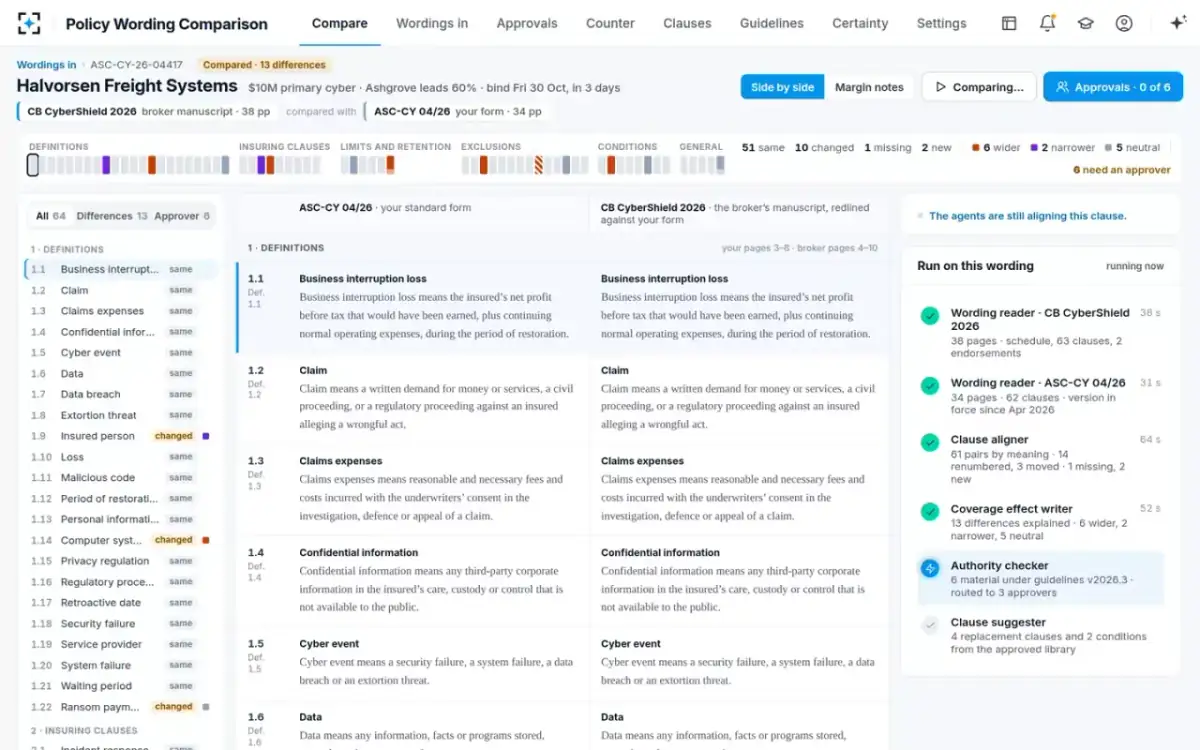
The missing clause is the finding that a reading by eye most often misses, because there is nothing in the broker's text to notice. Alignment starts from the form and accounts for every one of its 62 clauses; a clause that ends up unpaired is reported as missing. The other limit is equally deliberate: when the aligner is less than 0.85 confident that two clauses are a pair, a person confirms the pairing rather than the agent guessing.
Job two: can AI explain what a clause change does to the cover?
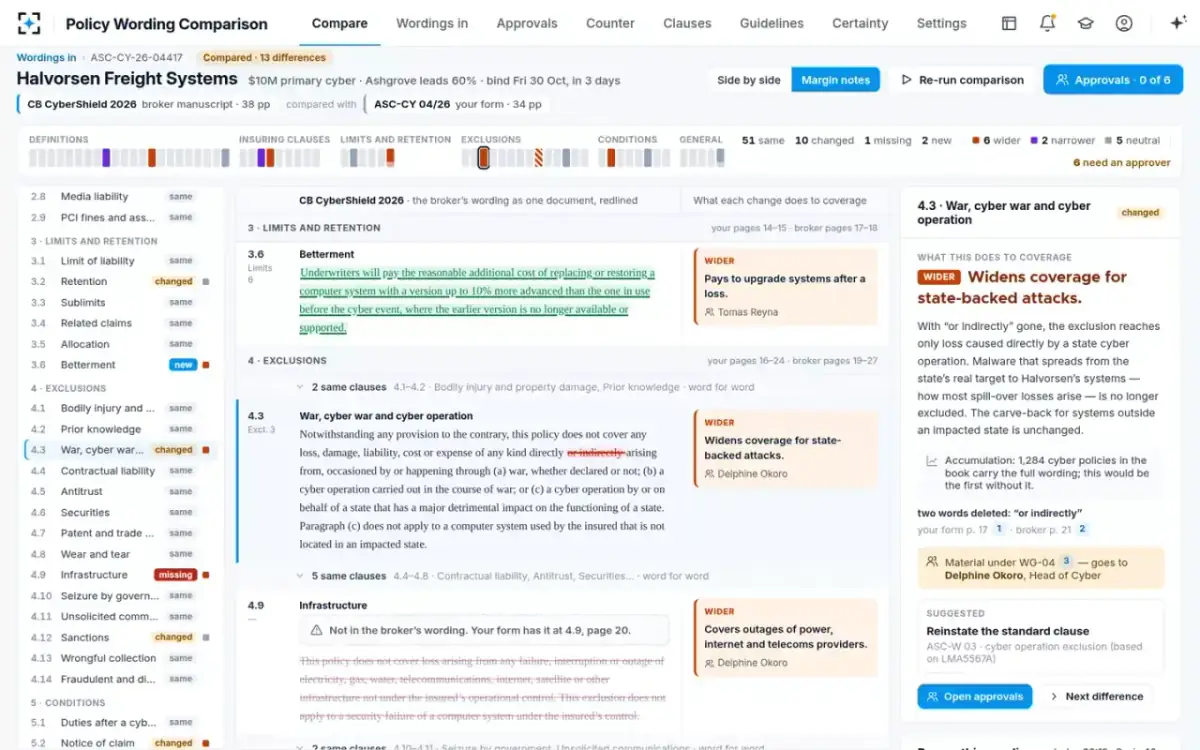
It can draft the explanation; a person must be able to check it, which is why each note cites both texts by page and says who gains, in what situation. The coverage effect writer rates each change wider, narrower or neutral for the insured. In the sample, the most consequential note is on clause 4.3, war, cyber war and cyber operation, where the manuscript deletes two words. The note reads: "Malware that spreads from the state's real target to Halvorsen's systems — how most spill-over losses arise — is no longer excluded." It cites the form at page 17 and the manuscript at page 21, and adds that 1,284 cyber policies in the sample book carry the full wording.
Citing both texts is not a courtesy. The U.S. Government Accountability Office, reviewing the cyber market, noted that the definition of act of war differs from contract to contract (GAO-22-104256, note 46; see cyber insurance war exclusion). A note that says only "war exclusion changed" tells the approver nothing; one that quotes the struck words and the clause they sat in lets the approver read the change, not a summary of it. Why two missing words decide who pays is set out in six kinds of non-standard change.
Margin notes: the broker's wording as one document, with the effect pinned beside each change
Job three: testing each change against the guidelines
A difference becomes material when the carrier's own wording guidelines say so, not when a reader feels it is important. Ashgrove's guidelines in the sample state a rule per clause family and an approver per rule: any change to the war, cyber war and cyber operation exclusion, "however small", goes to the head of cyber (WG-04); the infrastructure exclusion is required on every cyber wording (WG-05); computer system may include service providers only with the dependent sublimit, at most $2.5 million (WG-07); notice of claim may run up to 60 days from when the risk manager or the CISO becomes aware (WG-11); betterment needs a sublimit of up to $250,000 (WG-12); and only the approved sanctions clause may be used (WG-14).
Tested against those rules, six of the thirteen differences are material and seven are within the guidelines. The split does not follow the rating. The sanctions change is rated neutral for the insured and is still material, because the guideline cares which text is used, not who gains; the dependent business interruption change widens cover and is still within, because it stays inside the waiting-period rule.
Thirteen differences in the sample manuscript, by effect and by guideline
Effect for the insured
- Wider · 6 · 46%
- Narrower · 2 · 15%
- Neutral · 5 · 39%
Against wording guidelines v2026.3
- Material, to an approver · 6 · 46%
- Within the guidelines · 7 · 54%
Job four: who approves a non-standard wording?
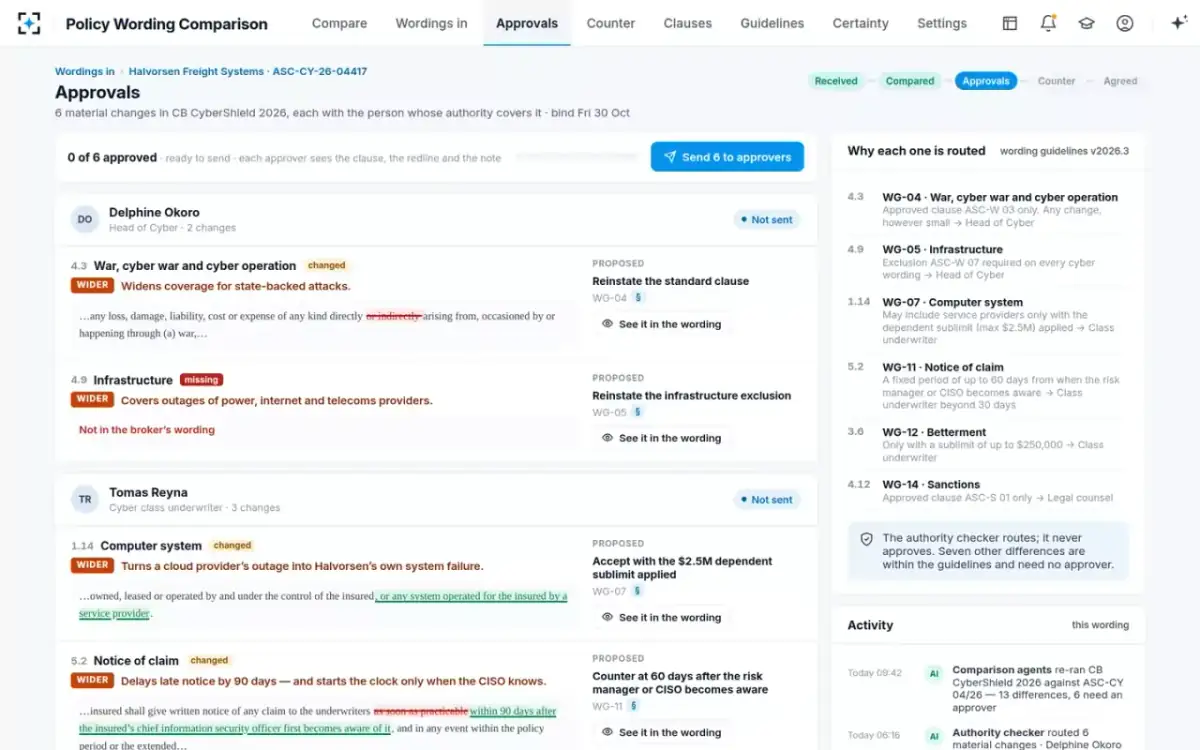
The person the carrier's authority matrix names for that clause family, and nobody else. In the sample the six material changes went to three people: the war and infrastructure changes to Delphine Okoro, head of cyber; computer system, notice of claim and betterment to Tomas Reyna, cyber class underwriter; and sanctions to Rafael Mendel, legal counsel. Beside each one the approver sees the rule that routed it. The seven differences within the guidelines need no approver, and the two narrower ones are flagged to the broker as a courtesy because they take cover away from the insured.
The approvers decided differently, which is the point of routing. Tomas accepted the computer system change with the $2.5 million dependent sublimit, countered notice at 60 days and accepted betterment with a $250,000 sublimit. Rafael replaced the broker's sanctions text with the approved clause. Delphine declined both of her changes, so "or indirectly" and the infrastructure exclusion go back in. Who signs off a change in cover, and what each signature attests, is set out for the roles across a wordings team.
Six material changes, grouped by the person whose authority covers them
What does a wording analysis report contain?
One row per difference, with the clause in both texts, the kind of change, the effect, the guideline it touches, the approver and the decision. The table below is the sample's report in that shape, before the approvers acted; a team that analyses wordings by hand can use the same columns.
The analysis report for the sample manuscript: thirteen rows, one decision each
1.9 Insured personAbout 340 seasonal and agency drivers fall outside "insured person".
ChangeChanged
EffectNarrower
GuidelineWithin · WG-20
Goes toCourtesy flag to the broker
1.14 Computer systemA service provider's outage pays at the full $10M limit, not the $2.5M dependent sublimit.
ChangeChanged
EffectWider
GuidelineMaterial · WG-07
Goes toClass underwriter
1.22 Ransom paymentAdds "including digital currency": clarifies what the form already covers.
ChangeMoved, changed
EffectNeutral
GuidelineWithin
Goes toNone
2.3 Data restorationBills of lading kept on paper at 14 depots could no longer be re-keyed.
ChangeChanged
EffectNarrower
GuidelineWithin · WG-20
Goes toCourtesy flag to the broker
2.4 Dependent business interruptionInside the guideline on waiting periods.
ChangeChanged
EffectWider
GuidelineWithin · WG-09
Goes toNone
3.2 Retention
ChangeChanged
EffectNeutral
GuidelineWithin
Goes toNone
3.6 BettermentPays to upgrade systems after a loss; allowed only with a sublimit.
ChangeNew
EffectWider
GuidelineMaterial · WG-12
Goes toClass underwriter
4.3 War, cyber war and cyber operation"or indirectly" deleted: spill-over malware from a state attack is no longer excluded.
ChangeChanged
EffectWider
GuidelineMaterial · WG-04
Goes toHead of Cyber
4.9 InfrastructureOutages of power, internet and telecoms providers would be covered.
ChangeMissing
EffectWider
GuidelineMaterial · WG-05
Goes toHead of Cyber
4.12 SanctionsNot the approved sanctions clause, whatever its effect.
ChangeChanged
EffectNeutral
GuidelineMaterial · WG-14
Goes toLegal counsel
5.2 Notice of claim90 days, starting only when the CISO knows.
ChangeChanged
EffectWider
GuidelineMaterial · WG-11
Goes toClass underwriter
5.6 Cancellation
ChangeChanged
EffectNeutral
GuidelineWithin · WG-15
Goes toNone
6.5 Lead underwriter
ChangeNew
EffectNeutral
GuidelineWithin · WG-19
Goes toNone
Two columns are missing from many hand-made reports and both matter later. The guideline column records why a change was or was not escalated, which is the question an auditor asks about a bound wording years on. The citation, shortened here but present on every row in the solution, lets anyone check the note against the text without re-reading the wording. A team building its own report can start from the inputs and columns to load before day one.
What should AI never decide on a wording?
Whether a change is acceptable, what to counter, and whether the wording can be signed. Those are underwriting decisions carrying the carrier's money, and in the sample each belongs to a named person. The agents' limits are written as hard rules: the coverage effect writer describes and never approves; the authority checker routes only to named approvers and never around the matrix; the clause suggester offers only approved clauses and marks anything drafted as needing legal review; and a wording decision cannot be signed while a material change is open.
Supervisors have set the same expectation in general terms. EIOPA's 2025 Opinion asks insurers using AI to define roles and responsibilities "in policy documents, including escalation procedures", and reminds them that insurance law already requires proportionate governance of every mathematical model, whether or not it is called AI (EIOPA Opinion on AI governance). Insurers are already heavy users: 95% of the insurers in the Bank of England and FCA's 2024 survey were using AI, more than in any other sector (Bank of England and FCA, 2024). The question for a wordings team is not whether to use it, but which decisions stay with people.
What does a wordings specialist check that the analysis cannot?
Three things, in the sample and in general. First, whether the form chosen is right: the analysis compares with the form it is given, so a manuscript compared with last year's form produces last year's differences. Second, whether the insured's operations make a neutral change matter: the note on computer system was useful because it knew Halvorsen runs dispatch and load matching on two hosted platforms, which is underwriting information, not wording. Third, whether the counter will land with the broker: the courtesy flags on insured person and data restoration were the specialist's way of keeping the placement on good terms while protecting the client.
The specialist's final act is a signature on a wording decision that lists what was accepted, conditioned and countered. In the sample, Imogen Hartley signed CB CyberShield 2026 as accepted with four replacement clauses and two conditions, after five checks had passed: all thirteen differences answered, six of six material changes approved, replacement clauses from the approved library, the cover note matching the schedule, and the bind date before inception. To see the whole analysis on screen, start from Policy Wording Comparison.
Questions people ask
What is the difference between a policy wording analysis and a blackline?
A blackline shows which words changed, in reading order. An analysis pairs clauses by meaning, then says for each difference what it does to the cover, whether guidelines allow it and who must decide. In the sample, the blackline of clause 4.3 is two struck words; the analysis is a note on state-backed spill-over losses and a route to the head of cyber.
How long does a policy wording analysis take?
By our estimate, comparing a 38-page manuscript with a form by eye takes three to four hours before any approval is sought. In the sample run, Policy Wording Comparison read, aligned, explained, tested and routed the same manuscript in 3 minutes 40 seconds; the specialist's own review and the approvers' decisions come on top.
What is a wider change in an insurance wording?
A change that gives the insured more cover than the carrier's form: a broader definition, a deleted exclusion, a longer notice period. Narrower changes take cover away from the insured. Neutral ones change words without changing who is paid, such as a clarification of what the form already covers.
Why is a neutral change sometimes material?
Because materiality comes from the carrier's guidelines, not from who gains. In the sample, the broker's sanctions text was rated neutral for the insured but still went to legal counsel, since the guideline allows only the approved sanctions clause, which the carrier's sanctions screening depends on.
Can the analysis be done on D&O, marine and casualty wordings?
Yes, provided each class has its own form and guidelines. The sample book holds standard forms for cyber, D&O, marine cargo, excess casualty, contractors' all risks and onshore energy, and each broker wording is compared with the form and guidelines for its class.