A policy wording comparison tool is software that sets one insurance wording, usually a broker's or manuscript wording, against another, usually the carrier's standard form, and reports every difference between them. Tools range from a word processor's compare to products that pair clauses by meaning and explain what each change does to the cover. The way to choose between them is not a demonstration on the vendor's documents: it is a test on your own, with twenty changes you planted and therefore know. Count what the tool finds, what it misses and what it invents, then check whether it rates each change correctly and sends it to the right approver. Botminds' Policy Wording Comparison is one such tool, built for specialty and E&S wordings; this guide gives the test in a form you can run on it or on anything else.
The examples come from a fictional sample placement as it runs through the solution: a primary cyber layer for Halvorsen Freight Systems, led by Ashgrove Specialty, on the broker Calloway Brandt's manuscript. The planted test set is ours, offered as a starting point.
Four outcomes for every clause: found, missed, invented and quiet
Reported by the tool
Not reported
Planted change
Found
Planted, and reported
"or indirectly" deleted from the war exclusion: reported, rated wider, sent to the head of class.
Missed
Planted, not reported
The infrastructure exclusion deleted outright: one struck block among the renumbering strikes, read as noise and passed over.
No change planted
Invented
Not planted, but reported
Clauses 1.2 to 1.9 renumbered after a new definition: eight "changes" that change nothing.
Quiet
Not planted, not reported
The other clauses, word for word the same, folded away so nobody reads them twice.
What is a policy wording comparison tool? Three kinds on sale
Three kinds of product answer to the name, and they do different jobs. The first is a text compare, in a word processor or a PDF viewer, which marks every character that differs in reading order. The second pairs clauses before comparing them, so that a renumbered or moved clause is matched to its counterpart and only changed words are marked. The third adds a reading of each change: what it does to the cover, whether it breaks the carrier's wording guidelines, and who has authority to accept it.
The test below works on all three, which is the point of it. A text compare will do well on edits inside a clause and badly on moves; a clause-pairing tool should do well on both; only the third kind can be scored on the effect and the approver. General contract tools sit across the second and third kinds and are built mostly for commercial contracts. How a general AI contract comparison tool differs from a wording-specific one is set out for reinsurance treaties, where the same question arises.
How do you test a wording comparison tool? Plant twenty changes in a wording you know
Take a standard form you use and a broker wording you have already placed and decided, so that every difference in it is known and has an agreed answer. Then make a copy of the broker wording and plant twenty more changes of your own, each recorded with its clause, its kind, the rating your specialists would give it and the person who would approve it. Four of the twenty should be decoys: edits that look like changes and are not.
Twenty planted changes for a cyber wording, and the answer each should get
| # | Planted change | Kind | The right answer |
|---|---|---|---|
| 1 | Delete "or indirectly" from the war exclusion | Changed trigger | Report; wider for the insured; head of class |
| 2 | Delete the infrastructure exclusion entirely | Deleted exclusion | Report as missing; wider; head of class |
| 3 | Add "or any system operated for the insured by a service provider" to computer system | Widened definition | Report; wider; class underwriter |
| 4 | Move notice of claim to general conditions and change 60 days to 90 | Moved condition, changed | Report once, as changed, not as deleted and new |
| 5 | Add a $250,000 sublimit to betterment | New sublimit | Report; narrower for the insured |
| 6 | Change "the risk manager or CISO" to "the CISO" as the person whose awareness starts notice | Changed trigger | Report; wider for the insured |
| 7 | Shorten the dependent business interruption waiting period from 12 hours to 8 | Changed number | Report; wider |
| 8 | Replace the approved sanctions clause with the broker's own text | Replaced market clause | Report; legal counsel |
| 9 | Delete "employee" from the definition of insured person | Narrowed definition | Report; narrower; courtesy flag to the broker |
| 10 | Change the retroactive date | Changed date | Report; wider or narrower by direction |
| 11 | Change choice of law to another jurisdiction | Changed condition | Report; legal counsel |
| 12 | Change "and" to "or" between two conditions of the ransom clause | One-word change | Report; wider |
| 13 | Add an endorsement that overrides an exclusion without editing it | Endorsement override | Report against the clause it changes |
| 14 | Delete a definition still used elsewhere in the wording | Orphaned term | Report; effect on every clause that uses it |
| 15 | Add a new extension for funds transfer fraud | New cover | Report as new; wider |
| 16 | Turn a condition into a warranty | Reworded warranty | Report; narrower; check against the law that applies |
| 17 | Renumber clauses 1.2 to 1.9 after inserting one definition | Decoy | Report only the new definition |
| 18 | Move the cooperation condition, words unchanged | Decoy | Report nothing, or a move flagged as neutral |
| 19 | Restyle headings and fix punctuation throughout | Decoy | Report nothing |
| 20 | Change "shall" to "will" in an insuring clause | Decoy | Report as neutral, or nothing |
The decoys matter as much as the real changes. A tool that reports items 17 to 20 as changes is not wrong in a narrow sense: the text did change. It is wrong in the sense that counts, because a reviewer who must clear false flags on every wording will either check all of them, which is slow, or start skimming, which is how real changes are missed. The Supreme Court made the same distinction when it compared disease clauses across several wordings and held that their textual differences did not change how the clauses were to be read ([2021] UKSC 1, para 48). Text that differs is not always cover that differs.
What the twenty planted changes test: half are edits inside a clause
What does a blackline miss?
A blackline buries or misses three things, and the test is built to show each. It buries what has gone: a deleted exclusion appears only as struck text among the strikes that renumbering produces, with nothing to say that a whole exclusion, not a sentence, has left the wording. The reliable way to find it is to start from the standard form and ask where each of its clauses went. It misses effects that travel: delete a definition, or change it, and every clause that uses the term changes meaning without a single mark in its own text. And it misses meaning altogether: it can show that two words were struck, never that the two words decided whether spill-over malware from a state attack is covered.
It also reports too much. Moves and renumbering appear as a deletion in one place and an insertion in another, which buries the planted move with a real change (item 4) among the decoy moves (items 17 and 18). Why the blackline floods, with a count from a test of our own on a twenty-clause form, is worked through separately.
What is a false difference in a redline?
A false difference is a change a redline reports that does not change the wording's meaning: a renumbered clause, a moved clause with the same words, reformatting, a restyled heading. It is the "invented" cell of the scoring grid. Count false differences per wording rather than as a percentage, because the reviewer's cost is per wording: twenty false differences on a 38-page manuscript is twenty clauses read twice.
Two judgement calls need agreeing before you score. Is a moved clause with unchanged words a difference? Our answer is no, provided the tool shows that it moved, because a condition moved into a different section can change how it applies. Is "shall" to "will" a difference? Usually not, but some teams treat any change to an insuring clause as worth a look. Write the answers down before the test, so the tool is scored against the team's rule rather than a rule invented after seeing the results.
How do you measure a comparison tool? Five numbers, not one
Measure five things: the share of planted changes found, the number of false differences per wording, the share of found changes rated correctly as wider, narrower or neutral, the share routed to the right approver, and the share whose citations point to the right page in both documents. A single "accuracy" figure hides which of these failed, and they fail for different reasons.
The standard for doing this well comes from outside insurance. NIST's AI Risk Management Framework says measures of accuracy should consider "computational-centric measures (e.g., false positive and false negative rates)", and that "Accuracy measurements should always be paired with clearly defined and realistic test sets – that are representative of conditions of expected use – and details about test methodology" (NIST AI 100-1). For a wording tool that means your wordings, your classes and your guidelines, not a vendor's demonstration file, and a written method another team could repeat.
Running the test: who plants, who runs, who scores, who decides
A person decides
Wordings leadPicks a placed wording and its form, plants the twenty changes and writes the answer key: kind, rating, approver.
Never: shows the key to the tool or its operator
Agent
The tool under testCompares the planted wording with the form and produces its differences, ratings, routes and citations.
A person decides
Second wordings specialistScores the output against the key without knowing which tool produced it, cell by cell of the grid.
Agent
The tool, three runsRuns again on the same files twice more, so that any variation between runs is visible.
A person decides
Head of wordingsReads the five numbers and the misses one by one, and decides whether the tool can be trusted with live wordings.
How accurate is AI at comparing contracts? What the research does and does not show
No published benchmark measures AI on insurance wordings, so the research can tell you how to test and roughly where tools fail, but not how a given tool will do on yours. The best-known benchmark for clause-level reading, CUAD, was labelled by legal experts on 510 contracts of 25 types filed with the SEC, from licence and supply agreements to hosting and transportation agreements (Hendrycks et al., NeurIPS 2021). It has an insurance label, but that marks a promise to carry insurance inside a commercial contract, not a policy wording. Stanford researchers who tested commercial legal research tools in 2024 found that each of them still hallucinated, which the authors gloss as making up "false information", in 17% to 33% of their test queries (Magesh et al., 2024). That is a different task from wording comparison, but the lesson carries over: a fluent answer is not a checked one.
What follows for a buyer is simple. Your planted test is the only evidence that applies to your wordings, so run it on every tool you shortlist, and require every reported change to cite both texts by page, so that a reviewer can check the claim in seconds. A team weighing a general chatbot instead of a wordings tool will find the same kind of planted test applied to treaty drafts.
Who is responsible when the tool misses a change?
The carrier, in every regime that has addressed it. EIOPA's 2025 Opinion on AI governance says "Undertakings are ultimately responsible for the AI systems that they use, regardless of whether the AI systems are developed in-house or in collaboration with third party service providers", and expects them to obtain information about "the limitations of the AI systems used" (EIOPA Opinion, para 3.11). New York's Department of Financial Services, in a circular on AI in underwriting and pricing, keeps responsibility for understanding a vendor-built underwriting tool with the insurer (Insurance Circular Letter No. 7, 2024; the Compliance guide to an AI vendor risk assessment questionnaire sets out what to ask).
The practical consequence is that the test is not a procurement step to be done once. Keep the planted wording and its answer key, and re-run them whenever the tool, its model or your guidelines change. A tool that cannot be re-tested on demand, with the same files, is a tool whose limitations the carrier cannot describe.
Running the test on Policy Wording Comparison
The solution was built to be scored this way. Every difference cites your form and the broker's wording by page; every rating is wider, narrower or neutral for the insured; every material change is routed by a named guideline to a named approver. Clause pairs the aligner is less than 0.85 confident about go to a person rather than being matched silently. And each version of your wording guidelines is tested on a set of wordings with known answers before it goes live: in the fictional sample, guidelines v2026.3 passed 42 of 42 on 28 August 2026.
The guidelines a comparison is scored against, with their own test
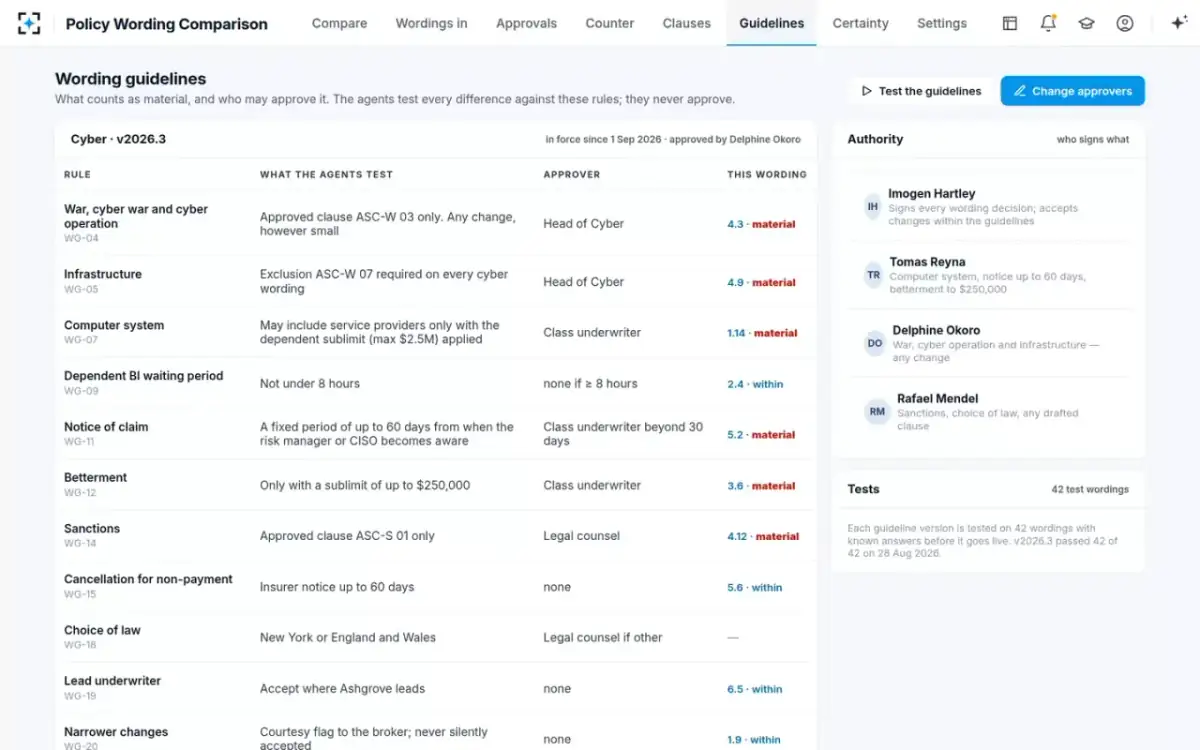
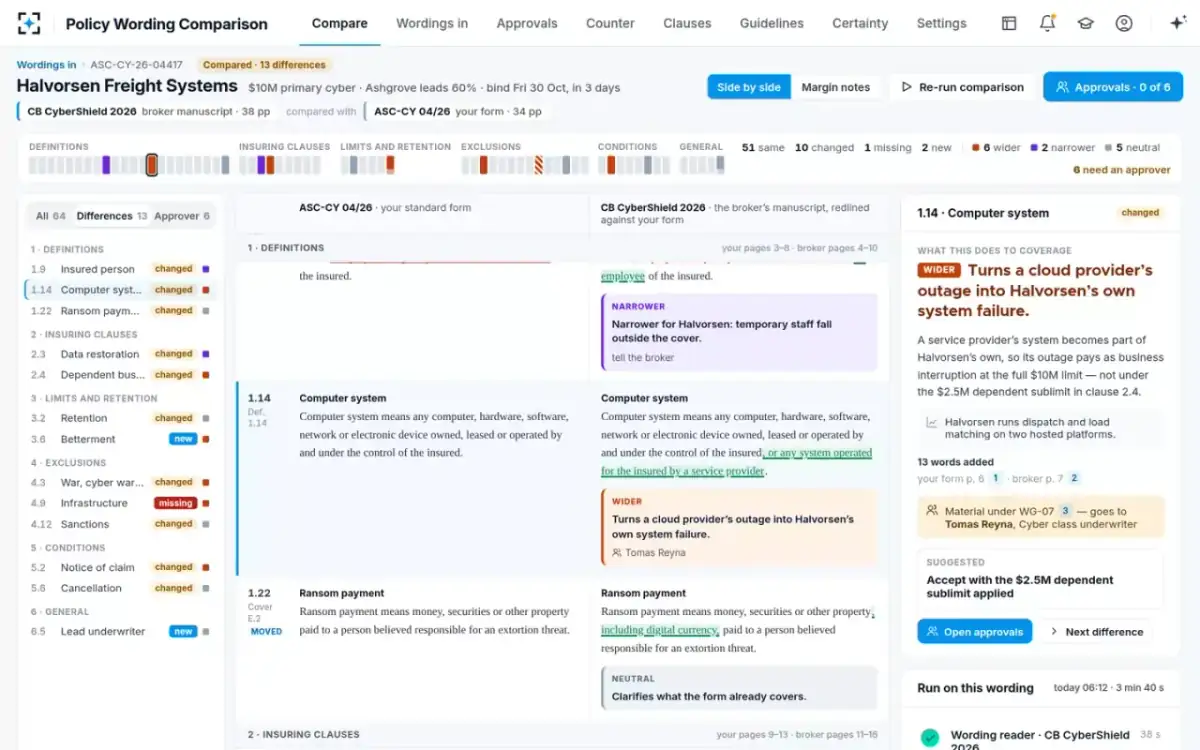
On the sample manuscript, the run produced the outputs the grid scores: 13 differences from 64 aligned rows, with 14 renumbered and 3 moved clauses matched rather than reported, each difference rated (6 wider, 2 narrower, 5 neutral) and the 6 material ones routed to 3 approvers. Those are sample results on fictional wordings, shown so you can see what to count; your planted test on your own wordings is the result that matters.
The differences only: what a scorer checks against the answer key
Where Policy Wording Comparison fits as a comparison tool, and where it does not
Policy Wording Comparison fits a team that compares broker and manuscript wordings against its own forms before bind and wants the decisions on the file: specialty, E&S and London market wordings in cyber, D&O, marine cargo, excess casualty, construction and energy. It does not fit a team that only needs to see what text changed between two editions of its own form, where a text compare is enough and cheaper. It does not file forms, decide coverage on a claim or replace the specialist: the agents describe and route, and people approve and sign.
Questions to put to any policy wording comparison tool before the test
- Will you run it on our wordings, with changes we planted?
A tool that can only be shown on its own documents has not been tested on yours.
- How does it treat renumbered and moved clauses?
Ask to see items 17 and 18 of the test: matched quietly, or flagged as moved, but never as deleted and new.
- How does it find a clause that is missing altogether?
It must start from your form and account for every clause in it.
- Does every reported change cite both texts by page?
Without citations a reviewer has to re-read to check, and the time saved is lost.
- Does it rate the effect, and against whose guidelines?
Wider or narrower for the insured, tested against your rules rather than a generic list.
- Can it approve anything on its own?
The right answer is no: it should route to the approver your authority matrix names.
- Can we re-run the same test after every change to the tool?
Same files, same key, same five numbers, whenever the model, the tool or the guidelines change.
Before any test, a team needs the inputs the tool will compare against: the forms, guidelines and authority matrix to load before day one. To see the sample manuscript run end to end, start from Policy Wording Comparison.
Questions people ask
Can AI compare insurance policy wordings?
Yes, and the useful question is how well on your wordings. AI can split wordings into clauses, pair them by meaning when renumbered or moved, and draft a note on what each change does. It should cite both texts so a person can check it, and it should never accept a change: in the regimes that have addressed AI, such as EIOPA's 2025 Opinion, the insurer stays responsible for the tool's output.
How many planted changes are enough?
Twenty per wording is enough to see each kind of change at least once and to include decoys; run it on two or three wordings from different classes if the tool will be used across classes. Fewer than ten tends to test only the kinds of change the tester thought of first.
Should we test on a real wording or a made-up one?
A real one you have already placed and decided, with planted changes added. Its known differences give you an answer key you did not have to invent, and its language, structure and endorsements are the conditions the tool will meet in use, which is what NIST's framework means by test sets representative of expected use.
What is a good score?
There is no published benchmark for insurance wordings, so set the bar before the test. Most wordings teams would treat any missed material change as disqualifying until explained, and would judge false differences by how many a reviewer can clear in minutes rather than hours.
Does a comparison tool replace the wordings specialist?
No. It replaces the reading and pairing that take most of the specialist's time, and leaves the judgement: whether a change is acceptable, at what condition, and what to counter. In Policy Wording Comparison the specialist signs every wording decision, and no counter goes to the broker before that signature.