Ambiguity in an insurance policy is wording that is reasonably capable of more than one meaning, so that insurer and insured can each read it their own way and both be reasonable. Courts first try to find the meaning a reasonable reader would take from the whole contract; only if that fails do they fall back on rules that usually favour the insured. For a carrier, the price of a loose clause depends on who finds it. A wordings specialist who notices it before bind spends an hour and sends a counter. A claims handler who meets it at a loss starts a coverage dispute. A market that meets it in a crisis ends up in a test case, as Britain's insurers did in 2020 over business interruption wordings. Botminds' Policy Wording Comparison is built to move that discovery to the cheapest point: it reads each broker or manuscript wording against your form before bind and says in plain words what every change does.
The product examples come from a fictional sample placement in the solution, a cyber manuscript for Halvorsen Freight Systems led by Ashgrove Specialty. The court and regulator material is real and linked where it appears.
Who finds the ambiguity decides what it costs
- 1
The drafter, while writing
Minutes: a second reading of a new phrase against the clauses that use it.
- 2
The wordings specialist, before bind
An hour or so: working out what a change does, then a counter to the broker.
- 3
The broker, at renewal
A negotiation: the clause is now a precedent the insured expects to keep.
- 4
The claims handler, at a loss
A coverage dispute: a reservation of rights, coverage counsel, a delayed payment.
- 5
A court, on one claim
Litigation on that wording, its cost borne by both sides and its answer binding them.
- 6
A court, for a whole market
A test case: 21 sample wordings, about 370,000 policyholders on insurers' lists, 438 days from the regulator's statement to the final declarations.
What is an ambiguous insurance clause?
An ambiguous clause is one whose words, read in context, will bear two or more reasonable meanings. California's Supreme Court put the test in brackets in a 2020 excess insurance case: terms are ambiguous when they are "susceptible of more than one reasonable interpretation" (Montrose Chemical v. Superior Court). The word that does the work is reasonable. A clause is not ambiguous because a party with money at stake has found a second meaning; it is ambiguous when a fair reader could hold that meaning too.
That distinction is where most disputes are actually fought. In the business interruption test case, insurers argued that a disease clause covering "any occurrence of a Notifiable Disease within a radius of 25 miles of the Premises" limited cover to the local effects of a local outbreak. The Supreme Court disagreed that the words were unclear at all: "we do not consider that there is any ambiguity in the description of the relevant insured peril" ([2021] UKSC 1, para 61). The clause was litigated to the highest court anyway. For a carrier, the expensive ambiguity is not only the one a court finds; it is any reading arguable enough to be worth a lawsuit.
How are ambiguities in insurance policies resolved?
In stages. Courts first read the words objectively, in the context of the whole policy and the background the parties shared; most apparent ambiguities end there. Where real ambiguity survives, many courts then ask what the insured could reasonably have expected, and only then construe the words against the insurer that drafted them.
California's court set out that ladder in so many words. If contractual language is clear and explicit, it governs; if it is ambiguous, courts interpret it to protect "the objectively reasonable expectations of the insured", and if those rules do not resolve the ambiguity, the court "may then" resort to "the rule that ambiguities are to be resolved against the insurer" (Montrose, 2020). Texas's Supreme Court, describing its own earlier decision, said "we construe an ambiguous contract in favor of the insured" (Ohio Casualty v. Patterson-UTI, 2024). English courts reach a similar place by a different route, preferring the meaning that makes commercial sense when words truly bear two. How a claims team applies these rules to a policy on a live loss is a separate question, covered in insurance policy analysis on a claim.
Who pays when a policy wording is unclear?
Usually the carrier, and always both sides' time. The rule against the drafter exists because the insurer usually wrote the words. Where a broker drafted the manuscript, a carrier cannot count on escaping that rule: it agreed the words, and whether the rule applies at all turns on the court and the facts. The cost also lands on insureds, who wait for payment while the wording is argued, and on brokers, who negotiated the text.
Delay is part of the price. The FCA's July 2020 update recorded that insurers' lists of potentially affected business interruption policies covered "approximately 370,000 policyholders", most of them waiting on an answer about the wording rather than about their losses (FCA test case page). And even the final answer was not a payment: the FCA points out that the judgment settled the basis for paying claims, not the amount due under any one policy.
The FCA test case: what an ambiguity costs when a whole market meets it
The business interruption test case is the clearest public record of what disputed wording costs at scale. When the pandemic closed businesses in 2020, thousands of claims were declined on the ground that the policies did not cover its effects. Rather than leave each policyholder to sue, the FCA took a representative sample of 21 wordings from eight insurers to court under a scheme for urgent questions of general importance, stating on 1 May 2020 that it was acting "with the aim of obtaining legal guidance more quickly and at lower cost to policyholders than would be the case if they took their own actions" (FCA).
From the FCA's statement to the final declarations: 438 days
- Statement to claim39 d
- To trial41 d
- Trial to judgment57 d
- To appeal hearing62 d
- Appeal to judgment60 d
- To declarations179 d
By the standards of litigation it was fast. The Supreme Court called it "a testament to the success of the Test Case Scheme procedure" that the issues were "finally decided following a trial and an appeal to the Supreme Court in just over seven months", and hoped the result would "achieve very considerable savings in the time and cost of resolving individual claims" ([2021] UKSC 1, para 43). By the standards of a business waiting for its claim, fourteen and a half months from the regulator's statement to the final order is a long time. And the case decided only what the clauses meant in principle; each policy still had to be adjusted.
The scale came from repetition. The same few clause types appeared in many wordings across many insurers, so one argued meaning became a market's problem. The 21 wordings, compared clause by clause, shows how small textual differences between them changed the outcome.
What the court said about clauses that cut cover from far away
The judgment also shows a second kind of loose drafting: an exclusion placed so far from the cover it cuts that no reasonable reader would connect them. The insurer under one sample wording argued that a general contamination and pollution exclusion on page 93 of a wording removed most of the disease cover granted on page 38. The court rejected that reading in terms any drafter can use.
"The reasonable reader would naturally assume that, if the intention had been to put a further substantive limit on the risk of business interruption specifically insured by the extension for infectious diseases in addition to the geographical and temporal limits stated in the extension itself, this would have been done transparently as part of the wording of the extension and not buried away in the middle of a general exclusion of contamination and pollution risks at the back of the policy."
FCA v Arch Insurance (UK) Ltd [2021] UKSC 1, para 78
For a wordings team the lesson cuts both ways. A carrier's own limits belong next to the cover they limit. And when a broker's manuscript moves a condition or an exclusion to another section, the move may change how a court reads it even if not a word of it changes, which is why a comparison should show moves rather than hide them.
Can an insurer fix an ambiguous wording mid term?
Only by agreement: a policy is a contract, and changing its words mid term is a variation the insured must accept, usually by endorsement. Where the fix would take cover away, the insured has little reason to agree before renewal, so in practice most ambiguities are fixed at the next renewal, if at all, and the current term runs on the loose wording.
In the UK the Insurance Act 2015 adds a specific clarity rule where a term would leave a business insured worse off than the Act's own protections. Such a disadvantageous term must be brought to the insured's attention before the contract or variation, and must also be clear and unambiguous about what it does (Insurance Act 2015, s.17(3); the section is read in full in the guide to Insurance Act 2015 warranties). A term that fails that test is of no effect to the extent it disadvantages the insured. Ambiguity there is not merely a dispute risk; it can void the term.
What a loose clause costs at the desk: the hour that prevents the rest
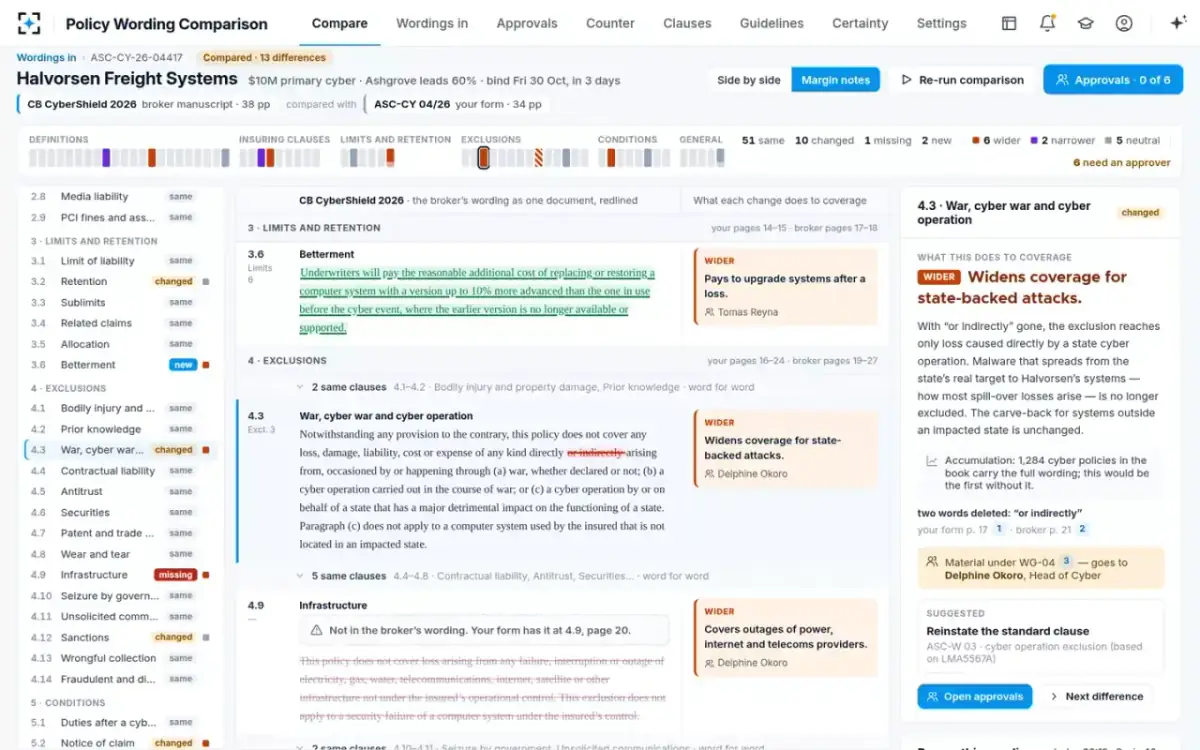
Before bind, the cost is reading time, and most of it goes on one task: working out what each change does to the cover. By our estimate, the by-eye comparison of a 38-page manuscript splits as below, and the effect reading is the largest single step.
Where a wordings specialist's hours go on one manuscript, by eye
That 1.5 hours is the cheapest point at which an ambiguity can be dealt with, and it is also the step most often cut short under bind pressure. The solution takes the reading and drafts the effect note; the specialist checks it. In the sample, the note on clause 1.14, computer system, explains that thirteen added words move a cloud provider's outage from a $2.5 million dependent sublimit into the $10 million limit, which is the kind of reading a claims handler would otherwise do two years later, with a loss on the desk.
The effect of each change, written beside it before bind
How do you avoid ambiguity in policy wording?
Mostly by discipline in drafting and comparison rather than by better prose. The checks below come from the patterns that put wordings in court: limits placed away from the cover, terms defined in one place and changed in another, and intentions recorded in emails rather than in the words.
Seven habits that keep a wording out of a coverage dispute
- Put every limit next to the cover it limits
An exclusion at the back of the policy that guts an extension at the front invites the reading the Supreme Court rejected.
- State distances, periods and triggers in the clause itself
If cover is local, say how local. If notice runs from someone's awareness, say whose.
- Re-read every clause that uses a changed definition
A definition widened in section 1 widens every clause that uses the term, with no mark in their own text.
- Prefer approved clauses to new text
A clause with a history of use and interpretation is less likely to bear a surprise meaning than one drafted on the day.
- Test a new phrase against two hostile readings
Ask how the insured would read it after a loss, and how the carrier would; if both are reasonable, redraft.
- Record the reason for a change in the decision, not only in email
Courts read the words, not the parties' private intentions; the carrier's file should show why each change was accepted.
- Show moves as well as edits when comparing
A condition moved to another section can be read differently even with its words unchanged.
Counter-wording drawn only from approved clauses, so the reply adds no new ambiguity
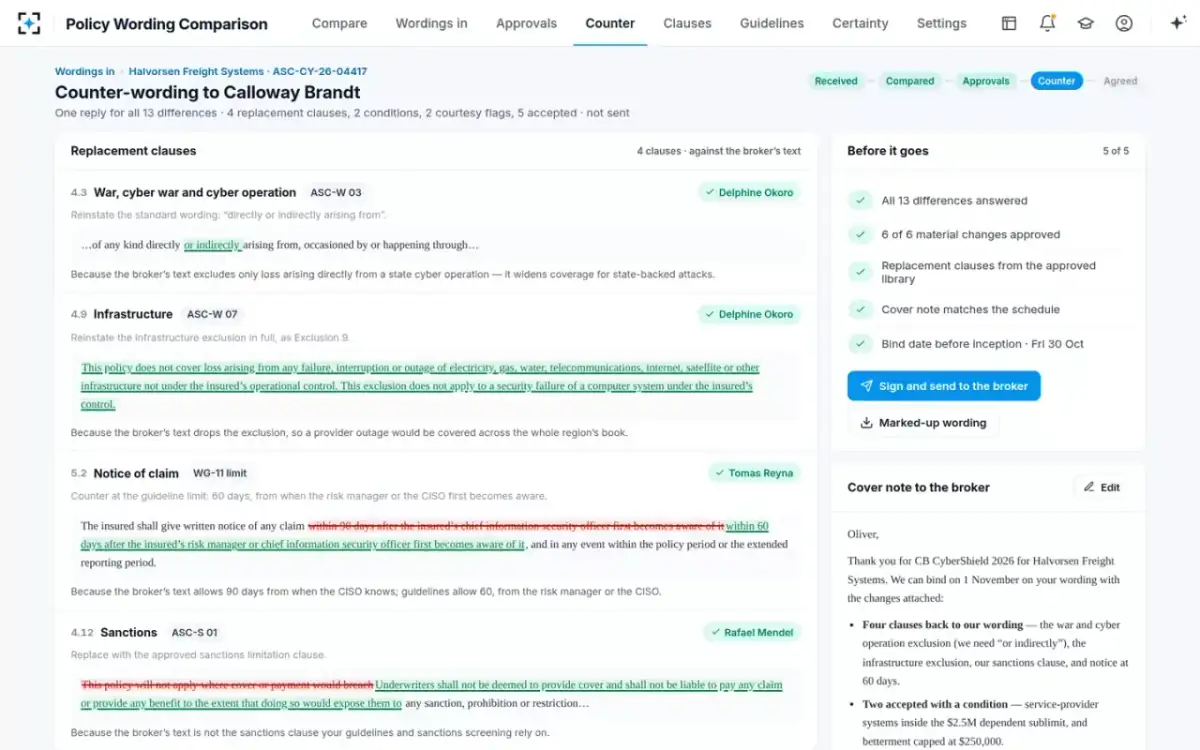
A comparison catches what drafting misses, because it reads the broker's text against your form rather than on its own terms. Six kinds of non-standard change lists the patterns to look for, with a check for each. To see a manuscript read clause by clause before bind, start from Policy Wording Comparison.
Questions people ask
What was the FCA business interruption test case?
A case the UK Financial Conduct Authority brought in 2020 to settle whether a representative sample of 21 business interruption wordings from eight insurers covered losses from the pandemic and the government's response. The Supreme Court gave judgment on 15 January 2021, substantially allowing the FCA's appeals and dismissing the insurers'.
How do courts interpret insurance policies?
Objectively: by asking what a reasonable person with the parties' background knowledge would understand the words to mean, reading the policy as a whole. In the UK test case the Supreme Court added that a policy sold mainly to small businesses is addressed to an ordinary policyholder reading conscientiously, not to a pedantic lawyer.
Are ambiguities in an insurance policy always resolved in favour of the insured?
Not always, and not first. Courts begin with the ordinary, objective meaning; most disputes end there, as the radius clause in the test case did. Only where genuine ambiguity remains do many U.S. courts, such as California's, turn to the insured's reasonable expectations and then construe the words against the insurer.
Who decides whether a clause is ambiguous?
In a dispute, the court, by asking whether the words in their context reasonably bear more than one meaning. In the test case the Supreme Court found no ambiguity in the 25-mile disease clause even though insurers had argued for a narrower reading. Before bind, the carrier decides for itself: the specialist flags a phrase that reads two ways, and the approver accepts it knowingly or counters it.
Is a missing clause an ambiguity?
No: a missing exclusion is usually clear, and clearly in the insured's favour. In the sample manuscript the infrastructure exclusion was simply absent, so outages of power, internet and telecoms providers would be covered. That is not a dispute risk but a decision someone must take knowingly before bind.