A manuscript policy is an insurance policy written for one insured, or one particular subject of insurance, rather than issued on the carrier's standard form; in specialty, excess and surplus lines and the London market it is often the broker's own wording, offered in place of the carrier's. Washington's insurance code describes such wordings as "manuscript policies, riders, or endorsements of unique character designed for and used with relation to insurance upon a particular subject" and exempts them from its commercial form-filing rule (RCW 48.18.103). The hard part is not the definition. A manuscript can follow the carrier's form for thirty pages and part from it in three clauses, and those three decide what is paid. Botminds' Policy Wording Comparison sets a broker's manuscript against your standard form clause by clause, explains in plain words what each departure does to the cover, and routes the material ones to the person whose authority covers them before the risk binds.
The worked examples come from a fictional sample placement as it runs through the solution: a primary cyber layer for Halvorsen Freight Systems, led by Ashgrove Specialty, on a 38-page manuscript from the wholesale broker Calloway Brandt. The law and market figures come from statutes, regulators and the NAIC, linked where they appear.
Standard form, endorsement, manuscript: three ways a wording reaches the insured
1
Standard form
Written by the carrier or a rating organisation, used across a book
The regulator: Usually filed with the state regulator before or soon after use
2
Endorsement
Changes one form for one insured: adds, deletes or rewrites a clause
The regulator: Filed like the form, unless a state exempts it
3
Manuscript policy
Negotiated text for one insured, often drafted by the broker on its own paper
The regulator: Exempt from filing in some states; checked against admitted forms in others
What a wordings team compares: the manuscript (3) against the standard form (1) with the endorsements the carrier would normally attach (2), clause by clause.
What is a manuscript policy? A wording made for one risk
A manuscript policy is a contract wording drafted for a particular insured or subject rather than taken from a filed form. In practice it means negotiated text. A Washington House bill report put it in one line: "Manuscript insurance policies are one-of-a-kind policies that pertain to unique needs" (HB 2726 bill report, 2004).
The definition matters because regulators treat the two kinds of wording differently. A standard form is used across a book, so states review it once for the many insureds who will hold it. A manuscript is used once, so reviewing it in advance would add a filing for every placement. Washington's code requires commercial property and casualty forms to be filed within thirty days after an insurer issues a policy using them, and then carves out manuscripts of "unique character" from that requirement (RCW 48.18.103(3)(b)).
In practice the word covers three things a wordings specialist meets every week. The broker's own policy wording, offered for a whole class of business. A wording negotiated from scratch for one large insured. And a manuscript endorsement: a single clause, written for one placement, that rewrites part of the carrier's form. Each has to be read against something, and the something is almost always the carrier's standard form for that class.
Manuscript policy vs standard form: how regulators treat each
The short answer is that a standard form is checked once by a regulator and a manuscript is checked every time, by the carrier. How much of the checking a state does depends on the state and the line, and several have moved large commercial and specialty lines out of form review altogether.
Texas is the clearest recent example. Senate Bill 1367 removed rate and form filing for seventeen kinds of commercial insurance and combinations of them, for policies delivered, issued or renewed from 1 September 2021, including directors' and officers' liability, product recall, media liability, commercial excess and umbrella liability, and "commercial cybersecurity, including first- and third-party commercial lines coverage for losses arising out of or relating to data privacy breaches, network security, computer viruses, and similar exposures" (TDI Bulletin B-0022-21). The same bulletin keeps the filing duty where an exempt line is combined with one that is not. For those lines the state no longer receives the wording to review before use; the carrier is the first, and often the only, reader.
Florida pulls the other way for surplus lines. A coverage exported to an eligible surplus lines insurer must sit on a form no more favourable to the insured than the admitted market's, "except that a coverage may be exported under a unique form of policy designed for use with respect to a particular subject of insurance" if the surplus lines agent files a copy with the Office of Insurance Regulation, which may disapprove it within ten days of filing, not counting weekends and legal holidays (Fla. Stat. § 626.916(1)(b)). The insured also signs a disclosure whose last sentence says that no Florida regulatory agency approves surplus lines insurers' rates or forms (the disclosure is read in full in the guide to Florida surplus lines diligent effort).
Standard form and manuscript policy, side by side
Standard form: The carrier, or a rating organisation the carrier subscribes to.
Manuscript policy: The broker, the insured's counsel or the underwriter, for one placement.
Standard form: The state regulator, where forms are filed; then every underwriter who uses it.
Manuscript policy: The carrier's wordings specialist and underwriter, often days before bind.
Standard form: On a version cycle, with a new edition date.
Manuscript policy: At every placement and often every renewal.
Standard form: Between editions, and in the endorsements attached.
Manuscript policy: In definitions, exclusions, conditions and sublimits, scattered through the text.
Standard form: Which edition was in force.
Manuscript policy: Who agreed each departure from the form, and on what authority.
Why manuscript wordings are common in E&S and specialty lines
Manuscripts cluster where the risk is large, unusual or written outside the admitted market, which is most of specialty. Cyber is the clearest case in U.S. data: the NAIC's report on the 2024 market records $4.35 billion of domestic direct written cyber premium from surplus lines insurers against $2.74 billion from admitted ones (NAIC, 2025 cybersecurity insurance report). Surplus lines wordings are where carrier forms meet broker forms most often, because the wholesale broker who brings the risk usually brings its own paper too.
Two forces keep manuscripts in use. The insured's broker wants a wording it knows, used across its clients, so that it can explain one document rather than six. And the large insured wants its own operations described: its hosted systems, its subsidiaries, its contractual promises to customers. A standard form drafted for a book of mid-sized risks rarely fits a freight platform that runs dispatch on two hosted services. Each fix is a departure from the form, and each departure is a decision someone must take with authority.
Where a manuscript usually departs from the standard form
Departures cluster in the parts of a wording that define the cover rather than administer it: definitions, exclusions, limits and conditions. Schedules and general conditions change too, but less often in ways that move a loss from unpaid to paid. The sample manuscript shows the pattern.
A 38-page manuscript against a 34-page form: 51 clauses the same, 13 that differ
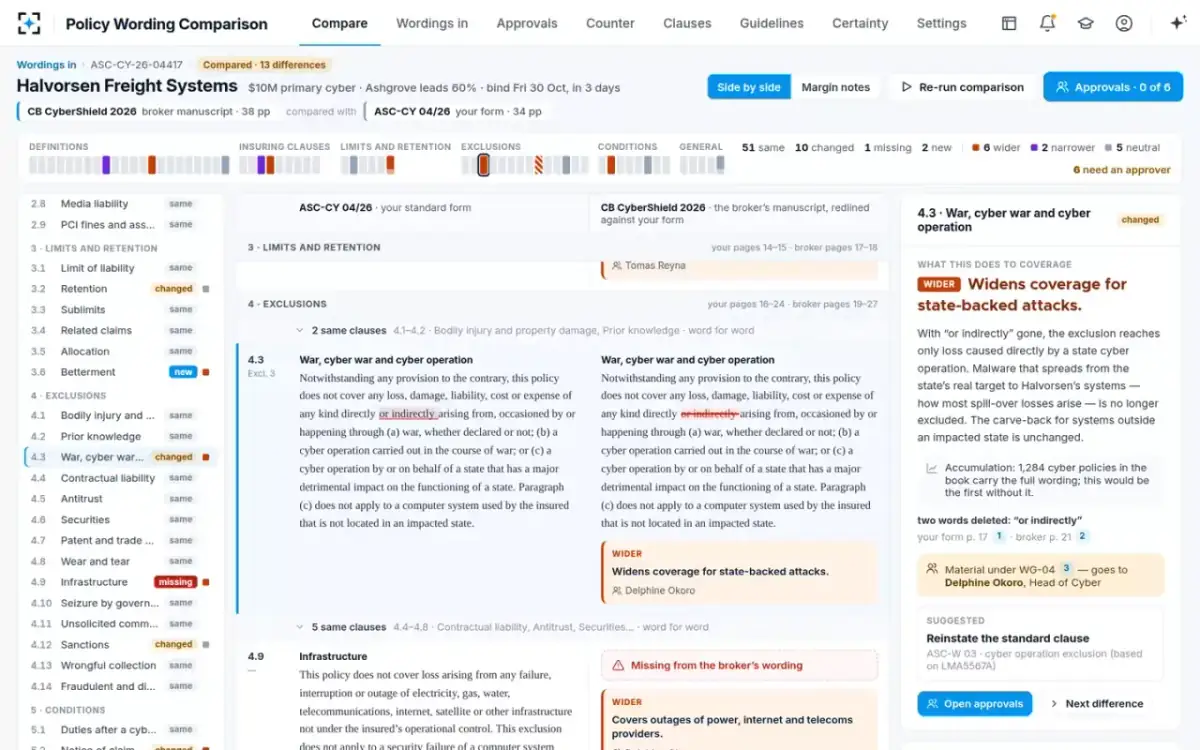
Of the thirteen differences in the sample, the ones that matter most are small. In the war, cyber war and cyber operation exclusion, two words, "or indirectly", are gone, so the exclusion reaches only loss arising directly from a state cyber operation. In the definition of computer system, thirteen words are added, "or any system operated for the insured by a service provider", which moves a cloud provider's outage from a $2.5 million dependent sublimit into the $10 million limit. The infrastructure exclusion is not there at all. None of those three is a new clause; two are edits to old ones, and one is an absence. Six kinds of non-standard change, with a check for each, are set out separately.
The manuscript beside the form: two struck words in the war exclusion
Is a renumbered clause a changed one?
No. A clause that has moved or taken a new number but keeps its words is the same clause, and a review that counts it as a difference wastes the reader's attention on nothing. In the sample manuscript, fourteen clauses were renumbered and three moved to a different section. A compare that pairs clauses by their number reports every one of them as a deletion and an insertion; a compare that pairs them by meaning reports none of them, and lists the ransom payment definition, which moved and gained the words "including digital currency", as one neutral change.
The reverse is also true: a clause can keep its number and change its meaning. The courts treat textual variation the same way. In the business interruption test case, the Supreme Court considered disease clauses in seven different wordings, accepted that their texts varied, and held that none of the variations changed the correct reading of the clauses ([2021] UKSC 1, para 48; the court's words are in the guide to the communicable disease exclusion clause). Comparing wordings is the same exercise at smaller scale: find the differences in words, then decide which differences are differences in cover. Why a word-processor blackline floods when clauses move is worked through with a test of our own.
What is a manuscript endorsement?
A manuscript endorsement is a single clause, or a short set of clauses, written for one insured and attached to the carrier's form to change it. It is the manuscript principle applied to part of a policy: the form stays, and one endorsement rewrites a definition, deletes an exclusion or adds a sublimit. Washington's exemption covers "manuscript policies, riders, or endorsements" alike (RCW 48.18.103), which reflects how close they are in practice.
Endorsements are where a carrier's own form can drift without anyone rewriting it. A wording that is the standard form plus six manuscript endorsements is, for comparison purposes, a manuscript: the reviewer has to read the endorsements into the clauses they change and ask the same three questions of each. What changed? What does it do to the cover? Who may accept it? The sample manuscript arrives with two endorsements of its own, and the solution reads them as part of the broker's text rather than as an appendix.
How courts read a manuscript, and why the reader matters
English courts read every policy objectively, and the objective reader changes with the kind of policy. The Supreme Court restated the core principle in the test case: "an insurance policy, like any other contract, must be interpreted objectively by asking what a reasonable person, with all the background knowledge which would reasonably have been available to the parties when they entered into the contract, would have understood the language of the contract to mean" ([2021] UKSC 1, para 47).
For standard forms sold mainly to small firms, the court described that reasonable reader closely. The policy is addressed not to "a pedantic lawyer who will subject the entire policy wording to a minute textual analysis" but to "an ordinary policyholder who, on entering into the contract, is taken to have read through the policy conscientiously in order to understand what cover they were getting" (para 77). A manuscript negotiated between a specialist broker and a carrier's wordings team has different parties and a different background. Our reading, not the court's, is that the background knowledge a court attributes to them is likely to be greater, which makes the carrier's own record of what it agreed, and why, more important rather than less. How courts resolve a wording that will bear two meanings is a question for what a loose clause costs.
How do you review a manuscript policy? A method in seven steps
Review a manuscript against the form it replaces, clause by clause, and record a decision on every difference rather than a general view of the document. The order below is the one the sample follows; a team can run it by hand, and the solution runs it for every wording that arrives.
Reviewing a manuscript policy against your standard form
- Pick the right form and edition
Compare against the form in force for that class on the inception date, with the endorsements you would normally attach. A comparison with last year's form finds last year's changes.
- Split both documents into clauses, keeping page and line
Every finding must point back to both texts, or an approver ends up reading a summary instead of the clause.
- Pair clauses by meaning, not by number
Renumbered and moved clauses are not differences. A clause that is in the form but missing from the manuscript is the most important difference of all.
- Classify each pair: same, changed, missing or new
Fold the identical ones away so the review time goes to the differences.
- Say what each difference does to the cover
Wider, narrower or neutral for the insured, in which situation, and to whose benefit. Narrower changes matter too: they are the broker's problem at claim time.
- Test it against your guidelines and route it
A material change goes to the person whose authority covers that clause family, not to whoever is free.
- Answer every difference before bind
Accept, accept with a condition, or counter from your approved clauses; sign the decision with the approvals on the file.
Most of the time in that list goes to the third and fifth steps. Pairing renumbered clauses by eye means holding two documents open and searching one for each clause of the other; working out what a change does needs the class underwriter's knowledge of the insured's operations. By our estimate, a 38-page manuscript takes three to four hours to compare with the form by eye, before any approval is sought. A full analysis of the sample manuscript shows the same steps split into four jobs, with what each may not decide.
Where Policy Wording Comparison fits beside the wordings team
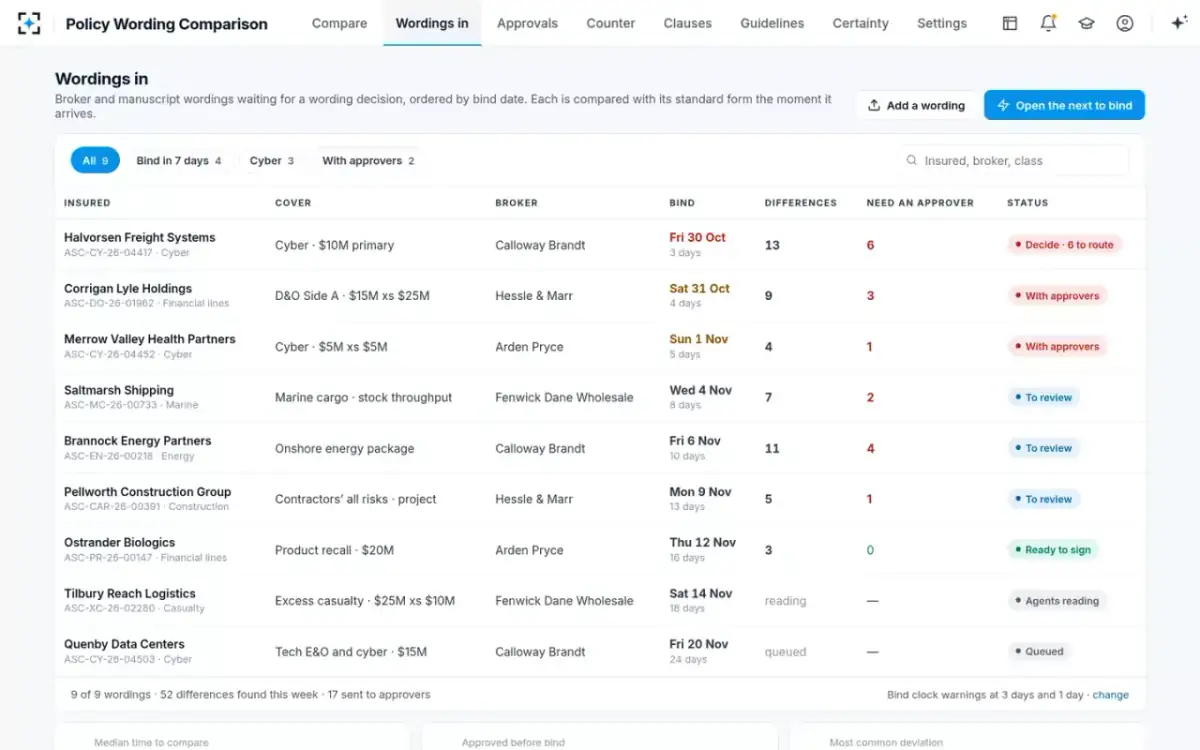
The solution takes the reading and the pairing, and leaves the decisions where they are. Six agents split the broker's wording and your form into clauses, align them even when renumbered or moved, write a plain-words note on each change, test it against your wording guidelines and route the material ones to the named approver. None of them approves a change, and replacement clauses come only from your approved library.
Every manuscript waiting for a decision, ordered by bind date
What it does not do matters as much. It does not file forms with a regulator, decide whether a state's surplus lines export conditions are met, or tell the broker a change is acceptable. It reads what it is given: if the right standard form is not loaded, the comparison is with the wrong document. To see the sample manuscript screen by screen, start from Policy Wording Comparison.
Questions people ask
What is a manuscript policy in insurance?
A policy wording written for one insured or one particular subject of insurance instead of the carrier's standard form. Washington's code calls them wordings "of unique character designed for and used with relation to insurance upon a particular subject", and exempts them from its commercial form-filing rule. In specialty lines it is often the broker's own wording.
Who writes a manuscript policy?
Usually the broker, for its clients across a class, or the insured's advisers for a single large risk; sometimes the underwriter drafts it. Whoever drafts it, the carrier that agrees to it carries the risk of every word, which is why its wordings specialist compares it with the carrier's own form before bind.
Are manuscript policies common in E&S?
Yes, because surplus lines risks are placed one by one and the wholesale broker often brings its own wording. In cyber, the NAIC's data for 2024 show surplus lines insurers writing $4.35 billion of domestic direct premium against $2.74 billion for admitted insurers, so most cyber wordings sit in the market where negotiated forms are routine.
Do manuscript policies have to be filed with the state?
It depends on the state and the line. Washington exempts manuscripts from its 30-day commercial form filing; Texas has exempted seventeen commercial lines, including D&O and commercial cyber, from rate and form filing since 1 September 2021; Florida requires a surplus lines agent to file a unique form, which the state may disapprove within ten days, not counting weekends and legal holidays.
Why would a broker use a manuscript wording?
To give its clients one wording it knows and can explain across several carriers, and to describe an insured's operations more precisely than a book-wide form can. The cost falls on each carrier, which has to find and decide the clauses that differ from its own form.
Is a manuscript policy the same as a manuscript endorsement?
No. A manuscript policy replaces the whole form; a manuscript endorsement changes one part of it for one insured. For review purposes they are handled the same way: each departure from the standard form needs a reading of its effect and a decision by someone with authority.