Florida surplus lines diligent effort was, until 30 June 2025, a defined term with a number in it: coverage sought from, and rejected by, at least three authorized insurers currently writing the coverage, with the rejections documented. Chapter 2025-145 of the Laws of Florida deleted that definition from § 626.914 and deleted the export condition in § 626.916 that required the full amount to be unprocurable from authorized insurers after a diligent effort, both from 1 July 2025. A Florida export therefore no longer depends, by statute, on a count of declinations. It still depends on a rate no lower than the admitted market's, a form no more favourable than the admitted market's, permitted deductibles and a disclosure the insured has signed or acknowledged, and the agent's quarterly affidavit still reports the efforts made to place with authorized insurers. Wholesale brokers who file in many states are the ones exposed: a rule table, a request template or a retail-agent checklist written before mid-2025 still asks for three Florida declinations. Botminds' Surplus Lines Filing Compliance holds each home state's rule as a sourced, versioned setting, so a change like this one is made once, approved, and applied to every open Florida placement.
The statute text quoted here is from the Florida Legislature's own sites: the 2024 and 2026 Florida Statutes and the session law as filed. Product screens show a fictional sample wholesale broker.
Florida's export rules before and after Chapter 2025-145
Until 30 June 2025: Diligent effort: rejected by at least three authorized insurers currently writing the coverage, documented; one rejection for a dwelling with replacement cost of $700,000 or more (§ 626.914(4)).
From 1 July 2025: Deleted. § 626.914 now defines only surplus lines agent, eligible surplus lines insurer and "to export".
Until 30 June 2025: Full amount must not be procurable from authorized insurers after a diligent effort by the producing agent; only the excess may be exported (§ 626.916(1)(a)).
From 1 July 2025: Deleted. No statutory search of authorized insurers is a condition of export.
Until 30 June 2025: The surplus lines agent verifies diligent effort by requiring a documented statement from the retail or producing agent, and may rely on it only if reliance is reasonable.
From 1 July 2025: Deleted with the condition.
Until 30 June 2025: Documented on a risk-by-risk basis.
From 1 July 2025: No statutory requirement. The quarterly affidavit still reports efforts made and their results (§ 626.931(2)).
Until 30 June 2025: The Financial Services Commission could declare classes eligible for export by rule after a hearing (§ 626.916(2)).
From 1 July 2025: Deleted.
Until 30 June 2025: Rate not lower than the majority of authorized insurers'; form not more favourable; deductibles as available from authorized insurers.
From 1 July 2025: Unchanged, relettered as § 626.916(1)(a)–(c).
Until 30 June 2025: Three sentences: surplus lines market, admitted market may have cover, no Florida Insurance Guaranty Act protection.
From 1 July 2025: A fourth sentence added: rates and forms are not approved by any Florida regulatory agency (§ 626.916(1)(d)).
What was diligent effort in Florida surplus lines until 30 June 2025?
It was a count of rejections. The 2024 Florida Statutes defined diligent effort as “seeking coverage from and having been rejected by at least three authorized insurers currently writing this type of coverage and documenting these rejections” (Fla. Stat. § 626.914(4), 2024). For a residential structure with a dwelling replacement cost of $700,000 or more, one documented rejection was enough.
The definition did its work inside the export conditions. A coverage was eligible for export only if the full amount was not procurable “after a diligent effort has been made by the producing agent to do so”, and the statute put the checking on the surplus lines agent: “Surplus lines agents must verify that a diligent effort has been made by requiring a properly documented statement of diligent effort from the retail or producing agent” (§ 626.916(1)(a), 2024). The agent's reliance had to be reasonable, judged by factors including “a regularly conducted program of verification of the information provided by the retail or producing agent”, and “Declinations must be documented on a risk-by-risk basis.”
That paragraph described a whole operating model: a retail agent who collects three refusals, a statement of diligent effort, a wholesaler who checks a sample of those statements on a schedule, and a file per risk. Much of the industry's Florida paperwork, and many request templates still in use, were built to it.
When did Florida change its surplus lines diligent effort rule?
On 1 July 2025, by Chapter 2025-145 (Committee Substitute for House Bill 1549). The act's own title lists the surplus lines changes among others: it is “deleting the definition of the term” diligent effort in § 626.914, “revising the conditions for insurance coverage to be eligible for export” in § 626.916, and “deleting the Financial Services Commission’s authority to adopt rules relating to insurance coverage or risk eligibility for export; deleting applicability” (Laws of Florida, ch. 2025-145). The governor approved it on 13 June 2025, and section 16 provides that “this act shall take effect July 1, 2025.”
The change is easy to miss because the act is titled “An act relating to financial services” and many of its sections deal with money services businesses, credit unions and banks. The 2026 statute confirms the result: § 626.914 now has three definitions and its history line ends “s. 2, ch. 2025-145” (Fla. Stat. § 626.914, 2026).
From approval to the first affidavit for a full quarter under the new rule
- 13 Jun to 1 Jul: approved, not yet in force18 days
- 1 Jul to 14 Aug: new rule in force; affidavit for Q2 (old rule) due 14 Aug44 days
- 14 Aug to 30 Sep: rest of Q3, the first full quarter47 days
- 1 Oct to 14 Nov: Q3 affidavit window45 days
Does Florida still require three declinations for surplus lines?
Not by statute. Since 1 July 2025 no Florida statute defines diligent effort, and no export condition in § 626.916 requires authorized insurers to have refused the risk. The remaining conditions are about what the admitted market charges and covers, not about who said no.
Two cautions keep that answer honest. First, the statute makes the Florida Surplus Lines Service Office's plan of operation and agent's manual binding: “All surplus lines agents licensed in this state must comply with the plan of operation and the agent’s manual” (§ 626.921(5)(c)). This guide does not restate the manual; read its current edition before removing any step. Second, the quarterly affidavit still asks for the efforts made to place with authorized insurers and their results (§ 626.931(2)), so an agent who stops recording any approach to the admitted market has nothing to put in it.
For multi-state filers the more immediate risk is the opposite one. A rule table that still lists three declinations for Florida sends requests to retail agents for refusals the law no longer needs, delays filings while they arrive, and can fail placements on a condition that no longer exists. The surplus lines filing requirements by state set Florida beside California, Texas, New York and Illinois, where the search rules did not change.
What still makes a Florida risk eligible for export?
Four conditions, all in § 626.916(1) of the 2026 statutes, and every one needs evidence in the file. The rate test: “The premium rate at which the coverage is exported shall not be lower than that rate applicable, if any, in actual and current use by a majority of the authorized insurers for the same coverage on a similar risk” (§ 626.916(1)(a)). The form test: the policy form “shall not be more favorable to the insured as to the coverage or rate than under similar contracts on file and in actual current use in this state by the majority of authorized insurers actually writing similar coverages on similar risks”, unless a unique form is filed with the Office and not disapproved within 10 days (§ 626.916(1)(b)).
The deductible test bars deductibles other than those available under similar policies of authorized insurers, except for extended coverage with fire policies and windstorm (§ 626.916(1)(c)). The disclosure test requires the insured to have signed or otherwise acknowledged the statutory notice (§ 626.916(1)(d)).
The first two tests are the quiet consequence of the repeal. They were in the statute before 2025, but a file built around three refusals rarely showed the admitted market's rates or forms. With the declination count gone, the rate and form comparison is the substantive admitted-market evidence the statute names. The insurer must also be an eligible surplus lines insurer: an agent “may not place any coverage with any unauthorized insurer which is not then an eligible surplus lines insurer”, and the Office publishes the list (§ 626.918(1), (3)).
What does the Florida surplus lines disclosure say?
Since 1 July 2025 it has four sentences, the fourth added by Chapter 2025-145. The insured must sign or otherwise acknowledge a disclosure “in substantially the following form”:
You are agreeing to place coverage in the surplus lines market. Coverage may be available in the admitted market. Persons insured by surplus lines carriers are not protected under the Florida Insurance Guaranty Act with respect to any right of recovery for the obligation of an insolvent unlicensed insurer. Additionally, surplus lines insurers’ policy rates and forms are not approved by any Florida regulatory agency.
Fla. Stat. § 626.916(1)(d), 2026
The statute attaches a presumption to a signature: “If the acknowledgment of the disclosure is signed by the insured, the insured is presumed to have been informed and to know that other coverage may be available.” A disclosure form printed before July 2025 has three sentences, so a form library needs the 2025 version and the file needs the version the insured actually signed, with its date.
What goes in the Florida surplus lines quarterly affidavit?
A statement that everything the agent transacted in the quarter was reported, and an account of the efforts made with authorized insurers. Each agent that transacted business in a calendar quarter files with the Service Office, “on or before the 45th day following the calendar quarter”, an affidavit stating that all surplus lines insurance it transacted “has been submitted to the Florida Surplus Lines Service Office as required” (§ 626.931(1)). Subsection (2) adds that the affidavit includes the efforts made to place the coverages with authorized insurers, and their results.
That second sentence survived the 2025 act untouched; § 626.931's history shows no 2025 amendment. So Florida now asks, once a quarter and under oath, for an account of efforts that its export conditions no longer require. The practical reading is that the agent's own records of any approach to the admitted market, whether refusals, rate comparisons or a note that no authorized insurer writes the class, remain the raw material of a truthful affidavit.
The Service Office checks the other side. Foreign insurers report Florida surplus lines business quarterly and alien insurers annually (§ 626.931(3)–(4)), the Office reconciles insurers' reports against agents' reports, and it “shall immediately report the particulars of any unfiled policy to the department” (§ 626.921(2)–(3)).
What is the Florida surplus lines tax rate?
4.94% of gross premium, plus a Service Office fee of up to 0.3%, both collected from the insured. The tax is “a premium receipts tax of 4.94 percent of all gross premiums charged for such insurance”, collected when the cover note, certificate or policy is delivered, and the agent may not absorb or rebate it (§ 626.932(1)). It is remitted each quarter with the affidavit, and delinquent tax carries interest at 9% a year.
How a Florida surplus lines premium is built up for tax
| Item | Treatment | Statute |
|---|---|---|
| Gross premium charged by the insurer | Taxed at 4.94% | § 626.932(1) |
| Policy, inspection, survey, membership or similar fees | Part of premium, so taxed | § 626.932(6) |
| Filing agent's per-policy fee | Part of premium; itemized before purchase and stated in the policy | §§ 626.916(2), 626.932(6) |
| Service Office fee, up to 0.3% of gross premium | Not premium; collected from the insured and paid to the Service Office quarterly | §§ 626.921(3)(f), 626.9325 |
| Risk partly outside Florida, Florida the home state | Tax on the gross premium; in-state and out-of-state premium reported separately | § 626.932(3) |
| Vessels, cargo and aircraft under § 626.917; state and local government risks | Outside the tax section | § 626.932(4) |
The worked arithmetic, with California and Texas beside Florida on the same premium, is in the surplus lines taxes and fees calculator guide.
Is a diligent search form still needed in Florida? The evidence a file needs now
The statute no longer requires a statement of diligent effort from the retail agent, so a Florida-specific diligent search form is not a statutory condition of export; whether the Service Office's manual still asks for one is a question for its current edition. What the statute does require, and what a Florida file should therefore hold, is shorter than the old list but not empty.
A Florida export file after 1 July 2025
- The disclosure in its 2025 wording, signed or acknowledged, with the date
The four-sentence form of § 626.916(1)(d); a signed copy carries the statutory presumption.
- Evidence for the rate test
What a majority of authorized insurers charge for the same coverage on a similar risk, if any rate is in use (§ 626.916(1)(a)).
- Evidence for the form and deductible tests
A comparison with similar contracts in actual use by authorized insurers, or the unique form filed with the Office and not disapproved within 10 days.
- The insurer on the Office's eligible list on the placement date
§ 626.918(1) bars placing with an unauthorized insurer that is not then eligible.
- A note of efforts made with authorized insurers and the results
The quarterly affidavit still asks for them (§ 626.931(2)); refusals, quotes and "no authorized insurer writes this class" all count as results.
- Fees itemized before purchase
The filing agent's per-policy fee, and any retail agent's fee, itemized separately to the customer before purchase (§ 626.916(2)–(3)).
- The tax and Service Office fee collected at delivery
Neither may be absorbed or rebated (§§ 626.932(1), 626.9325(1)).
- The home state, decided and evidenced
Florida's rules apply only if Florida is the insured's home state under the federal definition.
How Surplus Lines Filing Compliance handles a rule that changes
In the solution, a home state's diligent-search rule is a setting with its source, not a habit. Changing Florida's from a declination count to the post-2025 conditions is one edit, versioned and approved by the compliance manager, and from that moment the declination checker stops failing Florida placements for missing refusals while the checklist keeps the boxes the statute still asks for: the disclosure, the eligible insurer, the fees and the tax. The deadline watcher's requests to retail agents change with it, because they are drafted from the open boxes.
Filing rules as settings, each change versioned and approved
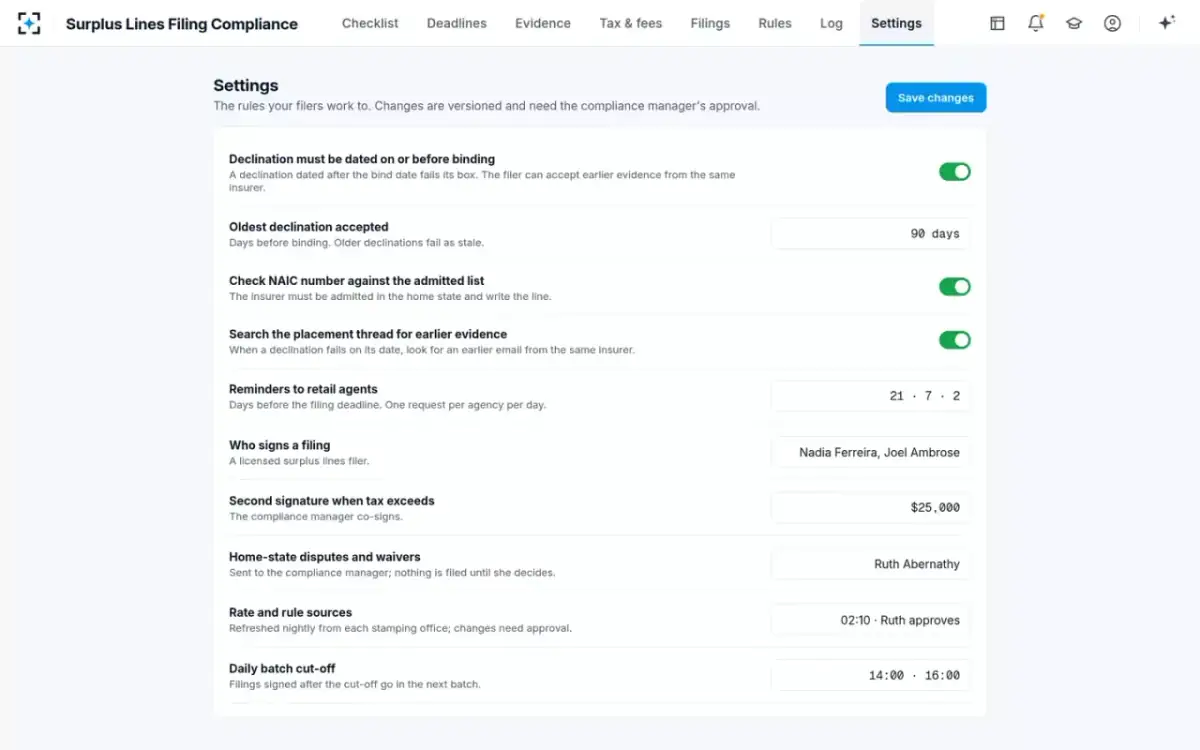
What the solution cannot do is decide how much admitted-market evidence your firm wants for the rate and form tests; that is a compliance decision, and it belongs in the settings with a named approver. The agents then apply it to every Florida placement and cite what they found. Who checks and who signs in a diligent search sets out that division of labour for the states where a search is still required.
Florida filings on their own calendar
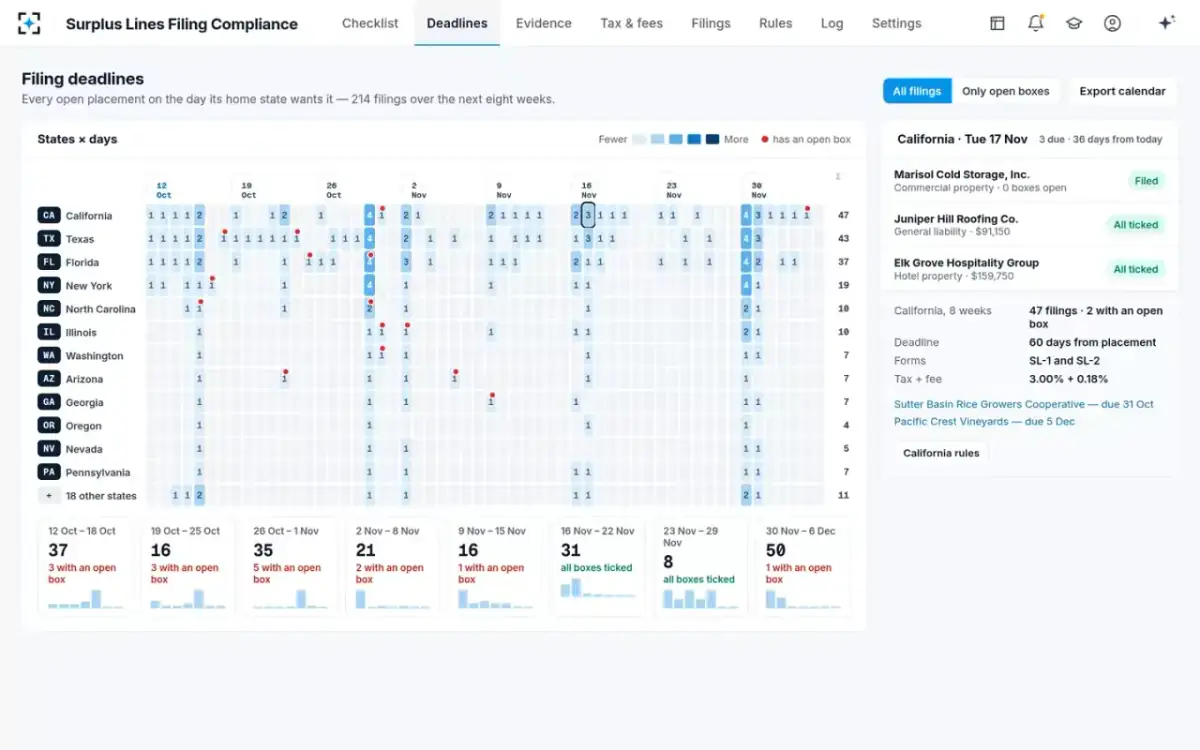
To see how the rule settings work on your own Florida book, start from Surplus Lines Filing Compliance.
Questions people ask
Does Florida still require three declinations for surplus lines?
No statute requires them since 1 July 2025, when Chapter 2025-145 deleted the definition of diligent effort in § 626.914(4) and the export condition in § 626.916(1)(a). The quarterly affidavit still reports efforts made with authorized insurers, and the Service Office's manual binds agents, so check its current edition before dropping a step.
What is diligent effort in Florida surplus lines?
Until 30 June 2025 it meant seeking coverage from, and being rejected by, at least three authorized insurers currently writing the coverage, with the rejections documented, or one rejection for a dwelling with a replacement cost of $700,000 or more. The term is no longer defined in Florida's Surplus Lines Law.
When did the Florida surplus lines diligent effort change take effect?
On 1 July 2025. The governor approved Chapter 2025-145, CS/HB 1549, on 13 June 2025, and the act took effect on 1 July. Business placed in the second quarter of 2025 was placed under the old rule; the third quarter, ending 30 September, was the first full quarter under the new one.
What fee can a Florida surplus lines agent charge?
A reasonable per-policy fee for each policy certified for export, itemized separately to the customer before purchase and stated in the policy; a retail agent may charge its own reasonable per-policy fee, also itemized before purchase. The filing agent's fee counts as premium, so the 4.94% tax applies to it.
Who is the Florida Surplus Lines Service Office?
A nonprofit association created by § 626.921, of which every Florida surplus lines agent is a member as a condition of the licence. It receives and reviews surplus lines documents, collects the tax and its own fee of up to 0.3% of premium, reconciles insurers' reports with agents' reports and reports unfiled policies to the department.
Can a Florida surplus lines policy be priced below admitted insurers?
No. The export rate may not be lower than the rate in actual and current use by a majority of authorized insurers for the same coverage on a similar risk, where such a rate exists, under § 626.916(1)(a). That condition was in the statute before 2025 and was not changed by the repeal of diligent effort.