To determine the home state for surplus lines taxes, apply the federal definition in 15 U.S.C. § 8206(6): the home state is the state where the insured maintains its principal place of business, or for an individual the principal residence; if 100 percent of the insured risk is outside that state, it is the state to which the greatest share of the policy's taxable premium is allocated; and where several affiliated companies are named insureds, it is the home state of the member with the largest share of premium. Only that state may tax the policy, so the answer decides where every dollar of tax and fee goes. The test sounds mechanical, but each step rests on a judgment about the insured that has to be evidenced, and the expensive errors come from groups, from risks almost but not entirely outside the head-office state, and from assuming a group's address is every member's. Botminds' Surplus Lines Filing Compliance applies the federal test placement by placement, shows its working on the checklist, and holds any placement with two plausible home states for the compliance manager instead of choosing.
The worked cases come from a fictional sample wholesale broker in the solution; the New York case is a real consent order of the state's Department of Financial Services, published in September 2026, and is linked where used.
The home-state test for surplus lines tax, in four questions
1Is more than one insured from an affiliated group named on the contract?
YesFind each member's home state by the tests below; the home state is that of the member with the largest share of the premium.
NoGo on with the one insured.
§ 8206(6)(B)
2Is the insured an individual?
YesStart from the state of the individual's principal residence.
NoStart from the state where it maintains its principal place of business.
§ 8206(6)(A)(i)
3Is 100 percent of the insured risk located outside that state?
YesThe home state is the state to which the greatest percentage of the taxable premium for this contract is allocated.
NoThat state is the home state, however much of the risk sits elsewhere.
§ 8206(6)(A)(ii)
4Is the insured a group of unaffiliated members, such as a purchasing group?
YesCheck the home state's own group rule: in New York and Illinois, who paid the premium decides whether each member's home state applies.
NoThe answer above stands.
State law
What is the home state for surplus lines tax purposes?
It is the one state that federal law lets tax and regulate the placement, defined in the Nonadmitted and Reinsurance Reform Act. For a single insured the home state is “the State in which an insured maintains its principal place of business or, in the case of an individual, the individual’s principal residence; or (ii) if 100 percent of the insured risk is located out of the State referred to in clause (i), the State to which the greatest percentage of the insured’s taxable premium for that insurance contract is allocated” (15 U.S.C. § 8206(6)(A)). The tax consequence follows from § 8201(a): no other state may require premium tax on the policy (§ 8201(a)).
States wrote the same test into their own codes, often word for word. Texas defines home state for its surplus lines tax as the principal residence or principal place of business, or, if 100 percent of the risk is outside that state, “the state to which the largest percentage of the insured's taxable premium for the insurance contract that covers the risk is allocated” (Tex. Ins. Code § 225.001(4)), and its chapter applies only where Texas is the home state. The NAIC's model act adopts the federal definition and then flags its gap: “The NRRA definition does not expressly cover unaffiliated groups. States have taken different approaches to the taxation of unaffiliated group policies” (Model #870, § 3J drafting note). Groups are where the states part company.
What if 100 percent of the risk is outside the home state?
Then, and only then, premium allocation decides. The words are strict: 100 percent, not most. An insured whose head office is in one state and whose risk is 99% in another still has the head-office state as its home state, because the second limb never opens. That makes the principal place of business the real question in most hard cases, not the allocation.
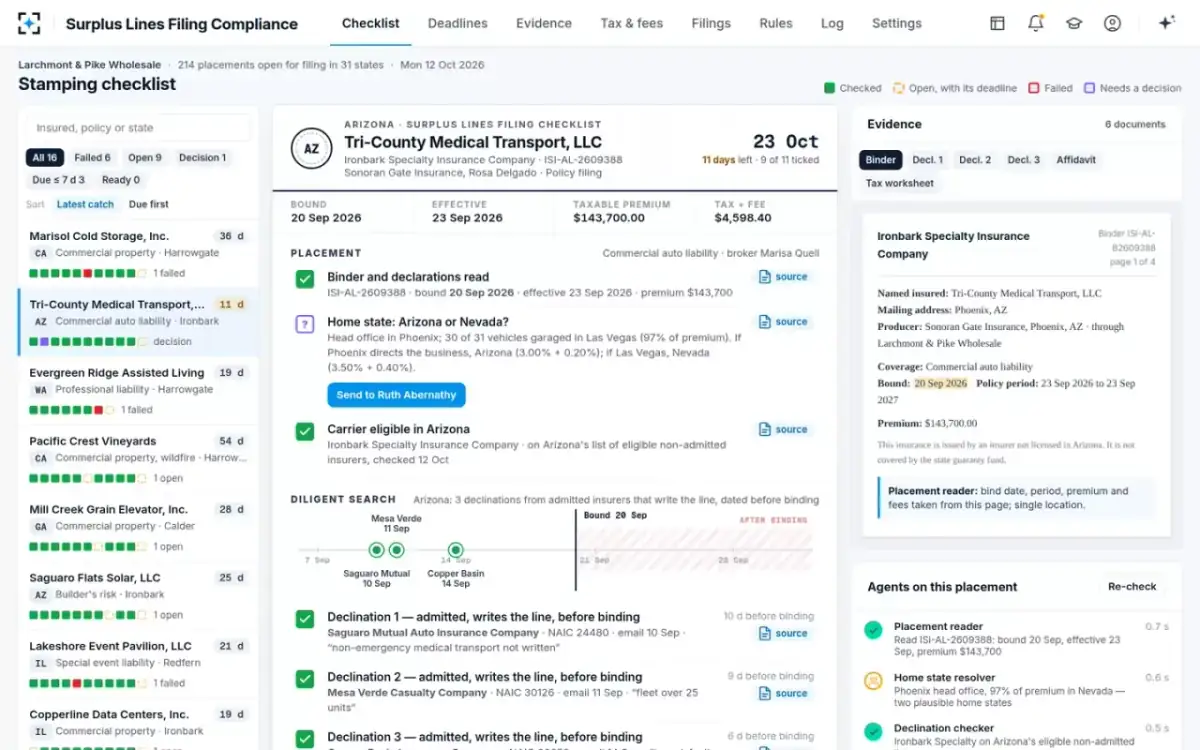
The solution's sample shows how close cases arrive. Tri-County Medical Transport has its head office in Phoenix, but 30 of its 31 vehicles are garaged in Las Vegas, carrying 97% of the premium. If any insured exposure, the 31st vehicle or the Phoenix office itself, sits in Arizona, the risk is not 100 percent outside Arizona and the allocation limb never opens; if Phoenix were not the principal place of business at all, Nevada would be the starting state anyway. Either way the case turns on where the company's principal place of business really is: if the business is directed from Phoenix, the home state is Arizona; if it is in substance run from Las Vegas, it is Nevada. That is a judgment about how the business is run, which is why the home state resolver holds the placement with both answers, each with its tax, for the compliance manager to decide.
Two plausible home states: held for a person, both answers on the screen
What is the home state for an affiliated group?
The home state of the member with the largest share of the premium. Where “more than 1 insured from an affiliated group are named insureds on a single nonadmitted insurance contract”, the home state is the home state, found by the single-insured test, “of the member of the affiliated group that has the largest percentage of premium attributed to it under such insurance contract” (§ 8206(6)(B)). Affiliation means control: owning or controlling 25 percent or more of any class of voting securities, or controlling the election of a majority of directors (§ 8206(4)).
Two practical consequences follow. The premium has to be attributed to members before the home state can be known, so a policy that prices a group as one schedule needs an allocation in the file. And the parent's head office may not decide: where a parent and a subsidiary are both named insureds and the subsidiary carries most of the premium, the home state is the subsidiary's, found from its own principal place of business.
How is home state determined for a risk purchasing group?
Not by the federal affiliated-group rule, because purchasing group members are not affiliates; the answer comes from the home state's own law, and it can turn on who paid the premium. New York's Department of Financial Services applied its rule in a September 2026 consent order. A broker had placed group professional liability policies for a risk purchasing group “headquartered and operating in California” from 2016 to 2020, and some members were New York residents. The Department found that because the group “did not pay 100% of the premiums for the Policies from its own funds”, the home state of the members was determined by their principal residences, “making New York the home state of group members who were New York residents” under Insurance Law § 2101(x)(3) (DFS consent order, September 2026).
Two states' rules for groups that are not affiliated, side by side
New York (as applied in the 2026 order): The group did not pay 100% of the premium from its own funds.
Illinois (215 ILCS 5/445, captured April 2025): Individual members pay 100% of the premium from their own funds.
New York (as applied in the 2026 order): Each member's principal residence; New York for the New York members.
Illinois (215 ILCS 5/445, captured April 2025): Each member's own home state, and each member's coverage is treated as a separate contract.
New York (as applied in the 2026 order): The order does not address a group that pays all of the premium itself.
Illinois (215 ILCS 5/445, captured April 2025): The home state of the group.
New York (as applied in the 2026 order): Who paid, and each member's residence.
Illinois (215 ILCS 5/445, captured April 2025): Who paid, and each member's home state where members pay.
Illinois' text puts the same idea the other way round. For unaffiliated insureds on one contract, if “individual group members pay 100% of the premium for the insurance from their own funds”, each member's home state applies and each member's coverage is treated as a separate contract; otherwise the group's home state applies (215 ILCS 5/445(1), as captured). A file for any group placement therefore needs a detail that a property schedule never asks for: where the premium money came from.
The New York order in numbers: 1,829 member-years taxed in the wrong state
The broker's position, as the order records it, was that it had reported the premiums and paid tax to California because California was the purchasing group's home state. The Department's answer followed in the same finding:
However, with respect to the New York insureds, New York was their home state, and the premiums were reportable, and the taxes were due, to the Superintendent.
New York DFS consent order, September 2026, finding 13
What one wrong home-state assumption cost over five years
1,829
New York member-years insured under the group policies, 2016–2020
$2.67M
gross premium collected for the New York residents
$96,231
New York tax at 3.6%, paid on top of the California tax already paid
$60,000
penalties, which the broker may not recover from any insurance
New York residents insured under the group policies, by year
The cost did not stop at tax. Because New York was the home state, every New York-only obligation was missed as well: the order found that the broker had not submitted declarations pages or cover notes to the Excess Line Association of New York, had not filed the affidavits required for purchasing-group policies, and had not reported the premiums in its annual premium tax statements. A wrong home state is not one error; it is every filing in the right state, missed at once. What a defensible placement file holds works through the documents an examiner checks.
Can two states tax the same surplus lines policy?
Not lawfully, but a broker can end up paying two. Federal law forbids any state but the home state from requiring premium tax, and its definition of premium tax reaches fees and assessments as well as taxes, whenever a government body bases them on the premium (§ 8206(12)). In practice the wrong state simply receives what the broker sends it. In the New York order the broker paid New York in full and kept, by express exception, only the right to apply to California for a refund of the tax it had paid there (DFS consent order, paragraphs 21–22). Until that refund arrives, the same premium has been taxed twice and the broker has funded the difference.
What happens if surplus lines tax is paid to the wrong state?
The right state collects its tax, can add penalties, and may refuse to let the broker pass the cost on. New York's order required the broker not to “seek nor accept, directly or indirectly, reimbursement or indemnification with respect to payment of the tax and late penalty, including but not limited to, payment made pursuant to any insurance” (paragraph 22). An errors and omissions policy is no help with that part.
Illinois shows what documentation can be worth. In the text captured in April 2025, where the Director is satisfied that a producer “has made a documented good faith determination of the home state” and paid tax to another state, and the determination turns out wrong, the producer may be required to file the contract and pay Illinois' tax and recording fees, “but there shall be no penalty, interest, or late fee assessed” (215 ILCS 5/445(8)). The key word is documented: the safe harbour is open only to a broker that can show, after the fact, how it reached the answer at the time.
The tax difference between states makes the error two-sided. A policy taxed in California at 3% that belonged to Florida at 4.94% under-collected nearly two points of premium from the insured; the taxes and fees calculator guide works the same premium through five home states.
What evidence proves a home state?
Whatever would let a stranger reach the same answer two years later. The list below is what we would expect a careful file to hold for each placement, scaled to the case: one line for a single-site insured, several pages for a group.
Home-state evidence, placement by placement
- The insured's principal place of business, and why
The address on the application and declarations page, and for a doubtful case where officers direct the business from: the evidence that makes one office principal.
- For individuals, the principal residence
Not a mailing address or a second home that happens to hold the insured property.
- The location of the insured risk, by state
Enough to show whether 100 percent of it is outside the principal-place state; one vehicle, location or employee in that state settles it.
- If the second limb applies, the premium allocation
The taxable premium allocated to each state for this contract, and the largest share.
- For affiliated insureds, the structure and the premium split
Which named insureds are affiliated (25% voting control or board control) and the premium attributed to each.
- For purchasing groups, who paid and where members live
Whether the group paid all of the premium from its own funds; each paying member's home state where it did not.
- The date and author of the determination
The decision as made at placement, by a named person; Illinois' good-faith relief requires a documented determination.
- The re-check at renewal
A principal place of business can move. Illinois brought in the home-state rule policy by policy as each was effective, renewed or extended, and at a multiyear policy's anniversary, which ties the answer to each term.
How Surplus Lines Filing Compliance settles the home state
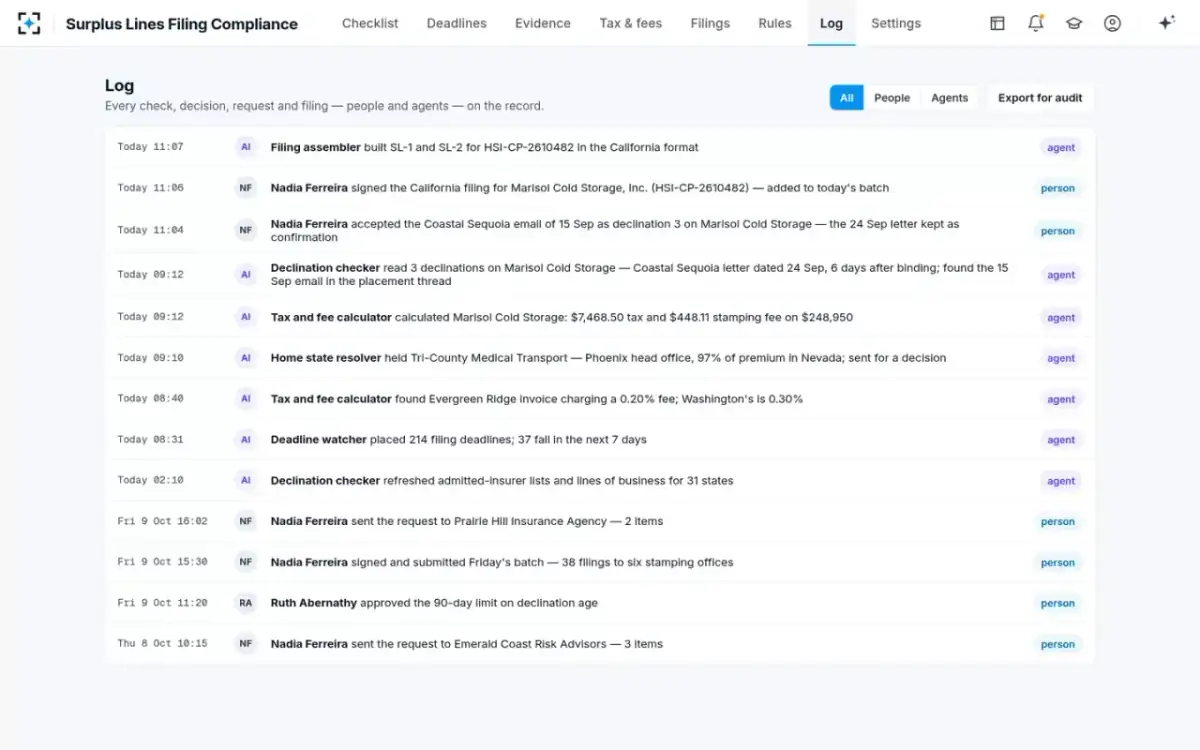
The home state resolver applies the federal test to each placement from the binder and the insured's details: principal place of business, or, if all of the risk sits outside that state, the state with the greatest share of taxable premium. Its two limits are written into it: it never decides when two states are plausible, and it never splits tax across states. For Marisol Cold Storage, the sample's Fresno business with a Reno warehouse holding 21.7% of its values, the checklist reads principal place of business Fresno, so California, and states that only California may tax the policy. For Tri-County, it stops.
Every home-state hold and decision on the log, with its time
What the solution does not do is make the principal-place-of-business judgment for you, or apply group rules a state has not written into the broker's settings; both are decisions with a named owner. To see the test applied to your own multi-state and group placements, start from Surplus Lines Filing Compliance, and for the rest of each state's rules see surplus lines filing requirements by state.
Questions people ask
How is home state defined under the NRRA?
In 15 U.S.C. § 8206(6): the state of the insured's principal place of business, or an individual's principal residence; if 100 percent of the insured risk is outside that state, the state to which the greatest percentage of the contract's taxable premium is allocated; and for several affiliated named insureds, the home state of the member with the largest share of premium.
What is the home state for an individual buying surplus lines insurance?
The state of the individual's principal residence, unless all of the insured risk is outside it, in which case premium allocation decides. A second home insured on a surplus lines policy in another state does not move the home state while the principal residence stays where it is.
Does the home state change if most of the risk is in another state?
No. The allocation test applies only when 100 percent of the insured risk is outside the principal-place-of-business state. A company headquartered in Arizona with 97% of its vehicles in Nevada still has Arizona as its home state if Arizona is truly where the business is run from.
How is home state determined for a risk purchasing group?
By the home state's own law, which often turns on who paid. New York's 2026 consent order treated members as having their own home states because the group did not pay all of the premium from its own funds; Illinois' text gives each member its own home state when members pay 100% of the premium themselves, and the group's otherwise.
What happens if surplus lines tax is paid to the wrong state?
The correct state collects its tax and may add penalties; in New York's 2026 case that was $96,230.99 of tax and $60,000 of penalties, with no recovery from insurance allowed. The broker's remedy for the tax paid to the wrong state is a refund claim there. Illinois waives penalty and interest where the broker made a documented good-faith determination.
Is the home state decided again at every renewal?
It should be, because the test applies to each contract and the insured's principal place of business can move. Illinois' statute, as captured in 2025, brought in the home-state rule for each policy as it was effective, renewed or extended on or after 21 July 2011, and for multiyear policies at the first anniversary after that date, so each term carries its own answer.