A surplus lines taxes and fees calculator works out three things for one placement: the taxable premium, the home state's premium tax on it, and the stamping or service fee and any other charge the same state levies. The arithmetic is one multiplication and an addition. The difficulty is upstream: only the insured's home state may tax the policy, each state defines premium differently, so a $350 inspection fee is taxed in Florida and excluded in Illinois, rates change with the policy's effective date, and the fee is set by a different body from the tax. A calculator that takes the home state and the premium as given will be exactly right about the wrong number. Botminds' Surplus Lines Filing Compliance calculates at the placement, from the binder and invoice, after the home state is settled, and checks the invoice against its own figure before a licensed filer signs.
The worked figures use one fictional sample placement: Marisol Cold Storage, a Fresno business whose commercial property policy was bound in September 2026 at a premium of $248,600 plus a $350 inspection fee. Rates and rules are from each state's statute, linked where used.
What a surplus lines taxes and fees calculator adds up
Taxable premium
gross premium + fees the state counts as premium − return premium
Florida and Texas count policy and inspection fees; Illinois, as captured in 2025, excludes every fee.
Home state's definition of premium
Premium tax
taxable premium × home-state rate
One state only: the insured's home state. Five rates in this guide run from 3% to 4.94%.
State statute
Stamping or service fee
gross premium × office fee rate
Set by a department or office within a statutory ceiling, such as 0.75% in Texas and 0.3% in Florida.
Filing office, under the statute
Other state charges
per the home state
For example Illinois' fire marshal tax on fire premiums; most states have none.
State statute
How do you calculate surplus lines tax?
Find the home state, build the taxable premium by that state's definition, multiply by that state's rate, then add the fee and any other charge, each rounded as the state rounds. In that order, because each step depends on the one before. The rate is the only input that is the same for every placement in a state, which is why rate tables get the attention and still produce wrong answers.
The steps, as a working routine:
- Settle the home state. Usually the state of the insured's principal place of business; the federal definition and its exceptions are in how to determine home state for surplus lines taxes.
- Read the premium and every fee from the invoice and the declarations page, including return premium on endorsements and cancellations.
- Apply that state's definition of premium to decide which fees join the base.
- Apply the rate in force for the policy's effective date, not today's: Illinois' statute, for instance, keeps 3% for policies effective before 1 July 2003 and 3.5% from that date.
- Add the stamping or service fee at the rate the office has set, and any other state charge.
- Compare with what the invoice charged, because the insured pays what the invoice says and the broker owes what the statute says.
Which state gets the surplus lines tax on a multistate policy?
Only the insured's home state: federal law bars every other state from requiring premium tax on a nonadmitted policy (15 U.S.C. § 8201(a)). Congress allowed the states to share the money among themselves by compact (§ 8201(b)), but the insured pays one state, and the home state commonly taxes the whole premium. Texas computes the tax “on the entire policy premium for any policy in which this state is the home state of the insured” unless it has joined an allocation agreement (Tex. Ins. Code § 225.004(c)); Florida taxes the gross premium of a policy only partly in Florida when Florida is the home state, while asking the agent to report the in-state and out-of-state premium separately (Fla. Stat. § 626.932(3)).
The federal definition of the tax is wide. A premium tax is “any tax, fee, assessment, or other charge imposed by a government entity directly or indirectly based on any payment made as consideration for an insurance contract” (§ 8206(12)). Read with § 8201(a), that is why a second state's fee on the same policy is as unlawful as a second state's tax. There are narrow exclusions inside a state's own law too: Texas does not tax premium properly allocated to federal or international waters, or ocean marine cover of baled cotton stored or in transit for export (§ 225.004(e), (g)).
What counts as premium? Three states, three answers
Each state writes its own definition, and they disagree about fees. Florida includes them: premium “includes any assessment, or any membership, policy, survey, inspection, service, or similar fee or charge in consideration for an insurance contract”, and names the filing agent's per-policy fee as premium, while excluding the Service Office's own fee (§ 626.932(6)). Texas defines premium as “any payment made in consideration for insurance” and lists premium deposits, membership and registration fees, assessments, dues and “any other compensation given in consideration for surplus lines insurance” (§ 225.001(5)).
Illinois, in the text captured in April 2025, goes the other way: premium is the amount designated as premium on the declarations page, policy or endorsement, “but does not include taxes, the Surplus Line Association of Illinois recording fee, or any other fee” (215 ILCS 5/445(1)). California taxes “gross premiums charged less return premiums” (Cal. Ins. Code § 1775.5(a)) without a fee list in that section, so how a California broker treats a fee is a question to settle with the state's guidance and write down.
The same $350 inspection fee, in three definitions of premium
| Home state | What the statute says premium includes | Is the $350 fee taxed? |
|---|---|---|
| Florida | Assessments and membership, policy, survey, inspection, service or similar fees; the filing agent's per-policy fee; not the Service Office fee | Yes: named in § 626.932(6) |
| Texas | Any payment in consideration for insurance, including deposits, membership and registration fees, assessments, dues and other compensation | Yes, if it is paid in consideration for the insurance |
| Illinois (captured April 2025) | The amount designated as premium; not taxes, the association's recording fee or any other fee | No |
One premium, five home states: a worked surplus lines tax calculation
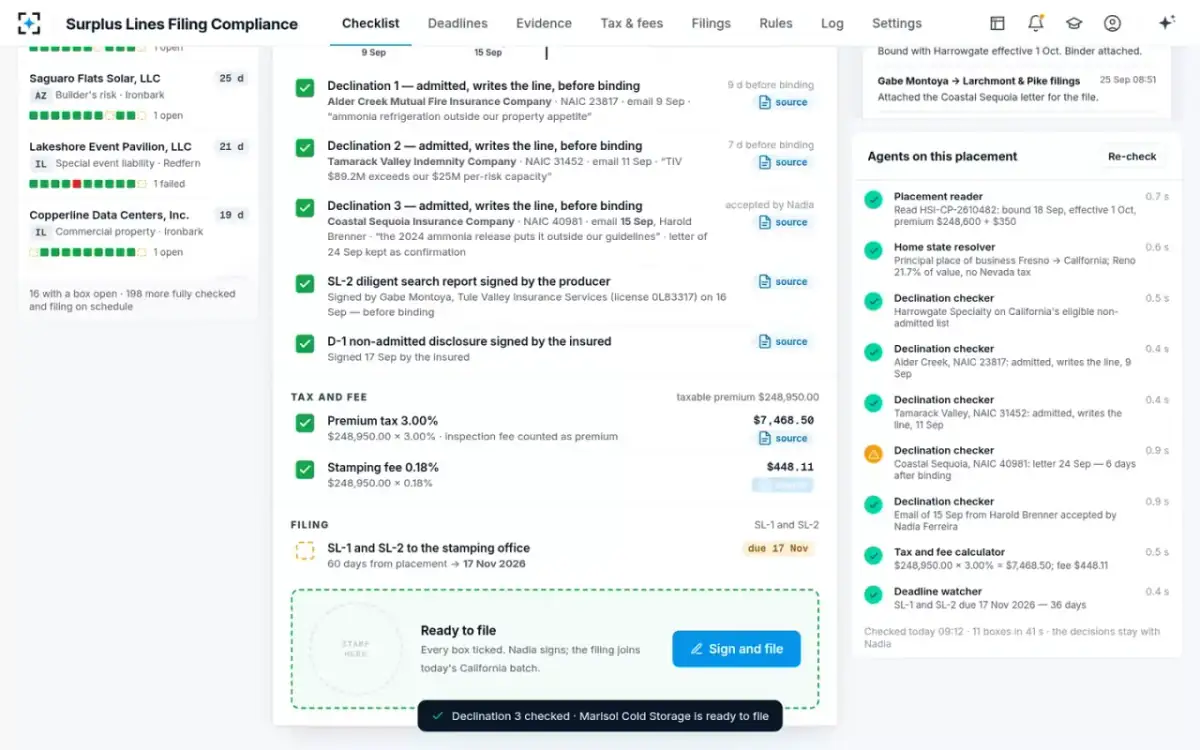
Take the sample placement and change only its home state. In the solution Marisol Cold Storage's home state is California, so the real answer is the first row: $248,950 of taxable premium, counting the inspection fee as the sample broker's California settings do, at 3%, or $7,468.50 of tax. The other rows are what the same policy would owe if the insured's principal place of business were in another state.
Premium tax on one $248,600 policy with a $350 inspection fee, by home state
| Home state | Taxable premium | Rate | Premium tax | Fee ceiling in the statute |
|---|---|---|---|---|
| California (the sample's actual home state) | $248,950.00 | 3.00% | $7,468.50 | None in § 1775.5 |
| Illinois (captured April 2025) | $248,600.00 (fee excluded) | 3.50% | $8,701.00 | Recording fee set by the association |
| New York | $248,600.00 (premium only; check fee treatment) | 3.60% | $8,949.60 | Set by the excess line association |
| Texas | $248,950.00 | 4.85% | $12,074.08 (half a cent rounded up) | Stamping fee up to 0.75%: at most $1,867.13 |
| Florida | $248,950.00 | 4.94% | $12,298.13 | Service fee up to 0.3%: at most $746.85 |
The same policy owes $4,830 more tax with a Florida home state than a California one
The spread is the argument for putting the home state first. A filer who taxes this policy in California when its home state is Florida has under-collected $4,829.63 from the insured, owes it to Florida anyway, and has paid California money it must now ask to have back. New York's 2026 consent order against an excess line broker shows how that ends: having reported and paid tax on the premium in California, the broker paid New York its 3.6% on the same premium, $96,230.99, plus $60,000 in penalties, and the order preserves only its right to seek a refund from California (DFS consent order, September 2026).
Is the stamping fee part of the surplus lines tax?
No. It is a separate charge, set by a different body and paid to the filing office, but it is collected from the insured in the same way. Texas lets its stamping office collect a fee “to be paid by the insured and determined by the department in an amount not to exceed three-fourths of one percent of gross premium” (Tex. Ins. Code § 981.154(b)(5)). Florida's Service Office fee is “up to 0.3 percent, as determined by the office”, and “The service fee shall be paid by the insured” (Fla. Stat. § 626.921(3)(f)); Florida keeps it out of the premium that is taxed. Illinois lets producers charge the association's recording fee to the insured (215 ILCS 5/445(3)(c)).
The NAIC model describes the same arrangement: the association's services are funded by a stamping fee on each premium-bearing document, set by its board from time to time and paid by the insured (Model #870). Because the board or office can change the rate without a change in statute, a calculator should keep the fee rate apart from the tax rate, with its own source and date.
Who pays surplus lines tax, the broker or the insured?
The insured bears it and the broker owes it. In Florida and Texas the agent collects the tax from the insured on delivery of the policy or confirmation and may neither absorb nor rebate it (§ 626.932(1); Tex. Ins. Code §§ 225.006(a), 225.010). But the liability to the state is the licensee's. Texas says the agent “holds taxes collected under this chapter in trust”, and an agent who does not pay by the due date, or who uses any of the tax, “commits the offense of theft” (§§ 225.007, 225.013).
The same logic runs through California, where each broker pays the tax on its own business and a late payment draws a 10% penalty plus 1% interest a month (§ 1775.5(a), (c)), and New York, where the excess line broker pays 3.6% for premiums of New York home-state insureds with its annual premium tax statement. Texas adds one twist that a calculator must know: if the agent places through a managing underwriter, the managing underwriter collects, reports and pays the tax, unless the two agree in writing, at or before binding, that the agent will (§ 225.006(b)–(c)).
When is surplus lines tax due in each state?
On five different calendars, which is why the same calculator output feeds different remittance runs.
When the tax is paid, and what lateness costs, in five home states
When it is paid: Annually, by 1 March, on the previous calendar year's business (§ 1775.5(a)).
What happens if it is late: 10% penalty plus 1% a month from 1 March; 25% added where late payment was due to fraud (§ 1775.5(c)–(d)).
When it is paid: By 1 March with the tax report; prepaid by the 15th of the next month once accrued tax reaches $70,000 (§§ 225.008–225.009).
What happens if it is late: Non-payment by the due date is theft under § 225.013; if the agent's business fails, the state is a preferred creditor for the tax (§ 225.012).
When it is paid: Quarterly, with the affidavit, by the 45th day after the quarter (§§ 626.931(1), 626.932(2)).
What happens if it is late: Interest at 9% a year, compounded annually, from the day it is delinquent (§ 626.932(2)(b)).
When it is paid: With the annual premium tax statement, by 15 March of the following year (DFS consent order, 2026).
What happens if it is late: Tax and penalties under Insurance Law § 9109, as in the 2026 consent order: $60,000 on $96,230.99 of tax.
When it is paid: Twice a year, by 1 February and 1 August, for the previous six months (445(3)(a), captured 2025).
What happens if it is late: Late fees, penalty and interest under § 412 of the Illinois Insurance Code.
The inputs that make a surplus lines tax calculator wrong
Almost every wrong answer comes from an input, not from the multiplication. The list below is the set a buyer should test any calculator against, and the set a filer should check by hand when a figure looks odd.
Eight inputs to test before trusting a surplus lines tax figure
- The home state
The largest error by far: the whole tax goes to the wrong state. A calculator should show which test it applied and stop when two states are plausible.
- Fees in or out of premium
Florida and Texas tax policy and inspection fees; Illinois, as captured, does not. The same invoice gives different bases.
- Return premium
California taxes gross premiums less return premiums; Illinois nets returned taxable premiums each half-year.
- Cancelled and rewritten policies
In Texas the taxable additional premium on a rewrite is only the amount above the unearned premium of the cancelled contract (§ 225.011).
- The rate for the effective date
A rate change applies by effective date; Illinois' text still distinguishes policies effective before 1 July 2003.
- Excluded risks
Florida's tax section does not apply to vessels, cargo and aircraft written under § 626.917; Texas excludes premium allocated to federal or international waters.
- Who owes it
In Texas a managing underwriter owes the tax unless a written agreement made at or before binding puts it on the agent.
- Rounding
At 4.85% a round premium can land on half a cent. Apply the state's rule, per policy, and keep it the same on the invoice and the return.
What to look for in a surplus lines taxes and fees calculator
A good calculator shows its working: the home-state test it applied, the premium definition, the rate with its source and date, the fee with its own source, and the rounding. The test of one is simple. Give it a quarter of closed placements, including a multi-state risk, a policy with an inspection fee, a cancellation and rewrite and a mid-term return premium, and compare its figures with what was actually remitted; a pilot on last quarter's filings sets out how to run that test and what to count.
The tax and fee calculator in Surplus Lines Filing Compliance works that way. It applies the home state's tax, fee and any other charge to the taxable premium read from the binder and invoice, rounds as the state does, checks the invoice against its figure and flags a fee charged at a rate other than the one in the broker's settings. Its limits are written into it: it never files, and it does not choose a home state. The home state resolver either settles the state on the federal test or holds the placement for the compliance manager with both answers and their tax.
Tax and fee on the checklist, each with its working
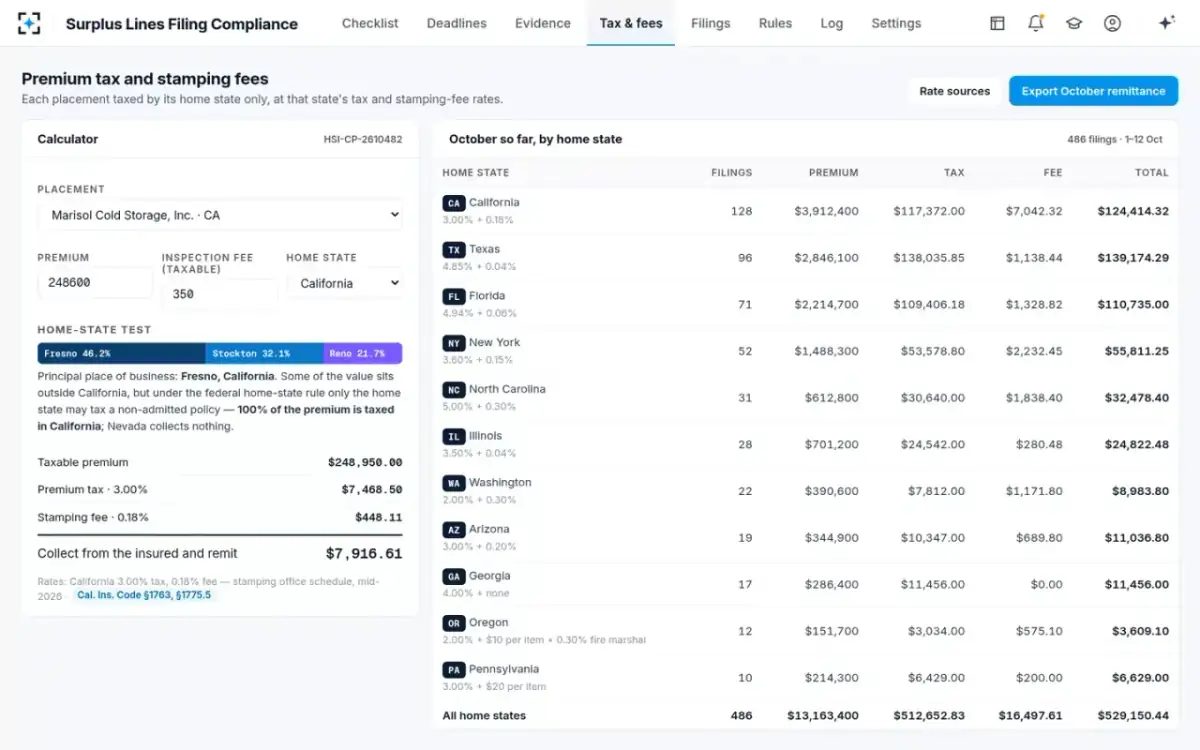
The month's tax and fees by home state, ready to export
What the solution does not replace is the tax return itself: the annual or quarterly statement each state requires is still filed by the licensee. To see the calculator on your own placements, start from Surplus Lines Filing Compliance; for Florida's tax and fee rules in detail, see Florida surplus lines after the 2025 changes.
Questions people ask
What is the surplus lines tax rate in Texas?
4.85% of gross premiums under Insurance Code § 225.004(a), on policies where Texas is the insured's home state. The Surplus Lines Stamping Office of Texas also collects a stamping fee, set by the department at no more than 0.75% of gross premium and paid by the insured.
What is the surplus lines tax rate in California?
3% of gross premiums charged less return premiums, under Insurance Code § 1775.5(a). The broker pays it once a year, by 1 March, on the previous calendar year's business, and a late payment draws a 10% penalty plus 1% interest a month.
What is the Florida surplus lines tax?
A premium receipts tax of 4.94% of gross premium under § 626.932(1), collected from the insured when the policy or confirmation is delivered and remitted quarterly. Policy and inspection fees count as premium; the Service Office's own fee, up to 0.3%, does not.
Do return premiums reduce surplus lines tax?
Generally yes, by the home state's method. California taxes gross premiums less return premiums and lets a broker carry forward or recover tax where returns exceed premiums in a year; Illinois nets returned taxable premiums in each half-year report; Texas taxes only the excess over unearned premium when a policy is cancelled and rewritten.
Can two states charge surplus lines tax on the same policy?
Not lawfully. Federal law lets only the insured's home state require premium tax on a nonadmitted policy, and its definition of premium tax covers fees and assessments based on premium. When tax is paid to the wrong state, the right state still collects; the broker's remedy is a refund claim against the other.
Is the surplus lines tax calculated on the premium or the total invoice?
On the premium as the home state defines it, which may include some invoice fees and never includes the tax itself. Florida adds policy, inspection and similar fees to premium, Texas includes registration and membership fees and other compensation, and Illinois, as captured in 2025, excludes every fee.