Surplus lines requirements by state come down to four questions asked of one state per placement, the insured's home state: must the broker show a diligent search of the admitted market, and who is excused; which office receives the filing and by what day; what tax and fee are due, and when; and what the file must keep. Federal law has made the home state's answers the only ones that count since July 2011, but the answers themselves differ widely: California treats three declinations as prima facie proof of a search, Florida deleted its declination rule in 2025, Texas starts its 60-day clock from the later of two dates, and New York's text already carries a shorter clock from 2029. A wholesale broker filing in dozens of home states works to that many rulebooks, and a wrong cell in its own table becomes a late filing or a tax paid to the wrong state. Botminds' Surplus Lines Filing Compliance holds each home state's rules as sourced settings and checks every placement against them before a licensed filer signs.
The examples on the product screens below come from a fictional sample wholesale broker. The rules come from each state's own statute text, linked where they are used; where a text was read from an older capture, the caption says so.
One placement, one rulebook: the federal frame in four numbers
1
state may require premium tax on a nonadmitted policy: the insured's home state
3
declinations: prima facie proof of a search in California, the default count in New York
60days
to file in California and in Texas, counted from different events
4.94%
Florida's tax on gross premium, the highest of the five states compared here
Why does only one state's rulebook apply to a surplus lines placement?
Because the Nonadmitted and Reinsurance Reform Act of 2010 says so in two short sentences. For tax: “No State other than the home State of an insured may require any premium tax payment for nonadmitted insurance” (15 U.S.C. § 8201(a)). For everything else: “the placement of nonadmitted insurance shall be subject to the statutory and regulatory requirements solely of the insured’s home State” (§ 8202(a)). Any other state's law that “applies or purports to apply” to a placement for an insured whose home state is elsewhere is preempted (§ 8202(c)).
The same section moves licensing to the home state. No state other than the home state “may require a surplus lines broker to be licensed in order to sell, solicit, or negotiate nonadmitted insurance with respect to such insured” (§ 8202(b)). The licence itself, and how a wholesaler holds one, is covered in the guide to wholesale brokers and MGAs. One carve-out matters to every rule table: the section does not preempt state law that restricts placing workers' compensation, or excess cover for self-funded workers' compensation plans, with a nonadmitted insurer (§ 8202(d)).
The practical result is a different shape of compliance from the one before 2011. A property schedule spread over six states is still one filing with one state, and Texas and Florida, for example, tax the whole premium when they are the home state (Tex. Ins. Code § 225.004(c); Fla. Stat. § 626.932(3)). The work moves to deciding that state correctly, which the federal definition settles for most insureds and leaves open for some; how to determine the home state, and prove it works through the hard cases, including a 2026 New York order against a broker that taxed in the wrong one.
Surplus lines requirements by state: five home states side by side
The table compares the five home states whose statutes a multi-state filer meets most often in the sample book: California, Texas, Florida, New York and Illinois. Each cell paraphrases the statute; the quotations that matter are in the sections below. Read across a row and the differences are larger than most rate sheets suggest.
Five home states, four questions: what the statute asks of each placement
| Home state | Diligent search | Filing: where and when | Tax and when it is paid |
|---|---|---|---|
| California | Search among admitted insurers that actually write the type of insurance in the state; three declinations, or proof that fewer than three write it, is prima facie evidence. Form signed by a licensed person. | Written report with the declarations page or binder to the commissioner or designee within 60 days of placing. | 3% of gross premiums less return premiums, paid by the broker each year by 1 March. |
| Texas | Diligent effort with insurers authorized to write and actually writing that kind and class of insurance; no number of declinations in the statute. | Policy, or the certificate or cover note, to the Surplus Lines Stamping Office of Texas by the 60th day after the later of the effective or issue date. | 4.85% of gross premiums, due 1 March; once accrued tax reaches $70,000 it is prepaid by the 15th of the next month. |
| Florida | No diligent-effort condition since 1 July 2025; export still needs the rate, form and deductible conditions and a signed disclosure. | Each policy reported to the Florida Surplus Lines Service Office under its plan of operation; quarterly affidavit by the 45th day after the quarter. | 4.94% of gross premiums, collected from the insured at delivery and remitted quarterly with the affidavit. |
| New York | Diligent effort; three declinations unless the superintendent sets another number after a hearing. | Declarations page or cover note to the excess line association within 45 days after the policy is procured (text in force until 1 July 2029). | 3.6% of gross premiums where New York is the home state, paid with the annual premium tax statement. |
| Illinois | Diligent effort, with exceptions for exempt commercial purchasers, commercial risks referred by an unaffiliated Illinois producer, and master policies and programs searched once a year. | Every contract and premium-bearing endorsement to the Surplus Line Association of Illinois for recording before delivery. | 3.5% for policies effective from 1 July 2003, reported and paid by 1 February and 1 August. |
Two columns hide most of the risk. The diligent-search column decides whether a placement was lawful at all; the filing column decides whether a lawful placement was reported in time. The tax column, the one every rate table prints, is the easiest to get right once the home state is right, which is why a taxes and fees calculator is only as good as the home-state answer it starts from.
How many declinations are required for surplus lines?
There is no national number: it is whatever the home state's statute says, and of the five states above only New York fixes a count. California makes three declinations evidence, not a rule. The search is presumed when the filed form “establishes that three admitted insurers that actually write the particular type of insurance in this state have declined the risk, or that fewer than three admitted insurers actually write the particular type of insurance” (Cal. Ins. Code § 1763(b)). A file with two declinations and a good explanation can still show a diligent search; a file with three from insurers that do not write the line shows nothing.
New York does fix the number. The declinations that make up diligent effort “shall be three, unless the superintendent after a hearing, on a record” sets another (N.Y. Ins. Law § 2118(a)(4), read from the Senate's published text). Texas sets no number at all: surplus lines may be written only if the full amount “cannot be obtained, after a diligent effort, from an insurer authorized to write and actually writing that kind and class of insurance in this state” (Tex. Ins. Code § 981.004(a)(1)). Illinois also speaks of diligent effort without a count. Florida, until 30 June 2025, defined diligent effort as rejection by at least three authorized insurers, or one for a dwelling with a replacement cost of $700,000 or more; what Florida changed on 1 July 2025 follows the repeal and what the file still needs.
The NAIC's model act states the variety plainly in a drafting note: “Diligent search statutes and regulations vary from state to state in terms of the number of declinations required and the person designated to conduct the search” (NAIC Nonadmitted Insurance Model Act #870). What the states share is the qualifier. California, Texas and New York all count only insurers that actually write the coverage in the state, so a declination can fail without being missing: one from an insurer that does not write the coverage in the state counts for nothing.
Which states require a diligent search, and who is excused?
Four of the five states require a search in some form; Florida no longer does. Every state must also honour one federal exception. A broker placing for an exempt commercial purchaser “shall not be required to satisfy any State requirement to make a due diligence search” if it has told the purchaser that the cover may be available from admitted insurers offering more protection and oversight, and the purchaser has then asked in writing for the nonadmitted placement (15 U.S.C. § 8205).
The exempt purchaser is defined by size and sophistication. It employs or retains a qualified risk manager, paid more than $100,000 in nationwide commercial property and casualty premiums in the previous twelve months, and meets one more test: net worth over $20 million, revenue over $50 million, more than 500 employees (or 1,000 across an affiliated group), a nonprofit or public entity spending at least $30 million a year, or a municipality of more than 50,000 people (§ 8206(5)). The dollar tests are adjusted for inflation every five years, so the figures in a rule table must be the current adjusted ones, not the 2010 base.
States add their own exits. Texas excuses an “industrial insured” on similar disclosure and request terms, provided the insurer is rated A- or better by A. M. Best, and lifts the search for flood cover from insurers so rated (§ 981.004(d)–(e)); it also requires the agent to keep the evidence that the insured qualified (§ 981.215(a)(12)). California excuses a “commercial insured” as its own code defines it, on written disclosure and request (§ 1763(h)). Illinois, as captured in April 2025, lets a surplus line producer skip the search on a commercial risk referred by an Illinois-licensed producer that is not affiliated with it, and lets master policies and program business be searched once a year rather than insured by insured (215 ILCS 5/445(1.5)(f)–(h)).
What is the surplus lines filing deadline in Texas, New York and California?
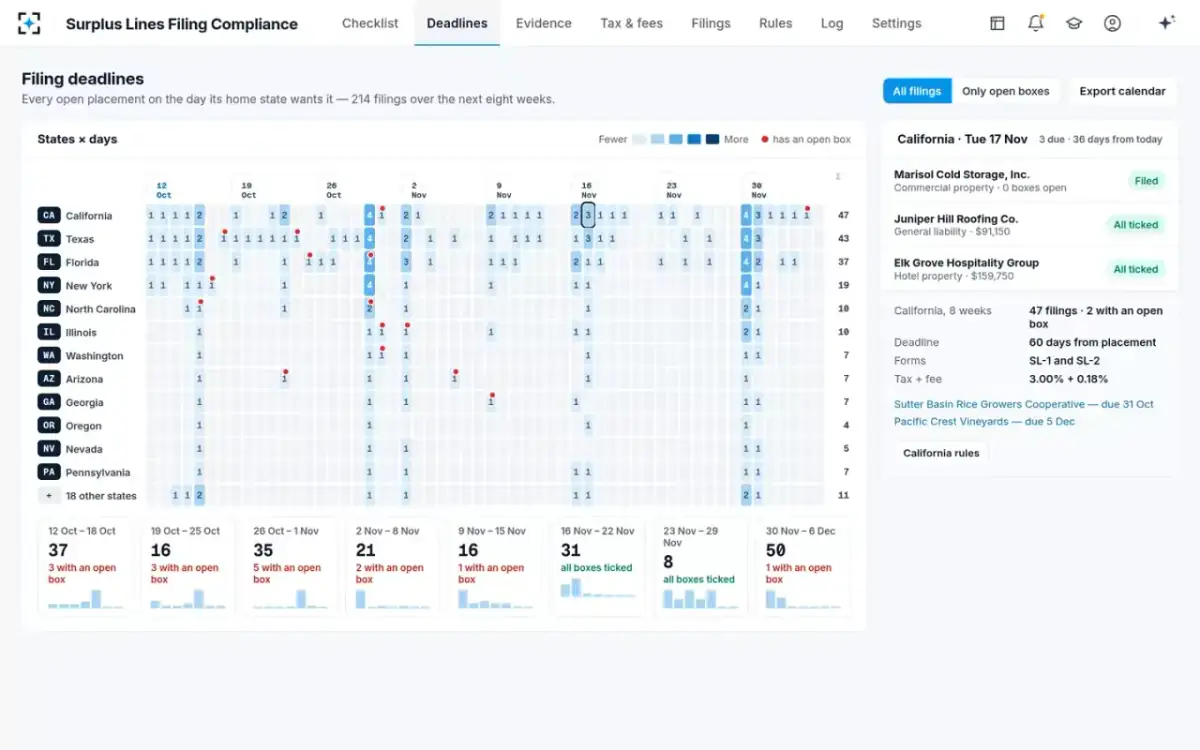
Texas and California both allow 60 days and New York allows 45, but the clocks start on different events, which is where most lateness comes from. California counts from placing the insurance (§ 1763(a)). Texas counts from whichever is later, the effective date or the issue date of the new or renewal insurance (§ 981.105(a)), and also wants every endorsement and substitute certificate filed promptly (§ 981.105(b)). New York counts from the day the policy is procured: “Within forty-five days after a policy is procured, a licensee shall submit the declarations page or cover note” (§ 2118(b)(1), text effective until 1 July 2029).
Filing clocks in four home states, in days, and the event each one counts from
New York's text is the one to calendar now. The Senate's published section carries two versions of the filing provisions: the 45-day submission to the excess line association, effective until 1 July 2029, and a version effective from that date under which statements are filed with the superintendent “within thirty days after such policies have been procured” (§ 2118(b)(4), 2029 version). A broker whose New York volume is filed at day 40 today has a process that fails on 1 July 2029 without any change on its side.
Florida and Illinois work differently again. Florida's agent files a quarterly affidavit by the 45th day after each calendar quarter, stating that all business was submitted to the Service Office (Fla. Stat. § 626.931(1)). Illinois ties the filing to delivery: as captured in 2025, it is unlawful for a producer to deliver a nonadmitted contract or premium-bearing endorsement “unless it contains evidence of recording by the Surplus Line Association of Illinois” (215 ILCS 5/445(6)). What being late costs, priced on Texas's fee ladder, is in the guide to surplus lines late filing fees.
Every filing on the day its home state wants it, in Surplus Lines Filing Compliance
Does every state have a surplus lines stamping office?
No. Some statutes create a filing office and name it; others leave the filing with the regulator. The NAIC model provides for an association that receives, records and stamps documents, funded by a stamping fee that “shall be paid by the insured” and set by the association's board (Model #870), but each state decides whether to have one. In the five states compared here, four statutes name the office:
- Texas makes the Surplus Lines Stamping Office of Texas a nonprofit association run under a plan of operation the commissioner approves. It collects a stamping fee set by the department of up to three-quarters of one percent of gross premium, paid by the insured, and it has no enforcement power: the subchapter “does not give the stamping office authority to enforce this chapter or Chapter 225” (§§ 981.151–981.160).
- Florida creates the Florida Surplus Lines Service Office as a nonprofit association of every surplus lines agent. It collects a service fee of up to 0.3% of gross premium, set by the Office of Insurance Regulation and paid by the insured, and it reconciles insurers' reports against agents' reports (Fla. Stat. § 626.921).
- New York sends declarations pages to the excess line association for recording and stamping (§ 2118(b)(1)); the Department of Financial Services' orders name it as the Excess Line Association of New York.
- Illinois sends every contract to the Surplus Line Association of Illinois, and treats the submission as the producer's certification that a diligent effort, where required, was made (215 ILCS 5/445(5)).
- California has the broker file “with the commissioner or his or her designee” (§ 1763(a)), so the statute itself names no office.
The office matters to compliance in two ways. Its plan of operation and manual set the working rules the statute leaves open, so a rule table built from statutes alone is incomplete for Florida and Texas. And its records are what the regulator reads: the Florida Service Office must report the details of any unfiled policy to the department straight away (§ 626.921(2)).
Surplus lines tax rates, and when each state wants the money
Rates in the five states run from 3% to 4.94% of gross premium, and the calendars differ more than the rates. California's broker pays once a year by 1 March on the previous year's business (§ 1775.5(a)). Texas wants the tax by 1 March too, but an agent whose accrued tax reaches $70,000 prepays by the 15th of the following month (Tex. Ins. Code §§ 225.008–225.009). Florida's agent collects at delivery and remits each quarter with the affidavit (§ 626.932(1)–(2)). New York's broker pays with the annual premium tax statement, due by 15 March according to the Department's 2026 consent order (DFS, September 2026), and Illinois' producer reports and pays twice a year.
Surplus lines premium tax in five home states, percent of gross premium
How do I keep up with surplus lines law changes?
By reading the statutes' history lines, not newsletters: each section records the act that last changed it, and the changes in this field arrive as sections of larger bills. Florida's repeal of diligent effort sat in Chapter 2025-145, a financial services act that also dealt with money services, credit unions and banks (Laws of Florida, ch. 2025-145); it was approved on 13 June 2025 and took effect on 1 July. Texas amended § 981.101, the section that sets what every surplus lines document must state, through S.B. 455 with effect from 1 September 2025, as the section's history line records. New York's 2029 version is already in the text.
Model-law trackers help less than they seem. The NAIC's own state page for Model #870 warns that the states themselves, and other readers, may not share the NAIC's view of whether a state adopted the model (NAIC, Model #870 state page, Summer 2025). How model laws travel into state codes, and why adoption maps lag, is in the guide to how states adopt NAIC model laws.
A change watch for a multi-state surplus lines rule table
- Date every cell
Each rule carries the statute section, the version read and the date it was read. An undated cell cannot be audited and cannot be refreshed.
- Read the history line of each section once a year
Florida §§ 626.914 and 626.916 both show "ch. 2025-145" at the end; that line is the alarm.
- Calendar versions with future effective dates
New York § 2118 already carries text effective 1 July 2029. Put the switch in the deadline engine now, with the date.
- Track the inflation-adjusted exempt purchaser thresholds
The federal dollar tests move every fifth 1 January; Texas sets its own by commissioner order (§ 981.0031(b)).
- Read the filing office's plan of operation and manual
Statutes in Florida and Texas leave filing procedures to the office's plan, so a statute-only table misses them.
- Route every rule change through one approver
A changed rate or deadline changes every open placement in that state; one named person approves it, with the source attached.
Where Surplus Lines Filing Compliance fits in a multi-state rule table
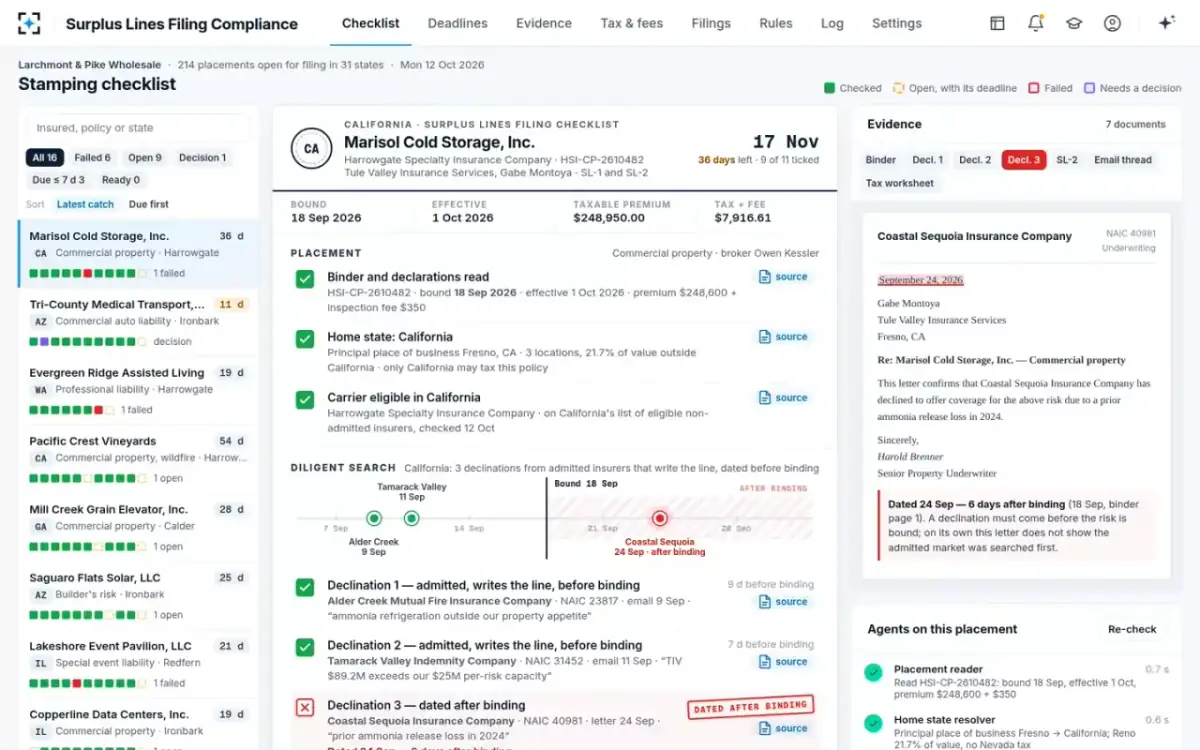
The solution keeps each home state's diligent-search rule, export list, tax, fee, deadline and forms as settings, each with its source, and its agents apply them placement by placement: the home state resolver applies the federal test, the declination checker reads each declination against the home state's admitted list, the tax and fee calculator works the figures, and the deadline watcher calendars the due date from the state's own starting event. Rule changes are versioned and need the compliance manager's approval, so a change like Florida's arrives as one approved edit rather than a filer's memory.
What it does not do is decide what a statute means. Where a rule is unsettled, such as which of two states is the home state, the agents hold the placement with both answers for a person. Take the fictional Marisol Cold Storage, a Fresno food-storage business with a Reno warehouse holding 21.7% of its values: California is its home state because its principal place of business is there, so the whole $248,950 taxable premium is California's to tax, and the checklist shows that reasoning beside the source.
One placement checked against its home state's rules
To see the rules applied to your own home states, start from Surplus Lines Filing Compliance.
Questions people ask
What are the surplus lines requirements by state?
They are the rules of the insured's home state, which federal law makes the only state that may regulate or tax the placement. In practice each home state answers four questions: whether a diligent search of admitted insurers is required and who is excused, where and by when the filing goes, what tax and fee are due, and what records must be kept. California, Texas, New York and Illinois all require a search in some form; Florida deleted its diligent-effort condition from 1 July 2025.
Do all states require three declinations for surplus lines?
No. New York fixes three unless the superintendent sets another number after a hearing. California treats three declinations from admitted insurers that write the line as prima facie evidence of a search, Texas and Illinois require a diligent effort without a count, and Florida no longer has a declination rule in its statute.
What is the surplus lines filing deadline in Texas?
The 60th day after the later of the policy's effective date or issue date, for new and renewal business, filed with the Surplus Lines Stamping Office of Texas under Insurance Code § 981.105(a). Endorsements and substitute certificates are filed promptly. A policy filed late draws a per-policy fee of $50, $100 or $200 depending on how late it is and the agent's late rate the year before.
How long do you have to file a surplus lines policy in New York?
Under the text of Insurance Law § 2118(b)(1) in force until 1 July 2029, the licensee submits the declarations page or cover note to the excess line association within 45 days after the policy is procured. The version of the section effective from 1 July 2029 has statements filed with the superintendent within thirty days after procurement, so a 45-day process needs changing before then.
Do surplus lines home-state rules apply to workers' compensation?
Not fully. The federal home-state section expressly does not preempt state laws that restrict placing workers' compensation insurance, or excess insurance for self-funded workers' compensation plans, with a nonadmitted insurer (15 U.S.C. § 8202(d)). Illinois, for example, bars procuring workers' compensation cover from an unauthorized insurer (215 ILCS 5/445(1.5)(d), as captured in 2025).
Which state's surplus lines rules apply if the risk is in several states?
Only the insured's home state, usually the state of its principal place of business. The other states where the risk sits can neither tax the premium nor apply their placement rules. The exception in the definition is when all of the insured risk lies outside that state: then the home state is the one to which the largest share of taxable premium is allocated.