Surplus lines audit requirements come from the insured's home state: what a surplus lines licensee must keep for each placement, for how long, who may inspect it, and which filings and tax statements must exist for every policy. Texas keeps the records open to the department without notice until three years after the contract ends; Illinois, in the text captured in 2025, for seven years from the policy's effective date. What examiners test is visible in the enforcement orders, and each names a document: a declarations page not submitted to the excess line association, an affidavit not filed, a premium tax statement that left out premiums, a policy filed with the stamping office after day 60. A defensible file is the inverse of those orders: for each placement, every document whose absence has been cited, dated and sourced, plus the reasoning behind the two decisions that cause most trouble, the home state and the diligent search. Botminds' Surplus Lines Filing Compliance builds that file as the work is done, with every check, decision, request and filing on a log that exports for an audit.
Orders and statutes are linked where they are used; firms named in orders are described, not named. Product screens show a fictional sample wholesale broker.
How far back surplus lines enforcement reaches
10yrs
from the first policy year in New York's 2026 wrong-state order (2016) to the order
6yrs
of late stamping filings, 2017 to 2022, settled in one 2024 New York order
3yrs
after a contract expires or is cancelled that Texas keeps the record open without notice
7yrs
from the policy effective date that Illinois requires records to be kept, as captured in 2025
What do surplus lines auditors check?
Whether every placement was lawful, filed and taxed in the right state on time, and whether the licensee's records prove it. The statutes give regulators the access to check. Texas requires the agent to keep each contract's record “open for examination by the department without notice at any time until the third anniversary of the date the surplus lines contract expires or is canceled”, and the commissioner “shall monitor the activities of surplus lines agents as necessary to protect the public interest” (Tex. Ins. Code §§ 981.215(b), 981.218). Illinois, as captured, opens a producer's records “at all times for inspection by the Director and by the Surplus Line Association of Illinois” (215 ILCS 5/445(7)).
California lets the commissioner or a designee review the diligent search form for accuracy, including whether the listed insurers write the type of insurance and whether they declined, and discipline the signer for a negligent or intentional misrepresentation (Cal. Ins. Code § 1763(b)). Florida builds the check into the market: the Service Office reconciles the policies insurers report with those agents report and must report the particulars of any unfiled policy to the department (Fla. Stat. § 626.921(2)–(3)). Each mechanism tests the same thing from a different side: does the licensee's file match what happened?
What are common surplus lines audit findings?
In the orders read for this guide, missing or late documents, and in one case the whole set of documents in the wrong state. None of the findings concerned the price or terms of the insurance; all concerned evidence and timing.
Recent surplus lines orders, and the document each found missing
| Order | Finding | Document the file lacked |
|---|---|---|
| New York DFS, September 2026 | Purchasing-group policies taxed in California for New York members, 2016–2020; $96,230.99 tax and $60,000 penalties | New York premium tax payment; declarations pages to the excess line association; purchasing-group affidavits; premiums in the annual premium tax statements |
| New York DFS, five orders, 2023–2024 | Documents not filed on time with the excess line association, over periods of four to six years; fines $28,575 to $160,800 | Timely declarations pages or cover notes for recording and stamping |
| Texas TDI 2026-9760, January 2026 | Policies filed late in 2024 after filing tasks were closed without filing; $50,000 | Timely policy or confirmation filings with the stamping office |
| Texas TDI 2026-9927, May 2026 | Late filings in 2024 and 2025; 2024 late fees paid late; $13,500 | Timely filings, and proof of timely payment of assessed fees |
The New York 2026 order is the one to read in full, because it shows how one upstream error multiplies. The Department's conclusions list four separate failures: the broker “failed to pay the gross premium tax for the Policies”, “failed to file declaration pages and cover notes for the Policies”, failed to file the affidavits required for purchasing-group policies, and “failed to report gross premiums for the Policies in its annual premium tax statements” (DFS consent order, September 2026). Four findings, one cause: the home state in the file was wrong. How to determine home state for surplus lines taxes, and prove it works through that case.
What records must a surplus lines broker keep?
A complete record of each contract, which Texas spells out item by item. The agent keeps, where applicable, the daily report; the amount of insurance and risks insured; a description and location of the property; the gross premium, return premium and rates charged; the contract terms and effective date; the insured's and insurer's names and addresses; the amount collected from the insured; any agreement with a managing underwriter about who pays the tax; and, where the diligent search was skipped for an exempt commercial purchaser or industrial insured, evidence that the insured qualified and that the statutory disclosure and request were made (§ 981.215(a)).
Illinois requires “separate records of the business transacted under his or her license”, including complete copies of the surplus line contracts on paper or electronically (215 ILCS 5/445(7), as captured). California's statute lists what the broker's report to the commissioner contains: the insured's name and address, verification that the insured is a home state insured, the insurers, a description and location of the risk, the premium, and a copy of the declarations page or the broker's certificate or binder, with the diligent search form beside it (§ 1763(a)). The NAIC model act's list of what each report contains is close to California's, and adds an affidavit on diligent efforts or exempt-purchaser status (Model #870).
How long must surplus lines records be kept?
As long as the longest rule in any home state you file in, and longer if you want to be able to answer the enforcement that actually happens. The statutory floors in the states read for this guide differ in both length and starting point.
Two retention rules, two starting points
Texas: Until the third anniversary of the date the contract expires or is cancelled.
Illinois (captured April 2025): 7 years from the policy effective date.
Texas: The department, without notice, at any time.
Illinois (captured April 2025): The Director and the Surplus Line Association of Illinois, at all times.
Texas: The itemised record in § 981.215(a), including exempt-purchaser evidence.
Illinois (captured April 2025): Separate records of the business, with complete copies of the contracts, paper or electronic.
Texas: Open to examination until 1 January 2030.
Illinois (captured April 2025): Kept until 1 January 2033.
The enforcement record argues for longer. New York's September 2026 order settled tax and filings for policies from 2016 to 2020, and its 2024 late-stamping orders covered filings from as early as January 2017 (DFS, August 2024). A broker that had kept only the statutory minimum in some states would have been answering about those years from memory.
What triggers a surplus lines audit?
The statutes and orders show four routes by which a regulator comes to look at a broker's surplus lines files. The first is reconciliation by a filing office: Florida's Service Office matches insurers' reports against agents' and reports unfiled policies to the department, and Florida requires foreign insurers to report their Florida surplus lines business quarterly and alien insurers annually (Fla. Stat. § 626.931(3)–(4)). The second is the late-filing machinery itself: Texas assesses late filing fees every year, and an agent who does not pay them on time moves into the disciplinary chapters, as the May 2026 order shows (TDI Order 2026-9927).
The third is a regulator's own investigation, which is how New York's 2026 order describes its start: the Department “conducted an investigation into” the broker's procurement of the policies. The fourth is the broker's own discovery: in the January 2026 Texas order, the firm found the problem in its own processing system, reviewed thousands of documents and filed everything, and the order still followed (TDI Order 2026-9760). The order records the firm's prompt action and its cooperation with the department and the stamping office; neither made the late filings on time.
What is in a surplus lines affidavit?
It depends on the state, but the model is a sworn account of the search and of what the insured was told. Under the NAIC model act the report on each placement includes “An affidavit on a standardized form promulgated by the commissioner as to the diligent efforts to place the coverage with admitted insurers and the results of that effort or the insured is an exempt commercial purchaser”, and the affidavit affirms that the insured was told in writing before placement that the insurer is not licensed in the state and that the state's guaranty fund will not pay its losses (Model #870).
California's version is a standardized form “setting forth the diligent efforts to place the coverage with admitted insurers and the results of these efforts”, signed by the licensed person responsible (§ 1763(a)). Florida's is quarterly and covers all of an agent's business, stating that it was all submitted to the Service Office and including the efforts made with authorized insurers (§ 626.931). New York's 2026 order adds a purchasing-group affidavit for every policy where the insured's home state is New York, with contents set by regulation. What each version has in common is that it is only as true as the file behind it, which is why who checks and who signs a diligent search matters to an audit.
The defensible placement file, item by item
Build the file from the findings backwards: every document an order has cited as missing, and the reasoning behind the decisions that produced the findings. The list below is what we would expect an examiner to be able to find, for each placement, without asking anyone.
A defensible surplus lines placement file
- The home-state determination, dated and signed
Principal place of business and the evidence behind it; premium allocation if all the risk is elsewhere; group structure and who paid. The New York 2026 order turned on this item.
- The declarations page, cover note or binder as filed, with the office's receipt
New York's orders cite declarations pages not submitted, or submitted late, to the excess line association.
- The filing date against the home state's clock
Texas counts 60 days from the later of the effective and issue dates; both 2026 Texas orders are about this date.
- The diligent search evidence
Each declination with insurer, NAIC number, line and date before binding, or the exemption and its evidence; California can review the form for exactly these points.
- The signed form, statement or affidavit
With the signer's licence; New York's 2026 order cites affidavits never filed.
- The insured's disclosure or acknowledgment
Where the state requires one, in the wording in force on the placement date (Florida changed its wording in 2025).
- Insurer eligibility on the bind date
The state's eligible list, or the NAIC Quarterly Listing edition for an alien insurer, with the date checked.
- The tax and fee working, and the remittance
The premium definition used, the rate and its source, the amount collected and where it was paid; New York's order cites tax unpaid and statements that left premiums out.
- Endorsements and returns
Each endorsement filed promptly (Texas), each returned filing with its reason and its cure.
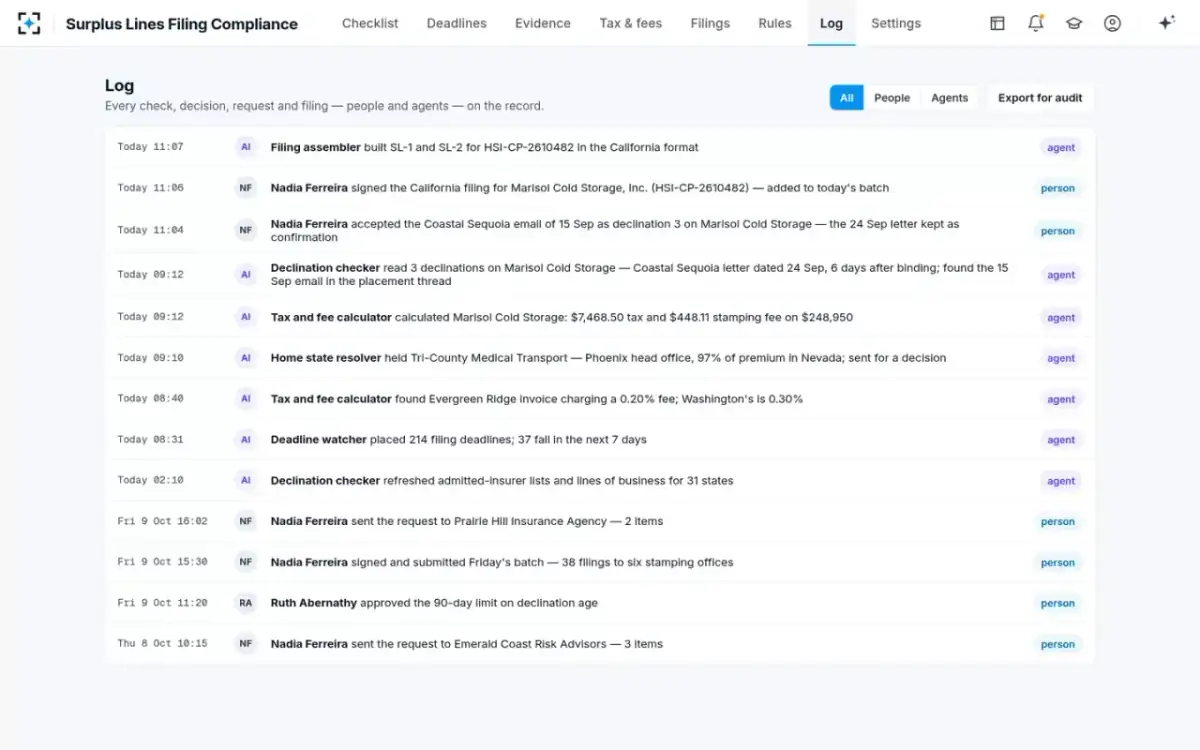
- The log of who did what, when
Every check, decision and request with a time and a name; this is what lets an examiner see the file was built when the work was done, not afterwards.
How do I prepare for a surplus lines exam?
Run the examiner's tests on yourself, before the examiner does, on a sample drawn the way an examiner would draw it. Pull a random sample of placements across home states and quarters, then for each one try to re-perform the checks from the file alone: re-decide the home state, re-check each declination against the admitted list and the binding date, recompute the tax and the filing deadline, and match the filing to the office's records. Every check that needs a phone call to complete is a gap in the file.
Then reconcile in bulk. Match your list of bound placements against the filing office's records for the same period, and your tax statements against the premiums on those placements; the Florida Service Office does the first comparison for itself, and New York's 2026 order was, in effect, the second done by the Department. The general preparation for a regulator's examination, from the call letter to the closing meeting, is in the guide to preparing for a market conduct examination; the surplus lines-specific part is the file above. For the Texas late-filing side of an exam, surplus lines late filing fees sets out the ladder an examiner will apply.
How Surplus Lines Filing Compliance builds the file as the work is done
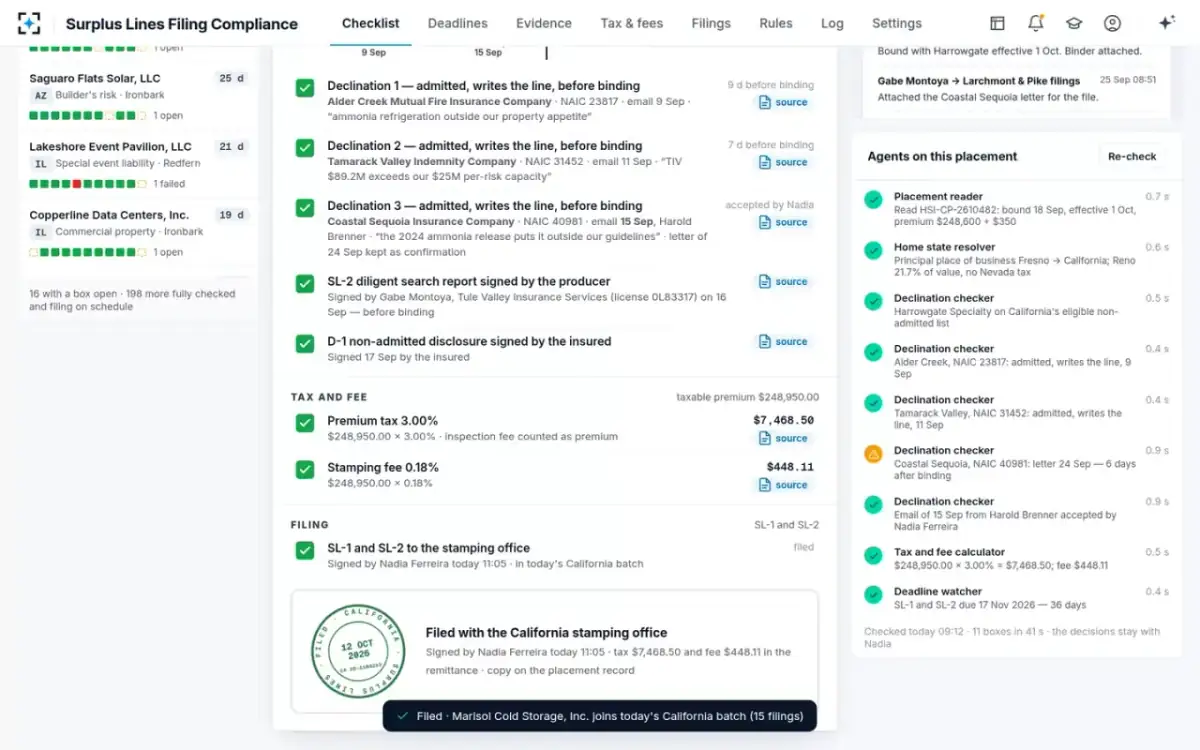
In the solution, each placement's stamping checklist is the file. Every box, from the binder read to the home state, the insurer's eligibility, each declination, the affidavit, the disclosure, the tax and fee and the filing itself, is ticked with a link to what it rests on: the page of the binder, the line of the email, the paragraph of the state rule. A late-dated declination is never edited; earlier evidence is accepted only by the filer and the later letter is kept as a confirmation. Every check, decision, request and filing, by a person or an agent, is on the log with its time, and the log exports for an audit. Rule and setting changes are versioned and approved, so the rule that applied on a placement's date can be shown as well as the placement.
The log: every check, decision, request and filing, ready to export for an audit
One placement's file after signing: each box with its source
What the solution does not do is replace your retention policy, your tax statements or your judgment on what a state's examiner will accept; it keeps the evidence and the reasoning so those can be shown. To see the file it builds on a sample of your own placements, start from Surplus Lines Filing Compliance; for insurer eligibility evidence on non-U.S. placements, see the NAIC Quarterly Listing of Alien Insurers.
Questions people ask
What records must a surplus lines broker keep?
A complete record of each contract. Texas lists the items: the daily report, amount and risks insured, a description and location of the property, gross and return premium, rates, terms and effective date, names and addresses of insured and insurer, the amount collected, any managing-underwriter tax agreement and, where the search was skipped, evidence that the insured was an exempt commercial purchaser or industrial insured.
How long must surplus lines records be kept?
By the home state's rule. Texas keeps each record open to the department without notice until three years after the contract expires or is cancelled; Illinois, as captured in 2025, requires seven years from the policy effective date. New York's 2026 order reached policies from 2016, which argues for keeping files longer than the shortest statutory floor.
What do surplus lines auditors check?
That each placement was lawful, filed on time and taxed in the right state, and that the file proves it: the home-state determination, the diligent search evidence and signed form, the disclosure, insurer eligibility, the filing and its receipt, and the tax paid. Recent orders in New York and Texas each named a missing or late document.
What are common surplus lines audit findings?
In recent New York and Texas orders: policies filed late with the stamping office or excess line association, assessed late fees paid late, and, in one 2026 New York case, premium taxed in the wrong home state, with the right state's declarations pages, affidavits, tax statements and tax all missing as a result.
What triggers a surplus lines audit?
Reconciliations by filing offices, such as Florida's matching of insurers' and agents' reports; annual late-filing fee assessments in Texas; regulators' own investigations, as in New York's 2026 order; and a broker's own discovery of a problem, which in a January 2026 Texas order still ended in a $50,000 penalty.
How do I prepare for a surplus lines exam?
Sample your own placements across home states and quarters and re-perform each check from the file alone: home state, declinations against the admitted list and binding date, tax, deadline and the filing office's record. Then reconcile bound placements with the office's records and tax statements with premiums, and fix each gap before an examiner finds it.