A surplus lines filing associate is the person at a wholesale broker or surplus lines agency who turns a bound excess and surplus lines placement into a lawful filing in the insured's home state. The seat reads the binder and declarations page, settles the home state, checks every declination and the diligent search affidavit, confirms the disclosure and the insurer's eligibility, works out the premium tax and stamping fee, builds the filing in the state's format and gets it to the filing office before the deadline, then chases retail agents for whatever is missing. It is a back-office desk, but it is where a placement becomes compliant or does not: an underwriting decision can be perfect and the placement still draw a fine because the paper reached the stamping office on day 61. Botminds' Surplus Lines Filing Compliance gives this seat agents that read and check every placement and a queue of only the ones that still need a person, while the licensed filer keeps every decision and signature.
The examples of the seat's day come from a fictional sample wholesale broker. Statutes and enforcement orders are linked where they are used.
Four seats around one surplus lines filing, and what each waits for
Today
Gets a separate email for each missing declination or signature, weeks after binding.
With agents
Gets one request per day listing every item the agency owes, each with its placement and date.
Still theirs: The client, the disclosure the insured signs, and the declinations the agency collected
Today
Places the risk, then is pulled back in when a filing stalls on a missing paper.
With agents
Sees only the boxes still open on his placements.
Still theirs: Market choice and the placement itself
Today
Reads every binder, letter and affidavit by hand, retypes figures into each state's format and chases by email.
With agents
Opens the placements with a box open, decides on the evidence the agents found, and signs the day's batch if licensed.
Still theirs: Acceptance of substitute evidence, and the signature where licensed
Today
Answers audits from files that hold a letter written after binding.
With agents
Decides home-state disputes with both answers in front of her and approves rule changes.
Still theirs: Home-state calls, rule settings and co-signature on large filings
What does a surplus lines filing associate do?
The job is to make the statute's checklist true for every placement, on the home state's clock. That breaks into eight tasks, each with a legal hook. The binder and declarations page give the bind date, effective date, premium and fees, which start the clocks. The insured's principal place of business gives the home state, which picks the rulebook. The declinations and the affidavit show the diligent search; the disclosure, where the state requires one, shows the insured was told; the insurer's eligibility shows the placement was allowed at all.
Then the money and the filing. The associate applies the home state's tax and fee to the taxable premium, builds the filing in that state's format, and gets it to the office in time: California's report goes “within 60 days of placing any insurance for a home state insured with a nonadmitted insurer” (Cal. Ins. Code § 1763(a)); Texas wants the policy within 60 days of the later of its effective or issue date and every endorsement “promptly” (Tex. Ins. Code § 981.105). Returns from the office, renewals and endorsements bring each placement back to the desk more than once a year.
The last task is the one nobody lists: chasing. The documents the filing needs are mostly made by other people, a retail producer's declinations, an insured's signed disclosure, an underwriter's letter, and they arrive late or not at all. The NAIC's model act recognises the gap in a drafting note: because surplus lines licensees often deal with the insured through a producing broker, the licensee “may not be in a position to affirm, based upon personal knowledge, that the insured received from the producing broker the written information required” (NAIC Model #870).
How many filings does a surplus lines filer handle?
No regulator or research body publishes a figure, and the federal occupational statistics do not separate this role from other insurance back-office work. The useful number is your own: placements and endorsements per filer per day, against the minutes each one takes. Botminds' estimate, from the sample placement worked by hand, is about 25 minutes for a straightforward one, split as below; a placement with a failed declination or a home-state question takes much longer.
Where a filer's 25 minutes on one placement go, by Botminds' estimate
One placement checked by hand
- Checking declinations and affidavit · 10 min · 40%
- Reading the binder, declarations and invoice · 4 · 16%
- Building the filing · 4 · 16%
- Tax and fee · 3 · 12%
- Home state · 2 · 8%
- Chasing evidence · 2 · 8%
The split explains the backlog. Four-tenths of the time is reading declinations and affidavits, the step that needs the most care and gets the least when the queue is long. At 25 minutes, one filer clears about 17 or 18 placements in a seven-and-a-half-hour day if nothing goes wrong; a broker that binds 40 a day needs more than two filers just to stand still, before endorsements, renewals and returns.
What happens if a surplus lines filing is late?
In Texas, a per-policy fee first and discipline after; in New York, consent orders with fines in six figures. The common thread in the orders is the filing desk. In January 2026 Texas fined a wholesale broker licensed in Texas and “numerous other states” $50,000 for late filings in 2024. The order records what went wrong: the firm discovered a serious problem in its IT processing system “where one employee responsible for surplus lines filings was releasing the filing task in the IT system without having processed the filings as required”, and fixed it by “manually reviewing thousands of documents to determine which policies needed to be filed” (TDI Order 2026-9760).
Two 2026 Texas orders on late surplus lines filings
$50,000
penalty after one employee closed filing tasks without filing, found in April 2024
$13,500
penalty on a broker that filed late in 2024 and 2025 and paid the 2024 late fees late
60days
the deadline both orders recite, from the later of the effective or issue date
The second order shows the ladder working as designed. A broker filed late in 2024 and 2025; the department assessed the statutory late fees in March 2025 and March 2026; the broker paid the 2025 fees on time but not the 2024 ones, and that is what turned fees into a $13,500 administrative penalty (TDI Order 2026-9927). Texas law makes late payment of a fee one of the doors to discipline (§ 981.105(h)(1)), which the guide to surplus lines late filing fees prices in full.
New York's late-stamping orders: years of backlog behind each fine
New York's orders are longer stories. Its Department of Financial Services lists consent orders in which excess line brokers “failed to timely file documents with the excess line association for recording and stamping pursuant to Insurance Law Section 2118(b)(1)”, over periods of four to six years (DFS disciplinary actions, May 2023; August 2024).
Five New York fines for late stamping filings, by the years they covered
Read together, the orders describe backlogs, not bad placements. None of the listed findings concerns the insurance itself; each records documents that did not reach the excess line association in time, over years, and the Texas order shows how that can happen inside a workflow tool that marks a task done.
Do surplus lines filers need a license?
The person who signs needs one; the person who does the work may not, depending on the state. California is explicit. The diligent search form “shall be signed by a person licensed under this code who has made the diligent search required by this section or who supervised an unlicensed person or persons who actually conducted the search” (§ 1763(a)). An unlicensed associate can run the search and prepare the filing; a licensed person who supervised it signs, and the commissioner may discipline that signer for a misrepresentation on the form caused by negligence or an intentional act, their own or the searcher's (§ 1763(b)).
Texas ties filing to the licence holder: an agent may not issue or cause to be issued a contract with an eligible surplus lines insurer without a surplus lines licence (§ 981.202), and the filing duty sits on the agent responsible for the tax (§ 981.105(a)). Federal law decides which state's licence matters: no state other than the insured's home state may require the broker to hold its licence for that insured (15 U.S.C. § 8202(b)), and states may charge surplus lines licence fees only if they take part in the NAIC's national producer database (§ 8203). How the licence, appointments and their renewals are managed is covered in the guide to insurance licence vs appointment.
Who signs a surplus lines filing?
A licensee, in every state compared here, and the signature carries the weight of an affidavit. In New York, under the text in force until 1 July 2029, the filing “shall be accompanied by a statement subscribed to, and affirmed by, the licensee or sublicensee”, or by “the affidavit of another broker involved in the placement affirming as true under the penalties of perjury” (N.Y. Ins. Law § 2118(b)(3)(A)). In Illinois, as captured in April 2025, submitting a contract to the Surplus Line Association of Illinois is itself a certification, by the surplus line producer or by the producer who presented the risk, that a diligent effort was made where required (215 ILCS 5/445(5)).
That is why the associate's real product is a file a licensee can sign without re-doing it. A signer who has to re-read every declination is doing the associate's job twice; a signer who signs without reading is relying on work they cannot see. Who checks and who signs in a diligent search draws that line state by state.
What skills does a surplus lines filer need?
Less tax knowledge than people assume and more evidence judgment. The sample filer in the solution puts it plainly: “I can calculate the tax in my sleep. What gets us fined is a declination nobody looked at.”
What the seat actually requires
- Clock arithmetic across states
Placing (California), the later of effective and issue date (Texas), procurement (New York), quarter end (Florida's affidavit): different events, different counts.
- Reading a declination as evidence
Who declined, whether that insurer is admitted and writes the line in the state, and whether the date is before binding.
- Knowing which state's definitions apply
Premium, home state, exempt commercial purchaser: each defined by statute, and not identically from state to state.
- Never editing a document to fit
A late-dated letter is kept as it is; earlier evidence is found and accepted, or the box stays open.
- Reconciling with the office
Reading the stamping office's returns and late-filing reports, and matching them to the broker's own list.
- Asking once, clearly
One request per agency, every missing item with its placement and date, instead of a trickle of emails.
- Knowing when to stop
A home state that could be either of two states, or substitute evidence, goes to a person with authority, with both answers attached.
The path upward runs through the licence. In California the signature on the diligent search form belongs to a licensed person who made or supervised the search, so a filer who obtains the licence can sign the filings they prepare; the next seat, the compliance manager's, adds the home-state calls, rule settings and audits that the surplus lines audit requirements guide describes.
How Surplus Lines Filing Compliance changes the filing associate's day
The solution moves the reading and checking to six agents and leaves the seat with the decisions. In the fictional sample, Larchmont & Pike Wholesale has 214 placements open for filing in 31 states; the filer's Monday list shows 16 with a box open (six failed, nine open, one waiting for a decision) and says the other 198 are fully checked and filing on schedule. She opens only the 16.
The filer's queue: only the placements that still need a person
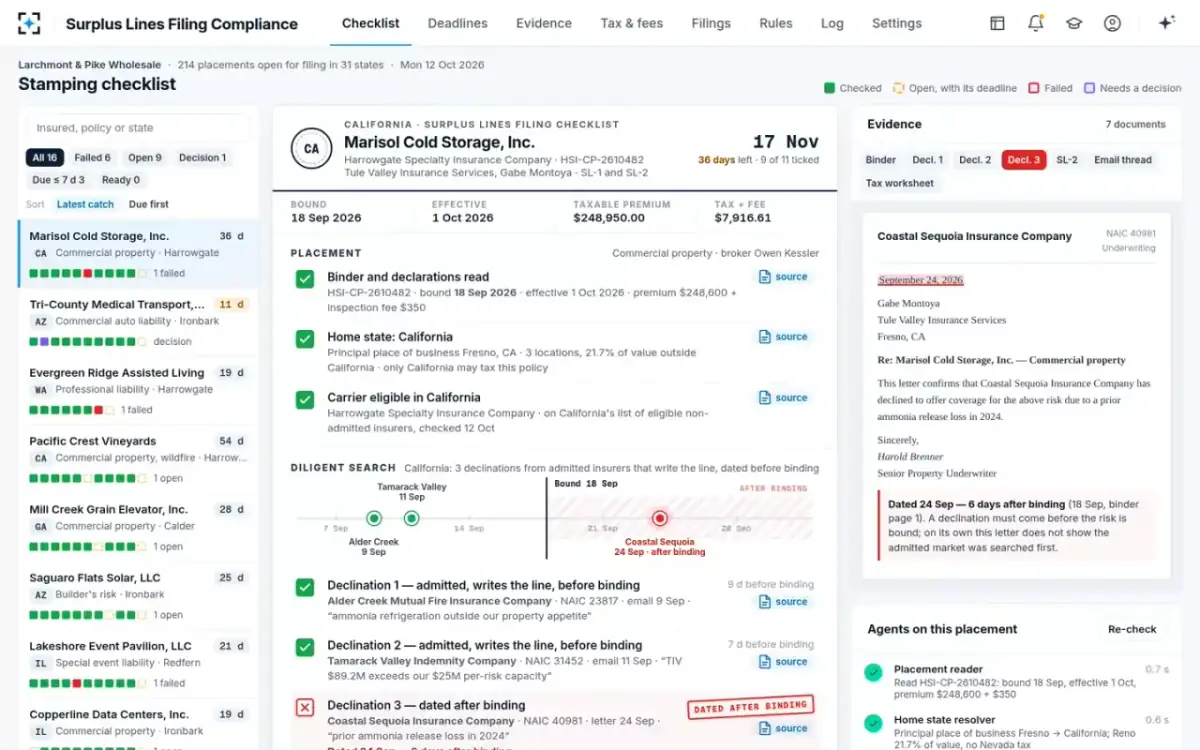
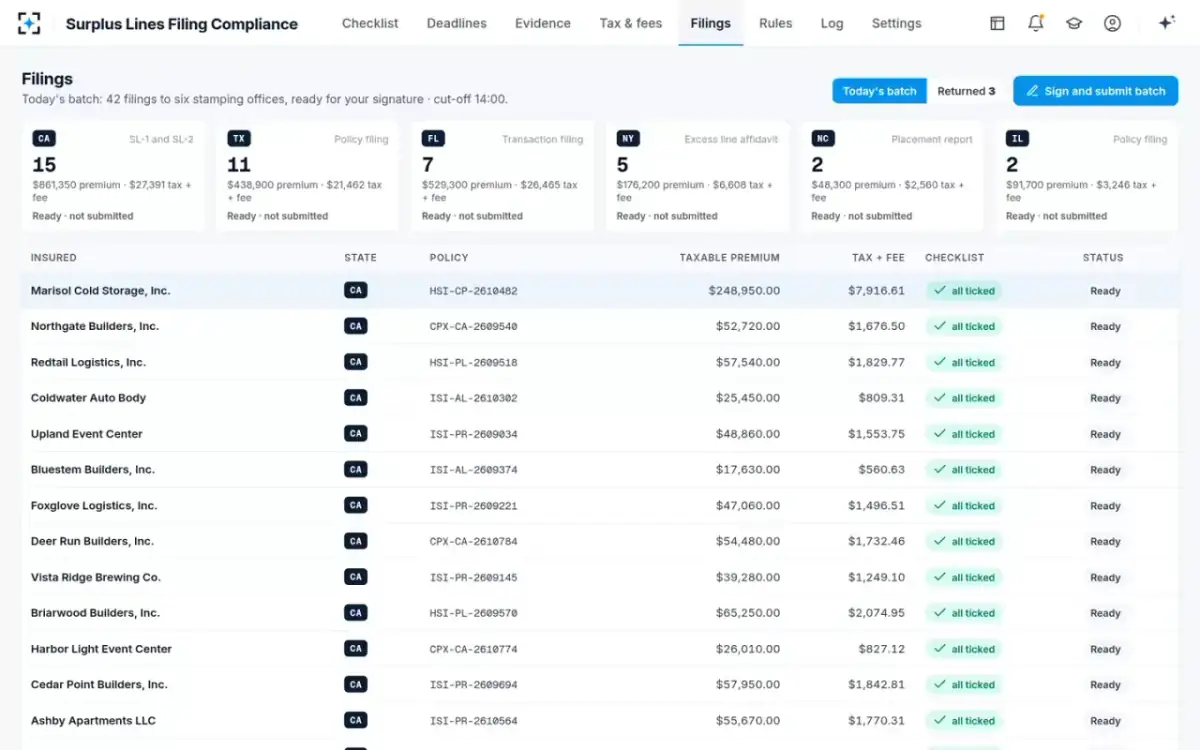
The agents' limits are what make that safe. The placement reader never infers a bind date; the declination checker never changes a date, never counts an insurer that is not admitted, and never accepts substitute evidence on its own; the filing assembler never submits without a licensed filer's signature; the deadline watcher drafts one request per retail agency per day and never sends it without the filer's release. Each filing then joins the day's batch by stamping office, and every check and decision lands on a log that exports for an audit.
Today's batch by stamping office, waiting for the filer's signature
To see the queue on a sample of your own placements, start from Surplus Lines Filing Compliance.
Questions people ask
What does a surplus lines filing associate do?
Prepares each bound excess and surplus lines placement for filing in the insured's home state: reads the binder and declarations page, settles the home state, checks the declinations, affidavit and disclosure, works out the tax and fee, builds the filing in the state's format and files it before the deadline. Chasing retail agents for missing documents is a large part of the week.
Do surplus lines filers need a license?
The person who signs does. California requires its diligent search form to be signed by a licensed person who made the search or supervised the unlicensed people who did, so an unlicensed associate can prepare the work. Texas requires a surplus lines licence to issue or cause to be issued a contract with an eligible surplus lines insurer.
Who signs a surplus lines filing?
A licensee. New York's text requires a statement subscribed and affirmed by the licensee or sublicensee, or another involved broker's affidavit under penalty of perjury; California's form is signed by the licensed person responsible for the search; Illinois treats the submission itself as the producer's certification.
What happens if a surplus lines filing is late in Texas?
The department assesses a per-policy fee of $50 or $100 up to day 180, or $200 between days 180 and 365 for agents with a low late rate the year before. An agent who files on or after day 365, files late with a high late rate, or pays the fees late becomes subject to disciplinary chapters, as one broker did in 2026 for a $13,500 penalty.
Why do surplus lines filers chase retail agents?
Because the documents a filing needs are often created on the retail side: the declinations collected before the risk went to the wholesaler and the disclosure the insured signs. The NAIC's model act notes that a surplus lines licensee dealing through a producing broker may not be able to affirm from personal knowledge what the insured received.
Is surplus lines filing a good career?
It is a compliance career with a licensing path. Federal occupational statistics do not break the role out, so there is no public pay or demand figure for it; what the statutes show is that the signature, and with it the responsibility, belongs to a licensed person, so a filer who obtains the surplus lines licence can move from preparing filings to signing them, and on to compliance management.