Surplus lines tax filing software takes a bound excess and surplus lines placement and does the filing desk's checking: it reads the binder, declarations page and invoice, settles the home state, checks each declination and the affidavit, works out the premium tax and stamping fee and prepares the filing in the state's format for a licensed person to sign. The way to evaluate it is not a demonstration on the vendor's examples but a replay of last quarter's closed placements, whose outcomes you already know: what was filed, what came back, which fees were assessed. Count the errors the software finds that the team missed and the false alarms it raises, against pass marks written down before the run. Botminds' Surplus Lines Filing Compliance is built to be tested that way: six agents check every placement and cite every tick, a licensed filer signs, and every check is on a log you can compare with what actually happened.
Statutes and orders are linked where they are used. Product figures are from the solution's fictional sample book or are design targets, and say so.
A six-week pilot on one quarter of closed placements
- Agree pass marks, pick the quarterweek 1
- Load your states' rules, with sourcesweek 2
- Replay every placementweek 3
- Review each disagreement blindweek 4
- Fix rules, run againweek 5
- Score and decideweek 6
What does surplus lines tax filing software do?
Everything the statute asks of a placement up to the signature. In practice that is eight jobs, each tied to a rule: read the placement documents and dates; settle the home state under the federal test; check the declinations and the affidavit against the home state's search rule; confirm the disclosure and the insurer's eligibility; compute the tax and fee on that state's definition of premium; calendar the due date from the state's starting event; build the filing in the state's format and track the office's receipt; and chase what is missing.
What it cannot do is the part the statutes assign to a person. California's diligent search form must be signed by a licensed person who either made the search or supervised the people who did (Cal. Ins. Code § 1763(a)). New York's text requires a statement that the licensee or sublicensee subscribes and affirms (N.Y. Ins. Law § 2118(b)(3)(A)). Illinois treats the submission itself as the producer's certification that a diligent effort was made where required (215 ILCS 5/445(5), as captured in 2025). Software that blurs who signs is selling a liability, not removing one.
Can surplus lines filing be automated?
The reading, checking, calculating and assembling can; the judgments and the signature cannot, and should not be made to look as if they had been. The NAIC anticipated the change in its model act's drafting note on diligent search: “States may want to consider changing diligent search requirements in light of electronic transactions” (NAIC Model #870, § 5 drafting note). None of the five home states compared in these guides lets a filing go in without a licensed person standing behind it.
Responsibility for a tool stays with the firm that uses it. New York's insurance regulator said so for underwriting models in 2024, in a letter addressed to insurers rather than brokers: insurers stay responsible for understanding the tools they use in underwriting and pricing, including those developed or deployed by third-party vendors (DFS Insurance Circular Letter No. 7, 2024). It is an analogy here, not a rule for surplus lines filing, but it states the standard a broker's own regulator is likely to apply: a filer must be able to show what the software did and why.
Why test surplus lines software on last quarter's closed placements?
Because the answers are already known and the hard cases are already in it. A closed quarter has filings that were accepted, filings that came back, perhaps a late-filing fee notice, and the occasional home-state call someone argued about. A vendor's demonstration set has none of your states' quirks, none of your retail agents' habits and none of your mistakes.
The errors that cost money are rare and specific: a declination from an insurer that does not write the line, a letter dated after binding, a Texas clock started from the effective date when the policy issued later, a purchasing-group member taxed in the group's state. A pilot has to contain those to test anything. A quarter of real placements usually does; if yours does not, add a handful of known past problems on purpose and say which ones they are only after the run.
What data do I need to test surplus lines software?
The placement documents as they arrived, the filings as they went out, and what came back. Everything the software will read in production should go in, unedited, and everything you will score it against should be held back until the run is over.
The pilot pack for one quarter of closed placements
- Binders, declarations pages and invoices
As received, including endorsements and return premiums in the quarter.
- Declinations and the placement email threads
Letters and emails both, so the software can be judged on dates and on finding earlier evidence.
- Signed affidavits, diligent search forms and disclosures
California's form, New York's statements, Florida's disclosure acknowledgments, as signed and dated.
- Your home-state determinations
What the team decided for each placement, and the reasoning where it was written down.
- The filings as submitted, with dates
Kept back as the answer key, with each office's receipt or return.
- Office reports and regulator notices
Late-filing reports, returned filings, a Texas fee notice under § 981.105(i): the outcomes to score against.
- Tax and fee remitted per placement
From the remittance or the annual statement, to compare figures to the cent.
- Your current rule table, with its sources
If a rule in it is out of date, the pilot should find that too.
Pass marks to agree before anyone sees a result
Write the scoring down in week 1, with the people who will decide, because once results arrive every number has a defender. The table below is the scoring we would use. The pass marks are suggestions for your own decision; no regulator or research body publishes a benchmark for any of these measures.
How to score a surplus lines filing software pilot
| Measure | How it is counted | A pass looks like |
|---|---|---|
| Home-state errors found | Placements where the software's home state differs from the team's and review confirms the software | Every confirmed case found; every doubtful case held for a person, none decided silently |
| Declination errors found | Declinations failed for date after binding, insurer not admitted, or insurer not writing the line, confirmed on review | Every confirmed failure found, each with its reason and source |
| Deadline accuracy | Due dates computed versus the statute's rule, placement by placement | All match; any mismatch traced to a rule setting, not to arithmetic |
| Tax and fee accuracy | Computed tax and fee versus the correct figure on the state's definition of premium | To the cent after the state's rounding |
| False alarms | Boxes failed that review finds were fine, per 100 placements | A number your filers agree they can live with, set in week 1 |
| Filer time | Minutes per placement for the filer's own review in week 5 | Measured on your filers, not quoted from the vendor |
Two measures matter more than the rest. A missed home-state error is the most expensive single failure in surplus lines filing: in New York's September 2026 consent order a broker paid $96,230.99 of tax and $60,000 of penalties after taxing a purchasing group's New York members in California (DFS consent order), and how to determine home state for surplus lines taxes takes that case apart. And a silent decision, a doubtful case resolved by the software without telling anyone, should fail the pilot by itself, however often it guessed right.
How long does a surplus lines software pilot take?
About six weeks for a multi-state broker, of which only one is the replay. The first two weeks set the scoring and load the rules for the home states in the sample, each with its statute and the date it was read; that step alone can find an out-of-date cell, such as a Florida rule still asking for three declinations after the 2025 repeal. Week 3 runs the quarter. Week 4 is the review of every disagreement, which is where the pilot's value is and where it takes compliance staff's time. Week 5 fixes rule settings that review showed were wrong and runs again, because a rule error is cheap to fix and should not be scored as a software error. Week 6 scores and decides.
The time drivers are the number of home states and the number of disagreements, not the number of placements. A broker that files mostly in five states will spend far less time in week 2 than one with thirty; one with clean files will spend less in week 4.
Does surplus lines software file in every state?
Ask which states it has rules for, who maintains them and from what source, and which offices it can submit to in their own format; then test those states in the pilot. Filing is state by state because the law is: only the home state's rules apply (15 U.S.C. § 8202(a)), the offices differ (a nonprofit stamping office in Texas, a service office in Florida, an excess line association in New York, the commissioner or a designee in California), and so do the forms and clocks. A tool that claims every state should be able to show, for any state you pick, the statute behind each rule and the date it was last checked.
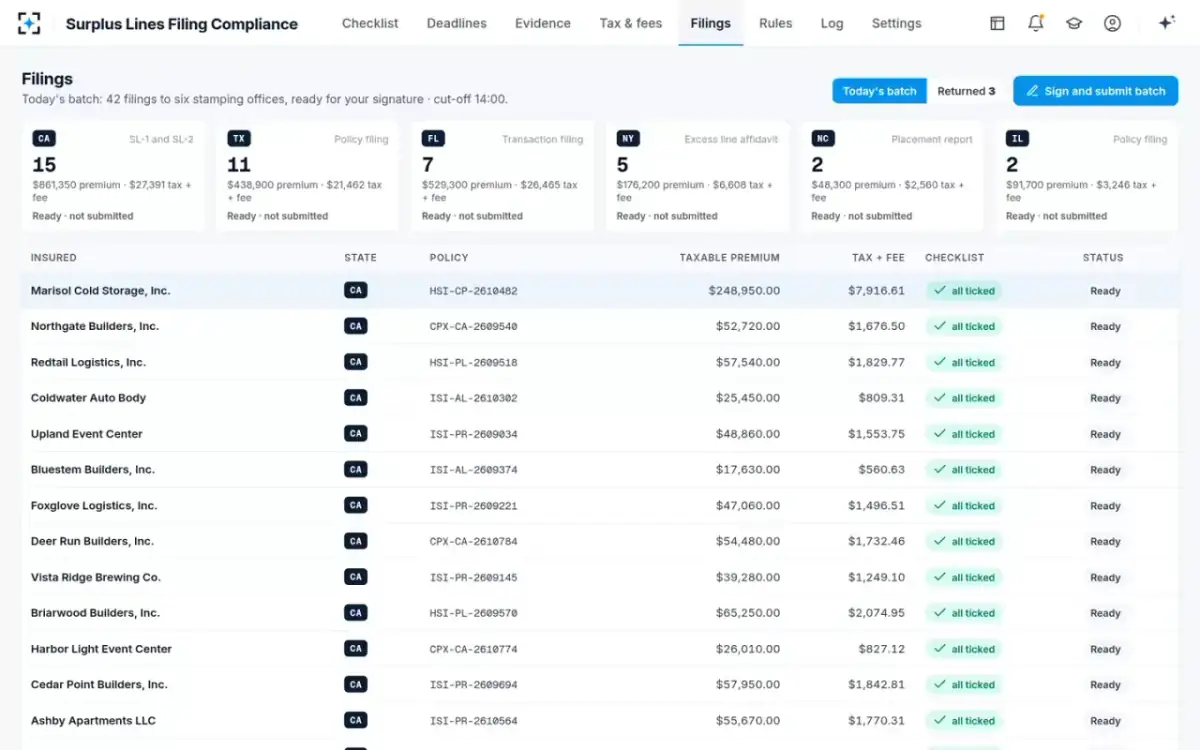
In the solution's fictional sample, a wholesale broker files in 31 home states and one day's batch goes to six offices in six formats: California SL-1 and SL-2, Texas policy filings, Florida transaction filings, New York excess line affidavits, North Carolina placement reports and Illinois policy filings. Each state's rule in the settings carries its source, and rule changes need the compliance manager's approval.
One day's batch in six offices' formats, waiting for one signature
Who is responsible if software files the wrong tax?
The licensee, in every statute and order read for this guide. Texas puts the tax in the agent's hands in trust and makes failure to pay it by the due date theft (Tex. Ins. Code §§ 225.007, 225.013); California can discipline the person who signs the diligent search form for a misrepresentation made through negligence, theirs or the searcher's (§ 1763(b)); and New York's 2026 order barred the broker from recovering the tax and penalty from anyone, insurance included (DFS consent order, paragraph 22).
The Texas order of January 2026 is the cautionary tale for software buyers. A broker's late filings were traced to its IT processing system, where filing tasks were released without the filings being made; it fixed the problem by reviewing thousands of documents by hand, and paid a $50,000 penalty anyway (TDI Order 2026-9760). A workflow that can mark work done without proof that it was done is a control failure waiting for an audit; the guide to surplus lines late filing fees prices what follows.
Questions to ask a surplus lines filing software vendor
Answers that should worry you, and answers that should not
A weak answer: Our compliance team keeps them current.
A strong answer: Each rule shows its statute or office rule, the version and the date it was read, and changes need your approver.
A weak answer: The system picks the most likely.
A strong answer: It holds the placement with both answers and their tax for a named person; nothing is filed until she decides.
A weak answer: We confirm three are attached.
A strong answer: Each is read for insurer, line and date, checked against the home state's admitted list, and compared with the binding date.
A weak answer: The filer can update the date.
A strong answer: The box fails; earlier evidence can be offered from the placement's emails, and only the filer can accept it. The document is never edited.
A weak answer: When it is sent.
A strong answer: When the office's receipt is recorded; a returned filing goes back to its checklist with the reason.
A weak answer: The system submits automatically.
A strong answer: A licensed filer signs every filing; a second signature above a threshold you set.
Where Surplus Lines Filing Compliance fits, and where it does not
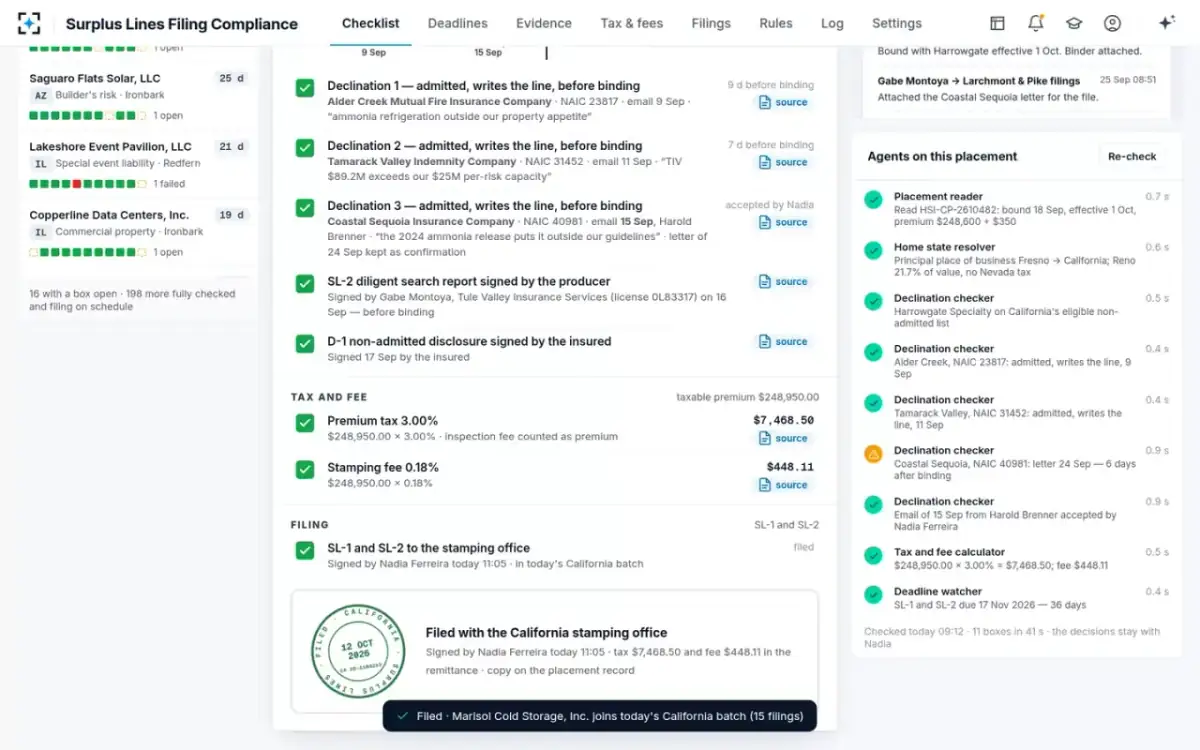
The solution answers the right-hand column. Six agents read the binder, every declination and the state's rules; a licensed filer decides and signs. Each tick links to the page of the binder, the line of the email or the paragraph of the rule it rests on, and every check, decision, request and filing is on a log that exports for an audit, which is what makes a pilot's week-4 review possible.
What to expect, and what to measure yourself
41s
to check all 11 boxes on one sample placement's stamping checklist
100%
of declinations checked for admitted status, line and date before binding: a design target
≈25→4min
filer time per straightforward placement, by hand and with the solution: Botminds' estimate
Filed and stamped, with the tax and fee in the remittance
Where it does not fit: it does not replace the licensee's judgment on substitute evidence or a disputed home state, it does not file the annual or quarterly tax statement each state requires of the licensee, and it is not a source of legal advice on what a statute means; each state's rule is a setting your compliance manager approves. It also needs your documents to work from: a placement whose declinations were never collected will show an open box, not a filing. To run the pilot on your own quarter, start from Surplus Lines Filing Compliance; for what the declination check should and should not decide, see the surplus lines diligent search tool guide.
Questions people ask
How do I evaluate surplus lines filing software?
Replay a closed quarter of your own placements through it, score its findings against what actually happened, and agree the scoring before the run. Count home-state, declination, deadline and tax errors it finds that your team missed, false alarms per 100 placements, and the filer's review time, and fail any tool that resolves a doubtful case without telling a person.
Can surplus lines filing be fully automated?
Not lawfully end to end. Reading, checking, calculating and preparing filings can be automated, but statutes put the signature on a licensee: California's diligent search form must be signed by a licensed person who made or supervised the search, and New York requires a statement subscribed and affirmed by the licensee or sublicensee.
What data do I need to test surplus lines software?
The placement documents as received (binders, declarations pages, invoices, declinations and email threads, signed forms and disclosures), plus the answer key held back until after the run: filings as submitted, office receipts and returns, late-filing reports or fee notices, and the tax and fee remitted for each placement.
How long does a surplus lines software pilot take?
About six weeks for a multi-state broker: two to agree the scoring and load each state's rules with sources, one to replay the quarter, one for compliance staff to review every disagreement blind, one to fix rule settings and run again, and one to score and decide.
Who is responsible if surplus lines software files the wrong tax?
The licensed broker or agent. Texas holds collected tax in trust in the agent's hands and treats non-payment by the due date as theft; New York's 2026 consent order made the broker pay the tax and $60,000 in penalties and barred recovering them from insurance.
Does surplus lines software replace the stamping office?
No. The stamping, service or association office in each state is created by statute to receive, record and review filings, and in Texas and Florida it collects the fee set under the statute. Software prepares and submits filings to those offices; it does not stand in for them.