A surplus lines diligent search tool checks the evidence that the admitted market was tried before a risk went to a nonadmitted insurer. For each placement it should read every declination, identify the insurer and its NAIC number, confirm that the insurer is admitted in the home state and actually writes that type of insurance there, compare the declination's date with the binding date, notice when the evidence is missing or late, and assemble the state's form or affidavit. It should not certify the search: California has a licensed person sign the form, New York a licensee or sublicensee affirm the statement, Illinois treats submission as the producer's certification. The tool worth buying does the reading at scale and puts each judgment, and the signature, in front of the person the statute names. Botminds' Surplus Lines Filing Compliance works that way: its declination checker reads, checks and finds earlier evidence; a licensed filer decides and signs.
Statutes are linked where they are used. The worked case is a fictional sample placement in the solution.
A diligent search check: what the agents do, and where a person takes over
Agent
Placement readerReads the binder for the bind date, effective date, coverage and insured, citing the page.
Never: infer a bind date; a missing date leaves the box open
Agent
Declination checker: who and whatReads each declination for insurer, NAIC number, line and reason; looks the insurer up on the home state's admitted list for that line.
Never: count an insurer that is not admitted or does not write the line
Agent
Declination checker: whenCompares each declination's date with binding; a date after binding, or older than the broker's set limit, fails its box.
Never: change a date
Agent
Declination checker: earlier evidenceWhen a date fails, searches the placement's email thread for an earlier message from the same insurer and offers it.
Never: accept substitute evidence on its own
A person decides
Filer decides on the evidenceReads what the agent found and accepts it, or asks the retail agent for a proper declination.
A person decides
Licensed filer signs the filingConfirms, as the licensed filer, that the search, affidavit and disclosure are complete and true.
What is a surplus lines diligent search?
It is the search of the admitted market that most states require before a risk may be placed with a nonadmitted insurer, made among the insurers that actually write that coverage in the state. The NAIC model act puts it as a condition of placement: the coverage may go to eligible surplus lines insurers “provided that a diligent search is made among the insurers who are admitted to transact and are actually writing the particular type of insurance in this state” (NAIC Model #870, § 5A(3)).
California adds the timing and the responsibility: “Each surplus line broker shall be responsible to ensure that a diligent search is made among insurers that are admitted to transact and are actually writing the particular type of insurance in this state before procuring the insurance for a home state insured from a nonadmitted insurer” (Cal. Ins. Code § 1763(a)). Texas calls it diligent effort with insurers authorized to write, and actually writing, that kind and class of insurance; New York and Illinois also call it diligent effort; and Florida, since 1 July 2025, no longer makes it a condition of export at all; Florida's 2025 change is covered on its own.
What makes a declination valid for surplus lines?
It comes from the right insurer, about the right coverage, at the right time. A declination counts toward the search only if the declining insurer is admitted in the home state and actually writes that type of insurance there; California defines type of insurance as “the hazard or combination of hazards covered by a contract of insurance” (§ 1763(e)), so a property insurer's refusal says nothing about a liquor liability risk. And it must show a search made before the insurance was procured.
Six tests a declination must pass before it counts
- The insurer is named fully, with its NAIC number
A trading name or a group name cannot be looked up on an admitted list; the company that declined must be identifiable.
- It is admitted in the home state
Not in the state where the producer sits or the risk partly lies; the home state's admitted list decides.
- It actually writes this type of insurance in the state
California, Texas and the NAIC model all qualify the search by insurers actually writing the coverage.
- It is about this risk
Named insured, location and coverage match the placement; a general "we don't write this class" note is evidence of a different kind and should be labelled as such.
- It is dated before binding
California requires the search before the insurance is procured; a letter dated afterwards does not on its own show that.
- It is not stale
No statute among the five compared sets an age limit; a broker can set one in policy, such as 90 days before binding in the solution's sample settings.
California also says what three valid declinations are worth: they are prima facie evidence of the search, and so is a showing that fewer than three admitted insurers write that type of insurance in the state at all (§ 1763(b)). The second half is the one tools forget: for a class only one or two admitted insurers write, the evidence is the list of who writes it, not three refusals. How declines are captured upstream, at the retail agency, is in the guide to out-of-appetite declines.
Can a declination be dated after binding?
It can be written after binding, but on its own it does not prove a search made before binding, which is what the statutes ask. A letter dated after the risk was bound may confirm a refusal given earlier by phone or email, or may be a refusal requested only to fill the file. The two look identical in a file. What separates them is earlier evidence from the same insurer.
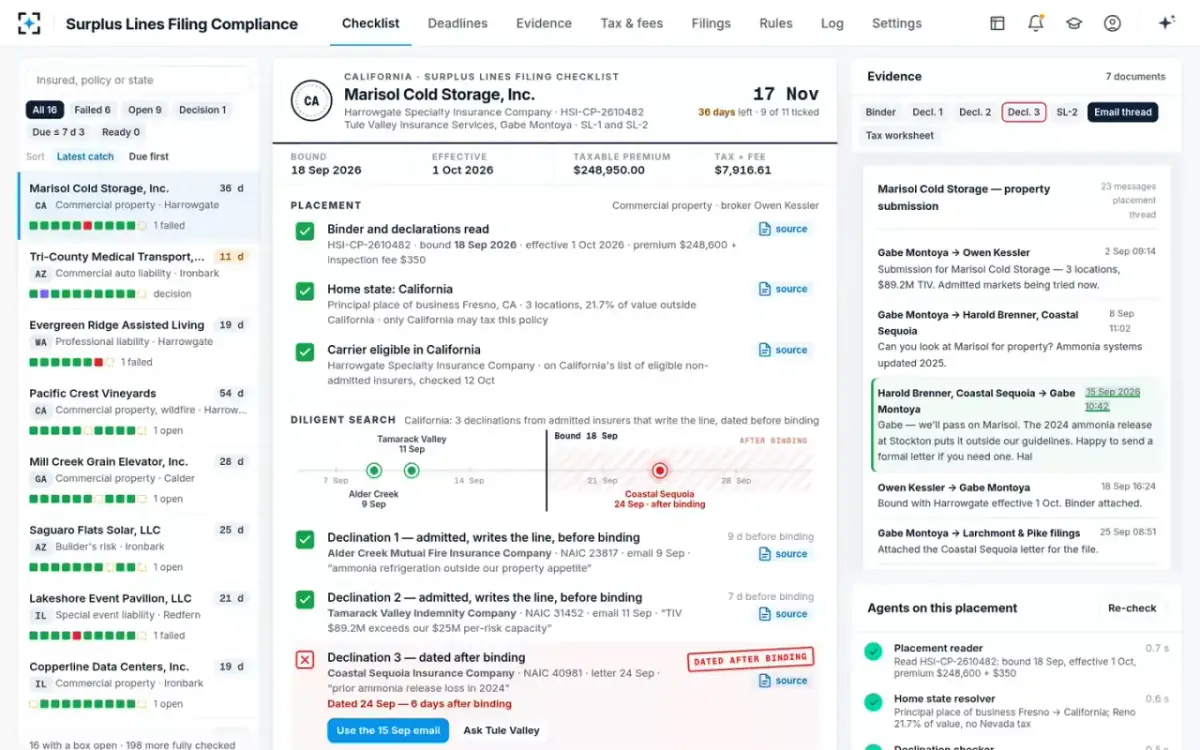
The solution's sample shows the case. Marisol Cold Storage's property policy was bound on 18 September; two declinations, by email on 9 and 11 September, pass. The third, Coastal Sequoia's letter, is dated 24 September, six days after binding, and its box fails. The declination checker then searches the placement's 23-message email thread and finds the Coastal Sequoia underwriter's email of 15 September at 10:42, three days before binding: “Gabe — we'll pass on Marisol. The 2024 ammonia release at Stockton puts it outside our guidelines.” It offers the email; it cannot accept it.
A declination dated after binding, and the earlier email found in the thread
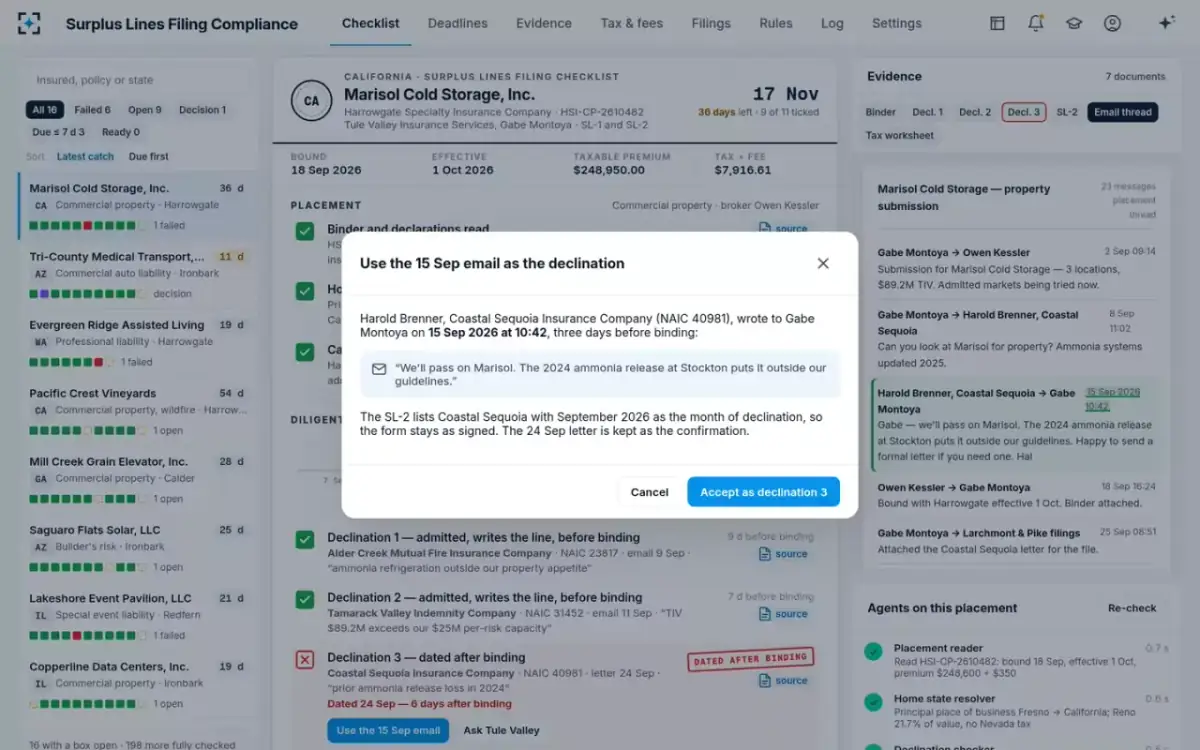
The filer reads it and accepts it as declination 3. The SL-2 already lists Coastal Sequoia with September 2026 as the month of declination, so the form stays as signed, and the 24 September letter is kept beside it as a confirmation, never edited. The sample's compliance manager states the principle: “If an auditor asks when the search happened, I want the email, not a letter written afterwards.”
The filer, not the agent, accepts the substitute evidence
Can a diligent search be automated?
The checking can; the certifying cannot. Every test in the checklist above is a lookup or a comparison a machine can make faster and more consistently than a person working through a queue, and it can make all of them on every placement rather than a sample. What no statute among those compared lets a tool do is stand behind the search. The line falls where the law draws it.
What a diligent search tool may do, and what the statutes keep for a licensee
A tool may: Read every declination, letter and email; extract insurer, NAIC number, line, date and reason; cite where each came from.
A licensed person must: Decide whether substitute or unusual evidence is good enough, such as an email instead of a letter.
A tool may: Check each insurer against the home state's admitted list and lines written.
A licensed person must: Decide what to do when the lists are out of date or the line is ambiguous.
A tool may: Compare dates with binding and flag any after it.
A licensed person must: Accept earlier evidence, or require a new declination.
A tool may: Check the exempt-purchaser tests and that a written request predates placement.
A licensed person must: Judge whether the insured really qualifies when the evidence is thin.
A tool may: Prepare the state's form from the checked evidence.
A licensed person must: Sign or affirm it, and answer for it.
Who must sign a surplus lines affidavit?
A licensee, though each state words the duty differently and some have no per-placement affidavit at all. The table sets out the five states compared in these guides.
Who stands behind the diligent search, state by state
| Home state | Document | Who signs or certifies |
|---|---|---|
| California | Standardized form setting out the diligent efforts and their results | A person licensed under the code who made the search or supervised the unlicensed people who did; open to discipline for negligent or intentional misrepresentation |
| New York | Statement accompanying the filing that diligent effort was made (text until 1 July 2029) | The licensee or sublicensee, subscribed and affirmed, or another involved broker by affidavit under penalty of perjury |
| Texas | No per-placement affidavit in the statute; an annual report to the department | The surplus lines agent, whose report must show insurance was placed only in excess of what authorized insurers would write |
| Florida | Quarterly affidavit to the Service Office | The surplus lines agent, stating all business was submitted and including efforts made and their results |
| Illinois (captured April 2025) | The submission of the contract to the Surplus Line Association | The surplus line producer, or the producer who presented the risk, by the act of submission |
Texas is the instructive exception. Its statute has no per-placement diligent search affidavit; instead the agent's annual report must “demonstrate that the amount of insurance obtained from each eligible surplus lines insurer is only the amount that exceeds the amount obtainable from an authorized insurer” (Tex. Ins. Code § 981.216(c)(1)). A tool that only produces state forms has nothing to offer a Texas filer; one that keeps each placement's checked evidence gives the annual report its support. The NAIC model, for its part, makes the affidavit “open to public inspection” and has it affirm that the insured was told in writing, before placement, that the insurer is not licensed in the state and that the guaranty fund will not pay its losses (Model #870).
Does an exempt commercial purchaser need a diligent search?
No, if two things happen first, and a tool's job is to check that they did. Federal law excuses the search for an exempt commercial purchaser if the broker has disclosed that the insurance “may or may not be available from the admitted market that may provide greater protection with more regulatory oversight” and the purchaser “has subsequently requested in writing the broker to procure or place such insurance from a nonadmitted insurer” (15 U.S.C. § 8205). The order matters: disclosure, then a written request, then placement.
The purchaser must also meet the definition at the time of placement: a qualified risk manager, more than $100,000 of nationwide commercial property and casualty premium in the previous twelve months, and one of the size tests (§ 8206(5)). Texas requires the agent to keep “evidence establishing that” the insured qualified and that the disclosure and request were made, whenever the search was skipped on that basis (§ 981.215(a)(12)). A tool can check each element and its date; whether a thinly documented risk manager really qualifies is a judgment for the licensee.
What is the Illinois referral exception to diligent effort?
A commercial-risk exemption for wholesale placements. In the text captured in April 2025, a licensed surplus line producer may procure a contract other than personal lines without the diligent effort “if the risk was referred to the surplus line producer by an Illinois-licensed insurance producer who is not affiliated with the surplus line producer” (215 ILCS 5/445(1.5)(f)). The same subsection lets the producer make the diligent effort for a master policy “annually for the master policy rather than individually for each insured that is added during the policy period”, and do the same for program business.
For a tool the exception changes the evidence, not the work. Instead of declinations, the file needs the referring producer's Illinois licence and proof that it is not affiliated with the surplus line producer, and the line must not be personal lines. For master policies and programs, the annual search and its variable provisions become the evidence for every insured added that year. A rule table that treats Illinois as "three declinations" misses all of this.
What the declination checker in Surplus Lines Filing Compliance does, and does not
The declination checker reads every declination, insurer, NAIC number, date and reason, checks the home state's admitted list and the lines the insurer writes, and compares the date with binding; a date after binding fails, and so does one older than the broker's set limit. When a date fails, it searches the placement's email thread for earlier evidence from the same insurer and offers it to the filer. Its limits are part of its design: it never changes a date, never counts an insurer that is not admitted, and never accepts substitute evidence on its own. A licensed filer signs every filing, and the compliance manager co-signs above a tax threshold the broker sets.
Where it does not fit: it does not decide that a thin exempt-purchaser file is good enough, it does not replace the retail agent who must actually approach the admitted market, and it does not make a late letter into an early one. It also depends on the admitted lists and rule settings it is given, which is why those are versioned and approved. For how to test it on your own closed placements, see surplus lines tax filing software: a pilot on last quarter's filings; for the person at the centre of it, the surplus lines filing associate. To see the checker on a sample of your own placements, start from Surplus Lines Filing Compliance.
Questions people ask
What is a surplus lines diligent search?
The search of the admitted market that most states require before a risk can be placed with a nonadmitted insurer, made among insurers that actually write that type of insurance in the home state. California requires it before the insurance is procured and treats three declinations from such insurers, or proof that fewer than three write the coverage, as prima facie evidence.
Who must sign a surplus lines affidavit?
A licensed person. California's form is signed by a licensee who made or supervised the search; New York's statement is subscribed and affirmed by the licensee or sublicensee; Florida's quarterly affidavit is the surplus lines agent's; Illinois treats submitting the contract as the producer's certification.
Can a declination be dated after binding?
A letter can be written after binding, but by itself it does not show the search was made before the insurance was procured, as California's statute requires. Earlier evidence from the same insurer, such as the original refusal email, shows when the search happened; without it the declination should not count.
Does an exempt commercial purchaser need a diligent search?
No, under 15 U.S.C. § 8205, if the broker first disclosed that admitted cover may be available with more regulatory oversight and the purchaser then asked in writing for the nonadmitted placement. The purchaser must meet the federal definition at placement, and Texas requires the agent to keep evidence that it did.
How old can a surplus lines declination be?
None of the statutes compared here sets an age limit; the requirement is a search before the insurance is procured. A broker can set its own limit in policy so that an old refusal is not reused; in the solution's sample settings it is 90 days before binding.
What is the Illinois referral exception to diligent effort?
Under 215 ILCS 5/445(1.5)(f), as captured in 2025, a surplus line producer may skip the diligent effort on a commercial, non-personal-lines risk referred by an Illinois-licensed producer that is not affiliated with it. Master policies and program business may instead be searched once a year.