Surplus lines late filing fees are set by statute in Texas: a policy filed with the Surplus Lines Stamping Office of Texas after the 60th day from the later of its effective or issue date draws a fee of $50 if no more than 5% of the agent's filings were late the year before, $100 if more than 5% were, and $200 if it is filed between day 180 and day 365 by an agent whose prior-year late rate was 2% or less. An agent who files on or after day 365, files after day 180 with a prior-year late rate above 2%, or fails to pay the assessed fees on time leaves the fee schedule and becomes subject to discipline. The ladder turns a late rate into money and then into licence risk, and because each year's fees depend on the year before, one bad quarter is priced twice. Other states have no ladder: New York has settled late stamping with six-figure consent orders. Botminds' Surplus Lines Filing Compliance calendars every filing from its home state's own starting event and chases the missing evidence early enough that the ladder is never climbed.
The fee amounts and thresholds come from Texas Insurance Code § 981.105; the scenario figures later in the guide are our arithmetic on an illustrative agency, labelled as such.
The Texas surplus lines late filing fee ladder, per late-filed policy
| When the policy is filed | Agent's late rate in the previous calendar year | Consequence |
|---|---|---|
| By day 60 after the later of the effective or issue date | Any | On time: no fee |
| Day 61 to day 180 | Not more than 5% | $50 fee |
| Day 61 to day 180 | More than 5% | $100 fee |
| After day 180, before day 365 | Not more than 2% | $200 fee |
| After day 180, before day 365 | More than 2% | Subject to Chapters 81, 82 and 84: sanctions and administrative penalties |
| On or after day 365 | Any | Subject to Chapters 81, 82 and 84 |
| Any late policy, fee not paid on time | Any | Subject to Chapters 81, 82 and 84 |
What is the late fee for surplus lines filings in Texas?
$50, $100 or $200 per late-filed policy, assessed once a year. The filing that starts the clock is due “Not later than the 60th day after the later of the effective date or the issue date of new or renewal surplus lines insurance” and is either a copy of the policy or, if the policy has not been issued, “a copy of the certificate, cover note, or other confirmation of insurance delivered to the insured” (Tex. Ins. Code § 981.105(a)). The second option matters for lateness: a filer waiting for the insurer's policy wording does not have to miss the deadline, because the confirmation already delivered can be filed.
The commissioner “may assess a fee against an agent who files a surplus lines policy after the filing deadline” (§ 981.105(c)), and the amounts are fixed by statute rather than by negotiation. Fees are billed in arrears: the department notifies each agent of the year's fees by 15 June of the following year, and the agent has 30 days from the notice to pay (§ 981.105(i)).
What is the 5 percent late filing rule in Texas?
It is the threshold that doubles the fee. For a policy filed by day 180, the fee is “$50 for each late-filed policy if, in the calendar year immediately preceding the year in which the policy is late-filed, the agent has filed not more than five percent of the policies the agent was required to file after the filing deadline”, and $100 if the agent filed more than five percent late that year (§ 981.105(d)). A second, tighter threshold applies to the very late band: the $200 fee for a policy filed after day 180 but before day 365 is available only to an agent that filed not more than two percent late in the previous year (§ 981.105(e)).
Two features make the rule bite. The rate is measured on the agent's whole book of required filings, so a large wholesaler with a small late share can still pay many fees, and a small one with a few late files can cross 5% quickly. And the rate is backward-looking: this year's late rate sets next year's fee level, so the cost of a bad year arrives twice, once in its own fees and again in the next year's.
How late can a surplus lines policy be filed in Texas? Two agents, the same late policy
- On timedays 0–60
- $50 a policydays 61–180
- $200 a policydays 181–364
- On timedays 0–60
- $100 a policydays 61–180
- Discipline: Chapters 81, 82, 84from day 181
Why Texas built a fee ladder for late surplus lines filings
Because the alternative was harsher. Before 2011 a late filing was simply a violation of the Insurance Code. The House committee's analysis of H.B. 3799, the House bill that proposed the ladder that year, recorded interested parties' concern that the filing requirement is unique to surplus lines “and that sanctions for failing to comply with the filing deadline should be similarly unique”, and reported that “the enforcement division of the Texas Department of Insurance has recently begun to impose administrative penalties on late-filed policy violations that may be disproportionately harsh given the violation” (House Committee on Insurance, bill analysis of C.S.H.B. 3799, 82nd Legislature).
The committee substitute raised the original bill's fees, which the analysis says were $25 and $50, to $50 and $100, and added the 180-day split. The ladder that became law arrived through Senate Bill 1806, effective 28 May 2011, according to the history line of § 981.105. The design choice that matters today is in subsection (g): “The assessment, imposition, or payment of a fee under this section does not establish a violation” for the disciplinary sections it lists. A fee is a price, not a finding, as long as the agent stays on the ladder.
Can TDI discipline an agent for late surplus lines filings?
Yes, through three doors that § 981.105(h) leaves open: failing to pay an assessed fee on time, filing on or after day 365, or filing after day 180 with a prior-year late rate above 2%. Through any of them the agent becomes subject to Chapters 81, 82 and 84 of the Insurance Code, which carry sanctions and administrative penalties.
Two Texas consent orders in 2026, two doors to discipline
$13,500
penalty where 2024 late fees were not paid on time, though 2025 fees were
$50,000
penalty for late filings in 2024 traced to filing tasks closed without being filed
30days
to pay each penalty from the date of the order
The May 2026 order is the first door in action. The broker filed late in 2024 and 2025; the department assessed fees in March 2025 and March 2026 because the late filings “met at least one of the conditions in TEX. INS. CODE § 981.105(d-e)”; the broker paid the 2025 fees on time but not the 2024 ones, and was ordered to pay a $13,500 administrative penalty (TDI Order 2026-9927). The fees themselves would have been the end of it. The January order records a different path: late filings across 2024, discovered by the firm and traced to its own workflow, cured by a manual review and new protocols, with the statutory late fees paid on time, and still a $50,000 penalty (TDI Order 2026-9760). The filing desk behind that order is the subject of the surplus lines filing associate guide.
What one year of lateness costs: the ladder priced
Price it on an illustrative wholesaler that must file 4,000 Texas policies a year. The fee per policy is small; the leverage is in the thresholds. The scenarios below change only the agent's late rate, in the year the fees are charged and the year before.
Texas late fees on 4,000 required filings, by late rate this year and last
The jump between the second and third bars is the 5% rule: the same 160 late policies cost twice as much because of last year. The last bar is the one compliance heads should fear, and not for its dollars. A handful of very late files in a year after a bad year are no longer priced at all; each is an open door to the disciplinary chapters, on top of the doubled fees on the rest.
The fee is also only the visible cost. Every late file is a placement someone had to find, chase and finish out of order, and in Texas the tax is due on its own calendar regardless: an agent that does not pay the surplus lines tax by its due date “commits the offense of theft” (Tex. Ins. Code § 225.013).
What are New York penalties for late excess line filings?
New York has no fee ladder; late stamping filings have been settled by consent order, with fines that run to six figures. The Department of Financial Services' monthly lists for May 2023 and August 2024 include five orders against excess line brokers that failed to file documents with the excess line association on time under Insurance Law § 2118(b)(1), covering periods of four to six years between 2017 and 2022, with fines from $28,575 to $160,800 and $554,225 in all (DFS, May 2023; DFS, August 2024).
Where lateness comes with an unpaid tax, the bill grows. In the September 2026 order on a purchasing-group program taxed in the wrong state, the broker paid $96,230.99 of tax and $60,000 of penalties, and agreed not to seek reimbursement of the tax and penalty from any insurance (DFS consent order, September 2026). Late tax elsewhere has its own price: California adds a 10% penalty and 1% interest a month to a late annual payment (Cal. Ins. Code § 1775.5(c)), and Florida charges 9% a year on delinquent tax (Fla. Stat. § 626.932(2)(b)).
How do I reduce late surplus lines filings?
Measure the late rate the way the statute does, start each clock from the right event, and never let a closed task stand in for a filed one. The checklist below is the routine we would put in place at any multi-state wholesaler, built from the statute and the two Texas orders.
Keeping a Texas book under 2% late
- Track the late rate monthly, on the statute's definition
Late filings divided by filings the agent was required to make in the calendar year, against the 2% and 5% lines that set next year's fees.
- Start every clock from the later of the effective and issue dates
A policy issued after it takes effect gets a later deadline; one issued early does not. Calendar each one from its own date.
- File the confirmation if the policy is not ready
§ 981.105(a)(2) accepts a copy of the certificate, cover note or other confirmation delivered to the insured.
- File endorsements and substitute documents promptly
§ 981.105(b) requires them, with a memorandum on what changed, separately from the original filing.
- Reconcile with the stamping office, not with your own task list
In the January 2026 order, filing tasks were closed in a workflow tool without the filings being made; the office's record is the one that counts.
- Escalate anything past day 150
Day 180 is where the fee rises or discipline starts; a list of placements past day 150 should reach a manager weekly.
- Pay assessed fees within 30 days of the notice
Late payment of the fee was the door to the $13,500 penalty in May 2026.
- Ask retail agents for everything once, early
A file waiting on a missing declination or signature is a file that can go late; one request per agency, well before the deadline, beats a reminder on day 58.
How Surplus Lines Filing Compliance keeps filings off the ladder
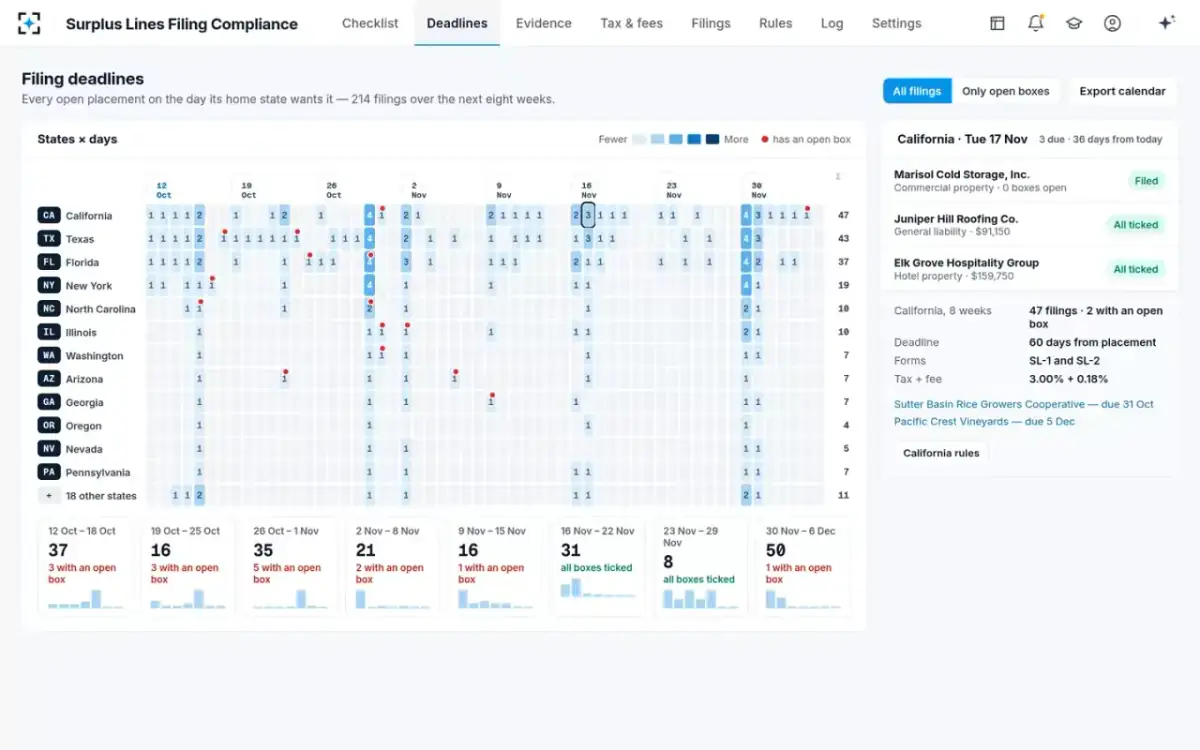
The deadline watcher calendars every filing's due date from the home state's rule in the broker's settings, which is where Texas's “later of the effective date or the issue date” belongs, and California's count from the date of placing. At 21, 7 and 2 days before each deadline it drafts one request per retail agency listing every open item and its date, which the filer releases. The filing assembler records each stamping office's receipt and routes a returned filing back to its checklist with the reason, so a filing sent and a filing received are not confused.
Every Texas filing on the day it is due, with open boxes marked
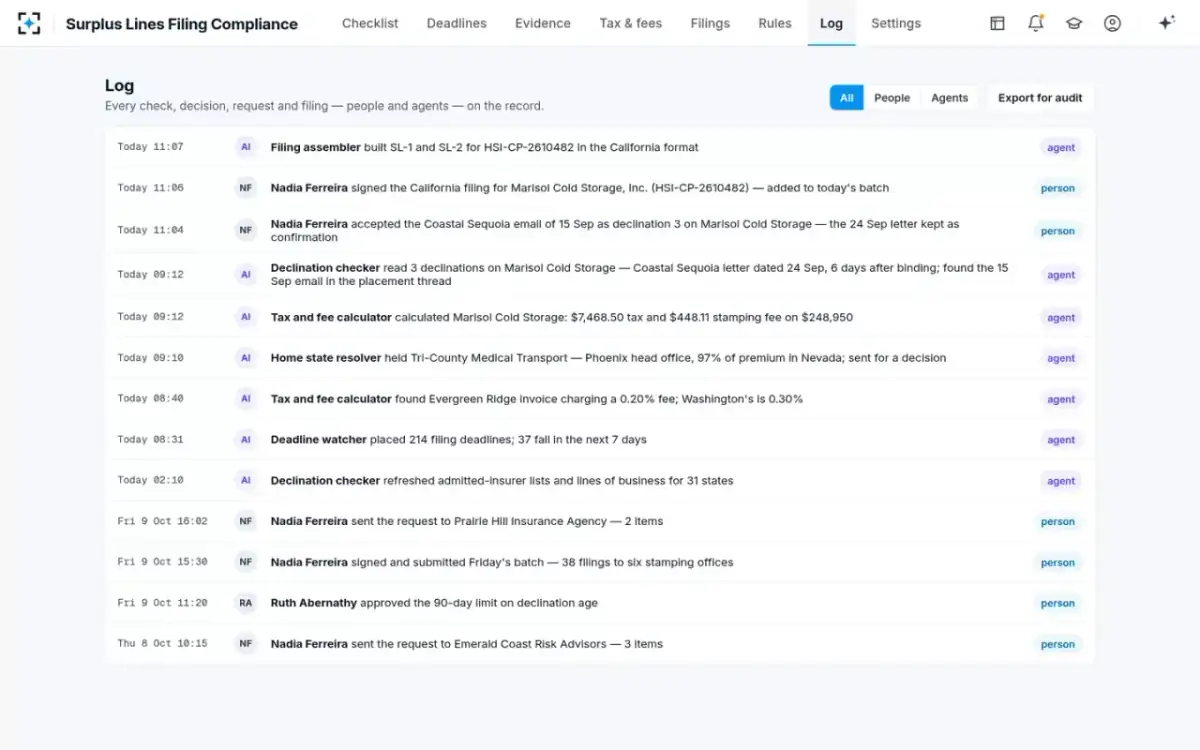
The log is the other half: every check, request and filing has its time, so a stamping office's late-filing report can be reconciled against the broker's own list placement by placement, and the reason for each late file is known before the fee notice arrives in June.
Every request, decision and filing, with its time
What the solution cannot do is make a retail agent answer, or file a placement whose evidence is not there; it can make sure the request went early, went once and is on the record. For how to test that on your own closed placements before buying, see surplus lines tax filing software: a pilot on last quarter's filings, and for the file an examiner reads after a late-filing finding, surplus lines audit requirements. To see the calendar on your own Texas book, start from Surplus Lines Filing Compliance.
Questions people ask
What is the late fee for surplus lines filings in Texas?
$50 per late policy if the agent filed 5% or less of its policies late in the previous calendar year, or $100 if it filed more than 5% late, for policies filed by day 180. Between day 180 and day 365 the fee is $200, but only for agents whose prior-year late rate was 2% or less.
How late can a surplus lines policy be filed in Texas?
The deadline is the 60th day after the later of the effective date or issue date. Up to day 180 a fee applies; after day 180 an agent with a prior-year late rate above 2% is open to discipline, and from day 365 every late filing is, whatever the agent's record.
When does TDI bill surplus lines late filing fees?
Once a year in arrears. Section 981.105(i) requires the department to notify each agent of the fees for a calendar year by 15 June of the next year, and the agent must pay within 30 days of the notice. Missing that payment is itself one of the conditions that exposes the agent to discipline.
Does paying a late filing fee count as a violation in Texas?
No. Section 981.105(g) says the assessment, imposition or payment of a fee does not establish a violation for the disciplinary sections it lists. Discipline comes only through the doors in subsection (h): unpaid fees, filing on or after day 365, or filing after day 180 with a prior-year late rate above 2%.
What are New York penalties for late excess line filings?
New York has no statutory fee schedule like Texas's; late filings with the excess line association have been settled by consent orders with fines. Five orders listed by DFS in 2023 and 2024 for late stamping filings over four to six years carried fines from $28,575 to $160,800.
Can a Texas surplus lines filing be made before the policy is issued?
Yes. If the policy has not been issued, § 981.105(a)(2) lets the agent file a copy of the certificate, cover note or other confirmation of insurance delivered to the insured, so waiting for the policy wording is no reason to miss the 60-day deadline.