A communicable disease exclusion clause removes from a policy's cover the loss, cost or interruption that arises from a communicable disease, meaning an illness that can pass between people or from animals or the environment, and usually also from the fear or threat of one. Insurers added or rewrote these exclusions after the business interruption claims of 2020 and the test case that followed, so a carrier's book now holds several versions at once: wordings bound before the pandemic with no express exclusion, the first standard, later editions with carve-backs, and broker variations agreed for particular insureds. Which version an insured has, and who agreed any departure, decides the next claim. Botminds' Clause Library & Precedent Search reads every bound wording and endorsement, groups each disease exclusion by version, and shows the approval behind each departure and any claim it was argued in.
This guide explains the clause, what the English courts said about disease wordings in the FCA test case, how a disease exclusion differs from the US virus exclusion, and how a wordings team can track which version sits in each policy. It does not advise on whether any particular claim is covered; for reading a policy against a claim, see the guide to insurance policy analysis on a claim.
The test case that sent insurers back to their disease wordings
370,000
policyholders covered by the policies insurers listed as potentially affected (2020)
21
policy types in the representative sample of wordings
8
insurers bound by the judgment
What is a communicable disease exclusion?
It is an exclusion that takes disease-related loss out of cover that would otherwise respond, most often in property, business interruption, marine and liability wordings. Versions differ in four places, and those four are what a wordings team should compare: the definition of the disease (any communicable disease, or only one declared by an authority), the losses excluded (physical damage, business interruption, clean-up, loss of attraction, fear or threat), the causal words ("arising from", "directly or indirectly", "in any way connected with"), and the carve-backs that write some cover back in, typically for damage caused by named perils.
Each of those choices has a cost to someone. A broad definition and loose causal words protect the insurer against accumulation and invite a dispute about whether an excluded disease really caused the loss. A narrow definition gives the insured certainty and the insurer a known exposure. The point of tracking versions is not to say which is right; it is to know which one each insured has.
Why did insurers add communicable disease exclusions?
Because in 2020 the question whether business interruption policies covered the pandemic became a dispute affecting hundreds of thousands of policyholders, and insurers had to decide what their next renewals would say. The FCA brought a test case to resolve "the contractual uncertainty around the validity of many BI claims", and the policies insurers listed as potentially affected covered "approximately 370,000 policyholders" (FCA).
European supervisors watched the same rewrite happen across markets. EIOPA reported that "Product complexity and unclear policy wording in insurance contracts magnify uncertainty over the insurance coverage and increase complaints and legal disputes", and that "Following systemic events, manufacturers often review existing products to clarify wording on exclusions or to include new exclusions without a proper application of POG rules", meaning the product oversight and governance process (EIOPA supervisory statement on exclusions related to systemic events, EIOPA-22/419, 2022). It asked insurers to "avoid overly broad exclusions and vague terms or complex wording that might not be easily understood".
From one outbreak to the next rewrite: twenty years of disease wording
- SARS; US virus exclusion follows2003–06
- Virus exclusion in some US property policies; disease clauses grant cover in others2006–2020
- Test case, 2020–21
- Rewrites2021–22
Did the FCA test case cover disease clauses?
Yes, but disease clauses that granted cover, not exclusions. The Supreme Court considered four types of clause that recur across many of the wordings in the case (the FCA v Arch guide compares all four), the first being "Disease clauses", which "in general, provide cover for business interruption losses resulting from the occurrence of a notifiable disease, such as COVID-19, at or within a specified distance of the business premises" (FCA v Arch Insurance (UK) Ltd [2021] UKSC 1, para 4). The others were prevention of access, hybrid and trends clauses.
The Court read the disease clauses together, noting: "There are some variations among these wordings, though for reasons we will give none of the differences in our view materially alters the correct interpretation of the clauses" (para 48). It held they covered cases of illness within the stated radius, 25 miles in most of the sample wordings, and not cases outside it, and then decided on causation that the local cases and the national outbreak were concurrent causes of the loss. For a wordings team the significance is the method: a court grouped versions by clause, compared their words, and decided whether the differences mattered. That is the precedent search a carrier now needs on its own exclusions.
Page 93: where an exclusion sits matters
The test case also showed what happens to an exclusion that does not sit with the cover it limits. One sample policy, RSA 3, "runs in total to no fewer than 93 pages"; on its last page, a general exclusion headed as a contamination or pollution clause excluded loss "due to contamination pollution soot deposition impairment with dust chemical precipitation adulteration poisoning impurity epidemic and disease" (para 75). The insurer argued it cut down the disease cover granted on page 38.
The Supreme Court disagreed. A reasonable policyholder would expect any further limit on the disease cover to sit openly in the extension itself, not inside a general contamination and pollution exclusion at the back of the policy (para 78; the passage is quoted in full in ambiguity in insurance policy wording). The general exclusion did not exclude COVID-19 claims.
The drafting lesson is plain: a limit on disease cover belongs in, or expressly linked to, the cover it limits. The clause library lesson is less obvious. A wording bound before 2020 may still carry an older general exclusion mentioning disease, and a search for "communicable disease exclusion" by title will not find it. The library has to be organised by what a clause does, not what it is called, which is why the solution's wording reader names each clause by family when it splits the wording.
How does a disease exclusion differ from a virus exclusion?
A virus exclusion turns on the agent that causes harm; a communicable disease exclusion usually turns on the illness and its spread. The US property market's "Virus or Bacteria" exclusion, quoted by the Washington Supreme Court in 2022, excludes loss or damage due to "[a]ny virus, bacterium or other microorganism that induces or is capable of inducing physical distress, illness or disease". The court noted that such exclusions "came to fruition in the wake of the SARS (severe acute respiratory syndrome) virus outbreak in the early 2000s", quoting scholars who wrote that the industry "had a virus and bacteria exclusion approved by regulators for inclusion in property insurance policies in 2006, in direct response to the SARS virus (though this exclusion is not featured in all property policies)" (Hill and Stout, PLLC v. Mutual of Enumclaw Insurance Co., No. 100211-4 (Wash. Aug. 25, 2022)).
The parenthesis is the clause library point. Even a standard US exclusion approved by regulators was "not featured in all property policies", and the same is true of every post-2020 disease exclusion: some wordings have it, some have an older version, some have a negotiated variation, and some have none. The Washington court decided that case on whether there was direct physical loss and addressed the exclusion separately; whether either kind of exclusion applies to a given loss is a coverage question for the claim, not something a version map can answer. What the map answers is which words apply.
Which policies have a communicable disease exclusion?
No regulator or market body publishes a count, and for a carrier the only answer that matters is its own book. The solution's fictional sample carrier holds a communicable disease exclusion family with five versions across 5,120 bound wordings. The figure shows how such a book might divide; the split is our illustration, not product data.
One exclusion, five versions: an illustrative version map for a sample book
No express exclusion
Bound before 2020
1,480wordings
Some wordings rely on a general contamination or pollution exclusion that mentions disease, the kind the Supreme Court refused to read across.
Standard, first edition
Mid-2020 onward
2,310wordings
The carrier's first standalone exclusion, applied at renewal.
Standard with named-peril carve-back
2021 onward
1,060wordings
Physical damage from listed perils written back; approved by the head of wordings.
Broker manuscript, narrower definition
2021–2023
210wordings
Agreed for a few insureds with approval, each with its reason.
Exclusion removed
Refused 14 times, bound twice
60wordings
The precedent a broker will cite; the claim outcome, if any, belongs beside it.
Three rows are where the work is. The pre-2020 row matters because those wordings renew into a new exclusion, or do not, at a date someone must track. The broker manuscript row matters because each variation was agreed for a reason, and a broker will cite it for the next insured. And the "removed" row matters most of all: it is the precedent behind the question "you took it out for them, why not for us?", and the answer depends on who approved it and whether a claim followed.
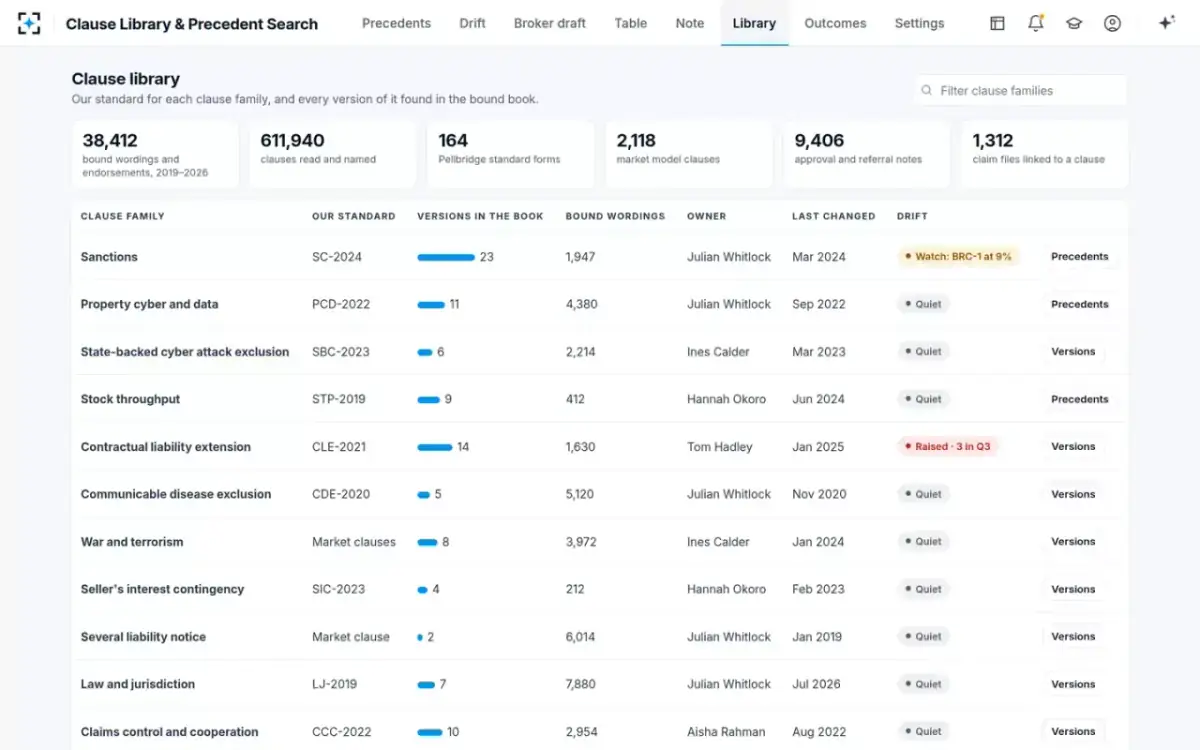
The clause library: every family, its standard, and how many versions the book really holds
Can a broker remove a communicable disease exclusion?
A broker can ask, and in specialty and surplus lines business the carrier can agree, because those wordings are largely negotiated rather than filed; Louisiana, for example, does not require surplus lines insurers to file or seek approval of property and casualty forms (La. R.S. 22:446). Whether the carrier should agree is an underwriting decision that turns on the insured's exposure, the carrier's accumulation and whatever its reinsurance requires.
For the wordings team the question comes first: has the carrier removed or narrowed this exclusion before, for whom, with whose approval, and was a claim argued under that wording? Under the default authority rules in Clause Library & Precedent Search, a version bound before with approval may be offered by the class underwriter; a version refused before or never bound, which is what removal usually is, goes to the head of wordings before it is offered. The difference between a clause library and a precedent bank is exactly this: the library holds the exclusion, the precedent bank holds every time it was waived.
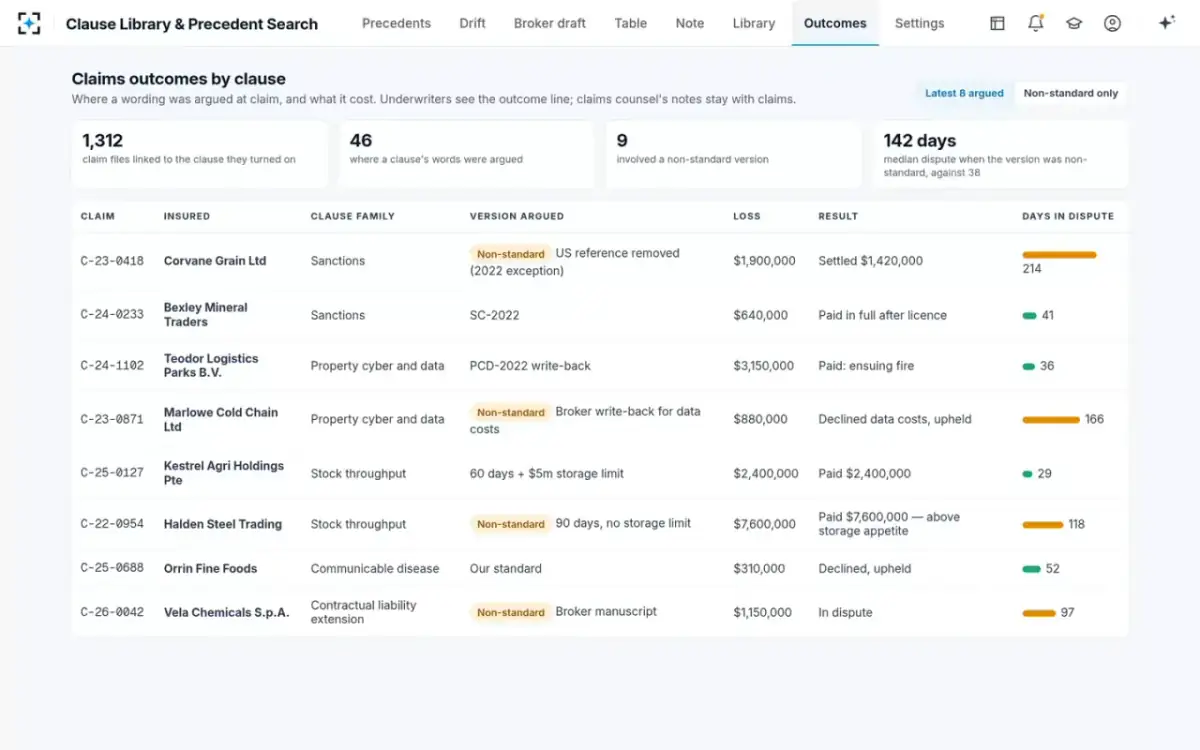
Claims outcomes by clause: which version was argued, and what it cost
How do you track which version is in each policy?
Track the exclusion at clause level across every bound wording and endorsement, not at policy level, and keep the decision behind each departure with the version. The checklist sets out the minimum; most of it is reading and linking, which is the part agents do.
Tracking communicable disease exclusion versions across a book
- Find the exclusion by what it does, not what it is called
Older wordings may exclude disease inside a contamination or pollution clause; the Supreme Court read one such general exclusion and declined to apply it to disease cover.
- Read endorsements with the wordings they amend
Many exclusions were added, narrowed or written back by endorsement at renewal.
- Compare the four parts across versions
Disease definition, losses excluded, causal words, carve-backs. Label each difference.
- Keep the reason for every departure
Who approved a narrower definition or a removal, when, and why; a refusal kept with its reasons is as useful as an approval.
- Link argued claims to the version argued
One outcome line per claim is enough for underwriters; claims counsel keeps the rest.
- Watch for drift
Alert the family owner when a non-standard phrase spreads past a threshold of new wordings.
- Keep the pre-2020 wordings
They are the comparison every renewal is negotiated against, and claims under them may still be argued.
The same method applies to every exclusion rewritten after a systemic event: cyber war, sanctions, infectious disease. The sanctions clause is the worked example of a family where one word changed the outcome. To see the communicable disease family on a sample book, start from Clause Library & Precedent Search.
Questions people ask
What is the difference between a communicable disease exclusion and a pandemic exclusion?
A pandemic exclusion is usually tied to a declared pandemic or epidemic, often by a named authority; a communicable disease exclusion usually applies to any disease that can spread, declared or not. The difference is in the definition clause, which is why the definition is the first part to compare between versions.
Does a communicable disease exclusion apply to cargo and marine policies?
It can: nothing confines these exclusions to property, and people regularly search for cargo and marine versions. Whether one is in a given policy depends on the wording and its endorsements, which is why a carrier needs a clause-level map of its own book.
Did the FCA test case decide anything about communicable disease exclusions?
It decided how disease clauses that granted cover should be read, and it refused to let a general exclusion mentioning "epidemic and disease" on page 93 of one policy cut down disease cover granted on page 38. The Court said a further limit would be expected to appear "transparently as part of the wording of the extension".
Is a virus exclusion the same as a communicable disease exclusion?
No. The US "Virus or Bacteria" exclusion, introduced after SARS and approved by regulators in 2006, turns on the agent: any virus, bacterium or other microorganism capable of inducing illness. A communicable disease exclusion usually turns on the disease and its transmission, and often reaches fear or threat of disease as well.
Should a clause library keep wordings without a disease exclusion?
Yes. They are the baseline for every renewal negotiation and the wordings under which earlier claims may still be argued. A library that keeps only current standards cannot show which insureds moved from no exclusion to the standard, and when.