An insurance clause library is the store an insurer uses to find, compare and reuse clause wording, and carriers run it in one of three ways: shared folders of standard forms and policy wordings, the clause library inside a contract lifecycle management tool, or a search that reads every wording the carrier has bound and answers with citations. All three can show the carrier's current standard. Only the third can say whether a variation a broker is asking for has been agreed or refused before, for whom, with whose approval and with what result at claim, which is the question that decides a renewal negotiation. Botminds' Clause Library & Precedent Search is built that way. This guide runs one broker question through all three approaches, sets out what each finds and how long it takes, and is plain about where the cited search is more than a carrier needs.
The comparison uses a fictional broker request and, where it shows the solution, the solution's fictional sample book of wordings. Times for the first two approaches are our estimates, not measurements.
Three ways to run an insurance clause library, and what each can find
Our current standard
Shared foldersFinds itIf someone keeps the index current
Contract tool clause libraryFinds itIts core strength
Cited precedent searchFinds itRead from the standard forms
Every variation we bound
Shared foldersPartlyOnly if you know which insured to open
Contract tool clause libraryDoes notOnly contracts drafted in the tool
Cited precedent searchFinds itEvery bound wording and endorsement, by clause
Requests we refused
Shared foldersDoes notLost in email
Contract tool clause libraryDoes notRarely held
Cited precedent searchFinds itFrom referral and refusal notes
Who approved each, and why
Shared foldersPartlyIf the email survives
Contract tool clause libraryPartlyFor approvals routed through the tool
Cited precedent searchFinds itAttached to the version
What happened at claim
Shared foldersDoes notHeld by claims
Contract tool clause libraryDoes notNot connected
Cited precedent searchFinds itOne outcome line per version
An answer within the broker's call
Shared foldersDoes notOne to three days by email
Contract tool clause libraryPartlyFor the standard only
Cited precedent searchFinds itSeconds, with citations
What is an insurance clause library?
An insurance clause library holds the carrier's clause wordings as separate units, organised by clause family, so an underwriter or wordings specialist can find the right language without opening whole policies. At minimum it holds the current standard for each family. A fuller one also holds approved alternatives, the market model clauses the carrier uses, and, in its most useful form, every version of each clause the carrier has actually bound.
What separates an insurance clause library from the clause libraries sold for commercial contracts is the direction of drafting. A company's procurement contracts are mostly drafted from its own templates, so its clause library describes most of what it signs. A specialty insurer's wordings are often drafted or marked up by brokers, many manuscript, many amended by endorsement, so its standard forms describe only a small part of what it has bound. On the solution's fictional sample book, 164 standard forms sat beside 38,412 bound wordings and endorsements.
How do insurers store clauses today?
Usually in four places that are filed differently: standard forms in a wordings team folder or library, bound wordings in policy folders filed by insured, approvals and refusals in a referral system or email, and claim outcomes in the claims system. Each is adequate for its own purpose. None is filed by clause, which is how the question arrives.
In the US surplus lines market there is no regulator's copy to fall back on either. Louisiana's statute, typical of the freedom-of-form approach, provides that "The commissioner shall not require surplus lines insurers to file or seek approval of their forms and rates for property and casualty insurance" (La. R.S. 22:446). The carrier's own folders are the only full history of its E&S wordings, and their filing system decides what can be found.
Can a contract lifecycle tool manage insurance wordings?
It can manage the standard forms and the approval of new templates well, and it struggles with the bound book. Contract lifecycle tools are built around contracts drafted inside them; their clause libraries hold the organisation's preferred text and route deviations for approval. A specialty carrier's precedent questions concern wordings drafted outside any such tool, by brokers, over years, and the refused requests that never became contracts at all.
The research behind contract-reading software shows the mismatch in miniature. CUAD, a widely used benchmark of 510 commercial contracts, labels 41 clause categories that "lawyers pay particular attention to"; one of them is called Insurance, and it asks: "Is there a requirement for insurance that must be maintained by one party for the benefit of the counterparty?" (Hendrycks et al., CUAD, NeurIPS 2021). For general contract tools, insurance is one clause in someone else's contract. For an insurer, every clause is the product.
A contract tool's clause library and a cited precedent search, side by side
Contract tool clause library: The organisation's templates and the contracts drafted in the tool.
Cited precedent search over the bound book: Every bound wording and endorsement already signed, wherever it was drafted.
Contract tool clause library: Drafting new contracts consistently and routing deviations for approval.
Cited precedent search over the bound book: Answering whether a variation was agreed or refused before, and what followed.
Contract tool clause library: Rarely; a refused request leaves no contract.
Cited precedent search over the bound book: Yes, from referral and refusal notes, marked as refused.
Contract tool clause library: Not usually; claims are outside its scope.
Cited precedent search over the bound book: One outcome line per clause version argued.
Contract tool clause library: The clause, and the approval history inside the tool.
Cited precedent search over the bound book: A cited answer, each sentence linked to a wording, form or note, or "no precedent found".
One broker question, three approaches
Take a fictional broker request on a renewal call: extend the storage period in a stock throughput clause from 30 to 60 days for a timber exporter, "as you did for another client". The underwriter needs to know whether the carrier has done that, for whom, on whose approval, and what happened.
The same storage-period question, answered three ways
- Waiting for the wordings team8 h
- Guessing insureds, opening wordings4 h
- Chasing the approval email3 h
- Asking claims2 h
- Writing the position
- Standard found at once; variation not held
- Falls back to the folders and the wordings team≈ 10 h
- Asking claims2 h
- Writing the position
- Search, compare, attach decisions
- Reading and writing the position
The folders lane is long because each step depends on knowing where to look: which insured had the 60-day storage, whose inbox holds the approval, whether claims ever saw it. The contract tool lane finds the standard instantly and then falls into the same folders, because the variation was never drafted in the tool. The cited search lane is short because the bound book has already been read and split by clause, so the variation, its approval and its claim are a lookup.
What is the best way to search past wordings?
By clause and version, not by insured; by meaning, not only by keyword; across bound wordings, endorsements and refusals; and with every answer cited. Each of those conditions removes a common failure. Searching by insured finds one policy, when the question is about every insured that agreed a change. Keyword search misses "sixty days" when asked for "60 days". Ignoring endorsements misses the variation agreed at mid-term. Ignoring refusals misses the most useful answer. And an answer without citations cannot be checked on the call.
If the search uses AI to read the question or write the answer, the last condition becomes the most important. A preregistered Stanford study of commercial legal research tools found that even tools built to cite real sources gave hallucinated answers, wrong or citing sources that did not support them, on a substantial share of queries (Magesh et al., 2024). What to demand of an AI clause library sets out the test.
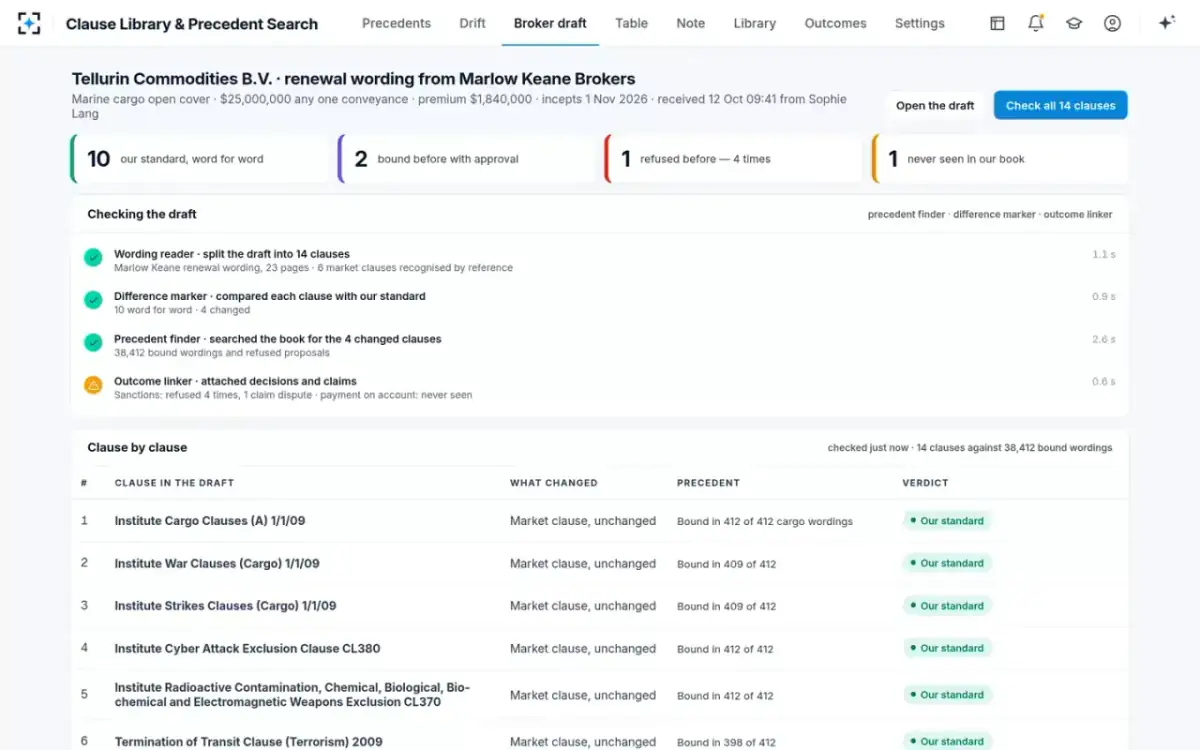
A broker's draft checked against the whole bound book, clause by clause
Does a clause library show past negotiations?
A library of standards does not; a precedent search does, if the referral notes, refusals and signed negotiation notes are connected to it. That is the line between a clause library and a precedent bank, and it is the line that matters on a renewal call. Precedent bank vs clause library sets out the difference and what English law says about using negotiation history.
The negotiations matter for a regulatory reason as well as a commercial one. European supervisors have asked insurers to keep exclusions narrow and their wording plain when drafting them (EIOPA, 2022; quoted in the guide to the communicable disease exclusion clause), and a carrier that can show which exclusions were negotiated, with whom and why, can show its wording decisions were made deliberately rather than by drift.
What should an insurance clause library include?
The standard for each family, every version actually bound, the refusals, the decisions behind each version and the claim outcomes, kept together by clause. The checklist is a buyer's version of that list.
What an insurance clause library should include, as a buyer's checklist
- The standard for each clause family, with its owner
The baseline every bound version is compared against.
- Every bound wording and endorsement, split by clause
Read from the document store, not re-keyed; a missing year is a missing precedent.
- Refused requests, marked as refused
With who refused, when and why.
- The approval behind each departure
Approver, date and reason, attached to the version.
- Claim outcomes by version
One outcome line for underwriters; privileged notes stay with claims.
- Market model clauses the carrier uses
So a broker's "market standard" can be checked against the published text.
- Cited answers and "no precedent found"
Every sentence linked to its source; an honest answer when the book holds nothing.
- Class and claims permissions
Underwriters see their classes and outcome lines; nothing more.
Where a cited precedent search fits, and where it does not
It fits a book with many negotiated wordings, many brokers and a few clause families that are argued at claim: specialty, E&S, London market and large commercial lines. There it answers in seconds what folders answer in days and contract tools cannot answer at all. It also fits carriers whose wordings knowledge sits with a few people, because it turns their memory into something the whole desk can query.
It is more than a carrier needs where wordings are almost all filed standard forms with little negotiation; a tidy standards library in folders, or a contract tool's library, will serve. It is not a drafting tool for new forms, and a carrier that has kept no referral or refusal history will get bound text without the decisions until that history is loaded. What one precedent answer costs gives the formula for deciding which side of that line a book sits. To see the cited search on a sample book, start from Clause Library & Precedent Search.
Questions people ask
What is the difference between an insurance clause library and an endorsement library?
An endorsement library holds the standard endorsements a carrier uses to amend its forms. An insurance clause library holds clauses by family wherever they appear, in the base wording or in an endorsement. A full clause library includes the endorsements, read with the wordings they amend.
Can we use our contract management system as our clause library?
For standards and for new wordings drafted in it, yes. For precedents, usually not, because the bound wordings brokers drafted, the refused requests and the claim outcomes were never created in it. Many carriers end up with both: a drafting tool for the standards and a precedent search over the bound book.
How do insurers search past wordings without a clause library?
By asking the wordings team, who search policy folders by insured, open wordings, compare them by eye and chase approvals and claims by email. Botminds estimates one to three working days for a precedent answered that way; most of it is waiting and fetching, not judgment.
Should market model clauses be in our clause library?
Yes, as reference text with their source and date, so a broker's claim that a wording is "market standard" can be checked word for word. They are not precedents of what the carrier agreed; the bound wordings are.
How long does it take to set up a cited precedent search?
For a mid-sized specialty book with wordings in a document store, about twelve weeks on our plan, most of it spent on the head of wordings' decisions about families and standards and on linking claims, not on reading the wordings.