A head of wordings owns an insurer's standard forms and clauses, approves or refuses every request to depart from them, and answers the clause questions an underwriter cannot settle alone. In a specialty or London market book that role sits at the end of a chain: the broker waits on the underwriter, the underwriter waits on the wordings team, and the wordings team waits on a search through years of bound wordings to find out whether the carrier has agreed the change before, for whom, and what happened next. The decision is usually quick. The search is not. Botminds' Clause Library & Precedent Search is built for that gap: it reads every bound wording, approval note and claim outcome, so an underwriter can ask in plain words whether a clause was bound before and get the versions back, cited, before the broker's call ends.
This guide maps who waits on whom when one clause question goes to the head of wordings, what the law asks of the wordings function in the UK, the EU and the US surplus lines market, and what a wordings team needs to answer in minutes rather than days. Where it uses the solution's own figures, they come from a fictional sample book of wordings and are labelled that way.
Who waits on whom when a broker asks for one clause change
The broker
waits on the underwriter
for a yes, a no or a counter-wording before the renewal call ends
Waitminutes
The class underwriter
waits on the wordings team
because the change is outside the standard and nobody on the desk remembers whether it was agreed before
Waitabout a day
The wordings specialist
waits on the search
through bound wordings, endorsements and referral notes filed under the insured, not under the clause
Waithours
The search
waits on other teams
for the approval note in the referral system and the claim outcome that only claims holds
Waithours to days
The head of wordings
decides
only now, with the precedents in front of them; the judgment itself rarely takes long
Waitminutes
What does a head of wordings do?
A head of wordings is responsible for the language the carrier sells: the standard forms, the clause library, the endorsements that modify them, and the authority rules that decide who may agree a change. The title varies (head of wordings, wordings manager, policy wordings lead), but the job description has four parts that recur.
First, they own the standard. Each clause family, from sanctions to law and jurisdiction, has a version the carrier prefers, and someone has to decide when it changes, after a court decision, a new sanctions regime or a claim that went badly. Second, they approve or refuse departures. An underwriter can usually offer the standard, and often a version bound before with approval, within line authority; anything new or previously refused goes up. Third, they answer questions. Most of a wordings team's day is not drafting; it is underwriters asking whether something was done before. Fourth, they carry the memory. In many teams, the knowledge of what was conceded to whom lives in one or two people and in email.
No public statistic counts them. The U.S. Bureau of Labor Statistics counts 125,600 insurance underwriter jobs in 2025 and projects a 4% decline to 2035, but it does not separate wordings specialists, marine underwriters or specialty classes, so nobody outside a carrier can say how many people do this work (BLS Occupational Outlook Handbook). What the numbers do say is that the underwriting workforce is not growing, and a wordings function that depends on a few people's memory gets more fragile, not less, as they retire.
The underwriting workforce a wordings team serves is shrinking
125,600
insurance underwriter jobs in the U.S. in 2025
−4%
projected change in underwriter employment, 2025 to 2035
$81,370
median annual wage for insurance underwriters, May 2025
Who answers clause questions in an insurer?
In a typical specialty carrier, three people can answer a clause question, and which one does depends on how far the request strays from the standard. The underwriter answers what is plainly standard. The wordings specialist answers whether a variation was agreed before and on what terms. The head of wordings decides anything that has not been agreed before, or was refused, and anything in a family the carrier treats as sensitive, such as sanctions or cyber.
The difficulty is that the underwriter often cannot tell which of the three questions they are asking. A broker's draft that reads like a tidy-up (a regime dropped from a list, "would" replaced by "may", a sentence moved) can be the carrier's standard, an exception agreed once under pressure, or a change refused four times. The underwriter sends it to the wordings team because they cannot be sure, and the team searches because it cannot be sure either. That is where the queue forms.
Claims counsel is the fourth person, and the one most often left out. Claims knows which clause versions were argued, how long the argument took and what it cost, but that knowledge rarely flows back to the underwriter who will be asked for the same clause next year. A wordings function that never hears from claims is deciding without its most expensive evidence.
Four people carry one wording, and each holds a different part of the answer
Today
Answers the same clause question for several underwriters a week, from memory and old email, and approves departures without seeing what happened to the last one.
With agents
Sees only what is genuinely new or was refused before; the rest is answered from cited precedents, with the claim outcome attached.
Still theirs: Decides every version never bound, or refused, before it is offered.
Today
Cannot tell on the call whether the broker's change is standard, a past exception or a past refusal, so promises to come back.
With agents
Asks in plain words and sees the bound versions, who approved or refused them, and the outcome, within the call.
Still theirs: Decides within line authority and signs the position.
Today
Pulls last year's wording from the policy folder and hopes it is the final one.
With agents
Checks the broker's draft clause by clause against the bound book and prepares the note.
Still theirs: Prepares; the underwriter decides.
Today
Argues the clause that was conceded years ago; the lesson rarely reaches underwriting.
With agents
Each claim is linked to the version argued; underwriters see one outcome line.
Still theirs: Privileged notes stay with claims.
How long does a wordings team take to answer?
By email, a clause precedent usually comes back in one to three working days. That is Botminds' estimate from wordings-team practice, not a published benchmark; no regulator or research body measures it, and a carrier that wants its own figure can take it from its inbox. The more useful number is how the time divides, because it shows which part a better tool can remove.
One clause question, by email and with cited search: most of the wait is the queue and the search
Read the bars from the bottom of each group. Writing the position, the part that needs a specialist's judgment, takes the same tenth of a day either way. Everything above it is waiting and fetching: a reply that sits behind other questions, a search for wordings filed under the insured's name rather than the clause, a comparison done by eye, and a trace through the referral system and the claims file. Those steps are mechanical, which is why they are the steps that can shrink to seconds, and why a wordings team that is short of people should look at them before it looks at hiring.
Why do brokers wait on wording decisions?
Brokers wait because a wording change cannot safely be agreed until someone knows what it changes, and in English law some changes must be explained before the contract is made. The Insurance Act 2015 lets a non-consumer insurer contract out of parts of the Act, but only openly: the insurer must have taken sufficient steps to bring the disadvantageous term to the insured's attention before the contract or variation was agreed, and the term must be clear and unambiguous about its effect (Insurance Act 2015, s.17; the statute's words are set out in the guide to Insurance Act 2015 warranties). A term that fails those requirements is, to that extent, of no effect.
Section 17 does not cover every clause; it bites on terms that put the insured in a worse position than the Act's own rules on fair presentation, warranties and fraudulent claims. But it sets the rhythm for the rest: the time to settle what a clause means is before inception, and a broker who is told "we'll come back to you" on the day of the renewal call is being told the carrier does not yet know. The commercial cost is plain enough. A broker with a deadline will go to the market that can answer.
There is also an asymmetry. The broker's draft arrives with its argument built in ("only a small change"), and the underwriter's answer has to be built from the carrier's own history. A broker can say the change is market practice in a sentence; the carrier needs its bound wordings to say whether that is true of its own book.
What is a wordings committee, and when does the law require one?
A wordings committee is the group, usually the head of wordings with senior underwriters, compliance and sometimes claims, that approves new standard forms and material changes to existing ones. It is a carrier's own control, and whether the law requires one depends on the business. In the EU, the Insurance Distribution Directive requires insurers to "maintain, operate and review a process for the approval of each insurance product, or significant adaptations of an existing insurance product" before it is sold (Directive (EU) 2016/97, art. 25).
The same article then says: "This Article shall not apply to insurance products which consist of the insurance of large risks." Large risks, under Solvency II, include railway rolling stock, aircraft, ships, goods in transit and aircraft and ship liability outright, and property, motor, general liability and financial loss covers for policyholders that exceed two of three limits: a balance sheet of EUR 6.2 million, net turnover of EUR 12.8 million, or 250 employees (Directive 2009/138/EC, art. 13(27)). Much of a specialty book therefore sits outside the statutory product approval process, and its wordings discipline is whatever the carrier builds for itself.
The US surplus lines market works the same way for a different reason. Admitted carriers generally file their forms with state regulators; surplus lines carriers generally do not. Louisiana's statute is typical: its commissioner may not require surplus lines insurers to file their property and casualty forms and rates or seek approval of them (La. R.S. 22:446). No regulator's file holds an E&S carrier's manuscript wordings. The carrier's own bound book is the only complete history of what it agreed, which makes the person who curates it more important, not less.
How are wording decisions kept, and why the reason matters six years later
Wording decisions are usually kept in three places that do not talk to each other: the bound wording in a policy folder, the approval or refusal in the underwriting referral system or an email, and the outcome, if there ever is one, in the claims file. The bound wording shows what was agreed. Only the other two show why, and what it cost.
The reason matters because wordings are read long after they are agreed. In England, "An action founded on simple contract shall not be brought after the expiration of six years from the date on which the cause of action accrued" (Limitation Act 1980, s.5), and the clock starts when the cause of action accrues, not when the policy incepts. An English case on the London market's standard sanctions clause concerned a cargo policy written in 2012, a theft that year and a claim made in 2013; the Commercial Court decided it in October 2018 (Mamancochet Mining v Aegis Managing Agency [2018] EWHC 2643 (Comm)). The underwriter who agreed the wording was not the person who had to explain it.
The questions a regulator asks run the same length. OFAC's insurance guidance holds underwriters, brokers and agents responsible for sanctions compliance for as long as they are involved with a policy, from application to claim payment (OFAC FAQs: insurance; the marine sanctions desks guide follows that duty seat by seat): the wording agreed at inception is still being tested at claim. A head of wordings who keeps only the final text, and not who approved it and why, leaves the next person to reconstruct the decision from email, if the email still exists. Why the approved text and the agreed precedent are two different stores is the subject of a separate guide.
What does a wordings team need to answer quickly?
A wordings team answers quickly when the three places come together around the clause, not the insured. The checklist below is what the fast answer needs; most teams have the first item and part of the second.
Six things a wordings team needs before it can answer a clause question in minutes
- Every bound wording split into clauses, each named by family and version
A search by insured finds one policy; a search by clause finds every insured that agreed it. The split is the step most folders never make.
- Refused requests kept alongside bound ones
The most useful answer to "can we agree this?" is often "we refused it four times, and here is why". A library of agreed text cannot give it.
- The approval or refusal attached to the version, with who and when
An underwriter may offer a version bound before with approval within authority; the same words without an approval are a new request.
- The claim outcome linked to the version that was argued
One line is enough: the loss, the result, the days in dispute. Privileged notes can stay with claims.
- Authority rules written down, not remembered
Who may accept a version bound before, who must see anything never bound, which families also copy compliance.
- Answers that cite their source sentence by sentence
An answer that cannot point to a bound wording, a standard form or an approval note is an opinion, and should be treated as one.
The first item is the expensive one, because it means reading every bound wording and endorsement and naming each clause. It is also the one that compounds: once the book is split by clause, the other five become joins rather than searches. A week-by-week plan for building a clause library from bound wordings sets out the order, the roles and how long each step takes.
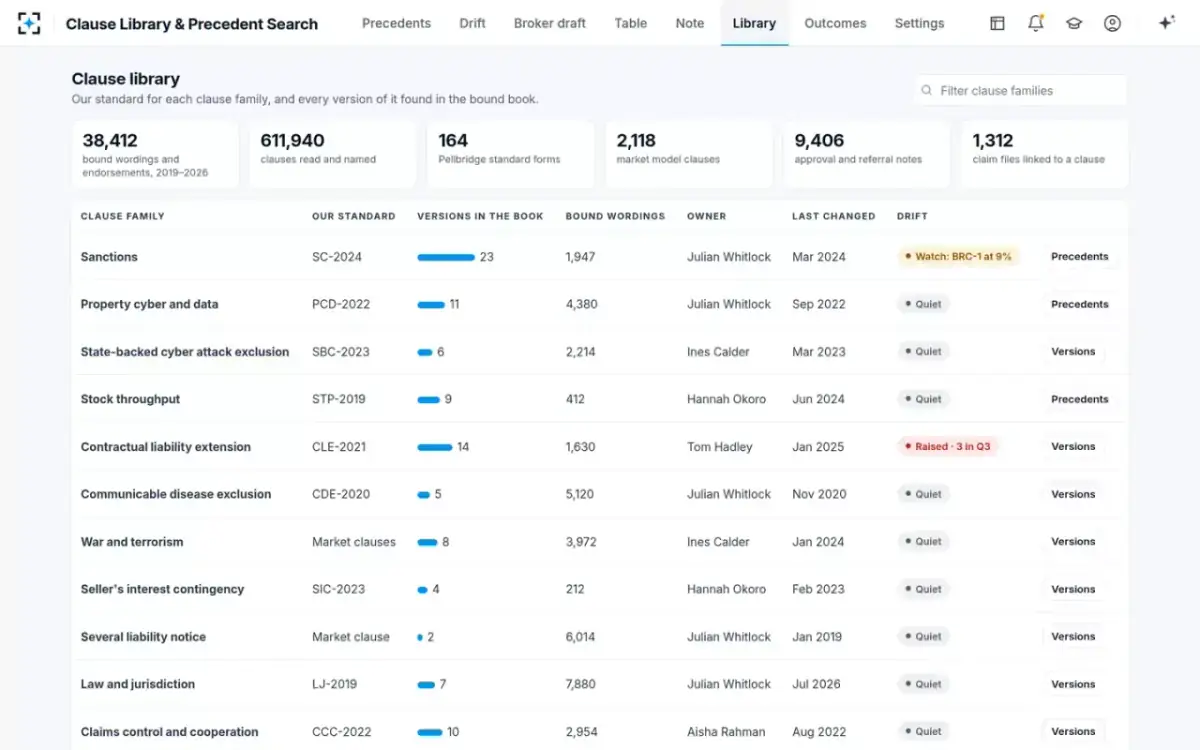
The clause library: our standard, every version in the book, and who owns each family
Where Clause Library & Precedent Search changes the head of wordings' queue
The solution changes which questions reach the head of wordings, not who decides them. Six agents do the mechanical steps in the chain: a wording reader splits every bound wording into named clauses; a precedent finder turns a plain question into a clause family, class and years; a difference marker shows the changed words; an outcome linker attaches approvals, refusals and claim outcomes; a drift tracker watches how each phrase moves across the book; and a note writer drafts the negotiation note. None of them sends anything to a broker, edits a wording or signs.
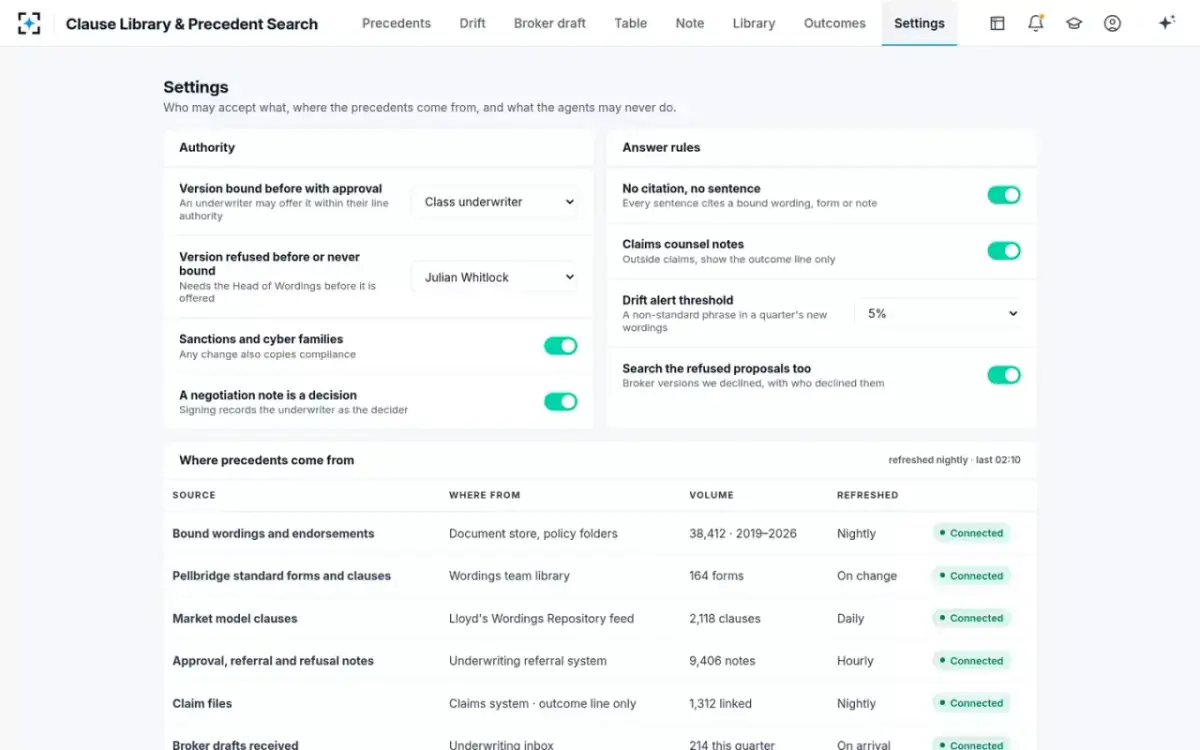
What is left for people is the judgment, under authority rules the carrier sets. A version bound before with approval can be offered by the class underwriter. A version refused before, or never bound, goes to the head of wordings before it is offered. Changes to the sanctions and cyber families also copy compliance. On the solution's fictional sample book, a 14-clause broker renewal draft came back as ten clauses matching the carrier's standard word for word, two bound before with approval, one refused before (four times) and one never seen; only the last two needed the head of wordings at all.
Authority rules as settings: who may accept what, and what the agents may never do
The effect on the queue is a filter. Questions whose answer is "yes, we have, here is the approved version" or "no, and here are the four refusals" are answered on the desk; the head of wordings sees what is genuinely new. That is also where the economics sit, and what one precedent answer costs, priced term by term, is worked through elsewhere. To see the whole flow on a sample book, start from Clause Library & Precedent Search.
Questions people ask
What is the difference between a wordings specialist and a head of wordings?
A wordings specialist drafts, compares and searches wordings and answers underwriters' questions about them. A head of wordings owns the standard forms and the authority to approve departures from them, and usually chairs any wordings committee. In smaller carriers one person does both.
Is a wordings committee required by regulation?
For EU retail and smaller commercial business, the Insurance Distribution Directive requires a product approval process that covers significant adaptations of a product, which in practice includes material wording changes. Article 25(4) excludes large risks, which take in the marine, aviation and transport classes, so for much specialty business a wordings committee is the carrier's own control rather than a legal requirement.
Do surplus lines insurers have to file their policy wordings?
Generally not for property and casualty business. Louisiana's statute, for example, bars its commissioner from requiring surplus lines insurers to file property and casualty forms and rates. That freedom is why an E&S carrier's own bound wordings are the only full history of what it agreed.
How long should an insurer keep bound wordings and approval notes?
At least as long as a claim can still be brought and argued. In England and Wales a contract claim can usually be brought for six years from when the cause of action accrues, which may be years after inception; the best-known sanctions-clause case was decided in 2018 on a policy written in 2012. A safe rule is to keep the wording and the notes behind it for the life of the policy plus that period.
Why do underwriters escalate clause changes that turn out to be standard?
Because a small textual change can be the carrier's standard, a past exception or a past refusal, and the underwriter cannot tell which from the words alone. Without a search of the bound book by clause, escalating is the safe choice, and it is why a head of wordings' queue fills with questions that have known answers.