A precedent bank is a store of documents an organisation has actually agreed, kept with the context that makes them reusable: who the other party was, what was conceded, who approved it and what happened afterwards. A clause library is a store of approved standard text, one preferred version of each clause. In insurance the difference decides who can answer the broker. The broker's question on a renewal call is rarely "what is your standard?"; it is "have you agreed this before?", and only a precedent bank, built from the carrier's bound wordings, approval and refusal notes and claim outcomes, can answer it. Most carriers have a clause library of some kind and keep their precedents in policy folders, referral emails and a few people's memory. Botminds' Clause Library & Precedent Search builds the precedent bank from what was bound and ties each precedent back to the standard in the library.
This guide defines both stores, shows which questions each answers, sets out what English law says about using negotiation history, and lists what an insurer's precedent bank should hold. Figures from the solution come from its fictional sample book of wordings.
Clause library and precedent bank: two stores, two different questions
Clause library: One approved standard per clause family, with model alternatives and drafting notes.
Precedent bank: Every version actually bound or refused, with the insured, year, approver, reason and outcome.
Clause library: "What wording do we want?"
Precedent bank: "Have we agreed this before, for whom, on whose approval, and what happened?"
Clause library: Slowly, by decision: a new standard after a court case, a regime change or a bad claim.
Precedent bank: Every day, by business: each bound wording, endorsement and refusal adds to it.
Clause library: The head of wordings, family by family.
Precedent bank: The same owner, fed by underwriters, the referral system and claims.
Clause library: Every underwriter drafts from last year's wording.
Precedent bank: The carrier concedes what it refused before, or refuses what it accepted for another insured.
What is a precedent bank?
A precedent bank is a searchable collection of documents an organisation has signed, kept so that the next person facing the same question can see what was done before. The term comes from legal practice, where a precedent is a past document used as a model for the next one. An insurer's precedent bank differs in one important respect: its value is the exact words that were bound and the circumstances in which they were agreed, not a polished model drafted from them.
That means four things kept together for each version of each clause: the bound text, the insured and context (class, year, limit), the decision (approved, refused, and by whom, with the reason), and what happened at claim. On the solution's fictional sample book, those four come from 38,412 bound wordings and endorsements, 9,406 approval and referral notes and 1,312 claim files linked to the clause they turned on. Three different systems; one precedent.
What is a clause library?
A clause library is the carrier's set of approved clause wordings, organised by family, each with a current standard and, often, approved alternatives. It is the product of decisions: the head of wordings chooses a standard, revises it after a court decision or a claim, and retires the old one. Its job is to make the carrier's preferred language easy to use and to make departures visible.
A clause library on its own cannot see the bound book. It knows the standard sanctions clause is SC-2024; it does not know that the book holds 23 versions of the sanctions clause across 1,947 wordings, as the solution's sample carrier's does. The library is the baseline; the precedent bank is everything measured against it.
What is the difference between a precedent bank and a clause library?
The clause library says what the carrier wants; the precedent bank says what it has done. They are different stores because they grow differently: the library changes by decision a few times a year, the precedent bank by business every day. They fail differently too. A missing library produces inconsistent drafting; a missing precedent bank produces inconsistent decisions, which are worse, because a broker can cite them.
The practical test is the broker's next sentence. "We'd like the US reference out of the sanctions clause" is a library question only if the answer is "that is our standard". Every other answer, "we did it once, as an exception", "we have refused it four times", "we have never been asked", comes from the precedent bank.
Which store answers which question
A broker's request passes through both stores, in a fixed order: library first, to see whether the request is the standard; precedent bank next, to see whether the variation has been agreed or refused; then a person decides within authority. The flow below is how the solution routes it.
One broker request, through the clause library and the precedent bank
Agent
Wording readerSplits the broker's draft into clauses and names each by family.
Never: Never treats the draft as bound.
Agent
Difference marker: the libraryCompares each clause with the carrier's standard; most come back word for word.
Never: Never judges whether a change is acceptable.
Agent
Precedent finder: the bankFor each changed clause, finds every bound and refused version that matches.
Never: Never shows a class the user may not see.
Agent
Outcome linkerAttaches who approved or refused each version, when, and any claim outcome.
Never: Shows claims as one outcome line outside claims.
A person decides
Class underwriter or head of wordingsOffers a version bound before with approval within authority; refers anything refused or never bound.
Never: The decision and signature stay with people.
Can negotiation notes be used to interpret a contract?
In English law, generally not to work out what the contract means, but they can be used for other purposes, which is why an insurer should keep them. The House of Lords confirmed the rule in 2009: "The rule excludes evidence of what was said or done during the course of negotiating the agreement for the purpose of drawing inferences about what the contract meant" (Chartbrook Ltd v Persimmon Homes Ltd [2009] UKHL 38, para 42). Lord Hoffmann said there was "no clearly established case for departing from the exclusionary rule" (para 41).
“It does not exclude the use of such evidence for other purposes: for example, to establish that a fact which may be relevant as background was known to the parties, or to support a claim for rectification or estoppel.”
Lord Hoffmann, Chartbrook Ltd v Persimmon Homes Ltd [2009] UKHL 38, para 42
That shapes what a precedent bank is for. Its main value is not to win an argument about construction; a court will read the bound words objectively, as the FCA test case and the 2018 sanctions clause case both did (FCA v Arch [2021] UKSC 1; Mamancochet [2018] EWHC 2643 (Comm)). Its value is consistency before the contract is made: knowing what the carrier agreed and refused, so the next decision is deliberate. And where the bound words fail to record what both sides agreed, the notes are the evidence a rectification claim would need.
There is a statutory reason to keep them too. Under the UK Insurance Act 2015, a non-consumer term that puts the insured in a worse position than the Act's default rules works only if the insurer took sufficient steps to bring it to the insured's attention before the contract was made (s.17; read in full in the guide to Insurance Act 2015 warranties). The negotiation note is where that step is evidenced.
Do insurers keep precedent banks?
Most keep the parts without the joins. The bound wording sits in a policy folder filed under the insured; the approval or refusal sits in a referral system or an email thread; the claim outcome sits in the claims system, and the link between the claim and the clause version argued usually sits only in claims counsel's head. Each part exists. What does not exist is the view that puts them together by clause, which is the only view in which they answer a broker.
Where each part of a precedent lives before a precedent bank joins them
| Part of the answer | Usually kept in | Filed by | What the underwriter can find |
|---|---|---|---|
| The bound words | Policy folders in the document store | Insured and policy number | Only if they know which insured to open |
| The approval or refusal | Referral system or an email thread | Date or sender | Rarely, unless they were copied |
| The reason | The approver's email, if written at all | Nothing searchable | Almost never |
| The claim outcome | Claims system | Claim number | Not without asking claims |
| The link from claim to clause version | Claims counsel's memory | Nothing | No |
What goes in a precedent bank for insurance?
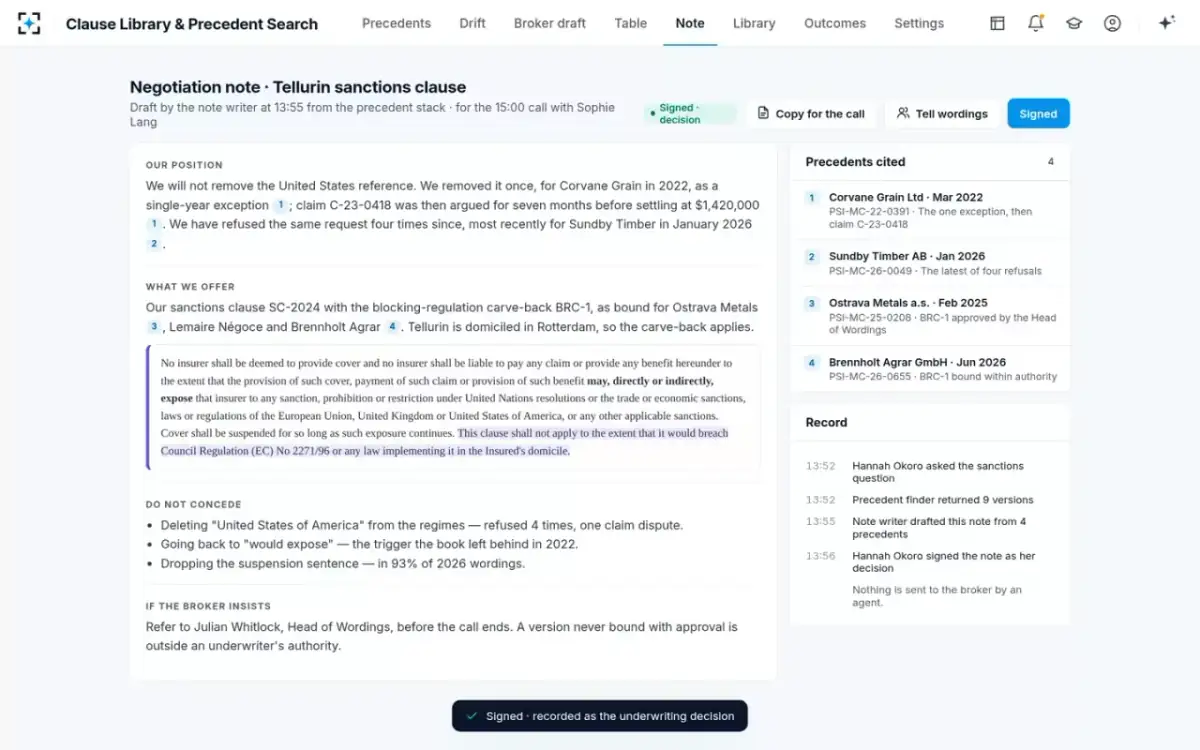
Every bound and refused version of every negotiated clause, each with its decision and outcome, and nothing that was not actually bound presented as if it had been. In practice that means bound wordings and their endorsements, read together; refused broker requests, marked as refused; approval and referral notes, attached to the version they approved; claim outcomes, attached to the version argued; and negotiation notes, signed by the underwriter who decided. Drafts and quotes belong in it only as evidence of what was asked.
A precedent bank view: one request, every class and year, bound and refused
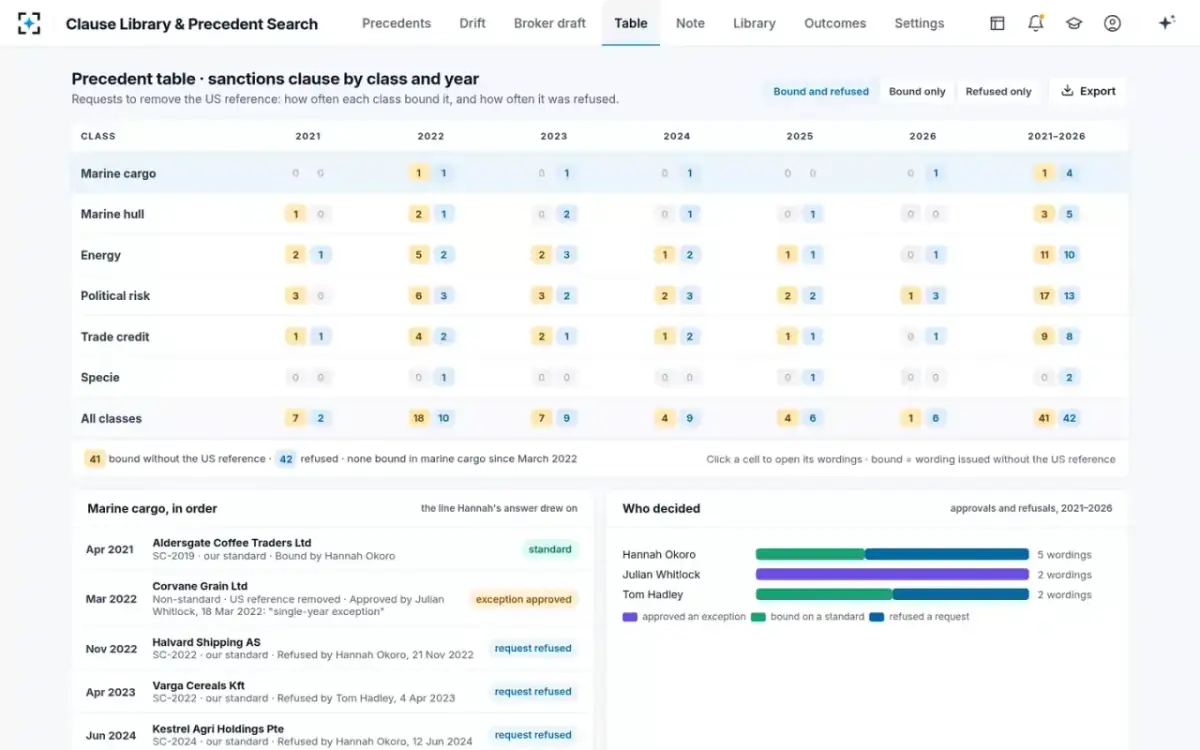
The refusals deserve emphasis because they are the first thing a folder-based system loses. A refused request leaves no bound wording behind, so a search of policy folders cannot find it. Yet it is often the most useful precedent the carrier has, and it is the one that stops the same concession being made a fifth time. Building the library from bound wordings, with refusals kept, covers how to capture them.
How law firms build precedent banks, and what insurers should borrow
In legal practice, a precedent is usually generalised before it is banked: names removed, options added, drafting notes written, so the next lawyer can adapt it. Insurers should borrow the discipline and not the method. The discipline is that a precedent is curated, owned and annotated, not just stored. The method, generalising the document, would destroy what an insurer needs, which is the exact words that were bound for a named insured and the decision behind them.
The annotation is where the two meet. A law-firm precedent carries notes on when to use each option; an insurer's precedent carries the approval or refusal, its reason, and the claim outcome. That is what turns a stored wording into an answer: "we agreed this once, for a single year, as an exception, and the claim under it was argued for seven months". One precedent entry, annotated part by part, shows the full set.
A negotiation note signed as the decision, with its four cited precedents
Do you need both a precedent bank and a clause library?
Yes, and they should be joined. The library's standard is the baseline every precedent is compared against, so the difference marker can say exactly what each bound version conceded. The precedent bank is what tells the head of wordings when the standard has drifted: when a non-standard phrase is spreading through new business, the library's standard may need to change, or the underwriters may need to stop agreeing it. To see the two joined on a sample book, start from Clause Library & Precedent Search.
Questions people ask
What does precedent bank mean?
A precedent bank is a collection of past signed documents, kept and annotated so they can be found and reused when the same issue comes up again. In law firms the documents are often generalised into models; in insurance the useful form keeps the exact bound words with the insured, the approval or refusal and the claim outcome.
Who uses a precedent bank in an insurer?
Class underwriters use it to answer brokers on the call; wordings specialists and the head of wordings use it to approve or refuse departures consistently; underwriting assistants use it to check broker drafts; claims counsel feeds it by linking argued claims to the clause version argued.
Can a past negotiation be used to change what a policy means?
Under English law, generally no: the House of Lords in Chartbrook confirmed that negotiations are excluded when a court decides what the contract means. They can be used for other purposes, such as a claim for rectification where the written terms fail to record what was agreed.
Is a precedent bank the same as a document management system?
No. A document management system stores whole documents, usually filed by insured or policy. A precedent bank is organised by clause and version across documents, and joins each version to the decision and outcome behind it, which a document store does not hold.
Should refused requests go in a precedent bank?
Yes, clearly marked as refused, with who refused and when. On the solution's fictional sample book, requests to remove the US reference from the sanctions clause had been refused 42 times and bound 41 times; a bank holding only bound wordings would have shown the 41 and hidden the refusals.