An insurance contract precedent is a clause the carrier has actually bound for a named insured, kept with the context that lets someone rely on it later: the standard it departed from, the exact difference, the insured and class, the date it was bound, who approved it and why, and what happened when a claim was made under it. The example below annotates one fictional precedent in those eight parts. Each part answers a question a broker or an underwriter will ask, and a precedent that is missing any of them can be misread: a one-year exception mistaken for a new standard, a draft mistaken for a bound wording, a concession repeated without knowing it cost the carrier a dispute. Botminds' Clause Library & Precedent Search returns each version of a clause with all eight parts, each cited to the wording, note or claim file it came from.
The precedent, the insured and the people in it are invented for this guide. The screens shown later come from the solution's own fictional sample book, which uses a different clause.
One insurance contract precedent, annotated in eight parts
Marine cargo · stock throughput · bound wording MC-24-1173 · final, filed
Velmora Timber AS · $15,000,000 any one location · bound 1 March 2024 45
Storage clause, as bound 1
This insurance covers the subject-matter insured while in storage at any one location for a period not exceeding sixty (60) thirty (30) days, subject to a sublimit of USD 5,000,000 any one location, after which cover ceases unless extended by agreement. 3
Departs from the standard 2
Standard STP-2019: storage at any one location for a period not exceeding thirty (30) days.
Decision Approved by the head of wordings, 26 Feb 2024: "Single renewal: port congestion at the loading port; revert to standard unless renewed with evidence." 67
Outcome Claim, warehouse fire on day 47 of storage: loss $2.1m, paid in full within the sublimit, 31 days to settle. 8
- 1
The bound text
Exactly as issued in the final wording, not as quoted or drafted. A precedent is these words.
- 2
The standard it departs from
The carrier's standard in force when this was bound: 30 days at any one location.
- 3
The difference
Two changes: 30 days became 60, and a $5,000,000 storage sublimit was added. Labelled as scope.
- 4
Insured and context
Who, which class, what limit: a timber exporter, marine cargo with stock throughput, $15m any one location.
- 5
Status and date
Bound, final wording filed, 1 March 2024. Not a draft, not a quote.
- 6
Approver
The head of wordings, 26 February 2024, because 60 days was outside the class underwriter's authority.
- 7
Reason
"Single renewal: port congestion at the loading port; revert to standard unless renewed with evidence." Without this, the next reader cannot tell an exception from a new standard.
- 8
Outcome
Claim, warehouse fire on day 47 of storage: $2.1m loss, paid $2.1m within the sublimit, 31 days to settle. One line; claims keeps the rest.
What is a contract precedent in insurance?
In insurance, a contract precedent is a past wording the carrier bound, used as evidence of what it has agreed before and on what terms. The word borrows from legal practice, where a precedent is a past document used as a model for the next. For an underwriter the use is narrower and sharper: when a broker asks for a change, the precedent says whether the carrier has agreed it before, for whom, with whose approval, and what followed.
A precedent is not a model clause and not a template. It is a specific version, bound for a specific insured, and its value comes from that specificity. The fictional storage clause above is useful precisely because it says 60 days, for a timber exporter, for one renewal, approved by a named person for a stated reason, with a claim that tested it. Remove any of those and it becomes a rumour that the carrier "has done 60 days before".
What is a bound wording?
A bound wording is the final policy wording the insurer issued for a risk it has accepted, together with any endorsements that amend it. It is distinct from the broker's draft, the quote, and the slip or binder issued before the wording was finalised. Only the bound wording, read with its endorsements, shows the contract as agreed.
The distinction matters for precedent because drafts and quotes are evidence of what was asked, not what was agreed. A search that returns a broker's draft containing 60 days as a precedent for 60 days has returned a request, perhaps a refused one. That is why the example's header reads "final, filed", and why the solution's wording reader does not treat a draft as bound until the final wording is filed.
What should a precedent entry contain? Eight parts
Eight parts, each answering a question someone will ask. The table sets them against the question and the place the answer is usually found.
The eight parts of an insurance contract precedent, and the question each answers
| Part | The question it answers | Usually found in |
|---|---|---|
| 1. Bound text | What exactly did we agree? | The final wording or endorsement |
| 2. Standard | What would we normally say? | The clause library, as at the bound date |
| 3. Difference | What did we give, word for word? | A comparison of 1 and 2 |
| 4. Insured and context | For whom, in what class, at what size? | The wording's schedule |
| 5. Status and date | Was it bound, and when? | The policy system and the filed wording |
| 6. Approver | Who had authority to agree it? | The referral or approval note |
| 7. Reason | Was it an exception or a new standard, and does the reason still hold? | The approval note, if anyone wrote it down |
| 8. Outcome | What did it cost when tested? | The claims system, linked to the version argued |
Parts one to five come from the wording and the policy system, and a well-kept document store holds them. Parts six to eight come from elsewhere: the referral system, someone's email, the claims file. They are also the parts that decide what the next underwriter does, which is why a search that returns only the first five is a clause finder, not a precedent search.
How do you document why a clause was accepted?
Write the reason in one or two sentences at the moment of approval, attached to the version, in words the next underwriter can test: what made this case different, and what would make it no longer apply. The fictional reason above does both: "port congestion at the loading port" says why; "revert to standard unless renewed with evidence" says when it stops. A reason like "commercial considerations" does neither.
The reason has a second audience besides underwriters. Under English law, what parties said in negotiation is not used to decide what a contract means; the House of Lords confirmed in 2009 that the exclusionary rule keeps such evidence out of the question of what the contract means, while leaving it available for a claim in rectification or estoppel (Chartbrook v Persimmon Homes [2009] UKHL 38, para 42; the passage is quoted in precedent bank vs clause library). And for a non-consumer term that puts the insured in a worse position than the Insurance Act's default rules, the insurer must show it took sufficient steps to bring the term to the insured's attention before the contract was made (Insurance Act 2015, s.17). The approval note and the negotiation note are where those steps, and what was actually agreed, are evidenced.
The decision line and the outcome line on one version: who approved it, why, and what followed
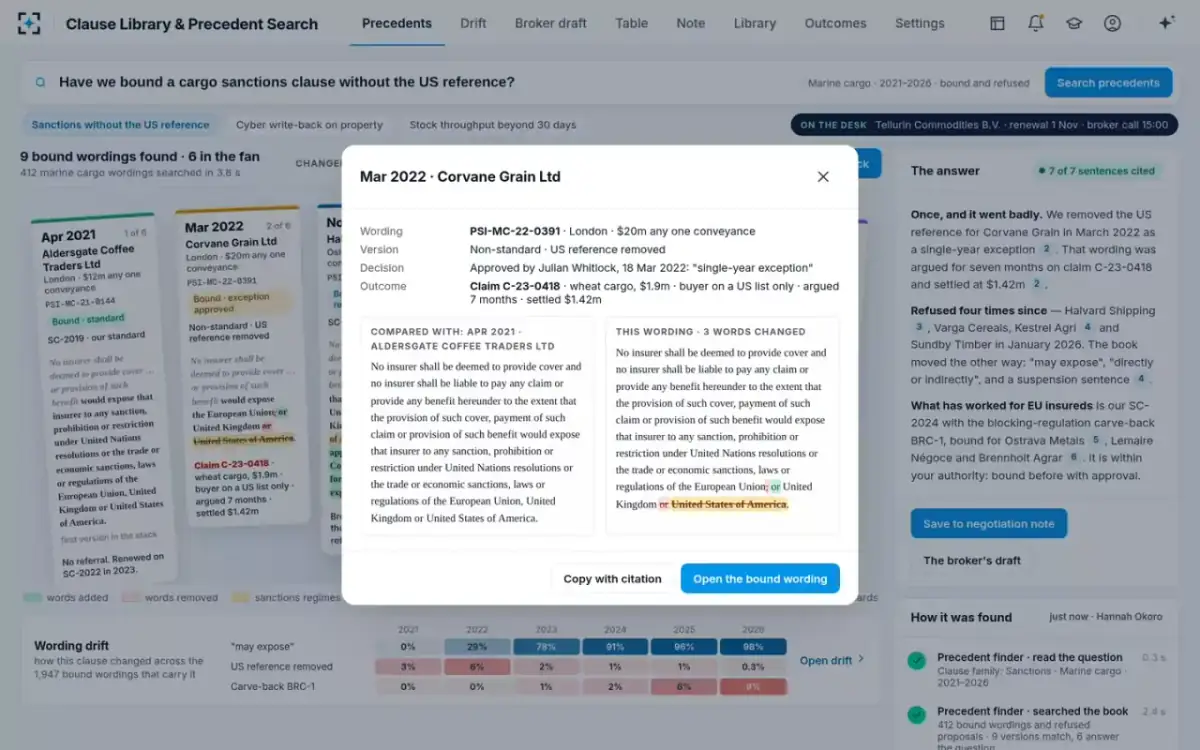
Who approved this clause before?
The precedent should name the person and the date, and say whether the approval was within someone's ordinary authority or an exception. In the fictional example, 60 days was outside the class underwriter's authority, so the head of wordings approved it. That changes what the next underwriter may do: under the default rules in Clause Library & Precedent Search, a version bound before with approval may be offered by a class underwriter within line authority, while a version refused before or never bound goes to the head of wordings first.
The example's reason adds a condition: "revert to standard unless renewed with evidence". So a second insured asking for 60 days is not automatically within authority just because the words were bound once; the reason was specific to one port and one renewal. A good precedent search shows the reason beside the approval for exactly this case, and an underwriter who reads both can tell the difference between "we have agreed this" and "we agreed this once, for a reason that does not apply to you".
How do you link a precedent to a claim?
Link the claim to the clause version that was argued or applied, not just to the policy, and show it to underwriters as one outcome line: the loss, the result and the time to settle or the days in dispute. The fictional example's outcome is uneventful: a warehouse fire on day 47, inside the extended period, paid within the sublimit in 31 days. That is still a precedent worth keeping. It shows the concession was used, and that the sublimit capped it as intended.
Claims linked to the clause they turned on, on the solution's sample book
1,312
claim files linked to the clause version they turned on
46
claims where a clause's words were argued
142days
median dispute when the version argued was non-standard, against 38 otherwise
Claims material carries privilege, so the line is deliberately short. In the solution, outside the claims team a claim linked to a clause appears only as its outcome line; claims counsel's notes stay with claims. The underwriter needs to know that a concession led to a dispute, and roughly what it cost; they do not need the legal analysis. Courts read wordings long after binding, and in England a contract claim can usually be brought for six years from when the cause of action accrues (Limitation Act 1980, s.5), so the link has to survive staff changes and system migrations.
What is a negotiation note?
A negotiation note is the underwriter's written position for a broker conversation: what the carrier will offer, the wording it will offer quoted exactly, what it will not concede, and whom to refer to if the broker insists, each point cited to a precedent. Once signed, it becomes a decision in its own right, and so a precedent for the next conversation.
A negotiation note built from cited precedents, ready for the broker call
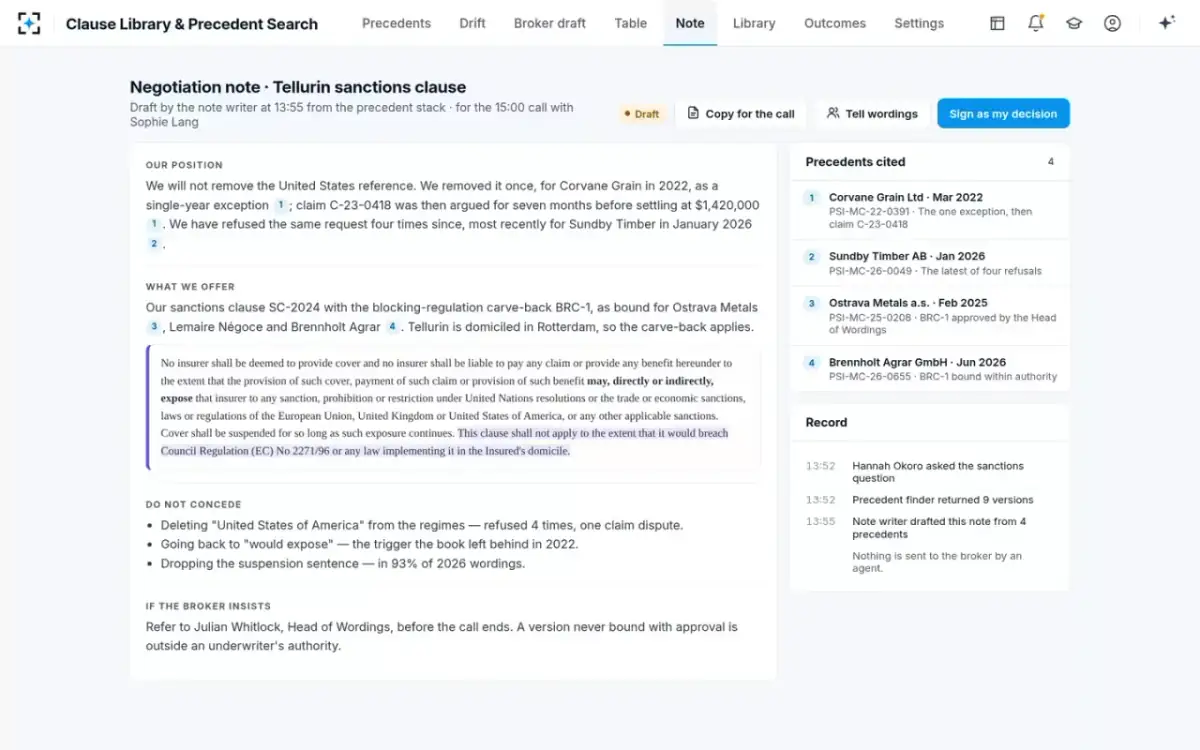
Applied to the fictional example, the next broker who asks for 60 days' storage for a different timber exporter would get a note along these lines: we have agreed 60 days once, for a single renewal, because of documented port congestion, with a $5m sublimit; we offer 30 days, or 45 with the same sublimit if congestion is evidenced; we will not concede 60 days without a sublimit; refer to the head of wordings if the broker insists. Each clause in that note cites a precedent, and the signature makes it the next one.
Before relying on a precedent, check these five things
- It is a bound wording, read with its endorsements
Not a draft, a quote or a slip. Check the status and the filing date.
- You are comparing with the standard in force at the time
A precedent from 2019 departed from the 2019 standard; the difference against today's may be larger or smaller.
- The approver had authority, and you can see who it was
An unapproved departure is not a precedent; it is a mistake that has not been tested.
- The reason still applies to your case
One renewal, one port, one insured: a reason tied to circumstances does not travel.
- You have looked at the outcome line
A concession that led to a long dispute is a precedent for caution, not for agreement.
The same eight parts apply to every family, from storage periods to the sanctions clause, where the courts have shown how much a few words can carry (FCA v Arch [2021] UKSC 1 on disease clauses; the sanctions clause guide on "would expose"). For how a bank of such entries differs from a library of standards, see precedent bank vs clause library. To see the eight parts returned for every version of a clause on a sample book, start from Clause Library & Precedent Search.
Questions people ask
Is a slip or binder a precedent?
It is evidence of what was agreed at placement, and it can matter, but the bound wording read with its endorsements is the contract the carrier will be held to. Where the slip and the wording differ, the precedent search should show both and say which is final.
How long should a precedent be kept?
At least as long as a claim under the wording can be brought and argued, and with its approval note and outcome line kept for the same period. In England and Wales, contract claims can usually be brought for six years from when the cause of action accrues, which can be well after the policy expires.
Can an underwriter offer a clause just because it was bound before?
Only if it was bound with the right approval and the reason still applies. Under the default rules in Clause Library & Precedent Search, a version bound before with approval may be offered within line authority; a version refused before or never bound needs the head of wordings first.
What is the difference between a precedent and a market model clause?
A market model clause is published wording intended for general use. A precedent is the version a particular carrier actually bound for a particular insured, which may be the model clause unchanged, a variation of it, or something written from scratch, with the decision and outcome attached.
Should a refused request be kept as a precedent?
Yes, marked as refused, with who refused it, when and why. A refusal is the precedent that stops the same concession being made again, and it is the one most often lost, because a refused request leaves no bound wording behind.