To build a clause library an insurer can rely on in negotiation, start from the wordings it has already bound rather than from its templates. Read every bound wording and endorsement, split each into clauses, name each clause by family and version, and attach to each version the approval or refusal behind it and any claim it was argued in. Then give each clause family an owner and write down who may offer which version. A library built this way answers the question brokers actually ask, "have you agreed this before?", where a template library can only say what the carrier would prefer. Botminds' Clause Library & Precedent Search does the reading, splitting and linking with agents; the wordings team decides the families, the standards and the authority rules. This guide gives the fields, the labelling method, the owners and a twelve-week plan from first connection to the first cited answer.
The plan is the one we run for a mid-sized specialty book; a larger or messier book takes longer, and the guide says where. Figures from the solution come from its fictional sample book of wordings.
Who does what while the clause library is built
Today
Owns the standard forms and approves departures, from memory and email.
With agents
Confirms the clause families and the carrier's standard for each; signs off the authority rules.
Still theirs: Accountable for the library and every family's standard.
Today
Answer precedent questions by searching policy folders.
With agents
Review the agents' clause splits and family names on samples; settle disputed labels; write worked examples.
Still theirs: Responsible for curation and label quality.
Today
Ask the wordings team and wait.
With agents
Write the test questions from real broker requests and score the answers in the pilot.
Still theirs: Consulted on what a useful answer looks like.
Today
Hold outcomes the underwriters never see.
With agents
Link argued claims to the clause version argued; decide what the outcome line may show.
Still theirs: Owns the privilege boundary.
Today
Sees sanctions and cyber changes after binding, if at all.
With agents
Is copied on any change to those families by setting.
Still theirs: Informed on sensitive families.
Today
Run the document store and referral system separately.
With agents
Connect the six sources read-only and agree refresh times.
Still theirs: Responsible for access and retention.
How do you build a clause library? Start from bound wordings, not templates
Start from bound wordings because they are the only direct evidence of what the carrier actually agreed. Templates show intent; bound wordings and their endorsements show what was signed, with every variation a broker negotiated. In a specialty book the two are different sizes by orders of magnitude. The solution's fictional sample carrier has 164 standard forms and 38,412 bound wordings and endorsements from 2019 to 2026, which its wording reader split into 611,940 named clauses.
Starting from templates has a further cost: it hides the variations, which are where the risk is. A library built top-down from the standard form will hold one sanctions clause; the bound book of the same sample carrier held 23 versions of it across 1,947 wordings. Every one of those versions is a precedent a broker can cite back, whether or not the carrier's library knows it exists.
There is a legal reason to know the variations too. Under the UK Insurance Act 2015, a term in a non-consumer policy that puts the insured in a worse position than the Act's rules on fair presentation, warranties or fraudulent claims has no effect unless the insurer has met the transparency requirements, including that the term is clear and unambiguous about what it does (s.17; s.16). A library that flags those terms by version shows which bound wordings depend on that test being met.
What goes into an insurance clause library?
Each entry is one version of one clause, with the context that makes it a precedent. The table lists the fields; the first five come from the wording itself, the rest from other systems, and the rest are what turn a clause store into something an underwriter can act on.
The fields of one clause version in an insurance clause library
| Field | Where it comes from | Why it matters |
|---|---|---|
| Clause family and version | Named when the wording is split | Lets every insured that agreed the same words be found together. |
| Clause text, exactly as bound | The final, issued wording or endorsement | A precedent is the words, not a summary of them. |
| Difference from the standard and the version before | Computed word by word | Shows what was actually conceded. |
| Insured, class, year, limit, wording reference | The wording's schedule | Context a broker will ask about: for whom, and at what size. |
| Status: standard, bound with approval, refused, draft | Wording plus referral system | Drafts and refusals are evidence of what was asked, never of what was agreed. |
| Approver, date and reason | Referral or approval note | A version bound with approval may be offered within authority; the reason tells the next reader whether it still holds. |
| Claim outcome line | Claims system, linked to the version argued | Loss, result, days in dispute: the price of the concession. |
| Flags: contracting-out term, sanctions or cyber family, market model clause | Named at split; confirmed by wordings | Routes changes to compliance and marks terms that need the transparency test. |
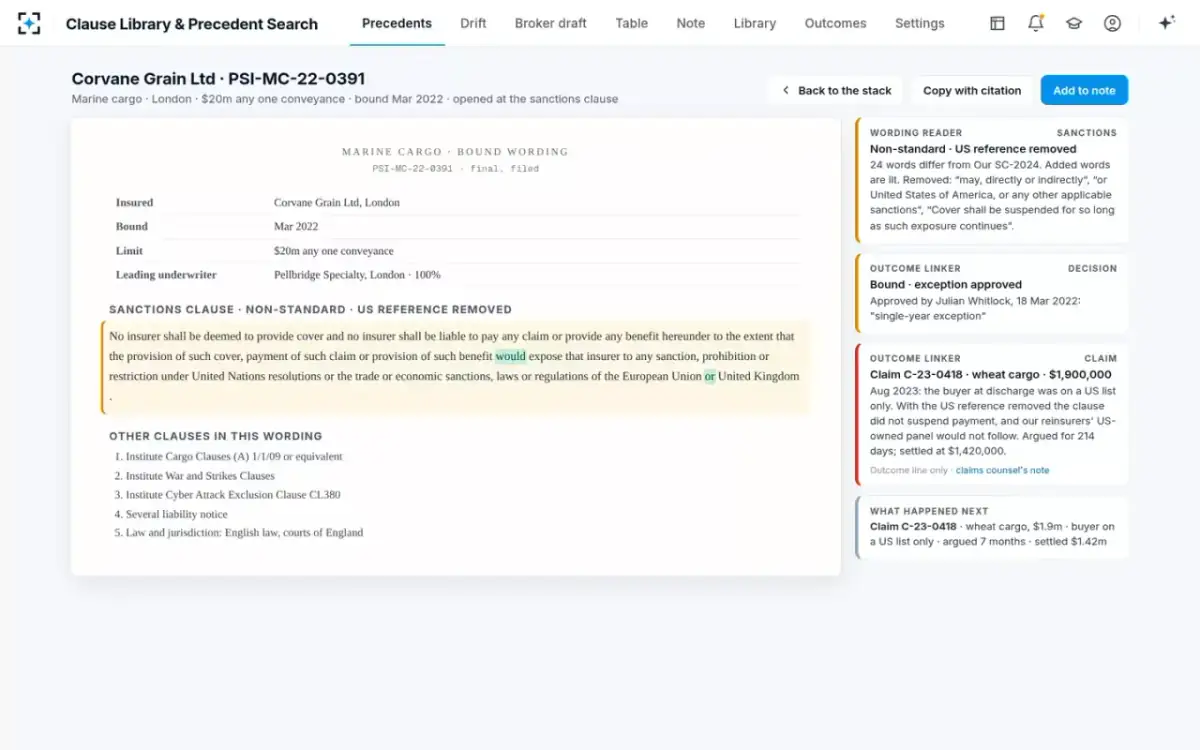
One bound wording opened at its sanctions clause, with the version, the decision and the claim in the margin
Should a clause library include refused clauses?
Yes, as their own status, clearly marked, and never as precedents of agreement. A refusal is often the most useful answer a carrier has: on the solution's fictional sample book, requests to remove the United States from the sanctions clause had been bound 41 times across all classes and refused 42 times, and the refusals showed that none had been bound in marine cargo since March 2022. A library holding only what was bound would have shown 41 precedents for the change and none against.
Keeping refusals has two conditions. They must carry who refused and when, or they become rumour. And they must be distinguishable at a glance from bound versions, in the data and on screen, so no one cites a refused draft as something the carrier agreed. The same applies to broker drafts that were never answered: the solution treats a draft as unbound until the final wording is filed.
How do you label clauses in a clause library?
Label clauses with a short list of families, a version for each distinct wording within a family, and written definitions with worked examples for every label. The definitions are the expensive part, and the research benchmark for contract clauses shows how expensive. Building CUAD, a dataset of 510 commercial contracts labelled for 41 clause categories, took law-student annotators "70-100 hours" of training, more than 100 pages of rules, and verification of each annotation "by three additional annotators" (Hendrycks et al., CUAD, NeurIPS 2021).
What it took to label contract clauses consistently, in one research benchmark
41
clause categories, chosen as those lawyers pay particular attention to
70–100h
of training for each law-student annotator before labelling
3
additional annotators verifying each annotation
An insurer's list is shorter and deeper. The solution's sample carrier works with twelve families, among them sanctions, property cyber and data, state-backed cyber attack exclusion, stock throughput, contractual liability extension, communicable disease exclusion, war and terrorism, and law and jurisdiction. Within a family, versions multiply; the definitions that matter most are the change types (scope, trigger, sanctions regime, cosmetic), because those decide what a reader is shown first. Test the definitions the way the research did: two specialists label the same sample independently and the disagreements become worked examples. Measuring agreement between two wordings readers gives the arithmetic.
Who owns a clause library?
The head of wordings owns it, in the sense that matters: accountable for each family's standard and for the authority rules that decide who may offer which version. Specialists curate; underwriters and claims feed it; IT runs the connections. Ownership by family is better than ownership of the whole, because families change at different speeds and for different reasons, and an owner per family is who the drift alert goes to.
Ownership also covers any vendor tool in the chain. New York's regulator told insurers in 2024 that responsibility for understanding a third-party underwriting tool stays with the insurer (NY DFS Circular Letter No. 7 (2024); the AI vendor risk assessment questionnaire covers what to ask). For a clause library, that means the owner must be able to see how each answer was found and which sources it cited, not only the answer.
How long does it take to build a clause library? A twelve-week plan
About twelve weeks for a mid-sized specialty book with its wordings in a document store and its referrals in one system; add time for paper-era wordings, several referral systems or claims data that has never been linked to wordings. The long pole is not reading the wordings, which agents do quickly; it is the people's decisions on families and standards, and the linking of claims.
A twelve-week build: the agents read in days, the decisions take weeks
- Connectwk 1–2
- Read the bookwk 3–5
- Familieswk 6–7
- Linkwk 8–9
- Testwk 10–11
- Livewk 12
Weeks one and two connect six sources read-only: bound wordings and endorsements, the standard forms, the market model clauses the carrier uses, the referral system's approval and refusal notes, the claims system's outcome lines, and the underwriting inbox for broker drafts. Weeks three to five read the back book; specialists review the agents' splits on a sample from each class. Weeks six and seven are the head of wordings' time: confirm the families and the standard version of each. Weeks eight and nine attach decisions and outcomes; claims decides what the outcome line shows. Weeks ten and eleven run the forty-question test, built from real broker requests and including questions whose true answer is "never"; the test is set out in the AI clause library guide. In week twelve the first cited answers go to a pilot desk.
How long should a clause library keep wordings and the decisions behind them?
At least as long as a claim on the wording can still be brought and argued, which can be longer than a retention schedule keyed to policy expiry. In England, a claim in simple contract must be brought within six years of the date the cause of action accrued (Limitation Act 1980, s.5; why that sets the record-keeping horizon is covered in head of wordings), and a cause of action under a policy can accrue years after inception. The English sanctions-clause case on a 2012 cargo policy was decided in 2018 (Mamancochet Mining v Aegis [2018] EWHC 2643 (Comm)).
The decision notes need the same life as the wording. A wording kept for ten years with its approval note deleted after three is a precedent with its reason cut off; the next underwriter can see that the carrier agreed a change but not whether it was a one-year exception or a new standard. Retention is a decision for the carrier's records and legal teams; the clause library's job is to keep the wording, the decision and the outcome together for as long as any of them is kept.
How do you keep a clause library current?
Keep it current by reading new bound wordings as they are filed, watching how each family's language moves, and reviewing a family when something outside the book changes. The first is mechanical: the solution reads the document store nightly and the referral notes hourly. The second is the drift tracker's job: it measures each phrase's share of a quarter's new wordings and alerts the family owner when a non-standard phrase passes a threshold, 5% by default on the sample.
Wording drift: how each phrase of one clause moved across the book, year by year
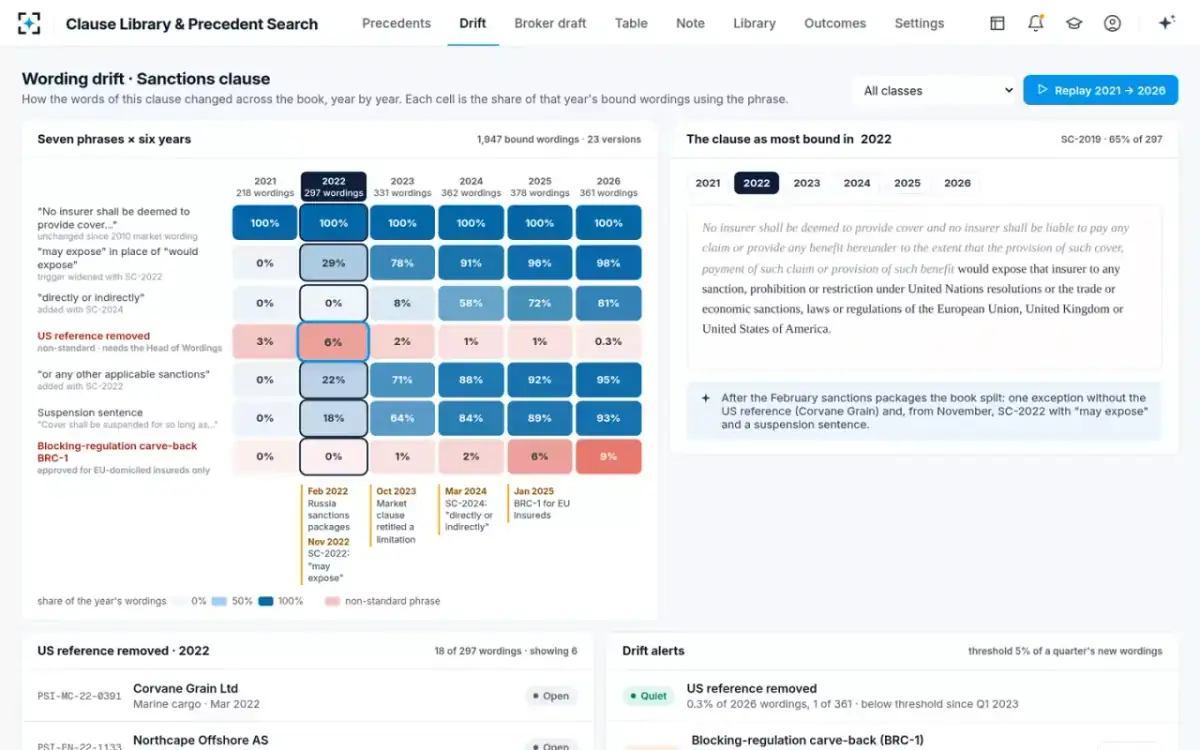
The third trigger is external: a court decision on a clause the carrier uses, a new sanctions regime, a market model clause revised, a systemic event that exposes an exclusion. European supervisors have warned that after systemic events insurers often rewrite exclusions, or add new ones, without running them through product oversight and governance (EIOPA supervisory statement on exclusions related to systemic events, 2022). A clause library makes that review traceable: which versions were in force, for whom, and what replaced them. The communicable disease exclusion after the pandemic is the worked case.
Before the first cited answer goes to the desk
- Every class in scope has its bound wordings and endorsements read
Check counts against the policy system; a missing year is a missing precedent.
- Each clause family has an owner and a confirmed standard
The drift alert and every never-seen request need somewhere to go.
- Refusals carry who and when; drafts are marked unbound
The two most common ways a library misleads.
- Authority rules are written as settings
Who may offer a version bound before; who must see a version never bound; which families copy compliance.
- Claims has agreed the outcome line
Loss, result, days in dispute; privileged notes stay with claims.
- The forty-question test passed with two scorers
Including the "never" questions: the tool must say when there is no precedent.
Once those six are true, the library is answering the question it was built for. To see the reading, linking and drift on a sample book, start from Clause Library & Precedent Search.
Questions people ask
What is the difference between a clause library and a template library?
A template library holds whole standard documents for drafting. A clause library holds clauses as separate, named units with versions, so the same clause can be found across many documents. Built from bound wordings, it also shows every variation actually agreed, which a template library cannot.
Can we build a clause library in Word or on a shared drive?
You can store standard clauses that way, and many teams do. What a document folder cannot do is split thousands of bound wordings into clauses, compare versions word by word, or attach approvals, refusals and claim outcomes to each version, so it answers "what is our standard?" but not "have we agreed this before?".
How many clause families should an insurer have?
Enough to cover the clauses that are negotiated and argued, and few enough that each has an owner. The solution's sample carrier uses twelve; the CUAD research benchmark used 41 categories for general commercial contracts. Start with the families brokers ask about most, and add families when the questions arrive.
Should endorsements be in the clause library?
Yes, linked to the wording they amend. Endorsements are where many variations are agreed, and EIOPA, the EU insurance supervisor, has noted that unclear exclusions in cyber endorsements are one source of unintended exposure (the affirmative vs non-affirmative cyber guide quotes it). A wording read without its endorsements is not the contract that was bound.
Who should approve a new standard clause?
The head of wordings, usually with a wordings committee that includes senior underwriters and compliance, and claims for families often argued at claim. For EU business other than large risks, the Insurance Distribution Directive's product approval process applies to significant adaptations of a product, which can include wording changes.