The sanction limitation and exclusion clause is the London market's standard sanctions clause. It says that no insurer is deemed to provide cover, or is liable to pay a claim, "to the extent that" doing so "would expose" the insurer to any sanction, prohibition or restriction under United Nations resolutions or the trade or economic sanctions of the European Union, the United Kingdom or the United States. In 2018 the English Commercial Court read "would expose" to mean that payment must actually be prohibited by one of those laws, not merely risky, and held that the clause suspends the insurer's liability while the prohibition lasts rather than extinguishing the claim. US sanctions guidance points the other way on that second point. A book that carries several versions of this clause, with regimes dropped, triggers reworded or carve-backs added, therefore carries several different answers to the same claim. Botminds' Clause Library & Precedent Search finds every version a carrier has bound, marks the words that changed, and shows who approved each one and what happened at claim.
This guide sets out the clause's text, the 2018 decision word by word, OFAC's expectations, an aviation sanctions clause read by the same court in 2025, and the EU Blocking Regulation behind many carve-backs. It is an explanation of public sources, not legal advice on any policy.
“The clause provides that the insurer is not liable to pay a claim where payment would be prohibited under one of the named systems of law and thus ‘would expose’ the Defendants to a sanction.”
Mr Justice Teare, Mamancochet Mining v Aegis Managing Agency [2018] EWHC 2643 (Comm)
What is a sanction limitation and exclusion clause?
It is a clause that limits an insurer's obligations wherever performing them would breach sanctions, so that the policy never requires an unlawful payment. The version tested in court was, in the judge's words, "on standard wording developed by the Joint Hull Committee (of the London market) and adopted by the Joint Cargo Committee", and read in full:
"No (re)insurer shall be deemed to provide cover and no (re)insurer shall be liable to pay any claim or provide any benefit hereunder to the extent that the provision of such cover, payment of such claim or provision of such benefit would expose that (re)insurer to any sanction, prohibition or restriction under United Nations resolutions or the trade or economic sanctions, laws, or regulations of the European Union, United Kingdom or United States of America."
Four parts of that sentence do the work, and each is a place where versions in a real book diverge. The three things limited: cover, claim payments and other benefits. The connecting words, "to the extent that", which make the limit proportionate rather than all-or-nothing. The trigger, "would expose". And the list of regimes: UN, EU, UK and US. People search for the clause by its market reference numbers; whatever the reference, these four parts are what a wordings team should compare.
What did the court decide in Mamancochet?
It decided that the insurers had to pay. A marine cargo policy governed by English law covered two cargoes of steel billets worth "some US$3.8 million", shipped from Russia to Iran in August 2012 and stolen from bonded storage in Iran between September and October that year. The claim was made in March 2013. The underwriters never disputed that the claim was valid in principle; they "resisted payment on the basis of the 'Sanction Limitation and Exclusion Clause' in the Policy" (Mamancochet Mining v Aegis Managing Agency [2018] EWHC 2643 (Comm)).
Thirty underwriters were sued in May 2018; nineteen settled. Of the eleven left, nine (UK entities owned or controlled by US persons) relied on both US and EU sanctions, and two on EU sanctions alone. The court decided three questions: what "would expose" means, whether payment would in fact expose the insurers to US or EU sanctions, and whether the EU Blocking Regulation stopped them relying on the clause. On the facts, payment before 11.59 pm on 4 November 2018 was not prohibited by US or EU law, so the claimant was entitled to be paid.
One cargo claim through six years of changing sanctions
- Loss and claim
- Payment prohibited by US and EU rulesMar 2013–Jan 2016
- Payment lawful but unpaid; judgment October 2018Jan 2016–Oct 2018
What does “would expose” mean in a sanctions clause?
On the reading the court adopted, "would expose" means that the payment would be prohibited by one of the named systems of law; a risk that a regulator might wrongly think it prohibited is not enough. The insurers argued that the clause applied if they were "at risk of being sanctioned by OFAC for paying a claim". The claimant argued that the insurers had to show, on the balance of probabilities, that payment "would put them in breach of the applicable sanctions". The judge preferred the claimant's reading.
His reasoning turned on the words and on what each side would have accepted. Before a sanction can lawfully be imposed "there must be conduct which is prohibited"; and "unless the conduct is prohibited, in law there can be no sanction". If the parties had meant risk, "I would have expected them to have made such intention clear, perhaps by referring in terms to 'exposure to the risk of being sanctioned'". And while an insurer might welcome a right to refuse when payment was merely risky, "clear words would be required" to show the assured had agreed to that.
That passage is why a single word in a broker's draft deserves a precedent search. A broker's draft, or a carrier's own revised standard, can move the trigger, for example by replacing "would" with "may" or adding words about exposure "directly or indirectly". Mamancochet did not rule on any of those wordings, and no decision in this guide's sources does. What the judgment does establish is the default reading of the standard words, and that a different result needs different words, clearly chosen. A wordings team should know which versions in its book carry which trigger, and why each was agreed.
Does a sanctions clause cancel cover or suspend it?
On the English reading of the standard clause, it suspends. The insurers argued that once payment was prohibited the claim was extinguished for good. The judge disagreed: "There is nothing in the sanctions clause which purports to extinguish a claim." The words "to the extent that" convey that "for as long as payment would expose the insurer to sanction, the insurer is not liable to pay", so when the prohibitions were lifted in 2016, the insurer was again liable. "In the meantime, that liability was suspended."
The court accepted that this leaves liability potentially open-ended, "subject to the effect of limitation", and suggested a practical answer: an assured can issue proceedings to stop limitation running, and the court can stay the claim while payment is prohibited and lift the stay when sanctions are relaxed. "The Defendant insurers will be able to account for the suspended liability in their books." For a wordings team the consequence is long-lived precedent. A clause agreed in 2012 can still be deciding a payment six years later, and the version of the clause in the policy at inception is the one that counts.
What does OFAC say about sanctions clauses in insurance?
OFAC, the US Treasury's sanctions office, applies to insurers throughout the life of a policy, from application to claim payment, and its guidance on clause wording differs from the English reading on suspension. In its insurance FAQs, OFAC says that "The best and most reliable approach for issuing policies with global risk coverage without violating U.S. sanctions law is to include a clause ensuring there is no coverage for risks that violate U.S. sanctions law", and that "The exact wording of such clauses may vary depending on the type of policy (e.g., open marine cargo policies versus personal accident policies)" (OFAC FAQ 102, updated 13 November 2024).
It then adds: "Insurers should also ensure such clauses do not create future economic benefit for a sanctioned person or jurisdiction by allowing for indemnification if or when relevant prohibitions no longer apply; there should be no coverage at the time of loss if, at that time, such coverage would have violated U.S. sanctions law." Set beside Mamancochet, that is the opposite emphasis: the English court read the standard words as suspending a claim that revives when sanctions lift; OFAC asks for clauses under which a claim that was prohibited at the time of loss never revives. Where a clause is not commercially feasible, OFAC says the insurer "should apply to OFAC for a specific license prior to issuing the global insurance policy" (FAQ 103).
The two texts answer different questions, one about what an English-law contract means and the other about what a US regulator expects, and a carrier subject to both has to satisfy both. That is a drafting decision for counsel. The precedent question for the wordings team is simpler and harder: which bound wordings in the book suspend, which exclude, which say nothing about time, and who agreed each.
Is the sanctions clause the same in every policy? Marine and aviation compared
No. Different markets use different standard clauses, and the same court has now read two of them. In the 2025 Russian aircraft lessor claims, the relevant policies incorporated "the market standard ‘Sanctions and Embargo Clause’, AVN 111", which removes cover where "providing coverage to the Insured is or would be unlawful because it breaches an embargo or sanction", and adds that where cover is lawful "but payment of a valid and otherwise collectable claim may breach an embargo or sanction, then the Insurer will take all reasonable measures to obtain the necessary authorisation to make such payment" (AerCap Ireland v AIG Europe [2025] EWHC 1430 (Comm), para 998).
Three texts on the same problem: the marine clause, the aviation clause and OFAC's expectation
Marine: the clause read in Mamancochet (2018): "would expose" the insurer to a sanction; read as: payment actually prohibited.
Aviation: AVN 111, read in AerCap (2025): Cover "is or would be unlawful because it breaches an embargo or sanction".
Marine: the clause read in Mamancochet (2018): Cover, claim payments and other benefits, "to the extent that" the trigger is met.
Aviation: AVN 111, read in AerCap (2025): Coverage, defence and payment, "to the extent that it would be in breach of such law or regulation".
Marine: the clause read in Mamancochet (2018): Suspends: liability revived when the prohibitions were lifted in 2016.
Aviation: AVN 111, read in AerCap (2025): Where cover is lawful but payment may breach sanctions, the insurer must seek authorisation.
Marine: the clause read in Mamancochet (2018): UN, EU, UK and US, listed in the clause.
Aviation: AVN 111, read in AerCap (2025): Any law or regulation applicable to the insurer at inception or later.
Marine: the clause read in Mamancochet (2018): Payment not prohibited before 4 November 2018; insurers liable.
Aviation: AVN 111, read in AerCap (2025): US and EU sanctions defences rejected; insurance to non-Russian lessors not prohibited.
Marine: the clause read in Mamancochet (2018): No indemnification "if or when relevant prohibitions no longer apply".
Aviation: AVN 111, read in AerCap (2025): No coverage at the time of loss if coverage would then have violated US sanctions law.
In the aviation case the war risks insurers relied on US sanctions and one also on EU sanctions; none relied on UK sanctions. The court held that the US export rule invoked "does not prohibit either the insurances at issue here, or the payment of any indemnity under them", and that the EU regulation's ban on insurance "in relation to goods and technology" for use in Russia did not reach insurance provided to non-Russian lessors; it rejected both defences (paras 1006 and 1013–1019). The common thread with 2018 is that an English court asks whether payment is actually prohibited under the named law, read on its own terms; the difference is in what each clause promises when it is.
What is the Blocking Regulation, and why do carve-backs exist?
The EU Blocking Regulation forbids EU persons from complying with certain listed foreign sanctions laws, and a carve-back is the sentence some sanctions clauses add so that the clause does not apply where relying on it would breach that regulation. Article 5 of Council Regulation (EC) No 2271/96 says: "No person referred to in Article 11 shall comply, whether directly or through a subsidiary or other intermediary person, actively or by deliberate omission, with any requirement or prohibition ... based on or resulting, directly or indirectly, from the laws specified in the Annex" (Regulation 2271/96, as quoted in Mamancochet). The Annex was extended to US sanctions on Iran from 7 August 2018.
The claimant in Mamancochet argued that relying on the clause to refuse payment because of US sanctions would itself be prohibited compliance. Because the court found that US law did not prohibit payment, it did not have to decide, but the judge said he saw "considerable force" in the insurers' answer: "the Blocking Regulation is not engaged where the insurer's liability to pay a claim is suspended under a sanctions clause such as the one in the Policy". That remark was obiter, not a ruling. A carve-back settles the question in the wording, for the insureds it covers, instead of leaving it to a remark.
A negotiation note quoting a sample standard clause with its blocking-regulation carve-back
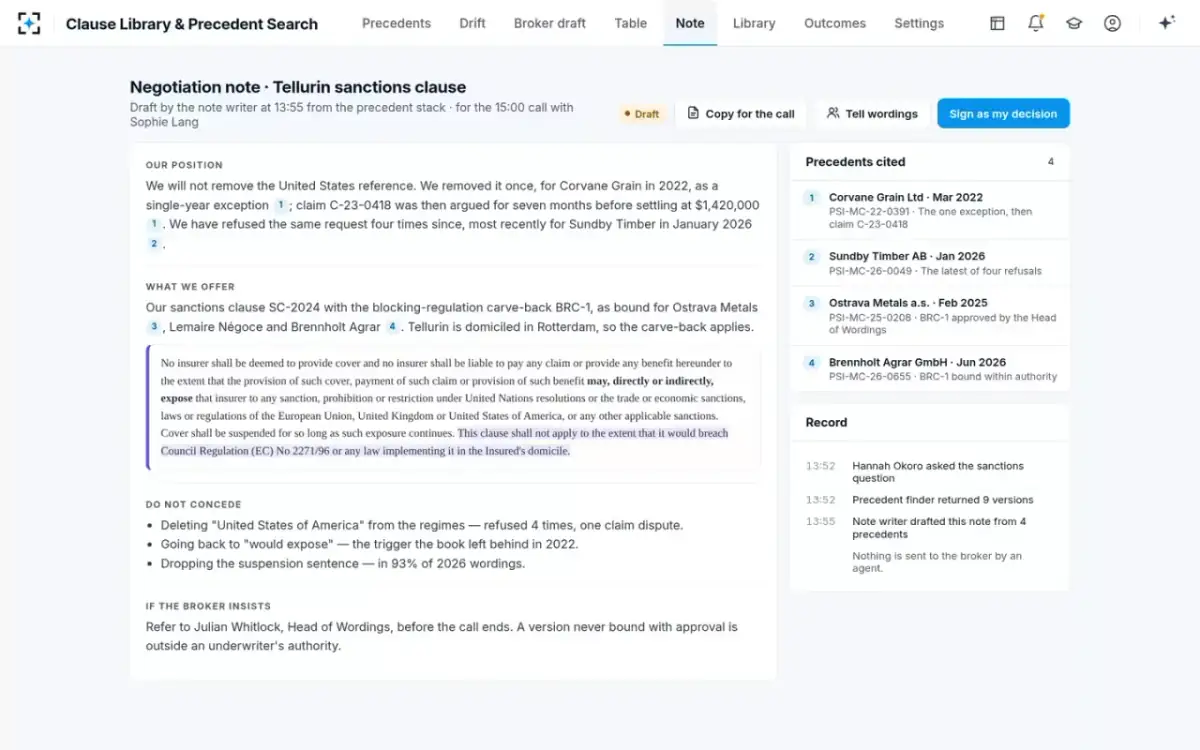
What a precedent search should show on sanctions clauses
A precedent search on sanctions clauses should show, for every bound version, the four parts the cases turn on and the decision behind each departure. The table is the minimum; compliance should be copied on any change to the family.
What to compare across every sanctions clause version in a book
| Part of the clause | What varies between versions | Why it matters, from the sources |
|---|---|---|
| Trigger | "would expose", "may expose", "is or would be unlawful", added words on direct or indirect exposure | Mamancochet read "would expose" as actual prohibition; the judge said a risk-based clause would need clear words. |
| Regimes | UN, EU, UK, US listed; one dropped; "any other applicable sanctions" added | A regime dropped from the list is a regime the clause no longer answers to, whatever the insurer's own legal obligations. |
| Time | Silent; an express suspension sentence; express exclusion with no revival | Mamancochet read the standard words as suspending; OFAC FAQ 102 asks for no indemnification after prohibitions lift. |
| Carve-back | None; blocking-regulation carve-back for EU-domiciled insureds | The Blocking Regulation point in Mamancochet was left undecided. |
| Authorisation | Silent; a duty to seek licences | AVN 111 obliges the insurer to take "all reasonable measures" to obtain authorisation. |
| Decision | Standard; approved exception; refused | An exception approved once is a precedent the next broker will cite. |
One version against the one before it: a regime struck from the list, and what followed
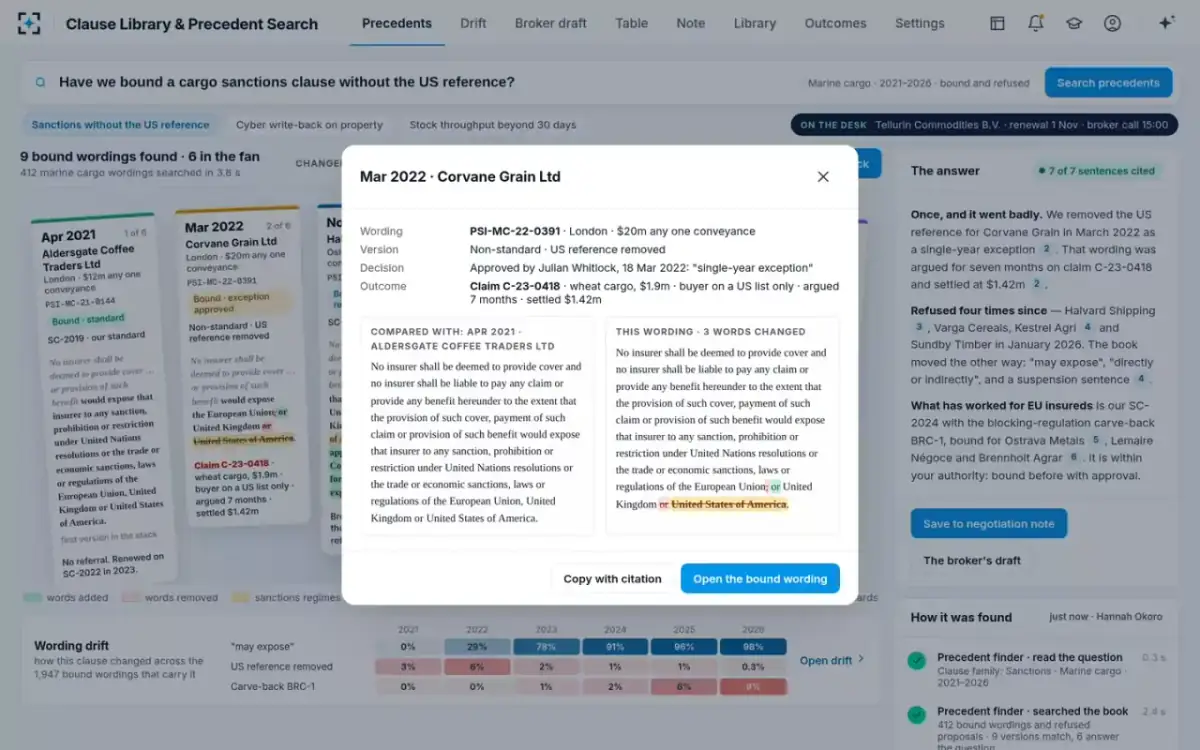
The fictional sample shows why the decision column matters most. A single approved exception that dropped a regime became, two years later, a claim argued over that very omission; the carrier refused the same request four times afterwards. A broker who knows about the exception will cite it; an underwriter who can see the claim behind it can answer. One bound clause, annotated part by part, works through a precedent entry of this kind in full, and who decides a change like this is covered in the guide to the wordings team. For how a carrier screens the risks themselves, rather than the clause, see the guide to who must comply with OFAC. To see sanctions clause versions on a sample book, start from Clause Library & Precedent Search.
Questions people ask
What does “to the extent that” do in a sanctions clause?
It makes the limit proportionate and, on the English reading, temporary. In Mamancochet the court read the words to mean that "for as long as payment would expose the insurer to sanction, the insurer is not liable to pay", so the liability was suspended while prohibited and revived when the prohibitions were lifted.
Does OFAC apply to non-US insurers?
OFAC's rules apply to US persons, and some programmes extend to foreign entities owned or controlled by US persons; in Mamancochet nine UK underwriters were in that position under the Iran regulations. OFAC's insurance FAQs say industry participants are responsible for compliance throughout their involvement with a policy, from application to claim.
Is the LMA sanctions clause the same as the marine sanctions clause in Mamancochet?
The clause in Mamancochet was, in the judge's words, standard wording developed by the Joint Hull Committee and adopted by the Joint Cargo Committee. Other market bodies publish their own sanctions clauses, and aviation uses AVN 111, which the Commercial Court read in 2025. Compare the trigger, regimes, time effect and any carve-back of the exact version in your wording.
Can an insurer refuse a claim because paying might upset OFAC?
Not under the standard "would expose" wording as the English court read it in 2018: the insurer had to show payment would actually be prohibited by a named law, and a mere risk of sanction was not enough. A clause drafted expressly around risk could give a different answer; the judge said that would need clear words.
What happens to a claim when sanctions are lifted?
Under the standard marine clause as read in Mamancochet, the suspended liability revives and the insurer must pay, subject to limitation. OFAC's 2024 guidance asks insurers to draft clauses so that a claim prohibited at the time of loss does not become payable later, so the answer depends on the exact wording and on which regulators the insurer answers to.