Clause library software stores an organisation's approved clauses so people can find, compare and reuse them, and in an insurer its value is best measured on one unit of work: a broker's clause question answered with the carrier's own precedent. That unit costs specialist hours, a wait of one to three working days by email, and, when the answer comes too late or not at all, the price of a concession the carrier has refused before or a refusal of something it has accepted. Botminds' Clause Library & Precedent Search is clause library software built for that unit: it answers from bound wordings, approval notes and claim outcomes rather than templates, in seconds rather than days. This guide prices the unit term by term, gives a return formula a wordings team can fill with its own numbers, and is plain about where the purchase does not pay.
The rates below come from the U.S. Bureau of Labor Statistics. Volumes and hours are illustrative inputs, marked as such, because no regulator or research body publishes how many clause questions carriers handle or how long each takes. Results from the solution come from its fictional sample book of wordings.
The cost of one precedent answer, term by term
Specialist time
Hours to find, compare and trace the precedent × loaded hourly rate
Finding the bound wordings, lining up versions, chasing the approval note and the claim outcome. Usually the wordings specialist's time, sometimes the head of wordings'.
Wordings team
Underwriter time
Hours spent asking, chasing and re-reading × loaded hourly rate
Small per question, but every question has it, and it falls on the people who write the premium.
Class underwriter
Waiting
Questions answered after the deadline × share lost or conceded × margin at stake
A renewal answered after the broker's call is sometimes still won, sometimes lost and sometimes won on worse terms. Your own renewal data sets the share.
Underwriting management
Blind concessions
Non-standard clauses agreed without the precedent × expected extra claim cost
The rare, expensive term: a change refused before, conceded under time pressure, later argued at claim.
Claims and wordings
What is clause library software?
Clause library software is any system that holds approved clauses as reusable units, rather than leaving them inside whole documents. Three kinds are sold under the name. Document-assembly libraries hold model clauses that drafters drop into new contracts. Contract lifecycle management systems add a clause library to a workflow for negotiating, approving and storing contracts, typically built around an organisation's own templates. Precedent search reads documents the organisation has already signed and finds every version of a clause in them, with what happened to each.
Insurers need the third more than the first two, for a reason specific to the trade. A carrier's standard forms are a small, slow-changing set; its bound wordings are tens of thousands of variations agreed with brokers over years, many manuscript, many endorsed. The broker's question is never "what is our standard?" It is "have you agreed this variation before?", and only the bound book can answer it. On the solution's fictional sample book, the bound wordings and endorsements numbered 38,412 against 164 standard forms. Folders, contract tools and cited search, run on one broker question, compares the three kinds in detail.
What does a precedent search cost? The unit, priced
A precedent search by hand costs a few hours of specialist time and a day or more of elapsed time; the money is mostly in what the delay and the occasional miss lead to. Each term in the formula above has a different owner and a different source of data, and teams often price only the first, which is why the purchase looks marginal on a spreadsheet and essential on a renewal call.
The terms divide by kind of question. On a routine question the labour terms are most of the cost: hours of fetching, priced at a loaded rate. On a question about a contested clause, such as sanctions, cyber or disease, the expected cost of conceding a term the carrier refused before outweighs the hours many times over. If a carrier's clause questions were all routine, clause library software would be a labour saving. They are not, and on the contested minority the carrier's exposure is the cost of getting the answer wrong, not the cost of finding it.
The hours: a loaded rate from BLS figures
Start with the cheapest term, because it is easiest to defend. The median wage for insurance underwriters in the United States was $81,370 a year, or $39.12 an hour, in May 2025 (BLS Occupational Outlook Handbook). Wages and salaries were 70.0% of private-industry employers' total compensation costs in June 2026, with benefits the remaining 30.0% (BLS Employer Costs for Employee Compensation, September 2026), so a loaded hourly cost is roughly the wage divided by 0.70: about $56 an hour at the median.
The inputs for the labour terms, from BLS
$39.12
median hourly wage for insurance underwriters, May 2025
$81,370
median annual wage for insurance underwriters, May 2025
≈ $56
loaded hourly cost at the median: $39.12 ÷ 0.70, our arithmetic
The loaded hour behind every precedent answer: wages are only 70% of it
Private-industry employer cost per hour worked, June 2026 ($46.89)
- Wages and salaries, $32.82 · 70%
- Benefits, $14.07 · 30%
Now an illustrative count. Suppose a specialty carrier's wordings team fields 600 precedent questions a year, each taking three hours of specialist time and half an hour of underwriter time. At $56 an hour that is about $196 a question and $118,000 a year in labour alone. Change any input to your own: the shape will hold, because the hours are spent on fetching (finding wordings, lining up versions, tracing approvals), and fetching is the part software does in seconds. If questions go to outside counsel instead, the arithmetic changes by an order of magnitude; research on contract review puts large-firm lawyers' billing rates in the US at "typically around $500-$900 per hour" (Hendrycks et al., CUAD, 2021).
The wait: what a day costs on a renewal
The wait costs whatever the broker does while waiting. By email, a clause precedent usually comes back in one to three working days; that is Botminds' estimate from wordings-team practice, not a published figure. A broker with a renewal call at three in the afternoon does not wait a day: they place the line with the market that answered, or they press the underwriter to agree on the call, which is how a blind concession happens.
No regulator or independent study measures how often a late wording answer loses a renewal, so measure it in your own book. Take the last year's renewals where a wording question was open at the broker's deadline, and count three outcomes: renewed on the carrier's terms, renewed on the broker's terms, and lost. Multiply the second and third by the margin at stake. Expect the lost renewals to be the smaller number and the conceded terms the larger, and the conceded terms are the ones that come back at claim.
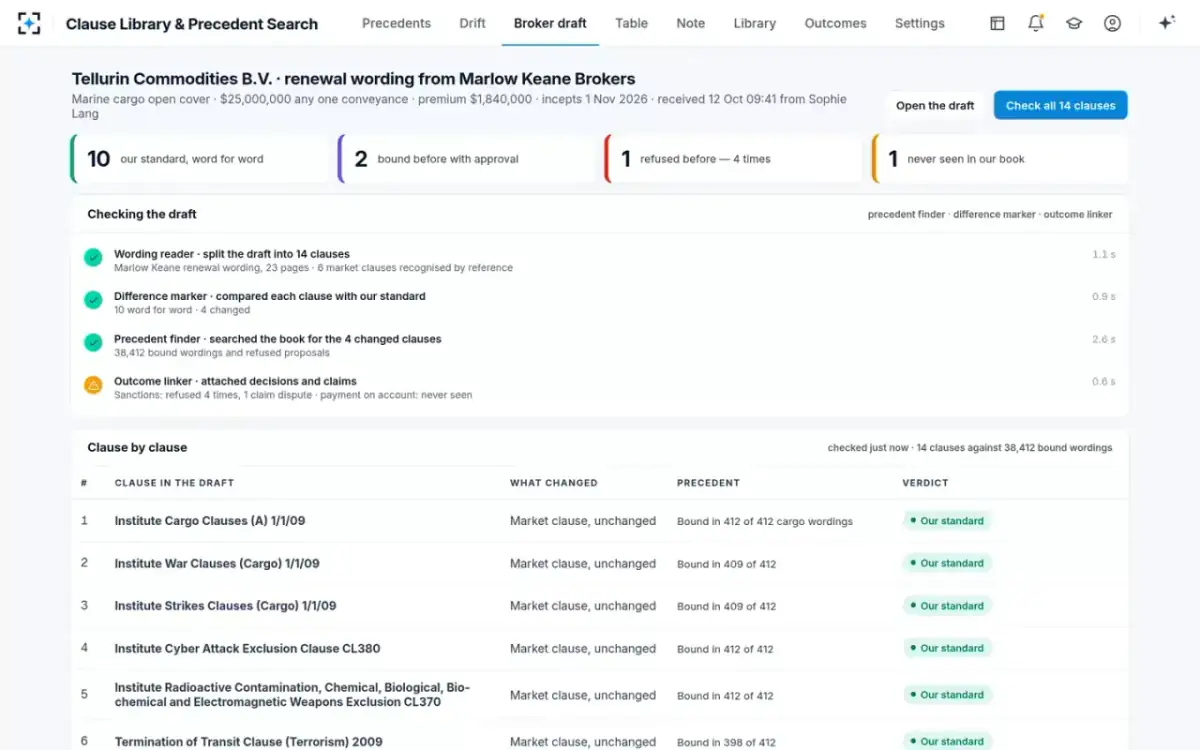
A broker's renewal draft, checked clause by clause against the bound book
What does a wording mistake cost?
The cost of a wording mistake is usually paid years later, at claim, and it is dominated by dispute rather than by the wording team's time. Public sources give the scale of uncertainty, not its price. When the FCA tested common business interruption wordings in court, the policies insurers listed as potentially affected covered "approximately 370,000 policyholders" (FCA). A single marine cargo claim worth "some US$3.8 million" under the London market's standard sanctions clause, on a theft in 2012, was decided by the Commercial Court in October 2018 (Mamancochet Mining v Aegis Managing Agency [2018] EWHC 2643 (Comm)).
The carrier's own claims file is the better source for its own price. Link each claim where a clause was argued to the version argued, and compare the time in dispute for standard and non-standard versions. On the solution's fictional sample book, 46 claims turned on a clause's words, nine of them on a non-standard version, and the median dispute was 142 days where the version argued was non-standard against 38 days for the rest. That is a sample result, not an industry benchmark; the point is that the comparison can be made, and once made it prices the fourth term in the formula.
On the sample book, a non-standard clause meant nearly four times as long in dispute
How much time does a clause library save?
On fetching, nearly all of it; on judgment, none. The solution searched 412 marine cargo bound wordings and refused proposals on its sample book and laid out the six versions that answered the question in 3.8 seconds, against Botminds' estimate of one to three working days by email. The specialist's reading of the precedents and the writing of a position take the same time either way, and should.
The saving that matters most is not the hours. It is that the answer arrives inside the broker's call, so the underwriter negotiates from the carrier's history rather than from memory. A clause library that saves the wordings team a day but answers after the call has ended has saved labour and lost the point.
What is the ROI of a clause library? A formula to fill in
The return is the four cost terms avoided, less the cost of the software and the work of loading the book. Put the terms in the order you can measure them.
Return on clause library software, a year at a time
Labour saved
Questions a year × hours of fetching per question × loaded rate
At the illustrative 600 questions, three and a half hours and $56 an hour, about $118,000. Use timesheets for the hours.
Our arithmetic, BLS rates
Renewals kept on your terms
Questions open at the deadline × share now answered in time × margin at stake
From your own renewal log; count conceded terms as well as lost renewals.
Underwriting management
Disputes avoided
Non-standard concessions avoided × (dispute days saved × daily cost + extra indemnity)
From your claims file, once claims are linked to the clause version argued.
Claims
The system's own cost
− subscription − loading the book − the team's pilot time
Loading is the largest one-off: every bound wording read and split into clauses, refusals and approvals attached.
Two cautions keep the formula honest. Do not count a saved hour that is not redeployed; if the specialist's freed time goes to queue clearing, count it once. And do not count disputes avoided until the book is linked to claims for long enough to see a difference; in year one, the third term is a forecast. The week-by-week plan for loading a book shows where the one-off cost falls.
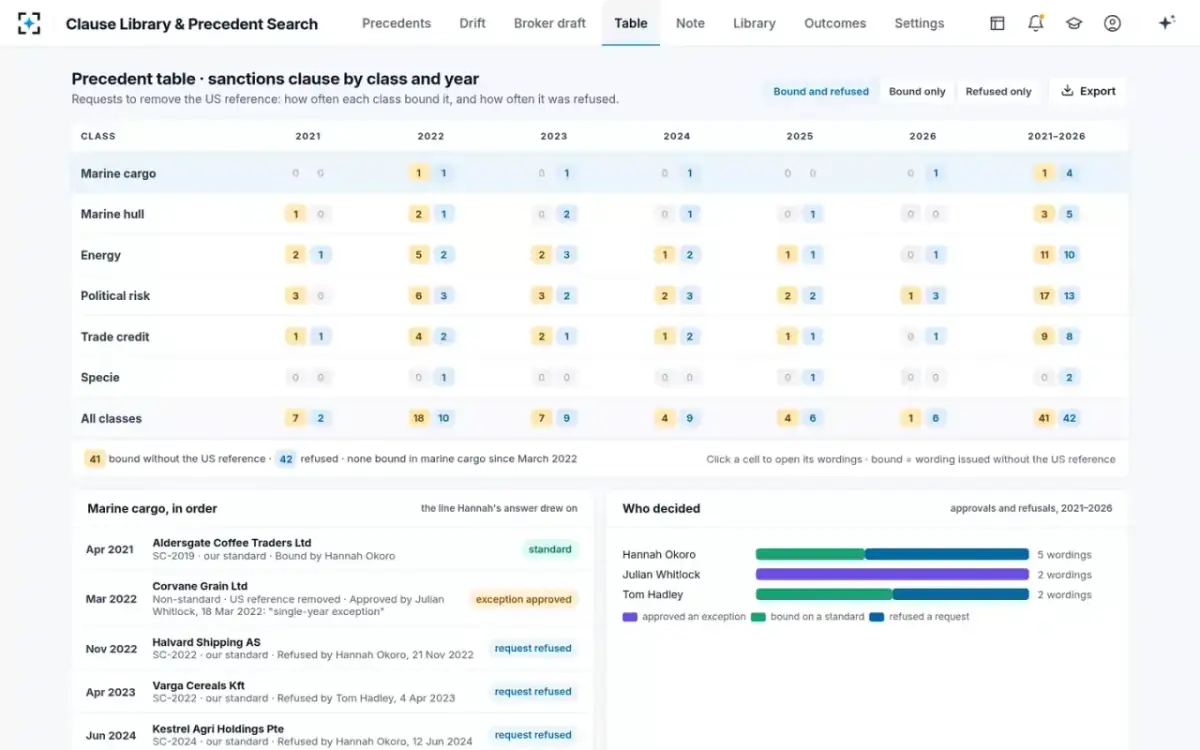
The precedent table: one request, every class and year, bound and refused
What to look for in clause library software
Look for software that answers from what you bound, keeps what you refused, and shows its sources. The questions below separate an insurance precedent tool from a template library with search.
What to look for in clause library software for an insurer
| Look for | Why it matters | Red flag in a demonstration |
|---|---|---|
| Reads bound wordings and endorsements, not only templates | The broker's question is about variations you agreed, which live only in the bound book. | The demonstration starts from an empty library and a template upload. |
| Keeps refused requests | "Refused four times" is often the most useful answer a carrier has. | Only executed documents are indexed. |
| Attaches approvals and claim outcomes to the version | A version bound with approval is offerable; the same words without one are a new request. | Approvals live in another system the tool cannot read. |
| Cites every sentence of an answer | The underwriter must be able to check the answer on the call. | Summaries without links to the clause text. |
| Respects class and claims permissions | Underwriters should see an outcome line, not privileged notes, and only their classes. | Every user sees everything. |
| Says when there is no precedent | A new request should go to the head of wordings, not get a nearest match. | Every question returns something. |
Where clause library software does not pay
It pays poorly where there is little variation to search. A carrier writing mostly admitted personal or small commercial lines on filed forms has few manuscript wordings and fewer broker negotiations; a well-kept standard form library is enough. It also pays poorly where the history is not kept: if refusals, approvals and claim links do not exist anywhere, the software can read the bound text but cannot say why it was agreed, and the first year goes on rebuilding that history.
It pays best in specialty, E&S and London market books with many brokers, many manuscript variations and a few clause families that are argued at claim: sanctions, cyber, disease, contractual liability. There the first term covers the cost and the other three make the case. To see the unit priced on a sample book, start from Clause Library & Precedent Search; for how the waiting arises in the first place, who waits on whom in a wordings team maps the chain.
Questions people ask
How much does clause library software cost?
Prices vary with the number of users and the volume of documents read, and vendors quote rather than publish. The larger cost for an insurer is usually loading the book: reading every bound wording and endorsement, splitting them into clauses and attaching approvals and claim outcomes. Ask for that work to be priced separately from the subscription.
Is a clause library worth it for a small wordings team?
Usually more than for a large one, because a small team's knowledge sits with fewer people. The U.S. Bureau of Labor Statistics projects underwriter employment to fall 4% between 2025 and 2035, so the memory a two-person team holds is getting harder to replace. The test is volume of variation, not team size.
Who uses a clause library in insurance?
Class underwriters ask it whether a variation was agreed before; wordings specialists and the head of wordings use it to approve, refuse and maintain the standard; underwriting assistants check broker drafts against it; and claims counsel links claims to the clause version argued so outcomes reach underwriting.
Can a contract management system's clause library do the same job?
It can hold your standard clauses and manage approvals for new contracts. It usually cannot answer what you agreed in thousands of bound wordings and endorsements you did not draft, nor what you refused, because those were never created in it. That history is the core of a precedent answer.
How quickly does clause library software pay back?
Run the labour term first: if your question count and fetching hours cover the subscription, the case stands without the rest, though the loading work comes first. The larger returns, renewals kept on the carrier's terms and disputes avoided, take a renewal cycle and a claims cycle to show in the carrier's own data.