A marine underwriting assistant supports cargo and hull underwriters: loading broker bordereaux and declarations, checking that documents are complete, chasing brokers, preparing files and keeping the underwriter's queue moving. On sanctions work the assistant is usually the first to see that something is wrong, a vessel that matches a list entry or a declaration with no certificate of origin, but the decision belongs to others: the underwriter decides cover, sanctions compliance decides whether there is a sanctions issue and whether to report, and the head of marine owns the rules both work to. U.S. sanctions guidance says underwriters, brokers and agents are all responsible throughout the life of a policy, so each desk carries part of the same duty. This guide follows one flagged declaration from desk to desk and shows how Botminds' Marine Sanctions Screening changes what each one does.
One flagged declaration, from the bordereau to the broker notice
Agent
Declaration readerReads the declaration line with its bill of lading and certificate of origin; marks missing documents.
Never: Never edits a declaration
Agent
Screeners and tracersScreen every party against the lists, trace the owners, rebuild the track, count listed-area days.
Never: Never call a match on a name alone
A person decides
Underwriting assistantChases the broker for missing documents and explanations; keeps the queue moving.
A person decides
UnderwriterDecides: cover, cover with additional premium, ask the broker, hold or refuse, with the reason on file.
A person decides
Sanctions complianceCountersigns any sanctions refusal or hold; decides whether anything is reported.
Agent
Decision drafterDrafts the reasons and the broker notice for the people to sign.
Never: Never signs; never names list entries to the broker
What does a marine underwriting assistant do?
A marine underwriting assistant keeps the paperwork of a marine account accurate and moving. On an open cargo cover that means loading each morning's bordereaux, checking that every declaration has the vessel, IMO number, cargo, ports, dates and insured value, matching it to its bill of lading and certificate of origin, and asking the broker for what is missing. On hull and energy accounts it means renewals, endorsements and survey reports. It is a support role with real judgement in it: knowing which gaps in a file matter.
Sanctions work lands on the assistant first because the assistant sees the data first. A name-screening tool raises its alerts into a queue, and someone has to look at each one before the underwriter's day begins. In most teams that someone is the assistant, who can clear the obvious mismatches, chase documents for the rest and pass on what cannot be cleared. The role is a common entry point to underwriting, and how well it is done shapes how much of the underwriter's day goes on noise.
The underwriting workforce the assistant's role feeds
125,600
insurance underwriter jobs in the United States, 2025
$81,370
median annual wage for insurance underwriters, May 2025
−4%
projected change in underwriter employment, 2025 to 2035
The projection matters for this desk. Fewer underwriters covering the same number of voyages means the screening work cannot simply be pushed up to them; whatever the assistant cannot resolve still has to be decided by someone with less time.
Who is responsible for sanctions screening in a marine insurer?
Everyone who touches the policy, in the American view. OFAC's insurance guidance says "Insurance industry participants, including underwriters, brokers, and agents, are responsible for compliance with OFAC sanctions throughout the lifecycle of their involvement with an insurance policy or other product or service" (OFAC FAQ 62). That sentence does not let a broker rely on the insurer's screen, or the underwriter rely on the broker's.
Within the insurer, responsibility is usually split by kind of decision, not by step. Compliance owns the sanctions policy, the lists, the alert procedure and any report to a regulator. Underwriting owns the decision to put the insurer on risk, including whether a referred voyage is within appetite at all. The head of marine owns the appetite itself: which areas, which thresholds, what clears without a person. The assistant owns none of these decisions and does much of the work for all of them, which is exactly why the handoffs are where time goes.
Who decides what on a marine sanctions alert
| Desk | Decides | Does not decide |
|---|---|---|
| Underwriting assistant | Whether the file is complete; which documents to chase; whether a name alert is an obvious mismatch on its identifiers | Cover, refusal, or whether a possible match is a true match |
| Underwriter | Cover, cover with additional premium, ask the broker, hold or refuse; the reason on file | Whether there is a sanctions breach, or whether to report one |
| Sanctions compliance | Whether an alert is a true match; whether a refusal or hold stands; whether and what to report | Commercial terms of the cover |
| Head of marine | Appetite: listed-area rates, gap and distance thresholds, the automatic-clear limit | Individual alerts, except where a setting refers them |
| Broker | Whether to supply the documents and explanations asked for | Anything about the list entries behind a refusal |
| Claims | Whether a presented claim can be paid, after re-screening | Whether cover attached in the first place, which is already decided |
What does a marine underwriter do on a sanctions alert?
The marine underwriter decides whether the insurer goes on risk for the declared voyage, and on what terms. On a sanctions alert that is a choice among a short list: cover as declared, cover with additional premium for days in a listed war area, ask the broker for evidence before deciding, hold, or refuse to attach cover under the sanctions clause. What the underwriter needs for that choice is not a score but the findings, each with its source.
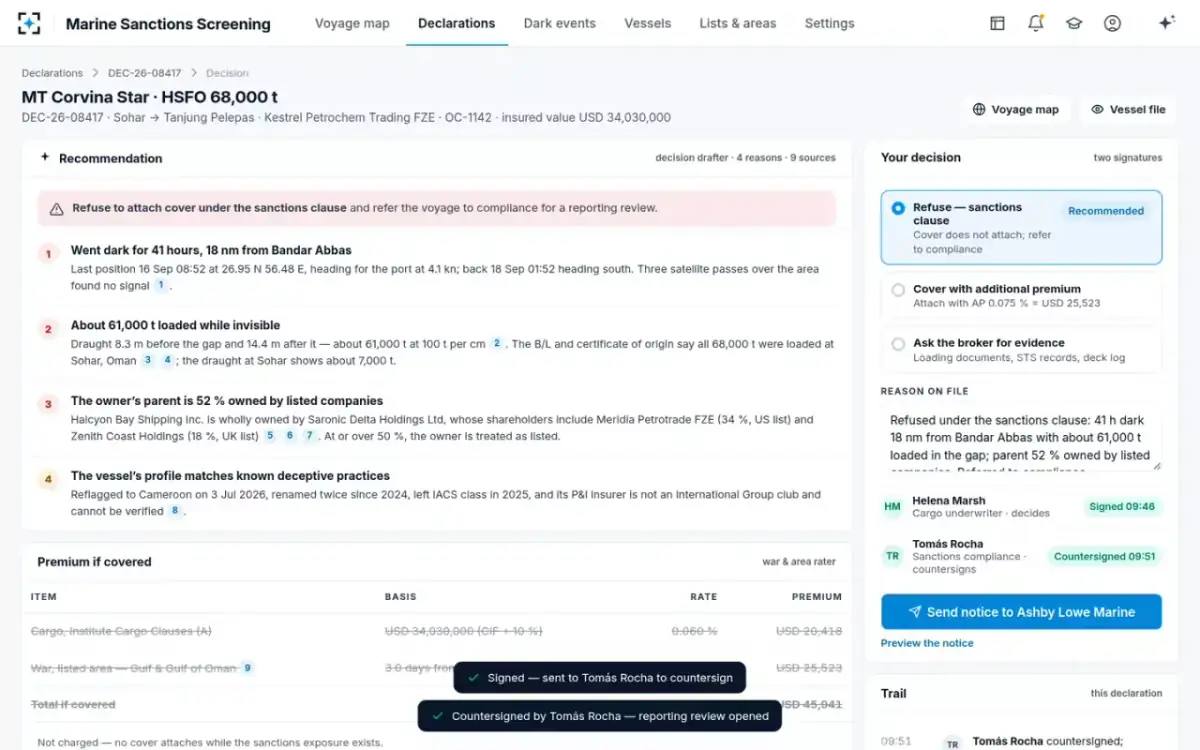
Take a sample insurer's morning as it runs through Marine Sanctions Screening; the insurer, broker, people and ships are fictional. Of 318 declarations screened since midnight, eight waited for the senior cargo underwriter. At the top was a tanker declared as loading 68,000 tonnes of fuel oil in Oman, which had gone dark for 41 hours 18 nautical miles from Bandar Abbas and come back 6.1 metres deeper, and whose owner's parent had two listed shareholders and a nominee holding 48% for an undisclosed owner. The recommendation was to refuse, with four reasons and nine sources.
Who can clear a sanctions alert?
Two different people, depending on what clearing means. An alert that is plainly not a match, a different ship with a similar name and a different IMO number, can be closed by the person who checked it, provided the identifiers that prove the mismatch go on file. An alert that may be a true match, or a finding that is not about a list at all, such as a gap near a port in a sanctioned country, is for compliance to clear or confirm.
The sample insurer's rule is written into its settings: a list match needs at least two identifiers, a name-only hit is shown as a possible match rather than a match, and every sanctions refusal or hold needs a second signature from sanctions compliance. The underwriter signed the refusal at 09:46 with her reason on file; the compliance analyst countersigned at 09:51, which opened a reporting review.
Signed by the underwriter, countersigned by sanctions compliance
What is a sanctions referral?
A sanctions referral is the handoff of a declaration from the underwriting desk to sanctions compliance, with everything compliance needs to decide it. A good referral states the finding, names its source and says what is not yet known. A bad one says "possible sanctions issue, please review" and starts a second investigation from scratch.
The history of one OFAC case shows why the handoff is the risk. In Eagle Shipping's case, the ship's captain refused to sign departure papers because, OFAC records, he "learned that some of the additional shipping documents (such as mate's receipt and export declaration) presented by the shipping agents explicitly listed Myawaddy as the shipper", an entity then on the SDN List. Later, when the company applied for a licence and was refused, "The former President of Eagle Shipping later received OFAC's denial letter, but allegedly failed to forward it to others within Eagle" (OFAC enforcement information, 27 January 2020). The person on the spot saw the problem; the organisation lost it between desks.
Where the time goes: the queue between the desks
On a flagged declaration screened by hand, most of the elapsed time is not screening; it is waiting for the next desk. With the checks automated, that becomes visible. In the sample, the agents took 3 minutes 48 seconds from reading the declaration to drafting a recommendation. The declaration then waited for the underwriter, and the countersignature followed five minutes after hers.
With the checks automated, the queue is most of the morning
That shape is the argument for designing the handoffs rather than only the checks. A queue ordered by severity, with the reason in one line, lets the underwriter reach the hold first. A referral that arrives with its sources lets compliance countersign in minutes rather than reopen the file. And a single trail across desks means nobody has to forward a letter for the next person to know.
Four desks on the same declaration, before and after
Today
"Half my day is asking the broker for the same three documents."
With agents
Sees the reason on every declaration, the documents the reader marked missing, and which tracking gaps are already marked as asked of the broker.
Still theirs: The broker relationship and the judgement about what to chase
Today
Hundreds of declarations a day on the open covers, deep checks only for a sample.
With agents
Opens only the declarations that need a decision, each on the map with its gap, owners and route, and signs with the reasons drafted.
Still theirs: Every decision to cover, charge or refuse
Today
"Show me the list entry and the shareholding, not a score."
With agents
Gets each alert with the list entry, the filing and the positions behind it; a single-identifier hit is shown as such.
Still theirs: The countersignature and any regulatory report
Today
"I need to prove we looked, voyage by voyage."
With agents
Owns the listed-area rate table and thresholds; every change waits for approval, and every declaration carries its trail.
Still theirs: The appetite and the authority limits
The broker's desk: what it may be told
The broker needs to know that cover does not attach, quickly; it does not need to know why in sanctions terms, and telling it can cause harm. The sample insurer's notice says that cover under the open cover does not attach to the declaration, that the sanction limitation and exclusion clause applies, that no premium is charged, that no further declarations should be made on the vessel, and that the insurer is unable to discuss the reasons further. It names no list entry.
The notice to the broker: what it says, and what it leaves out
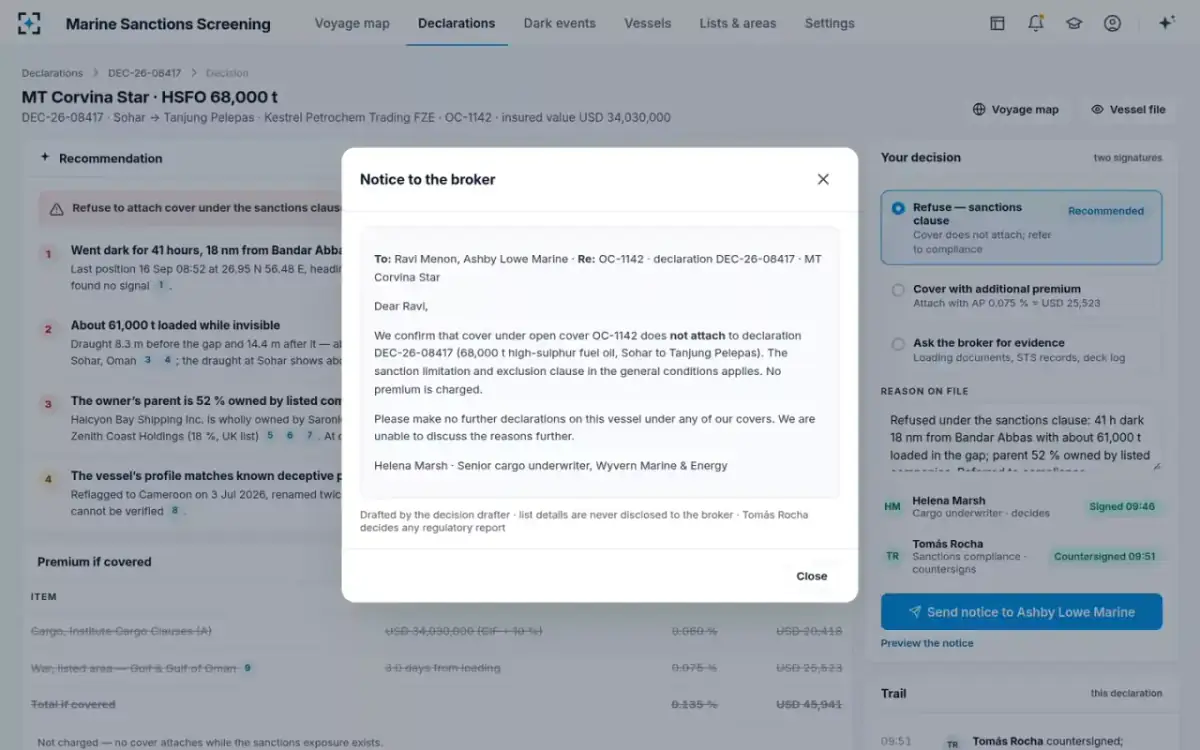
U.S. guidance allows some disclosure where a policy is actually blocked: OFAC says an insurer "may notify the policyholder that the policy is blocked without obtaining a specific license" and "may identify to the policyholder the corresponding sanctions program pursuant to which the insured took action" (OFAC FAQs 68 and 69). A refusal to attach cover to a declaration is a different event, and many compliance teams choose to say less. Whatever the policy, it is compliance's call, made once and applied by the drafter every time, rather than improvised by whoever answers the broker's phone call.
Claims: the desk that finds what screening missed
Claims is the last control and the most expensive place to find a sanctions problem. OFAC's guidance names both the submission and the payment of a claim among the points at which insurers should consider screening (OFAC FAQ 65), and the May 2020 advisory asks maritime insurers to check a vessel's AIS history when a claim is presented as well as before cover. A declaration that attached on a name check alone can surface at claims with a track, an owner and a cargo origin that no one looked at when it would have been cheap to.
The 2020 advisory also gives the claims and compliance desks a step that is easy to forget: "Informing legal regulators/competent authorities, other insurers, commercial databases, the International Maritime Organization (IMO), and when relevant, the United Nations (UN) Security Council 1718 Committee Panel of Experts" when cover is denied or cancelled over illicit activity (Sanctions Advisory for the Maritime Industry, 14 May 2020). In the UK, anyone who deals with funds or economic resources of a designated person "should immediately freeze the assets or funds and alert OFSI using our reporting form" (OFSI maritime guidance, 3.1). Those are compliance decisions, but claims is often where the facts first appear. What one missed voyage can cost follows that path through to the money.
What skills does a marine underwriter need for sanctions work?
The craft skills have not changed: reading a voyage, a cargo and a ship, and pricing them. What has changed is the evidence an underwriter is expected to weigh. A vessel's flag history, a single-ship owner formed months before the voyage, a manager whose fleet has been renamed, a draught change across a tracking gap: these are now underwriting facts, not compliance trivia, and the U.S., UK and IMO guidance all expect marine insurers to look at them.
For the assistant the change is larger. A desk that screened names and chased documents becomes one that reviews findings and asks the broker the specific question the findings raise: the deck log for a 27-hour gap, the loading documents for a transfer at sea. That is closer to the underwriter's own job, which makes it a better route into it. The five checks a marine sanctions screening tool should run sets out what each finding means.
Questions people ask
Is a marine underwriting assistant the same as an assistant underwriter?
Not usually. An underwriting assistant supports the underwriter with administration, data and broker contact; an assistant underwriter is a junior underwriter with some delegated authority to quote and bind within limits. Titles vary between markets, so the authority letter matters more than the job title.
Can an underwriting assistant clear a sanctions hit?
An assistant can usually close an alert that is plainly not a match, if the procedure allows it and the identifiers that prove the mismatch go on file. A possible true match, or any finding about ownership or a vessel's movements, should go to sanctions compliance. In the sample insurer, every sanctions refusal or hold needs the underwriter's signature and a compliance countersignature.
How do marine underwriters check sanctions?
At minimum by screening the vessel, its IMO number and the named parties against the sanctions lists. U.S., UK and IMO guidance expect more: the vessel's ownership and management, its AIS history, its flag and name changes, and the origin of the cargo. Doing all of that by hand takes 30 to 60 minutes per flagged voyage on the solution's own estimate, which is why it is often done for a sample.
Does the broker share responsibility for sanctions screening?
Yes. OFAC's guidance names brokers alongside underwriters and agents as responsible for compliance throughout their involvement with a policy, and UK guidance treats insurance intermediation as a financial service under sanctions regulations. A broker cannot rely on the insurer's screen, and the insurer cannot rely on the broker's.
What happens after a sanctions refusal is countersigned?
In the sample insurer the broker notice goes out the same morning and a reporting review opens for sanctions compliance, who decides whether anything must be reported and to which authority. Both signatures and every agent step stay in the declaration's trail for later review.