An oil price cap attestation is a written assurance, usually given in a contract clause or a signed form, that Russian-origin crude oil or oil products carried by sea were bought at or below the price cap set by the Price Cap Coalition. It exists because a service provider such as an insurer may only cover that seaborne trade if the price is within the cap, and an insurer never sees the price. As of 27 October 2026 the UK and EU cap on Russian crude is $44.10 a barrel; cargo insurers, hull and machinery insurers, P&I clubs and insurance brokers sit in the attestation tier that must hold an attestation before the contract takes effect and a fresh one for each voyage within 30 days of loading. This guide explains those duties and where Botminds' Marine Sanctions Screening fits: it does not price oil, but it runs the checks an attestation cannot, on the vessel, its owners, its track and the origin papers of each declared cargo.
The EU crude cap since 2022: three levels, and the next review paused to July 2027
- 5 Dec 2022 to 2 Sep 2025$60
- Sep 2025 to Jan 2026$47.60
- From 1 Feb 2026$44.10
What is an oil price cap attestation?
An oil price cap attestation is the paper that lets a service provider rely on someone else's knowledge of the price. The UK guidance describes the system as one "designed to apply different requirements to different actors in the oil supply chain, depending on whether they routinely know the price paid in their ordinary course of business and how often they transact" (OFSI, UK Maritime Services Ban and Oil Price Cap industry guidance). Traders who set the price hold the invoices; everyone further from the price collects an attestation from the party nearer to it.
The attestation can be a standalone signed form or a clause. For an insurer it is usually a clause in the policy or the cover terms in which the counterparty confirms that the unit price "is or will be at or below the Price Cap", which the UK guidance says "can act as the first attestation" (OFSI guidance, 5.6.1). OFSI publishes a sample attestation form agreed by the G7 alongside its general licences (OFSI licences and reporting forms).
The point of the system is liability. In the European Commission's words, "In cases when an EU operator without direct access to price information reasonably relies on an attestation, after performing appropriate due diligence, and such an attestation was falsified or provided by illegitimate actors, the EU operator would not be considered in breach of the price cap provided it has acted in good faith" (European Commission, price cap FAQ 38). The attestation is a shield, and the shield is only as good as the due diligence behind it.
What is the current Russian oil price cap?
For Russian crude oil, the UK and EU cap is $44.10 a barrel. The UK guidance announced that "At 23:01 (GMT) Saturday 31 January 2026 the crude Oil Price Cap will be lowered from $47.60 to $44.10 per barrel", and as of 27 October 2026 that is still the level its guidance and general licence show (OFSI guidance, updated 15 January 2026). The EU applies the same $44.10 from 1 February 2026.
The EU's cap now moves by formula. Since the 18th sanctions package, "the price cap is equal to the average market price for Russian crude oil minus 15%", recalculated over 22-week periods every six months, with no change if the new figure is within 5% of the old one. But the Commission's FAQs record that in Regulation (EU) 2026/1848 of 23 July 2026 the Council "decided to pause the adaptation of the price cap agreed in the 18th sanctions package for a full year, until July 2027", giving as the reason that Russia should not "benefit from the closure of the Strait of Hormuz" (European Commission, price cap FAQ 2). The next scheduled notice of the average price is expected on 15 July 2027, though the Council kept the option of an earlier review.
The oil price caps a marine insurer may have to apply, as of 27 October 2026
| Jurisdiction | Crude oil | Oil products | What to watch |
|---|---|---|---|
| United Kingdom (OFSI) | $44.10 a barrel from 23:01 GMT, 31 Jan 2026 (was $47.60) | Separate caps for "Premium to Crude" and "Discount to Crude" products | The cap "will be kept under review"; the UK promises at least a 45-day wind-down for any change |
| European Union | $44.10 a barrel from 1 Feb 2026 (was $47.60, and $60 before 3 Sep 2025) | $100 for premium-to-crude products such as diesel and petrol; $45 for discount-to-crude products such as fuel oil | Automatic review paused until July 2027 by Regulation (EU) 2026/1848 |
| United States (OFAC) | $60 a barrel, by Treasury determination effective 5 Dec 2022 | Set by separate determination | OFAC's January 2025 petroleum-services determination still refers to "the relevant determined price caps" |
Two caps can therefore apply to the same voyage. A London cargo insurer with a U.S. reinsurer, or a U.S.-owned insurer writing through a European branch, has to know which regime governs which service. The lower cap does not simply win; each authority's cap governs the services its own persons provide.
Which tier are insurers in the price cap?
Direct marine insurers are in Tier 3A; reinsurers are in Tier 3B. The UK guidance lists Tier 3A as including "P&I clubs; hull & machinery insurers; cargo insurers; insurance brokers; flagging registries; shipowners; and ship management companies", and describes them as providers "who do not know and cannot access the Unit Price of the Russian oil" (OFSI guidance, 5.6). The European Commission's tier table places insurers and insurance brokers, P&I clubs included, in Tier 3A, and reinsurers and reinsurance brokers in Tier 3B (European Commission FAQs, Section 7).
Tier 3A and Tier 3B: what a direct insurer owes, and what a reinsurer owes
Tier 3A: cargo, hull and P&I insurers, brokers: Request and receive an attestation before its effective date; a policy clause can serve as the first one.
Tier 3B: reinsurers, reinsurance brokers: Request and receive an attestation before the effective date; a contract clause may be considered sufficient.
Tier 3A: cargo, hull and P&I insurers, brokers: Require further attestations for every relevant voyage within 30 days of lifting or loading, for the life of the contract.
Tier 3B: reinsurers, reinsurance brokers: Not required: the guidance judges reinsurers too far from the voyage for it to be practical.
Tier 3A: cargo, hull and P&I insurers, brokers: Require counterparties to provide an itemised breakdown (freight, insurance and so on) within 30 days of a request.
Tier 3B: reinsurers, reinsurance brokers: Not required in the EU; the UK guidance sets no itemised-cost duty for Tier 3B.
Tier 3A: cargo, hull and P&I insurers, brokers: UK: cease doing business on that contract unless the failure is further up the chain, and report the inability to OFSI.
Tier 3B: reinsurers, reinsurance brokers: Provide an attestation on request to the parties it deals with.
The UK guidance is precise about the burden. The duty to produce per-voyage attestations and itemised costs falls on those with the price, "largely Tier 1 and occasionally Tier 2", while "The requirements on Tier 3A providers are limited to updating relevant contracts or issuing a Circular or any other relevant publication to require that they be provided with per-voyage attestations" (OFSI guidance, 5.8). An insurer is not asked to find the price. It is asked to make sure its contracts demand the paper, and to act when the paper does not come.
What an insurer must hold, voyage by voyage
A cargo insurer writing Russian-origin oil under an open cover has to manage the attestation trail per voyage, not per policy. The UK guidance says "Attestations should be collected for each voyage", and treats a ship-to-ship transfer as the start of a new voyage: it "would constitute two separate voyages", with the onward Tier 1 or Tier 2 provider producing a new attestation (OFSI guidance, 5.3). For a declaration-based cover that means one attestation file per declared shipment, and a second one when the declared ship transfers its cargo at sea.
What a Tier 3A marine insurer should be able to show for each Russian-origin oil voyage
- A first attestation before the contract took effect
Usually a policy or cover clause confirming the unit price is at or below the cap; dated before the effective date.
- A per-voyage attestation within 30 days of loading
For every voyage under a contract that covers more than one; a new one after any ship-to-ship transfer.
- The cap that applied on the contract date
Which level, under which regime, and whether a transition period was being relied on.
- A right to itemised ancillary costs
A clause, often an access-to-records clause, entitling the insurer to freight, insurance and other costs within 30 days of asking.
- The due diligence behind the reliance
Vessel, owners, managers and track checked, so that reliance on the attestation was reasonable and in good faith.
- What was done when paper did not arrive
The chaser, the decision to cease business on that contract, and the report to OFSI where required.
Which date's cap applies to a contract?
The cap that applied when the contract was made, for a limited time. When the EU lowered the cap to $47.60, contracts entered into before 20 July 2025 at the old price could rely on $60 if executed by 18 October 2025, the 90-day wind-down in Article 3n(5). Contracts made between 20 July and 2 September 2025 could rely on $60 only until 2 September (European Commission FAQs 13a and 13b). For the step to $44.10 the EU's table gives 16 April 2026 as the end of the transition for contracts concluded before 16 January 2026 that were compliant at $47.60.
The UK publishes its wind-down with each change, and has committed to "at least a 45-day wind-down period to allow oil already on the water to reach its destination" (OFSI guidance, 1.3). For an underwriter this is the detail most easily lost. An attestation that says "at or below the price cap" without naming the cap or the contract date proves less than it appears to after a change, and the EU transition periods for both cuts have now expired.
What is the maritime services ban?
The maritime services ban is the prohibition that the price cap is an exception to. In the UK it stops UK persons "providing financial services, funds, and brokering services to anyone, anywhere in the world, who is supplying or delivering Russian-origin oil and oil products by ship from a place in Russia to a third country, or from one third country to another third country" (OFSI guidance, 2.1). Insurance is a financial service, so the ban catches cargo, hull and liability cover alike.
The price cap exception, delivered in the UK through a general licence, then permits those services where the oil was bought at or below the cap. The exception is narrow. It does not apply "to services for the benefit of designated persons or to services in relation to specified ships" (OFSI guidance, chapter 4). An attestation that the price was within the cap does nothing for a voyage on a ship the UK has specified, or for an owner on the list. That is why price cap compliance and sanctions screening are two checks, not one.
What happens if the price cap is breached?
The service becomes prohibited, and the consequences depend on what the insurer knew and did. In the UK, OFSI "can impose civil monetary penalties for breaches of these trade sanctions on a strict liability basis", though it "will still need to demonstrate on the balance of probabilities that a breach occurred" (OFSI guidance, 3.4). The same chapter sets out the safe harbour: OFSI does not anticipate enforcement against a person who has completed the attestation process in full and on time with appropriate due diligence, including where a counterparty falsified the attestation.
The EU route is similar in effect. Under Article 10 of Regulation 833/2014, operators face no liability "if they did not know, and had no reasonable cause to suspect, that their actions would infringe the measures", and a third-country vessel that carried oil bought above the cap loses EU services for Russian oil "for a period of 90 days following the date of unloading of the cargo purchased above the price cap" (European Commission FAQs 35 and 37).
What both regimes punish is reliance without diligence. OFSI's own example of reasonable cause to suspect is "a person's refusal or reluctance to provide requested price information" (OFSI guidance, 2.8.2). A chased attestation that never arrives is not a gap in the file; it is a red flag in the file.
When the ship is at sea: OFSI's rule on withdrawing cover
An insurer that finds a suspected breach mid-voyage may not simply cancel. OFSI's guidance says "Where a vessel is at sea when a suspected breach of prohibitions is discovered, OFSI does not view it as reasonable for insurance (or other maritime or associated services) to be removed immediately" (OFSI guidance, 2.8.2). The vessel returns to its port of origin if closer, unless that is in Russia, or continues to its destination; the service is withdrawn once it is in port; and the person who identified the suspected breach reports to OFSI and tells the other service providers.
That rule changes how an underwriter should think about timing. A problem found on the day the declaration arrives can stop cover attaching at all. The same problem found mid-voyage commits the insurer to carry the risk to port and to a reporting sequence. The cheapest moment to look is the first one, which is the argument of screening every open cover declaration on receipt.
Where the attestation ends and sanctions screening begins
An attestation answers one question, the price, and only for oil of Russian origin. It says nothing about who owns the ship, whether it has gone dark near a terminal, or whether the declared origin is true. OFSI has issued a separate advisory on evasion through "fabricated and falsified certificates of origin" (OFSI advisory, 21 November 2024), and the European Commission reminds operators that origin is decided under the EU's non-preferential rules, relying on "documentation at their disposal to determine the origin of the oil, which may include certificates of origin" (European Commission FAQ 8).
That is the part of the job Marine Sanctions Screening does. It cannot see the oil's price and does not pretend to. For each declaration it reads the bill of lading and certificate of origin, screens the vessel, owners, managers and counterparties against the US, UK, EU and UN lists, rebuilds the track, and compares what the documents say with what the ship did. Take a fictional sample voyage: a tanker declared as loading 68,000 tonnes of fuel oil at Sohar in Oman, whose track shows a 41-hour gap near Bandar Abbas and a return 6.1 metres deeper, about 61,000 tonnes loaded while it was invisible. No price attestation would have caught that, because the question it answers is the wrong one.
The reasons behind a refusal: origin papers set against the ship's draught
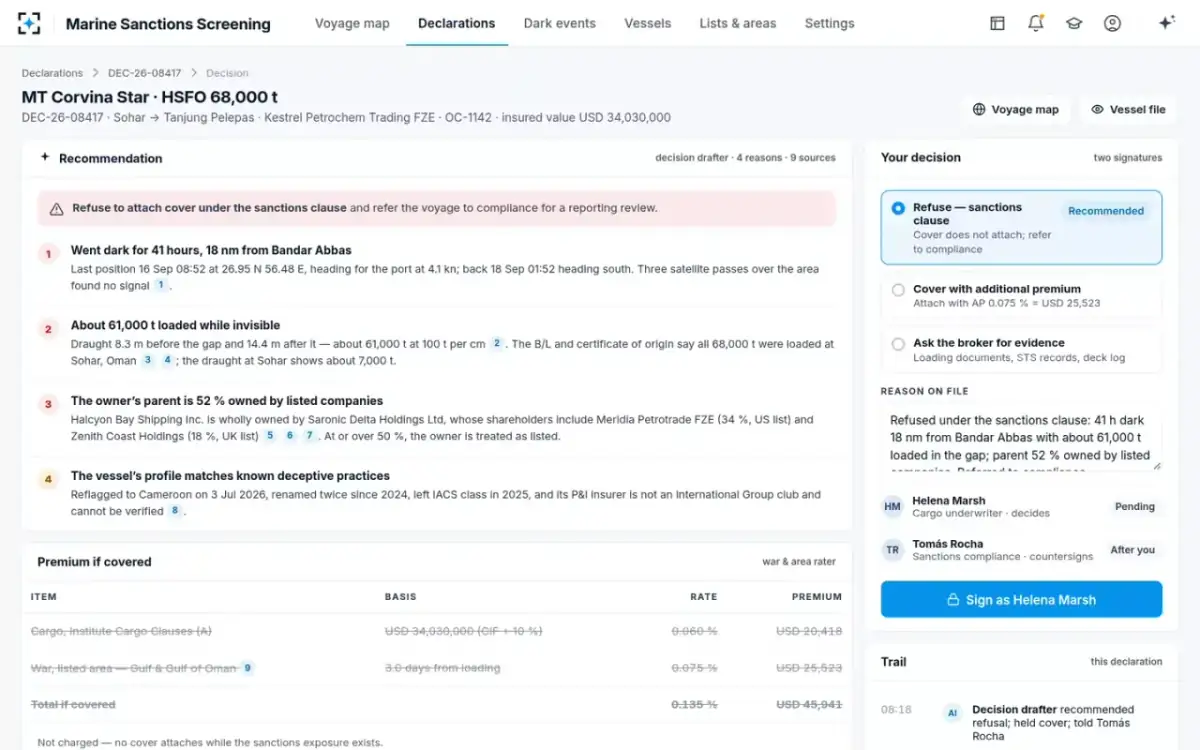
The same logic applies to Russian cargoes. A per-voyage attestation for a cargo declared as loaded at a non-Russian port, from a ship that went dark beside a Russian terminal, is exactly the kind of paper that should not be relied on in good faith. The screening result is what lets an insurer say its reliance was reasonable, or tells it that it would not be.
List changes, and which voyages on cover they touched
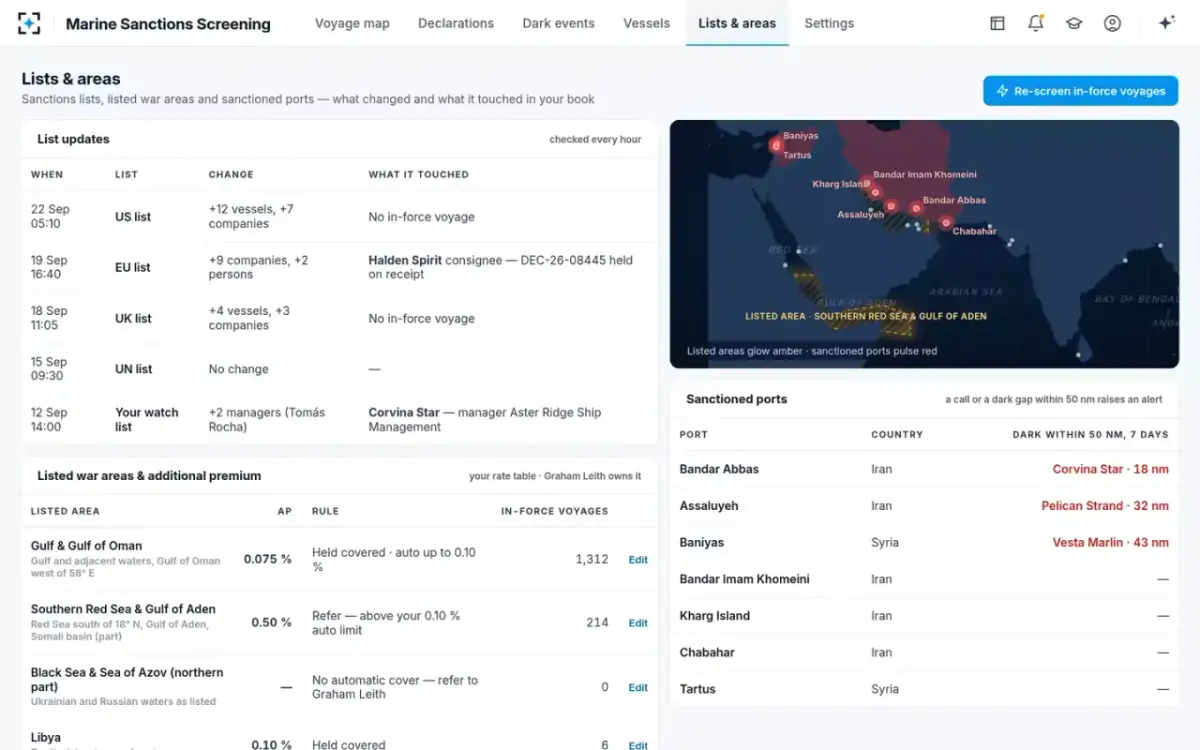
For the series' other half, the evidence an insurer should look for on the ship itself, why the IMO named the marine insurance industry in its dark fleet resolution sets out the signs, and when an AIS gap is a sanctions red flag explains how a dark period is weighed.
Questions people ask
Do insurers need a new attestation for every voyage?
Under the UK and EU rules, a Tier 3A insurer whose contract covers more than one voyage must require per-voyage attestations within 30 days of each lifting or loading (in the EU, for Russian oil loaded from 20 February 2024). Reinsurers in Tier 3B do not, because they are judged too far from the voyage; a contract clause can satisfy their requirement.
Can a sanctions clause count as an attestation?
The UK guidance says a Tier 3A provider's first attestation can be a contract clause stating the price is at or below the cap, or a clause that funds must not be used for activity breaching sanctions "along the lines of the Lloyds Market Association 3100, 3100A or 3200 clauses". Per-voyage attestations must still be required on top of it.
When did the UK lower the price cap?
The UK and EU announced in July 2025 that the crude cap would fall from $60 to $47.60, and the UK lowered it again, to $44.10, at 23:01 GMT on 31 January 2026. OFSI says the cap "will be kept under review" and that any future change will come with at least a 45-day wind-down.
What does an insurer do if the attestation never arrives?
In the UK, it should stop doing business on that contract unless it is satisfied the counterparty used its best efforts and the failure lies further up the chain, and it should report the inability to obtain the information to OFSI. The duty to cease business is contract-specific and applies only to policies for seaborne Russian oil.
Does the price cap apply to oil that is not Russian?
No. It applies to Russian-origin crude and oil products. Oil that originates elsewhere and only loads in or transits Russia is outside it if both origin and owner are non-Russian, and mixed cargoes need an attestation for the Russian share, or for the whole shipment if the share cannot be determined.