Dark fleet insurance is the cover, or lack of it, behind ships that move sanctioned cargo while hiding their identity, owners or movements. The International Maritime Organization defined the dark fleet in December 2023 as ships engaged in illegal operations to circumvent sanctions, evade safety or environmental rules, or avoid insurance costs, and among its markers are not carrying adequate liability insurance and deliberately avoiding commercial screenings. That makes marine insurers two things at once: a service the dark fleet tries to obtain on false terms, and one of the few controls that can refuse it. The IMO accordingly urged the private sector, "including the marine insurance industry", to build due diligence against it. Botminds' Marine Sanctions Screening checks each declared voyage for the dark fleet's signs: vessel age and history, flag and class changes, unverifiable P&I cover, opaque single-ship owners and tracking gaps near ports of concern.
"Dark fleet" or "shadow fleet" mean ships that are engaged in illegal operations for the purposes of circumventing sanctions, evading compliance with safety or environmental regulations, avoiding insurance costs or engaging in other illegal activities.
IMO Assembly resolution A.1192(33), 6 December 2023, operative paragraph 1
What is the dark fleet?
The dark fleet is the set of ships that trade outside the rules on purpose. The IMO's Assembly resolution, the first time the organisation defined the term, lists six things such ships may do: unsafe operations outside international regulations and industry standards; "intentionally avoiding flag State and port State control inspections"; "not maintaining adequate liability insurance or other financial security"; "intentionally avoiding commercial screenings or inspections"; operating without a transparent corporate governance policy; and "intentionally taking measures to avoid ship detection such as switching off their AIS or LRIT transmissions or concealing the ship's actual identity" without a legitimate safety reason (IMO resolution A.1192(33)).
Three of the six concern an insurer directly. Liability insurance is the cover itself. Commercial screenings are, in large part, the checks insurers, charterers and banks run before they deal with a ship. And concealment of identity or movement is aimed at exactly those screenings. The resolution's preamble pulls the threads together, describing ships that "have substandard maintenance, unclear ownership, lack of insurance coverage and disguise their cargoes' destination or origin".
The IMO's six dark fleet markers, and what a marine insurer can see of each
| IMO marker | What an insurer can see | Where it shows up |
|---|---|---|
| Unsafe operations outside standards | Age, casualty history, detentions, class status | Vessel history, port state control records |
| Avoiding flag and port state inspections | Flag changes, flags with weak oversight, inspection gaps | Registry and inspection history |
| Inadequate liability insurance | P&I insurer unknown, unrated or not verifiable | P&I certificate on the declaration |
| Avoiding commercial screenings | Name changes, new owning companies, documents that disagree | Vessel file, ownership filings, bill of lading and certificate of origin |
| Opaque corporate governance | Single-ship owners, nominees, managers rotating | Company filings, manager's fleet |
| Avoiding detection | AIS gaps, impossible jumps, identity changes | Rebuilt track, gap and draught analysis |
Dark fleet vs shadow fleet: is there a difference?
Not in the IMO's usage: its resolution treats the two terms as one, defining "dark fleet" or "shadow fleet" together. In practice, "shadow fleet" is the term the Price Cap Coalition and most governments use for tankers carrying Russian oil outside the coalition's services, and "dark fleet" is often used for ships that go dark, switching off their tracking, especially in Iranian and Venezuelan trades. The ships and owners overlap, and an insurer's checks are the same for both.
What matters more than the label is the behaviour. A ship can be part of a shadow trade while broadcasting AIS faithfully, and a ship can go dark for a day for an innocent safety reason. The IMO's markers are useful because they are about conduct an insurer can observe, not about which sanctions programme a cargo falls under.
Do dark fleet ships have insurance?
Often they have something, which is the problem. The Price Cap Coalition's advisory of October 2023 warned that "Ships involved in the shadow trade may rely on unproven Protection and Indemnity (P&I) insurance providers that operate in jurisdictions with opaque or limited regulation, and insufficient capital, reinsurance arrangements, and/or technical expertise to handle a major claim in the event of a marine casualty" (Price Cap Coalition advisory, 12 October 2023). The same advisory describes cover that is "unknown, untested, sporadic, or fraudulent".
OFAC's April 2025 guidance on Iranian oil makes it a check: parties "should ensure vessels have adequate and legitimate insurance coverage and are not relying on sanctioned insurance providers (e.g., Kish Protection & Indemnity Club) or new and untested insurance providers for no apparent business reason" (OFAC, Guidance for Shipping and Maritime Stakeholders, 16 April 2025). It also records that in July 2024 OFAC sanctioned Ascent General Insurance Company, registered in the Seychelles, for insuring vessels that were blocked property. A dark fleet tanker's P&I certificate can be a red flag in itself.
What is unproven P&I insurance?
It is liability cover from a provider whose ability to pay a major claim cannot be shown: little capital, no visible reinsurance, an opaque regulator, or no track record. The Coalition's first recommendation is to "Require appropriately capitalized P&I insurance", and it suggests that anyone dealing with a ship insured elsewhere do "sufficient due diligence to ensure that the insurer can cover all relevant risks", which "could include, as feasible, a review of an insurer's financial soundness, track record, regulatory record, and/or ownership structure" (Price Cap Coalition, 2023, Recommendation 1).
Signs of P&I cover that can pay, against signs of cover that may not
Cover an insurer can rely on: Known club or insurer, regulated where it is established, with a claims history.
Unproven cover: New provider, recently formed, in a jurisdiction with opaque or limited regulation.
Cover an insurer can rely on: Capital and reinsurance that can be seen and match the limits offered.
Unproven cover: Capital and reinsurance unknown, or small against an oil-spill limit.
Cover an insurer can rely on: Cover for the whole voyage, renewed without gaps.
Unproven cover: Cover that starts and stops, or appears only for one port call.
Cover an insurer can rely on: Valid State certificate of insurance under the liability conventions.
Unproven cover: Certificate missing, or issued on the strength of the unproven cover.
For a cargo or hull insurer, the P&I question is not academic. A tanker with unproven liability cover is a tanker whose owner cannot pay for a spill or a collision, which raises the cargo insurer's exposure in a casualty and signals the kind of operator the IMO describes. The Coalition's standard is cover "for the entirety of their voyages", not cover that appears for a port call.
What did the IMO say about the dark fleet?
Beyond the definition, the resolution asks for action from each part of the system. It calls on flag States to make their ships respect ship-to-ship transfer rules, encourages port States to check that ships carry "valid State certificates of insurance, in accordance with the IMO liability and compensation conventions", and recommends enhanced inspections for ships that switch off their AIS or conceal their identity. Then it turns to the private sector. In operative paragraph 8 the Assembly:
Urges Governments, the Secretary-General, flag State authorities, port State control authorities, ship owners and operators, non-governmental organizations, the private sector including the marine insurance industry, ship brokers and other relevant maritime stakeholders to develop and deliver workshops that focus on enhancing capabilities and due diligence practices for the prevention, detection and reporting of the operation of dark fleets or shadow fleets and illegal activities facilitated by such ships.
IMO Assembly resolution A.1192(33), operative paragraph 8
The paragraph asks for workshops, and it is a non-binding Assembly resolution. Its significance is the naming. The IMO, an intergovernmental body, put the marine insurance industry in the same sentence as flag and port State authorities, as a party expected to have due diligence practices for prevention, detection and reporting. That is the same three-part job a screening program does: refuse, find and report.
Why are older tankers a risk?
Because the dark fleet is built from them. The Price Cap Coalition's 2024 advisory says the vessels in the shadow trade "are typically older ships, many of which are operating past their traditional lifespans", often registered with flag States that do not meet their obligations, and adds that some have moved away from the established classification societies (Price Cap Coalition advisory, 21 October 2024). OFAC's 2025 guidance describes the Iranian shadow fleet the same way: "older, poorly maintained vessels that operate outside of standard maritime regulations" (OFAC, April 2025).
Age is not a sanctions finding; plenty of older tankers trade lawfully. It is a reason the rest of the file gets read. An older tanker that has recently changed flag, name and owner, left its classification society and shows an unknown P&I provider carries the profile both advisories describe.
A fictional tanker's file: age, flags, class, P&I and a manager's renamed fleet
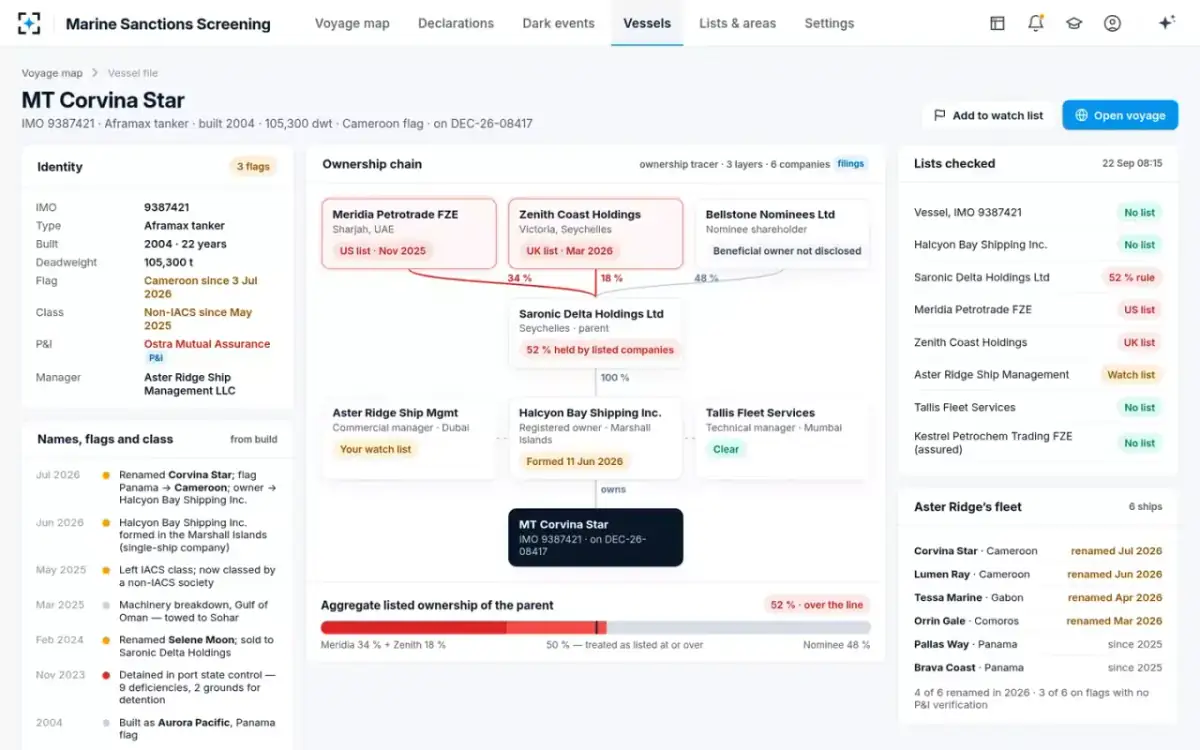
Take that sample tanker, as it appears in Marine Sanctions Screening; the ship, owners and insurers are fictional. Built in 2004, detained in a port state inspection in 2023 with nine deficiencies, renamed and sold in 2024, out of its classification society in 2025, under a new single-ship owner formed in June 2026 and a new flag the month after, with a P&I provider that is not an International Group club and cannot be verified. Its manager's fleet of six ships includes four renamed in 2026. None of that is on a sanctions list. All of it is in the vessel's history.
How big is dark shipping?
Large enough to matter to any insurer that covers tanker cargoes. A National Bureau of Economic Research working paper by Jesús Fernández-Villaverde, Yiliang Li, Le Xu and Francesco Zanetti, using a machine-learning model of ship movements, estimates that "From 2017 to 2023, dark ships transported an estimated 7.8 million metric tons of crude oil monthly – 43% of global seaborne crude exports" (NBER Working Paper 33486, February 2025). It is a working paper, not yet peer-reviewed, and its definition of dark shipping is the authors' own; the order of magnitude is the point.
Dark shipping's share of global seaborne crude exports, 2017 to 2023
Seaborne crude exports, monthly average
- Carried by dark ships, about 7.8 Mt a month · 43%
- All other seaborne crude · 57%
How can insurers spot dark fleet vessels?
By reading the ship's history and behaviour, not only its name. The checks that find dark fleet vessels are the ones the IMO's markers point to: identity and flag changes, class and inspection history, the owning company and its age, the manager and its fleet, the P&I provider, and gaps in the track near ports and transfer areas of concern. The Price Cap Coalition adds a practical trigger: heightened diligence for ships with many administrative changes, such as new flags, names and owners, the subject of the five checks a marine sanctions screening tool should run.
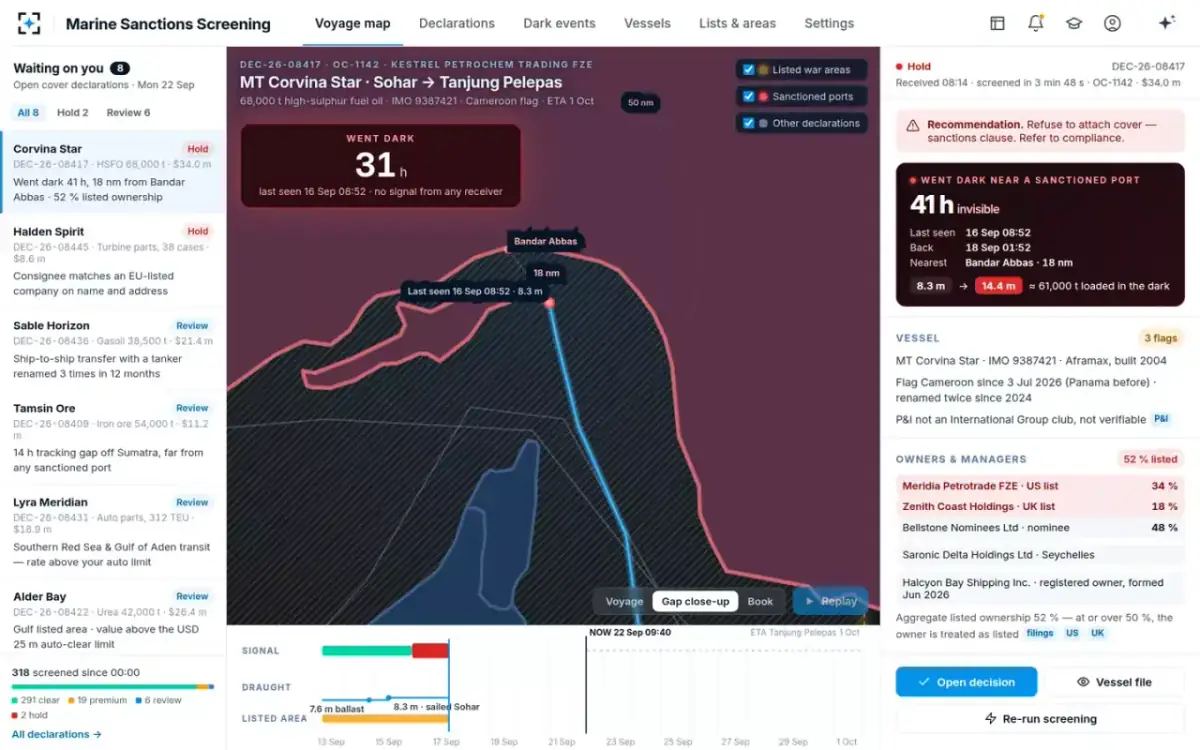
Behaviour completes the picture. In the sample case the tanker, declared as loading fuel oil in Oman, went silent for 41 hours 18 nautical miles from Bandar Abbas and came back 6.1 metres deeper. Replayed in the solution, the hour counter runs while no receiver hears the ship, and the timeline under the map fills in signal, draught and listed-area days as it plays.
Replaying the voyage: the counter runs while no receiver hears the ship
When an AIS gap is a red flag sets out how a gap's length, place and draught change become log, ask or refer. For tanker cargoes of Russian origin, the attestation trail in oil price cap attestation is the other half of the insurer's job.
The insurer as target and as control
The dark fleet needs insurance it can show, and marine insurers are among the few businesses that can see a ship's whole history before they deal with it. That is why the IMO named the industry, and why the Price Cap Coalition asks every stakeholder to require "continuous and appropriate maritime insurance coverage for the entirety of their voyages" (Price Cap Coalition, 2024, Recommendation 1). Each refusal to cover a dark fleet voyage, made on evidence and reported where required, removes something the trade depends on.
The risk runs the other way too. A cargo insurer that covers declarations on a name check alone may find it has insured cargo on a dark fleet tanker, with the sanctions, casualty and reputational exposure that follows. What one missed voyage can cost sets out the money.
Questions people ask
What does dark fleet meaning refer to in shipping?
It refers to ships that operate outside international rules to evade sanctions, safety or environmental regulation, or insurance costs, usually by hiding their identity, owners or movements. The IMO adopted that definition in resolution A.1192(33) in December 2023, treating "dark fleet" and "shadow fleet" as the same thing.
Is it illegal to insure a dark fleet ship?
Insuring a ship is not illegal in itself; providing cover that sanctions prohibit is. If the ship, its owner or its cargo is subject to sanctions that apply to the insurer, or the voyage breaches the oil price cap rules, cover is prohibited and penalties can follow. Dark fleet markers are the warning signs that such a prohibition may apply.
Why do dark fleet tankers change names and flags so often?
To break the link between a ship's past and its present, so that screenings run on the current name, flag or owner come back clean. Guidance from the Price Cap Coalition and OFSI treats frequent re-flagging, renaming and changes of owner or manager as reasons for heightened due diligence rather than as normal commercial churn.
What should a cargo insurer check on the P&I certificate?
Who the provider is, where it is regulated, whether its capital and reinsurance can be seen, whether it is on any sanctions list, and whether the cover runs for the whole voyage. OFAC's 2025 guidance names a sanctioned Iranian P&I club and warns against new and untested providers used for no apparent business reason.
Do dark fleet ships always switch off AIS?
No. Some spoof their AIS instead, broadcasting a false identity or position, and some trade with AIS on but with opaque owners and unproven insurance. A gap is one marker among six in the IMO's list, which is why screening has to look at ownership, documents and insurance as well as the track.