A maritime sanctions screening process is the sequence a marine insurer follows to check each voyage it covers: read the declaration, screen the vessel and every party against the lists, trace the owners, review the vessel's track and port calls, compare the cargo documents with what the ship did, decide, and re-screen while the voyage is on cover. Most insurers measure it by volume: alerts raised, alerts cleared, time to clear. Those numbers say how busy the process is, not what it misses. The five measures in this guide count misses instead: owned or controlled parties not referred, tracking gaps not found, list changes not re-screened in time, decisions with no source, and recommendations overturned. Botminds' Marine Sanctions Screening keeps the evidence each measure needs, so a compliance team can run them on its own past declarations rather than take a vendor's word.
Five measures of a maritime sanctions screening process, and how to compute each
- 1. Ownership recall, per regime
Owned or controlled parties referred ÷ owned or controlled parties present, in a test set where the answer is known. Computed separately for each sanctions regime.
- 2. Gap recall
Tracking gaps near ports of concern that were found and reviewed ÷ such gaps on the insured voyages. Count the ones found only at claim as misses.
- 3. Re-screening delay
Time from a list change to the last affected voyage on cover being re-screened. Report the slowest case, not the average.
- 4. Unsourced decisions
Clears, holds and refusals with no source attached ÷ all decisions. The aim is zero.
- 5. Override rate, both ways
Recommendations people reversed ÷ recommendations made, split into holds cleared and clears held, each with the reason.
What is the maritime sanctions screening process?
It is every check between a declaration arriving and the voyage ending, applied consistently. In a marine insurer the steps are the same whether done by hand or by software: identify the vessel and the parties; screen them against the US, UK, EU and UN lists and the insurer's own watch list; follow the owners and managers up through company filings; rebuild the track and look for gaps, transfers and port calls near places of concern; set the cargo documents against the track; decide; and screen again when the lists or the ship's behaviour change.
U.S. guidance frames it as continuous. OFAC tells insurers that "OFAC's sanctions programs and lists are updated frequently" and expects screening beyond issuance (OFAC FAQ 65). The UK guidance asks maritime firms to scrutinise ownership over time: "It is imperative to scrutinise whether a vessel exhibits a pattern of frequent changes in ownership or control" (OFSI, Financial sanctions guidance for maritime shipping, 4.6). A process that runs once per declaration does neither.
Why are sanctions alerts cleared wrongly?
Mostly because the reviewer answers a narrower question than the law asks. The commonest version is clearing an alert because the party is not itself on the list, when its owner is. That is what happened in OFAC's 2024 case against American Life Insurance Company. Its list screening of a UAE entity raised alerts that were closed as false positives because the entity was not on the SDN List, although its trade licence showed it was owned by the Iranian embassy; a separate politically-exposed-person alert caught the embassy and the application was rejected. A week later the same agent reapplied through a third-party administrator with a licence that named no owner, the list alert was closed the same way, and the policy was issued. OFAC's comment was direct: "The Government of Iran is blocked, but the SDN List does not list every Iranian government agency or official" (OFAC enforcement release, 14 November 2024).
The same case shows two more ways a process misses. On the second application, "there was no system in place to flag applications that had previously been rejected". And after the policies were suspended, the insurer's third-party administrator kept paying: "for several weeks backdated claims continued to be paid from the administrator's batch processing system" (OFAC, ALICO). Neither failure would show up in a count of alerts cleared. Both would show up in the measures below. The case is life and health insurance, not marine, but the failure points are the same in any line.
Measure 1: ownership recall, computed per regime
Ownership recall is the share of owned or controlled parties that the process actually refers. It is the measure the ALICO case failed, and it has a trap built in: the answer depends on which regime is asking. OFAC and OFSI set out the difference side by side in their joint guide of June 2026. OFAC's rule covers entities "owned 50 percent or more by blocked persons, either individually or in the aggregate"; for the UK, "OFSI's 50 percent requirement does not apply when different designated persons' shareholdings in an entity amount to 50 percent or more", and an entity whose designated owners each hold less than 50% "generally is not subject to UK sanctions unless there is evidence to suggest the ownership structure is intended to obfuscate control" (OFAC and OFSI, The U.S. and UK Economic Sanctions Authorities: A Comparative Overview, 23 June 2026).
Take a fictional sample case from Marine Sanctions Screening. A tanker's registered owner, a single-ship company formed in June 2026, is wholly owned by a holding company whose shareholders are a company on the U.S. list (34%), a company on the UK list (18%) and a nominee (48%) whose beneficial owner is not disclosed.
One ownership chain, three readings: why recall has to be measured per regime
| Reading | What counts | Result for the holding company |
|---|---|---|
| OFAC 50 Percent Rule | Holdings of persons blocked under U.S. sanctions, aggregated: the 34% U.S.-listed holder | Not blocked by the rule on these filings alone: 34% is under 50%. Blocked if the undisclosed 48% proves to be held for a blocked person |
| UK ownership test | One designated person holding more than 50%, or control; different designated persons are not added together | Not caught by ownership on these filings: 18% is the only UK-listed stake. Caught if the structure is shown to obfuscate control |
| A sum across lists | 34% plus 18% | 52%, a figure neither regime uses. It overstates the U.S. position and the UK position at once |
| What the analyst does | Both listed stakes, the undisclosed nominee and a parent formed recently | Refer: the 48% nominee is the decisive unknown, and the structure looks built to keep each listed stake under a line |
The right answer in this case is a referral, and the reason is the nominee, not a percentage. The Price Cap Coalition noted the pattern in 2024: "The ownership of shadow fleet tankers may be concealed through complex corporate arrangements, with a recent increase of single vessel fleets" (Price Cap Coalition advisory, 21 October 2024). A test set for ownership recall should include cases like this one, where the correct result is a referral because the answer is unknown, as well as the plain ones; the OFAC 50 percent rule, explained covers the U.S. arithmetic in full.
Measure 2: gap recall on the voyages you insure
Gap recall is the share of tracking gaps near ports or transfer areas of concern that the process found while the voyage was on cover. The denominator is the hard part: a desk that never rebuilds tracks cannot count the gaps it missed. The way to build it is retrospective. Take a quarter of insured voyages, rebuild every track afterwards, list the gaps over the insurer's threshold within its chosen radius of a port of concern, and check which of them were reviewed at the time.
On the fictional sample book, a week of sweeps across 2,946 voyages on cover found 14 gaps of 12 hours or more; 3 were within 50 nautical miles of a port in a sanctioned country and 2 came back with a draught change of more than a metre. A process that only rebuilds tracks for sampled declarations would, at a 10% sample, expect to review about one of those three in three weeks. When an AIS gap is a red flag explains how to set the threshold and the radius before measuring against them.
Measure 3: how often should vessels be rescreened?
Often enough that the delay between a list change and the re-screen of every voyage it touches is shorter than the voyage. That delay is the third measure, and it should be reported as the worst case, not the average: one voyage re-screened a month late is the one a regulator will ask about. OFAC's insurance guidance counts a change to its own sanctions or lists among the events that should prompt a fresh screen (OFAC FAQ 65; the full list of trigger events is in marine open cover declaration screening).
The first week after a list change: unchecked, or re-screened the same day
- Voyages on cover unchecked against the change until the monthly run168 h and counting
- Re-screened< 24 h
- On cover, swept again each morningdaily
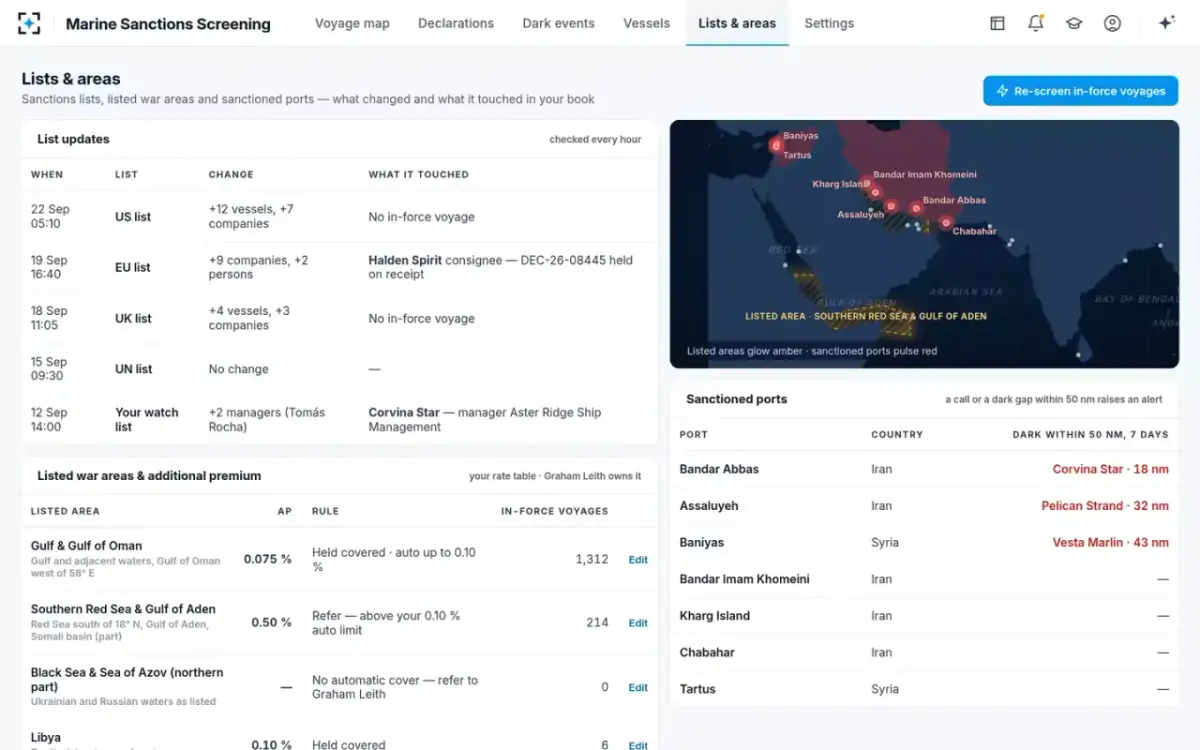
A useful report shows each list change next to what it touched. On the sample insurer's calendar for one fortnight, most changes touched nothing on cover, and one touched a declaration that arrived later and was held on receipt.
A fortnight of list changes, and what each touched in the book
Measure 4: decisions with no source
An unsourced decision is a clear, hold or refusal that cannot show the evidence it rested on: the list entry and its version, the filing behind an ownership link, the positions around a gap, the document behind a cargo finding. It is the measure that matters most after the fact, because it decides whether the insurer can show what it knew and when. The aim is zero, and the count is cheap to take: sample decisions and ask for the source of each reason.
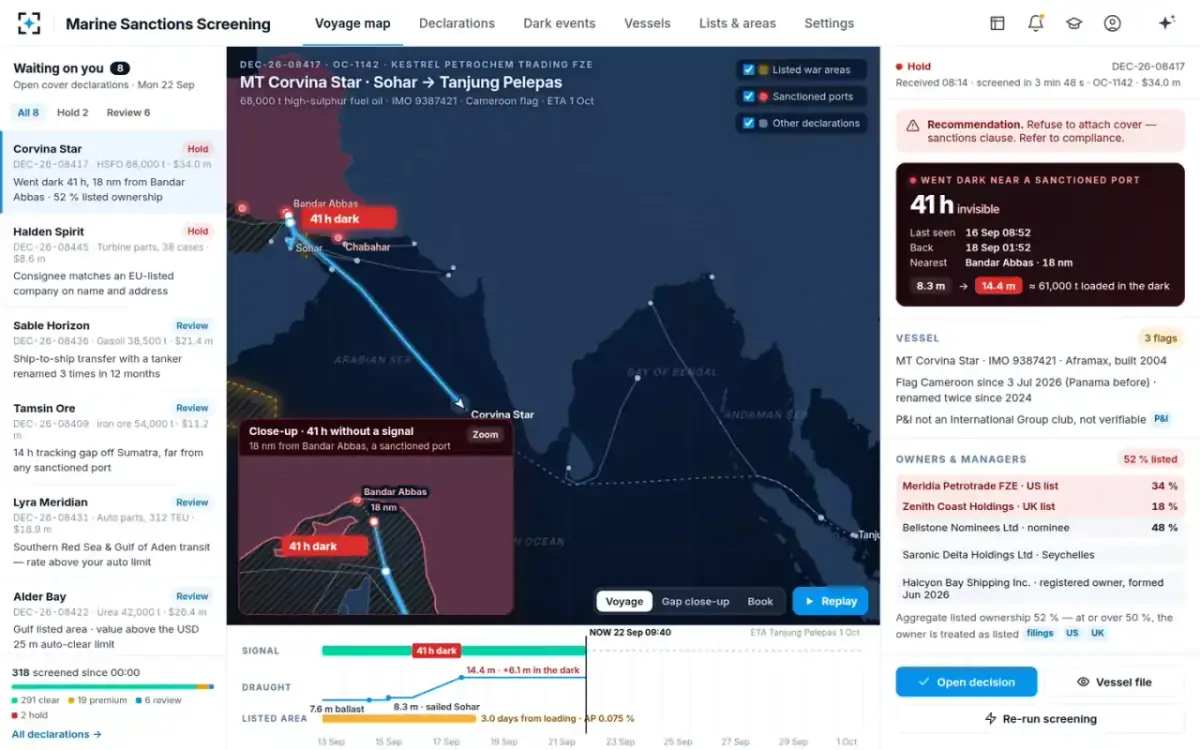
In Marine Sanctions Screening this is designed in rather than audited after: the target is that 100% of alerts link to the position, filing or list entry behind them, and the decision drafter may not give a reason without a source. On the sample voyage the recommendation to refuse carried four reasons and nine sources, and the trail holds both signatures and every agent step.
The underwriter's queue: each declaration with its reason, the ship on the map
Measure 5: override rate, in both directions
The override rate is how often people reverse the process's recommendation, counted separately for holds that people cleared and clears that people held. A high rate of cleared holds means thresholds that are too tight and underwriters learning to ignore alerts. A high rate of held clears means the process is missing things that people catch, which is worse. Either way the reason given for each override is the useful data: it tells the head of marine which threshold to move and which check to add.
The ALICO remedies show what overrides teach. Among the measures OFAC recorded were "Enhanced screening designed to generate alerts when the name of a sanctioned country appears in the name of the entity" and an "Enhanced onboarding process to track entities that were rejected based on sanctions compliance" (OFAC, ALICO). Both are rules a team would write after reading its own overrides and misses. In the solution, a threshold change is made as a new version of the settings, tested against the last seven days, and applied only after the head of marine approves it.
How do you test a screening process?
By replaying the past with known answers planted in it. Take last year's declarations. Add cases whose correct outcome you know: a vessel whose current name is clean but whose former name is listed, an owner held through a nominee, a gap beside a terminal with a draught change, a certificate of origin from a jurisdiction the 2025 OFAC guidance names. Run the process, by hand or by tool, and compute the five measures. Then run it again after every material change to lists, thresholds or software.
Two rules keep the test honest. The people scoring it should not be the people who built the test set. And the set should include cases where the right answer is to refer because nobody can yet tell, like the nominee case above, because a process that always reaches a confident answer is guessing on some of them. The banking guide on sanctions screening testing covers list-matching tests in more depth; the maritime additions are the ownership, track and cargo cases.
What do regulators expect from insurer screening?
A risk-based process the insurer can explain, applied through the life of the policy, with evidence. OFAC leaves screening frequency to each insurer's risk assessment, which depends on its size, products and customers, and points insurers to its Framework for Compliance Commitments (OFAC FAQ 65). OFSI does not prescribe measures for the maritime sector but lists maritime insurance companies first among the organisations "that may be particularly exposed to financial sanctions risk" (OFSI maritime guidance, 3).
Neither regulator publishes a target for any of the five measures, and no independent study gives industry figures for them. That is an argument for measuring, not against: an insurer that can show its ownership recall on a seeded test, its worst re-screening delay and its count of unsourced decisions is in a far stronger position than one that can show only how many alerts it cleared. What to bring to start a maritime sanctions compliance program sets out the inputs that make these measures possible from day one.
Lists and areas: each change, and what it touched
Questions people ask
What is ownership screening?
Ownership screening checks whether a party that is not itself listed is owned or controlled by one that is, by following company filings upwards. The tests differ: OFAC aggregates holdings of blocked persons at 50% or more, while the UK test is a single designated person holding more than 50%, or control. A good process reports each regime's answer separately.
What is a good false positive rate for vessel screening?
No regulator sets one, and a low false positive rate is easy to buy by screening less. It is more useful to track the override rate in both directions and the share of decisions with a source. A process that clears most alerts quickly but cannot show why is worse than one that refers more and documents every clear.
How do you measure sanctions screening quality?
Seed a copy of past declarations with cases whose answer you know, run the process, and compute recall for ownership and tracking gaps, the worst re-screening delay after a list change, the share of decisions without a source, and the override rate. Repeat after every material change to lists, thresholds or software.
Should insurers screen against lists they are not subject to?
Many marine insurers screen against US, UK, EU and UN lists whatever their home regime, because reinsurers, banks and clients are subject to them and sanctions clauses often refer to several regimes. What matters is that each result says which regime it belongs to, so that an ownership test from one regime is never applied to another's list.
What did OFAC say insurers should learn from the ALICO case?
That screening against the SDN List is not enough where an entity is owned by a blocked government that the list does not name, that previously rejected applicants should be flagged when they reapply, and that third parties who administer policies need controls that stop activity once a policy is suspended. ALICO settled for $178,421 in November 2024.