An AIS gap on a vessel is a stretch of time in which no shore station or satellite received the ship's Automatic Identification System broadcasts, so its track has a hole in it. Gaps happen for ordinary reasons, such as poor reception or equipment faults, and for deliberate ones, such as a tanker switching its transponder off to load cargo it does not want seen. The International Maritime Organization's position is that a missing signal is not proof of wrongdoing but can justify a closer look. For a marine underwriter the useful question is therefore narrower than whether the ship went dark: how long, where, and did anything about the ship change while nobody could see it? Botminds' Marine Sanctions Screening rebuilds each insured voyage from terrestrial and satellite AIS, measures every gap against those three questions, and sends only the ones that need a person to the underwriter, each with the positions behind it.
A rule for an AIS gap: three questions, three outcomes
1. How long?
Measure the gap from the last position any receiver heard to the first one after, terrestrial and satellite together. Below your threshold, log it; at or above it, it is an event.
2. Where?
Distance from the last and first positions to the nearest port or terminal of concern, known transfer areas and listed war areas. Far from all of them, it is usually explained by reception.
3. What changed?
Draught before and after, heading, speed and how far the ship could have travelled. A deeper or lighter ship, or a position the ship could not have reached, means cargo or identity moved in the dark.
Log
Short gap, open sea, no change: kept on the voyage, no action.
Ask
Long gap or near a place of concern, no change: ask the broker for the deck log or the reason.
Refer
Near a place of concern and a draught change or impossible jump: to the underwriter and compliance before cover is confirmed.
What is an AIS gap?
An AIS gap is the interval between the last position any receiver heard from a ship and the next one. AIS transmits a vessel's identity, position, course and speed by radio; shore stations pick it up near the coast and satellites pick it up at sea, though neither does so continuously. A gap therefore has two possible causes that look identical in the data: the ship stopped transmitting, or nobody was listening.
The IMO said so in plain terms when it adopted its resolution on the dark fleet in December 2023. Its Assembly noted:
Non-receipt of AIS transmissions by shore stations or AIS satellites may not be determinative of illegal activity but may warrant further investigation.
IMO Assembly resolution A.1192(33), 6 December 2023
Both halves of that sentence matter for underwriting. The first is why a gap alone should never refuse a risk. The second is why a gap near the wrong port should never be cleared without a look. The practical work is deciding which gaps fall into which half.
Is turning off AIS illegal?
Not always. Ships covered by the Safety of Life at Sea Convention must run AIS, and OFSI's maritime guidance says SOLAS "requires that certain classes of vessels travelling on international voyages operate AIS at all times with few exceptions" (OFSI, Financial sanctions guidance for maritime shipping, 4.8). The exceptions are about safety. The IMO's own operating guidelines allow the master to switch AIS off where its continued operation "might compromise the safety or security of his/her ship or where security incidents are imminent", and add that "Actions of this nature should always be recorded in the ship's logbook together with the reason for doing so" (IMO resolution A.1106(29), paragraph 22).
That gives the underwriter a test. A legitimate switch-off leaves a reason in the logbook, and the Price Cap Coalition's advisory asks for the same: "If a ship needs to disable its AIS in response to a legitimate safety concern, the ship should document the circumstances that necessitated disablement" (Price Cap Coalition advisory, 21 October 2024, Recommendation 3). A gap off the Somali coast with a logbook entry about a piracy alert is one thing. A gap beside an oil terminal with no entry is another.
The sanctions significance is separate from the safety rule. The IMO's dark fleet resolution describes ships that "intentionally disable or manipulate" AIS "in disregard of the guidance for legitimate disablement" (IMO A.1192(33)). Whether the switch-off broke flag-state law is for the flag state; whether it hid a sanctioned loading is the insurer's question.
What does going dark mean in shipping?
Going dark means a ship deliberately stops broadcasting its position so that its movements are not seen. OFSI's guidance describes vessels that "intentionally disable their AIS transponders (in a practice known as ‘going dark’) or manipulate the data transmitted to mask their movement" (OFSI maritime guidance, 4.8). The usual purpose is to hide a port call or a ship-to-ship transfer that would expose the cargo's origin.
OFAC's April 2025 guidance on Iranian oil names the pattern an insurer should look for: AIS manipulation together with "evidence of extended periods of time without AIS transmission in high-risk jurisdictions and certificates of origin from certain jurisdictions" should prompt enhanced due diligence before continuing to provide services (OFAC, Guidance for Shipping and Maritime Stakeholders, 16 April 2025). The same guidance lists insurers among those who "should consider investigating vessels that appear to have manipulated AIS data".
What is AIS spoofing?
Spoofing is the opposite of going dark: the ship keeps transmitting, but what it transmits is false. In OFSI's words it "allows ships to broadcast a different name", a different IMO number or Maritime Mobile Service Identity, "or other identifying information", and "can also conceal a vessel's next port of call or other information regarding its voyage" (OFSI maritime guidance, 4.8).
Spoofing does not leave a gap; it leaves an inconsistency. Two signs are common in tracking data: a position the ship could not have reached at its reported speed since its last fix, and a track that looks too regular, such as a ship holding a steady course in open water while satellite imagery or another receiver places it elsewhere. That is why the solution's track analyst flags impossible jumps alongside gaps. A gap and a jump on the same voyage are each weak; together they say the reported track cannot be the real one.
How long an AIS gap is suspicious?
No regulator sets a number of hours. The U.S. maritime advisory of May 2020 asks maritime insurers to investigate "any significant time period with non-transmission that is not consistent with" SOLAS and "a pattern of turning off AIS in a manner inconsistent with SOLAS" (Sanctions Advisory for the Maritime Industry, 14 May 2020, guidance for maritime insurance companies), and leaves "significant" to the insurer.
A threshold has to be set against how often the ship should be heard. Near a busy coast with good shore coverage, a few hours of silence is unusual. In the open ocean, gaps of several hours between satellite fixes can be normal. That is why a single number works less well than two: one for open water and a shorter one inside the areas where loading in the dark actually happens.
Take the fictional sample book used throughout this series, as it runs through Marine Sanctions Screening: 2,946 voyages on cover, swept every morning for gaps of 12 hours or more. In one week the sweep found 14. Most were short and far from anything of interest.
Fourteen gaps in one week: most short, two over a day
In the same sample, the head of marine asked to treat an 8-hour gap inside listed areas as dark. Re-running the last seven days with that setting added five events, all in the Gulf and none within 50 nautical miles of a port of concern. That is the right way to set a threshold: change it, re-run the past, and see what it would have added before it becomes the rule. The change was saved as a new version of the settings and waited for the head of marine's approval.
What is a draught change across a gap?
A draught change is the difference between how deep the ship sat in the water before it went silent and after it came back. Loaded ships sit deeper; a ship that returns from a gap deeper has probably taken cargo on, and one that returns lighter has probably discharged. Multiplied by the ship's tonnes per centimetre of immersion, the change gives a rough cargo figure.
In the sample, a tanker declared as loading 68,000 tonnes of fuel oil at Sohar in Oman was last heard at 08:52 on 16 September, 18 nautical miles from Bandar Abbas, at 8.3 metres. It was next heard at 01:52 on 18 September at 14.4 metres: 6.1 metres deeper after 41 hours, which at about 100 tonnes per centimetre is about 61,000 tonnes. The draught it showed sailing from Sohar implied about 7,000 tonnes aboard.
The gap close-up: last and first positions, and 6.1 metres deeper
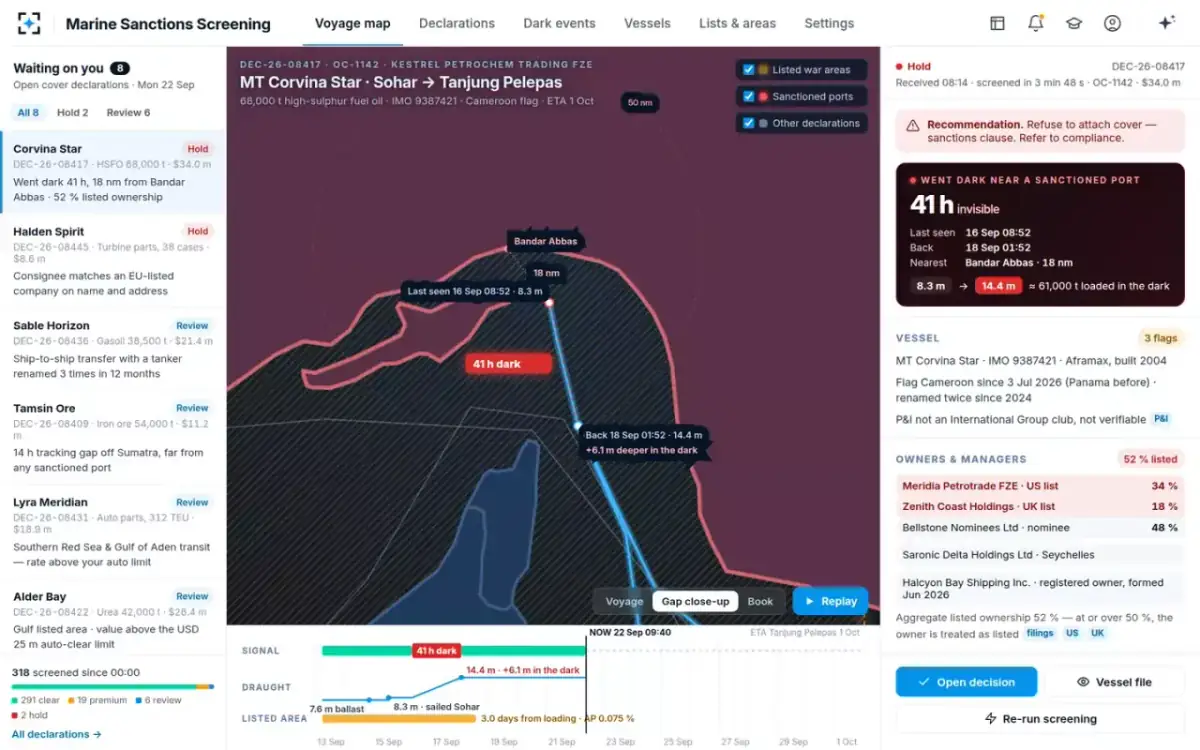
One caution keeps this honest. The draught in an AIS message is not measured by a sensor; the IMO's guidelines say it is "To be manually entered at the start of the voyage using the maximum draft for the voyage and amended as required" (IMO A.1106(29), table 1). A crew can forget to update it, or update it falsely. A draught change is strong evidence when it is large, when it fits the ship's position and when the documents disagree with it, as they do here. It is still evidence, which is why the solution reports it with the positions and leaves the conclusion to people.
Where the gap happened: ports, transfer areas and listed waters
Place turns a gap from noise into a question. The useful distances are to ports and terminals in sanctioned countries, to the waters where ship-to-ship transfers cluster, and to the war areas the market lists for additional premium. OFAC's 2025 guidance points to "the outer port limits of Malaysia and Singapore, or near China" as places where AIS abnormalities in Iranian oil trades have been seen (OFAC, April 2025); the Gulf and the Gulf of Oman are where the sample's longest gaps sat.
Turning an AIS gap into an action: length, place and change together
| What the gap shows | Example from the sample week | Reasonable action |
|---|---|---|
| Gap over the threshold, open sea, no draught or heading change | 14 hours off Sumatra, far from any port of concern | Log on the voyage; no referral |
| Long gap near a port of concern, no draught change | 27 hours, 32 nm from Assaluyeh, drifting at 0.4 knots before the gap | Ask the broker for the deck log and the reason; hold the decision until it arrives |
| Gap near a port of concern, ship returns lighter | 19 hours, 43 nm from Baniyas, back 2.9 m lighter, about 18,000 t discharged | Refer to sanctions compliance; the cargo may have gone to a prohibited buyer |
| Gap near a port of concern, ship returns deeper, documents say otherwise | 41 hours, 18 nm from Bandar Abbas, back 6.1 m deeper against a declared Omani loading | Hold cover; refer to the underwriter and compliance with every position and document |
Every alert opens the positions behind it
An underwriter cannot weigh a gap from a label. What settles it is the raw evidence: the last and first positions with their times, speeds, headings and draughts, and whether any receiver could have heard the ship in between. In the solution, clicking the went-dark panel opens exactly that.
The source behind a went-dark alert: the positions either side of the gap
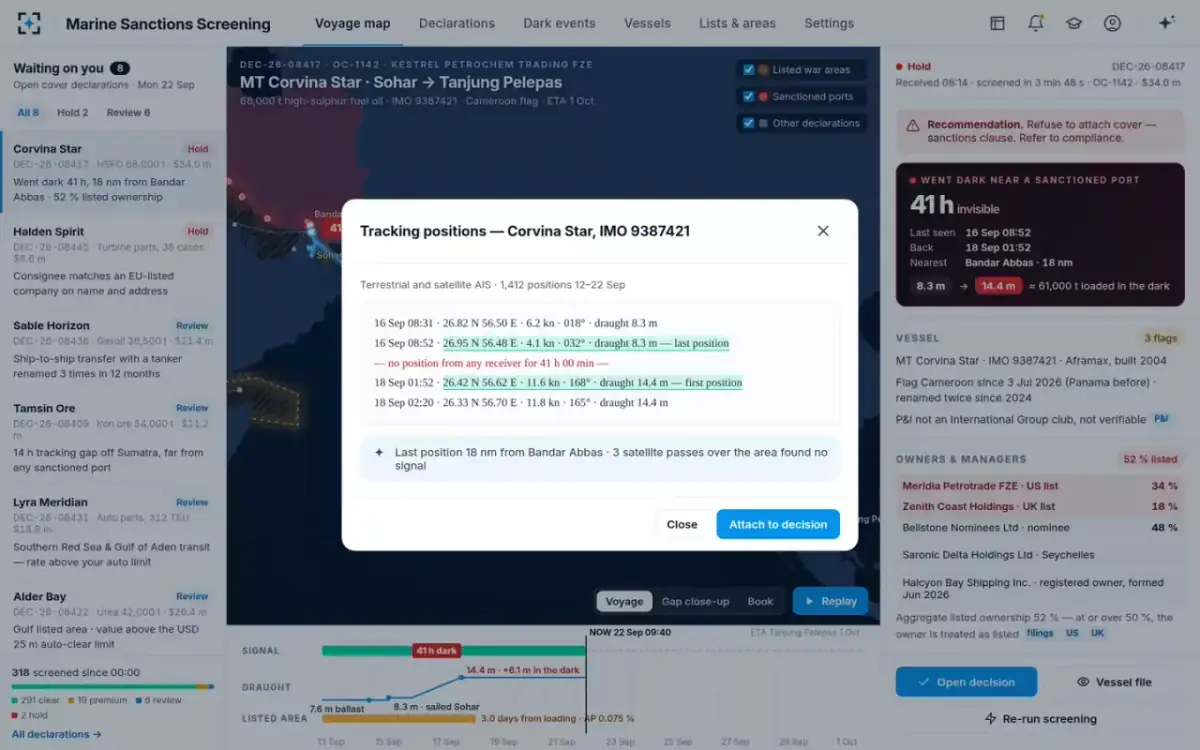
The satellite passes are the detail that most often decides a case. If satellites passed over the area during the gap and heard nothing, the silence was the ship's, not the network's. If no receiver could have heard the ship, the gap says much less. The Price Cap Coalition adds a further source for those who have it: flag registries with access to Long-Range Identification and Tracking "should use it to determine the true location of vessels" during AIS outages (Price Cap Coalition, 2024). Insurers rarely have that access, which is one more reason to ask the broker rather than assume.
How do insurers use AIS data?
Insurers use AIS data at three points: before cover attaches, while the voyage is on cover, and when a claim is presented. The 2020 advisory recommends "Monitoring Automatic Identification System (AIS) transmissions and investigating" gaps, route deviations and transfers with dark vessels "when involving an insured vessel", and suggests contract wording "explicitly notifying clients that AIS disablement or manipulation inconsistent with SOLAS is possible grounds for investigation by the insurer of the ship's activities and could result in cancellation of insurance" (May 2020 advisory).
In practice the first point is a history check, the second is a daily sweep and the third is a reconstruction of the loss voyage. The common thread is that AIS tells the insurer where a ship was said to be, not who owns it or what it carried. Vessel tracking software or sanctions screening sets out what tracking data leaves undone, and dark fleet insurance covers the ships whose whole business model depends on gaps.
Questions people ask
What does AIS gaps meaning refer to in sanctions guidance?
In sanctions guidance an AIS gap means a period when a ship's transponder was off or unheard, especially near ports or transfer areas linked to sanctioned trade. U.S. and UK guidance treat unexplained gaps as a red flag for enhanced due diligence, not as proof; the IMO says non-receipt "may not be determinative of illegal activity".
Can a ship legally switch off AIS?
Yes, where the master believes continued operation would compromise the ship's safety or security, for example in waters with a piracy threat, under IMO resolution A.1106(29). The switch-off and its reason should be entered in the logbook and AIS restarted once the danger has passed, which gives an underwriter a document to ask for.
Do satellites see every AIS signal?
No. Satellite AIS covers the open ocean but not continuously, and reception can be degraded in busy waters. That is why a useful gap report says whether any satellite passed over the area during the gap; in the sample case three passes heard nothing.
Is a draught change proof that cargo was loaded?
Not by itself. AIS draught is entered by the crew, so it can be stale or false. A large change that fits the ship's position, together with documents that say the cargo was loaded somewhere else, is strong evidence for a referral, and the decision stays with the underwriter and compliance.
What should an insurer ask the broker after an AIS gap?
The deck or logbook entries for the period, the reason the AIS was off, any ship-to-ship transfer records, and the loading documents for the cargo. In the sample week, one 27-hour gap near Assaluyeh with no draught change was handled by asking for the deck log rather than by refusing the voyage.