A marine sanctions screening tool checks the voyages an insurer covers for sanctions exposure: the vessel, the companies that own and manage it, where it actually went, whom it met at sea and where its cargo really came from, against the US, UK, EU and UN lists and the regulators' red flags. A name-and-IMO lookup is the first of those checks, not the tool. What separates a useful tool from a dangerous one is less what it finds than what it is allowed to decide: a name alone should never make a match, a gap should never be treated as proof, and no software should clear, refuse or pay. Botminds' Marine Sanctions Screening runs five checks on every declaration with six agents, each with written limits, and leaves every decision to the underwriter and sanctions compliance. This guide is for heads of marine and compliance teams choosing a vessel screening tool, and is honest about where ours does not fit.
Five checks, and what each may not decide
| Check | What it establishes | What it may not do |
|---|---|---|
| 1. Identity | That the vessel and parties in the declaration are, or are not, the ones on a list: name, IMO number, flag, former names, addresses, registration numbers. | Call a match on a name alone; it needs at least two identifiers. |
| 2. Owners and managers | Who owns the registered owner, up through company filings, and who manages the ship commercially and technically. | Infer a shareholding without a filing, or apply one regime's ownership test to another regime's list. |
| 3. Track and gaps | Where the ship was, where it was silent, and whether its draught or position changed while it was. | Treat a gap as proof; it reports hours, positions and draught for a person to judge. |
| 4. Ports, transfers and areas | Calls and loiters near ports of concern, meetings with other ships at sea, days in listed war areas. | Quote additional premium outside the underwriter's authority. |
| 5. Cargo and documents | Whether the bill of lading and certificate of origin agree with each other and with the track. | Edit a declaration, or accept a missing document as present. |
| All five | A recommendation with numbered reasons and the source behind each. | Sign, attach cover, refuse, pay, or tell the broker which list entry was involved. |
What is a marine sanctions screening tool?
It is software that takes what an insurer knows about a voyage, usually a declaration, a bill of lading and a certificate of origin, adds what others know about the ship and the companies around it, and tells the underwriter whether anything in that picture touches a sanction. The minimum is list screening. The rest is due diligence that regulators have described for years and that most desks can only afford for a sample.
The UK guidance accepts that tools are part of the answer. OFSI notes that "Companies can use subscription-based resources or free online tools to check ownership structures, vessel flag details, home ports, and recent ports visited", and that "Even with limited resources, companies can access this information for initial risk assessment" (OFSI, Financial sanctions guidance for maritime shipping, 3.1). The question for a buyer is not whether to use data tools but whether the tool joins them into a decision an underwriter can stand behind.
A vessel name lookup against a marine sanctions screening tool
Name and IMO lookup: Current name and IMO number against the lists.
Five-check screening: Name, IMO number, former names, flags and class since build, and the fleet of its manager.
Name and IMO lookup: Registered owner if it is named.
Five-check screening: Registered owner, parents to five layers, commercial and technical managers, assured and consignee, each with its filing.
Name and IMO lookup: None.
Five-check screening: Track rebuilt from terrestrial and satellite AIS; gaps, transfers and impossible jumps measured.
Name and IMO lookup: None.
Five-check screening: Declared origin and loading port set against the track and the draught.
Name and IMO lookup: Hit or no hit.
Five-check screening: Clear, cover with additional premium, ask the broker, hold or refuse, with numbered reasons and sources.
What checks are done for vessel sanctions?
Five, in the order the evidence usually comes. Identity first, because everything else hangs on the right ship. Ownership second, because most sanctioned interests in shipping are held through companies that are not on any list. Then track, ports and cargo, because a clean ship with clean owners can still carry a sanctioned cargo. The Price Cap Coalition's 2024 advisory sets the scope in one sentence: "Heightened diligence may be appropriate for ships that have undergone numerous administrative changes such as re-flagging, vessel name changes, and ownership changes or otherwise have elevated risk profiles based on age, incident history, deficiencies, and/or inspection history" (Price Cap Coalition advisory, 21 October 2024, Recommendation 6).
OFAC's April 2025 guidance gives the vessel half of the same list. For vessels, due diligence "includes researching its IMO number and associated vessel history, including, but not limited to, travel patterns, available STS history, ownership history, insurance, flag history, ties to evasive activities, actors, or regimes" (OFAC, Guidance for Shipping and Maritime Stakeholders, 16 April 2025). A tool that cannot show each of those for an insured ship is screening a name.
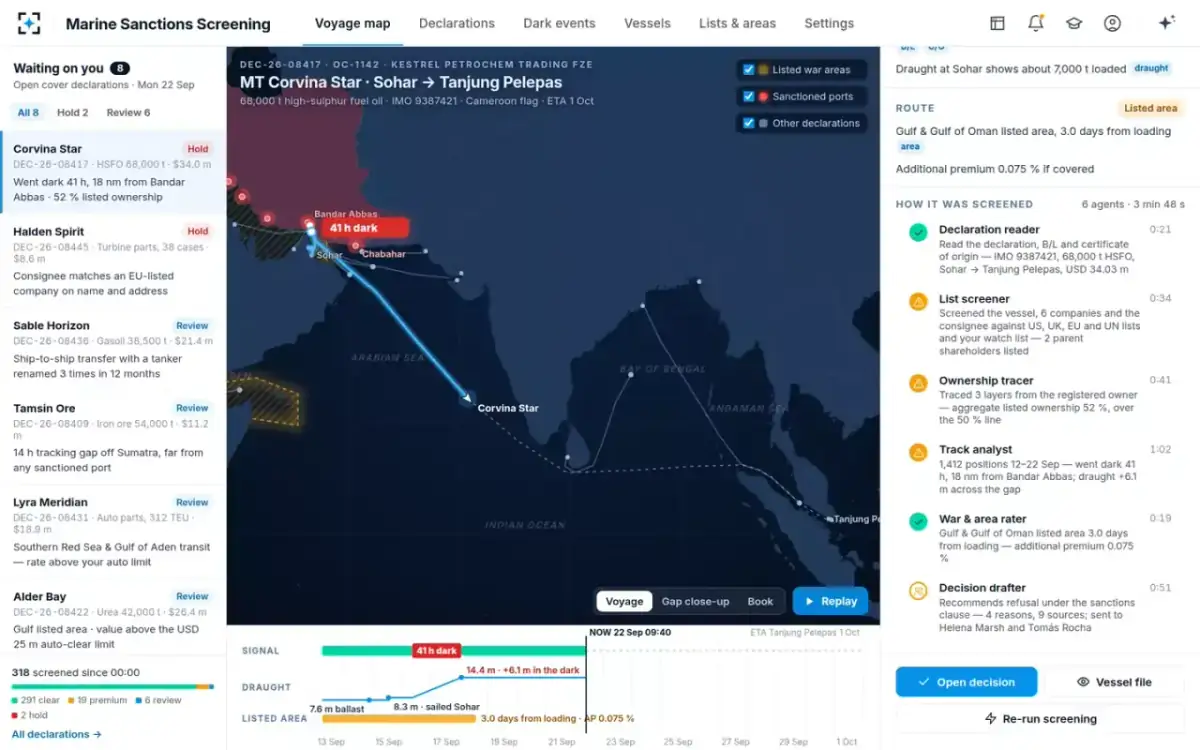
Six agents, five checks, each step timed: 3 minutes 48 seconds
How are vessel names matched to sanctions lists?
By more than the name. Ship names repeat, change and are deliberately reused, so a name match is a reason to compare identifiers, not a finding. OFAC's guidance on potential matches tells organisations to compare the other details of the listing (OFAC FAQ 5), and the banking side of the same problem, a ship's name in a payment, is worked through in vessel sanctions screening by IMO number. For an insurer the identifiers are usually richer: the declaration carries the IMO number, the registry gives flag and owner, the vessel's history gives former names.
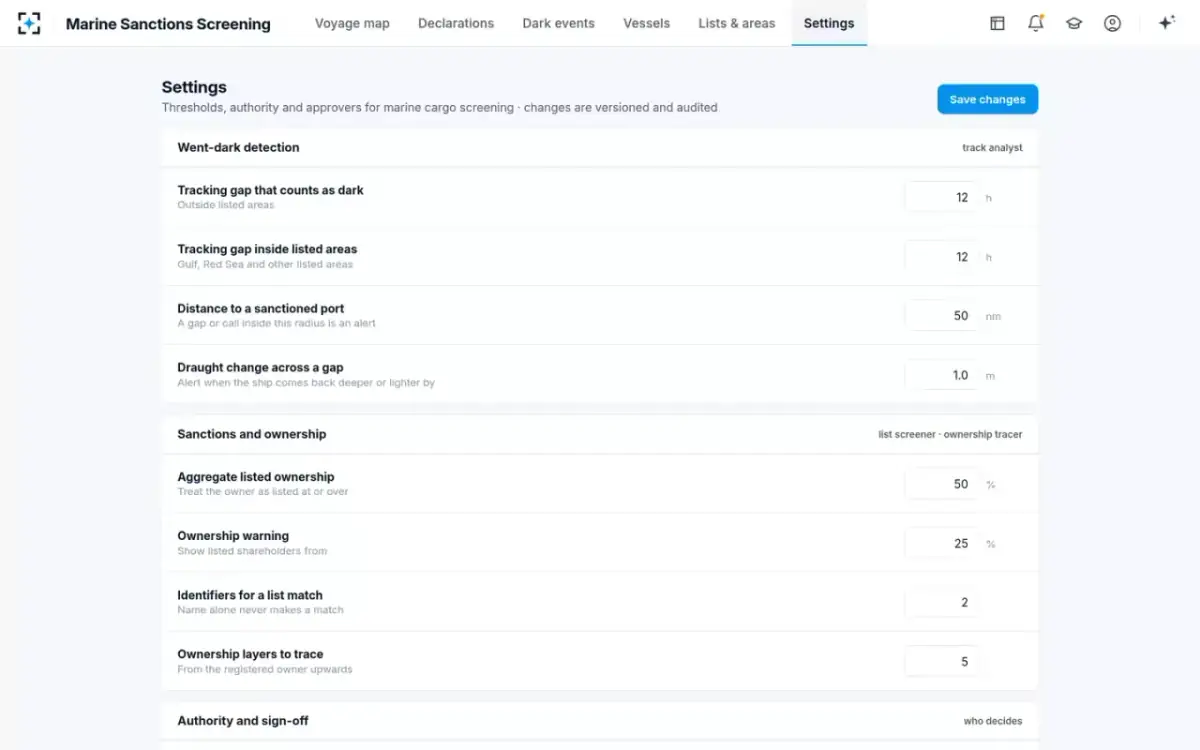
The rule worth holding a tool to is simple: two identifiers or no match. In the sample insurer's settings a list match needs at least two of name, address, registration number, IMO number or date of birth, and a hit on a name alone is shown as a possible match for review. On the sample morning one consignee matched a listed person on a single identifier; it went to the review queue labelled as exactly that, not to the hold queue as a hit.
Identity also has to cover the ship's past. OFSI's guidance lists "False Flags and Flag Hopping", "New Vessel Acquisitions" and "Physically Altering Vessel Identification" among common evasion practices (OFSI maritime guidance, chapter 4). A tool that only knows today's name will clear a renamed ship whose old name is the one on the list.
What is ownership and control screening for ships?
It is finding out who stands behind the registered owner, which for most merchant ships is a company that owns one ship and nothing else. OFSI's guidance is explicit about why it matters to insurers: a breach includes "making coverage available to a body corporate where a designated person has indirect, or direct, ownership or control" (OFSI maritime guidance, 6). The UK test for ownership is a person holding "(directly or indirectly) more than 50% of the shares or voting rights in an entity", or able to appoint the board, or able to ensure the entity's affairs follow their wishes (OFSI maritime guidance, 7).
The U.S. test is different: OFAC treats an entity owned 50 percent or more, individually or in the aggregate, by persons blocked under U.S. sanctions as itself blocked (the OFAC 50 percent rule, explained). A tool therefore has to trace ownership per regime and say which regime each result belongs to. Summing a U.S.-listed holding and a UK-listed holding into one percentage produces a number that neither regime uses. Measuring a screening process works through why that distinction is the commonest source of wrong clears and wrong holds.
The vessel file: names and flags since build, the ownership chain, and the manager's fleet
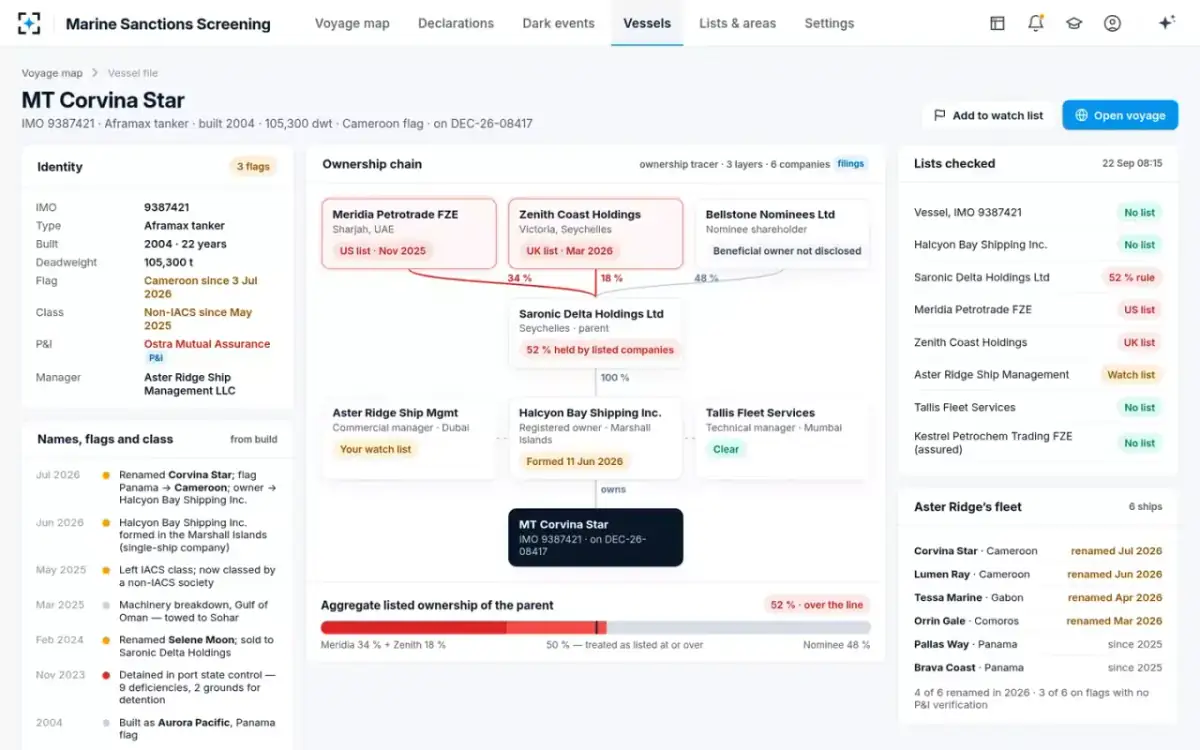
The sample shows what good ownership work surfaces beyond percentages. The registered owner was formed about three months before the voyage. The parent's largest holder is a nominee whose beneficial owner is not disclosed. The commercial manager is on the insurer's own watch list, and four of its six ships were renamed in 2026. The 2020 U.S. advisory suggests exactly this fleet view: insurers "could research the AIS history for all the vessels under the ownership or control of such parties" (Sanctions Advisory for the Maritime Industry, 14 May 2020).
Track, ports and transfers: the checks a list cannot make
The third and fourth checks look at behaviour. The track analyst rebuilds the voyage from terrestrial and satellite AIS, finds gaps over the insurer's threshold, measures the distance from each gap to the nearest port of concern and compares the draught before and after. The same agent flags ship-to-ship meetings and positions the ship could not have reached. When an AIS gap is a red flag sets out how those findings turn into log, ask or refer.
The area check is commercial as well as legal. The war and area rater counts days inside each listed war area from the time cover attaches and applies additional premium from the insurer's own rate table, up to an automatic limit, 0.10% on the sample book, above which the declaration is referred. On the sample voyage, three days in the Gulf and Gulf of Oman listed area would have cost 0.075%, USD 25,523 on a USD 34.03 million insured value, had cover attached.
Cargo origin: where documents and track disagree
The fifth check sets the documents against the voyage. OFAC's 2025 guidance is pointed about where to look: "Certificates of origin issued in jurisdictions known for obfuscating Iranian origin, such as Oman, United Arab Emirates, or Iraq, or known to have a high frequency of Iranian STS operations in adjacent waters, such as Malaysia or Singapore, should be thoroughly investigated" (OFAC, April 2025). It adds that "Testing samples of the cargo's composition can reveal chemical signatures unique to Iranian oil fields", a check no software can do but a claims surveyor sometimes can.
In the sample, the bill of lading and the certificate of origin both said 68,000 tonnes of fuel oil were loaded at Sohar in Oman. The ship's draught at Sohar showed about 7,000 tonnes. It then went silent for 41 hours 18 nautical miles from Bandar Abbas and came back 6.1 metres deeper, about 61,000 tonnes at the ship's 100 tonnes per centimetre. No list held any of that. The documents and the track held all of it.
Who decides a vessel sanctions alert?
People, in two roles. The underwriter decides whether the insurer goes on risk; sanctions compliance decides whether an alert is a true sanctions issue and whether anything is reported. A tool should make both decisions quicker and better evidenced, and should not be able to make either. In Marine Sanctions Screening, the only things that happen without a person are the declarations with no alert at or under the head of marine's automatic-clear limit, USD 25 million on the sample book, and listed-area premium within the automatic limit. Every sanctions refusal or hold needs the underwriter's signature and a compliance countersignature.
Settings: what counts as dark, how close is too close, when to refer
What is a false positive in vessel screening?
A false positive is an alert on a ship or company that turns out not to be the listed one, or a behavioural flag that has an innocent explanation. Both are inevitable; the cost is in how long each takes to close. A name hit with a different IMO number should take a minute if the tool shows both numbers side by side. A 14-hour gap off Sumatra, far from any port of concern, should be logged without anyone's time; on the sample book it was, as one of the 14 gaps that week.
The opposite error matters more. A false negative is a voyage cleared that should have been referred, and it is usually cleared because the tool was asked a narrower question than the regulator would ask: was the ship listed, rather than who owns it and what it did. That is why the limits in the table at the top of this page include not applying one regime's ownership test to another's list. A tool that over-holds wastes underwriters' time; one that under-holds leaves the insurer covering voyages it should not.
Can AI screen ships for sanctions?
AI can do the reading, matching and tracing that make full screening affordable, and it can draft the reasons. It should not be the one deciding, and it should not be trusted for anything it cannot cite. The working test is whether every finding opens its source: the AIS positions behind a gap, the registry filing behind an ownership link, the list entry and version behind a match, the listed-areas circular behind a premium. In the sample solution that is a design target: 100% of alerts linked to the position, filing or list entry behind them.
The regulators' framing supports this division. OFSI leaves the choice of measures to each firm while expecting due diligence proportionate to its risks (OFSI maritime guidance, 3), and OFAC's guidance makes underwriters, brokers and agents responsible for compliance throughout their involvement with a policy; the responsibility stays with the insurer whatever tool it uses. A tool that cannot show its work leaves the insurer unable to show its own.
Buying a marine sanctions screening tool: questions to ask, and where this one does not fit
Run any candidate on your own past declarations, including the ones your team referred and the ones it later wished it had. Then ask the questions below. They apply to Marine Sanctions Screening as much as to anyone.
Questions to put to any marine sanctions screening tool
- Does every alert open its source?
The positions, the filing, the list entry and its version. A score without a source cannot be countersigned.
- What makes a match?
How many identifiers, which ones, and how a name-only hit is shown to the reviewer.
- Is ownership traced per regime?
OFAC aggregation at 50% or more, the UK test of more than 50% without aggregating different designated persons, and any other regime that applies, each reported separately.
- What does it do with silence?
Gap thresholds in and out of listed areas, distance to ports of concern, draught change, and whether any receiver could have heard the ship.
- Does it read the documents?
Bill of lading and certificate of origin set against the track, and missing documents marked rather than assumed.
- Who can change a threshold?
Versioned settings with an owner and an approval step, and a way to re-run the past week under a proposed change.
- What happens without a person?
Exactly which outcomes are automatic and up to what value; everything else should need a signature.
- How often is the book re-screened?
On each list change and on a daily sweep of voyages already on cover, not only when a declaration arrives.
Where Marine Sanctions Screening does not fit is as important. It does not supply tracking data of its own and has no access to Long-Range Identification and Tracking; it works from the AIS feeds, registries, filings and lists the insurer connects. It does not price oil and cannot tell whether a Russian cargo was bought under the cap; that needs the attestation trail described in oil price cap attestation. It does not give legal opinions, and its ownership results are evidence for compliance, not a determination. And its thresholds start as the head of marine's settings: they need tuning on the insurer's own book before anyone should rely on them.
Questions people ask
What should a vessel screening tool show?
At minimum: the vessel's identifiers and history, the ownership chain with its filings, the track with any gaps, the ports and transfers near places of concern, and the documents set against all of these. Each finding should link to its source, and the tool should say which outcomes it applied without a person.
Can a screening tool decide to refuse a risk?
It should not. Under U.S. and UK rules the insurer remains responsible for its decisions, and a refusal under a sanctions clause is a decision with legal and commercial consequences. In the sample insurer, every sanctions refusal or hold needs an underwriter's signature and a compliance countersignature.
How many layers of ownership should be traced?
Enough to reach a person or a listed company. Many ships sit under a single-ship owner, a holding company and one or two more layers. The sample insurer traces up to five layers by default and flags nominee shareholders and companies formed in the last 12 months, which in the sample case surfaced a registered owner formed about three months before the voyage.
Does a screening tool replace sanctions compliance?
No. It replaces the reading, matching and tracing that compliance and underwriting staff do by hand, and gives them evidence faster. The decisions, the countersignatures and any report to a regulator stay with people, which is also what U.S. and UK guidance assume.
Is screening the vessel enough, or must the cargo be screened too?
The cargo too. A compliant ship with compliant owners can carry cargo of sanctioned origin, and OFAC's 2025 guidance singles out certificates of origin from certain jurisdictions for thorough investigation. A tool that never compares the declared loading with the ship's track will miss the cases where the paperwork is the evasion.