A marine open cover declaration is the notice an assured or its broker sends to tell the insurer that a shipment falls under a standing cargo cover: which vessel, which cargo, which ports, on what date and for what value. Cover usually attaches automatically, and the declaration often arrives after the ship has sailed, bundled with dozens of others in a broker's bordereau. Checking a vessel name against the sanctions lists takes seconds; checking who owns the ship, where it actually went and where the cargo really came from takes far longer, so most desks do those deep checks for a sample. Botminds' Marine Sanctions Screening runs every check on every declaration as it arrives, and re-screens the voyages already on cover each morning, so the underwriter opens only the declarations that need a decision.
A sample review leaves an exposure unseen for weeks; a daily sweep leaves it unseen for hours
- Declared3 days
- Owners, track and cargo wait for the sample, if it is picked27 days
- Declared3 days
- On cover, re-screened every morning and on each list changedaily
What is a marine open cover declaration?
A marine open cover declaration is one line of a running arrangement. The insurer agrees in advance to cover an assured's shipments within agreed limits of vessel, cargo, route and value; the assured then declares each shipment as it happens, and the declaration fixes what is covered. Under a well-run open cover the underwriter does not see the shipment before it is insured. The declaration is how the underwriter learns of it at all.
English law has had a rule for this since 1906. Section 29 of the Marine Insurance Act describes a policy which "leaves the name of the ship or ships and other particulars to be defined by subsequent declaration", and sets the default rules for those declarations: they "must be made in the order of dispatch or shipment" and, for goods, "comprise all consignments within the terms of the policy" (Marine Insurance Act 1906, s.29). Most modern open covers write their own declaration terms, as the section allows, but the shape is the same: the assured declares everything, and the insurer accepts what is declared.
That shape is what makes an open cover efficient, and it is also what makes it a sanctions problem. The assured has every reason to declare quickly and little reason to look behind the ship it chartered. The broker aggregates. The insurer receives a spreadsheet. Nobody in that chain has, by default, looked at the owner of the ship or at what the ship did between ports.
When are open cover declarations made, and why after sailing?
Declarations are usually made once the shipment is fixed and the documents exist, which in practice is often after loading and sometimes after arrival. A bill of lading is issued on loading; the insured value depends on the invoice; the assured batches its shipments; the broker batches its assureds. The declaration that reaches the underwriter on Monday morning may describe a ship that left port the week before.
The 1906 Act even allows for the late case. Under section 29, "an omission or erroneous declaration may be rectified even after loss or arrival, provided the omission or declaration was made in good faith" (s.29(3)). A rule written for honest clerical slips also means that the first time an insurer sees some voyages is after the cargo is already discharged, or after the claim.
For sanctions work the timing changes the question. A screen run before a ship sails can prevent a prohibited service. A screen run on a declaration for a ship already at sea is checking whether the insurer is, at that moment, covering something it must not, and whether the voyage it is covering has already done something it should not have. That is a check on facts that have already happened: the track, the port calls, the draught, the transfers.
Are open cover declarations screened for sanctions?
They are, but usually only at the shallow level: vessel name, IMO number and the named parties against the lists. U.S. sanctions guidance expects more than a check at the start. OFAC's insurance guidance says insurers should consider screening "at policy renewal, policy amendment (including, but not limited to, the addition of insured parties or beneficiaries to the policy), claim submission, claim payment, updates by OFAC to its sanctions or sanctions lists", and warns that "Screening only at the point of policy issuance may expose insurers to sanctions risk" (OFAC FAQ 65).
An open cover is issued once and then carries hundreds of shipments, each of them, in substance, an addition to the risk. A desk that screened the assured when the cover was written and screens names on each declaration has done the minimum on the first point and only part of it on the second.
The U.S. maritime advisory of May 2020, issued jointly by the State Department, the Treasury and the Coast Guard, says what the deeper part looks like for an insurer. Among its practices for maritime insurance companies is "Including in pre-coverage and claims presentment, due diligence procedures that assess the AIS history of vessels" in high-risk areas, because these "may warrant further investigation of the ship's voyage, charter, ownership, and other factors" (Sanctions Advisory for the Maritime Industry, 14 May 2020). Under an open cover, "pre-coverage" is the moment the declaration arrives, because cover has already attached in principle and the declaration is the first chance to stop it.
Why a sample of declarations misses the voyages that matter
A sample finds an average; a sanctions exposure is not average. The voyages that matter are rare and concentrated: a tanker that switched off its transponder near an Iranian port, a newly formed single-ship owner, a cargo whose certificate of origin was issued in a different country from where it was loaded. A random 10% sample of declarations will, on average, miss nine in ten of them.
Take a sample marine insurer's week as it runs through Marine Sanctions Screening. All the people, companies and vessels in it are fictional. Across 2,946 voyages on cover, the daily sweep found 14 tracking gaps of 12 hours or more, of which 3 were within 50 nautical miles of a port in a sanctioned country and 2 came back with a draught change of more than a metre. A desk that deep-checked one declaration in ten would expect to look at 0.3 of those three voyages a week. Over a quarter, it would expect to have looked at about four of roughly forty.
The reason sampling persists is arithmetic, not neglect. The solution's own estimate is 30 to 60 minutes to screen one flagged voyage by hand: reading the declaration and its documents, screening every party, tracing the owners, rebuilding the track, counting days in listed war areas and writing up the reasons. On the sample morning described below, 27 declarations carried a finding of some kind: additional premium, a review or a hold. At 48 minutes each, near the middle of that range, checking them by hand is more than 21 hours of work before lunch.
Where a flagged declaration's minutes go, by hand and with Marine Sanctions Screening
By hand, about 48 min
- Documents · 12.5%
- Parties vs lists · 16.7%
- Owners · 25%
- Track · 25%
- Area days · 8.3%
- Reasons · 12.5%
With the solution, about 4 min
- Documents · 12.5%
- Parties vs lists · 12.5%
- Owners · 17.5%
- Track · 25%
- Area days · 7.5%
- Reasons · 25%
The shares tell the story. Half of the manual time goes on the two checks that a sample-based desk skips for most declarations: following the owners up from the registered company, and rebuilding where the ship went. Those are also the two checks that find what a list lookup cannot.
The better measure: how long an exposure stays unseen
A sampling desk reports coverage: we deep-checked 10% of declarations this month. That number says nothing about risk, because the 10% that were checked were mostly clean. The measure that does say something is age: for any voyage now on cover, how long has it been since every check was run against current lists and current tracking data?
Under sampling, the honest answer for nine declarations in ten is "never". Under monthly re-screening, it is up to a month. Under screening on receipt with a daily sweep of the in-force book, it is under a day, and a matter of hours for a list change if the lists are checked hourly. Age is also how a regulator will look at it after the fact: the question will be when the insurer could have known, not what share of its book it sampled.
Sampling the declarations against screening every one
A sample, deep-checked monthly: Vessel name and named parties checked against the lists.
Every declaration, swept daily: Vessel, owners, managers, parents, counterparties and consignee screened; documents read; track rebuilt.
A sample, deep-checked monthly: Traced for the sampled declarations only.
Every declaration, swept daily: Followed through company filings from the registered owner upwards, with the filing behind each link.
A sample, deep-checked monthly: Rarely rebuilt; a gap near a port in a sanctioned country is found if the voyage is sampled.
Every declaration, swept daily: Every gap of the set length measured for hours, distance to the nearest port of concern and draught change.
A sample, deep-checked monthly: Seen at the next sample, if that voyage is in it.
Every declaration, swept daily: Lists checked hourly; the voyages a change touches are re-screened the same day.
A sample, deep-checked monthly: A sample log and a clean list check for the rest.
Every declaration, swept daily: Each declaration with its result, its reasons and the source behind each reason.
A sample, deep-checked monthly: Share of declarations checked.
Every declaration, swept daily: Age of the oldest unscreened exposure, and every referral with its outcome.
What happens if a declared voyage is sanctioned?
If the declared voyage involves a sanctioned person, a sanctioned jurisdiction or a prohibited trade, the insurer must not extend cover to it, whatever the open cover says. OFAC's guidance on global policies names open cargo covers specifically. The wording of a sanctions exclusion can differ by policy type, and OFAC gives open marine cargo policies as its example (the full answer is read in the guide to the sanction limitation and exclusion clause), "but the legal effect of the clause should prevent the extension of a prohibited service (e.g., insurance coverage or indemnification) to sanctioned persons or jurisdictions, or for prohibited activities" (OFAC FAQ 102).
In practice that leaves the underwriter three decisions, and a fourth for compliance. Cover does not attach to the declaration. The broker is told so, without being told which list entry or which finding is behind it. No premium is charged for a voyage that is not covered. And sanctions compliance decides whether anything must be reported, and to whom. What one missed voyage can cost works through the money: penalties, blocked premium and what the sanctions clause does and does not protect.
The worst version of this is the one found late. A declaration screened only by name, attached without question and found to be a problem when the claim arrives leaves the insurer holding premium for a voyage it should not have covered and a claim it may not be allowed to pay.
Screening every declaration on receipt: one sample morning
Screening on receipt means every declaration in every bordereau gets every check before the underwriter's day starts, and only the ones with a reason come to a person. On the sample insurer's Monday, 318 declarations arrived from 12 bordereaux sent by four brokers between midnight and the morning. Each was read, its parties screened, its owners traced, its track rebuilt and its listed-area days counted.
318 declarations by morning: 291 cleared, 27 for a person or a premium
The 291 that cleared did so because nothing was found and the insured value sat within the limit the head of marine set for clearing without a person. The 19 were covered with additional premium for days in a listed war area, at rates from the insurer's own table and within the automatic limit. That left eight declarations for the underwriter, each with its reason in a sentence: a tanker that went dark for 41 hours 18 nautical miles from Bandar Abbas; a consignee matching an EU-listed company on name and address; a ship-to-ship transfer with a tanker renamed three times in a year; a vessel renamed 18 days before sailing, its manager changed the same week.
Every declaration since midnight, with the reason for each result
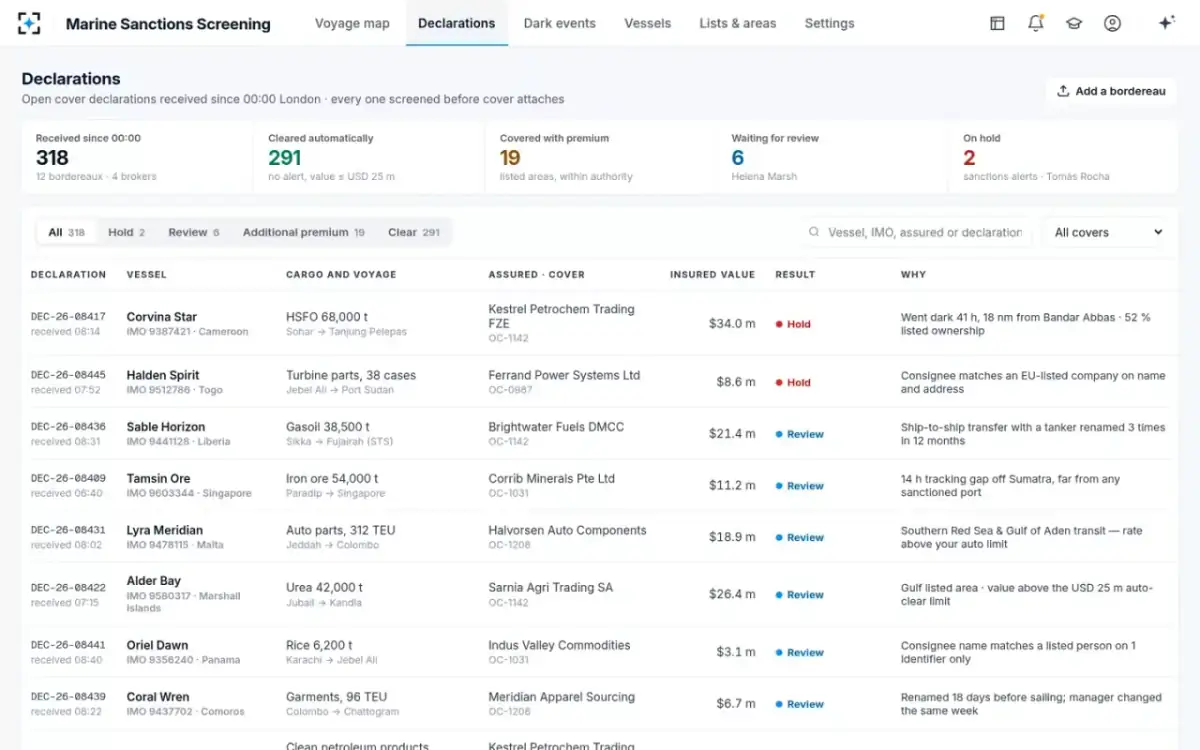
Two details on that screen matter more than the totals. A consignee whose name matches a listed person on one identifier only is shown as exactly that, and sent for review, because a name alone does not make a match. And the reason column is written for the person who decides, not for a log: it says what was found and where, so the underwriter can tell in one line whether to open the file.
Re-screening the in-force book: lists change, ships go dark
A declaration that was clean on receipt can stop being clean while the ship is at sea, in two ways. The lists change: on the sample insurer's calendar, the U.S. list added 12 vessels and 7 companies on 22 September, the EU list 9 companies and 2 persons three days earlier. And the ship's behaviour changes: a tanker that was transmitting normally when declared can disappear for a day near a terminal it was never declared to visit.
So the in-force book is screened again. In the solution, list changes are checked every hour and the voyages they touch are re-screened the same day; the EU change on 19 September matched the consignee of a declaration that arrived later, which was held on receipt. Every morning at 06:00, all voyages on cover are swept for tracking gaps. The 2020 advisory frames the same idea as monitoring "Throughout the Entire Transaction Lifecycle" (May 2020 advisory, practice 3); for a cargo insurer the transaction lasts from loading to discharge, not from declaration to bordereau.
The morning sweep: tracking gaps across the book, nearest to a port of concern first
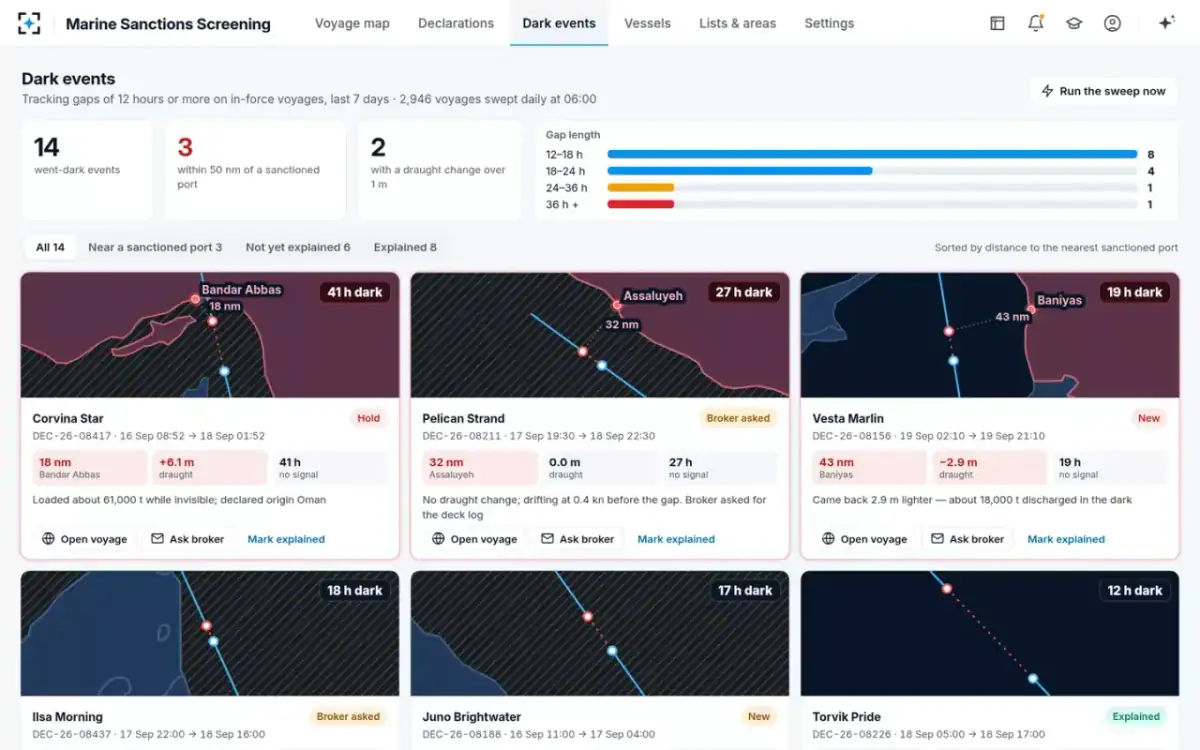
The sweep does not decide anything. A gap is an event to explain, and many have ordinary explanations: poor reception, a ship at anchor, equipment failure. Of the 14 gaps in the sample week, 8 had already been explained. What the sweep changes is who knows: the gap near a port in a sanctioned country is on the underwriter's screen the morning after it closes, not in a claims file months later. When an AIS gap is a red flag sets out how the length, place and draught of a gap turn into refer or clear.
How often should open cover declarations be rescreened?
Every time something that the screen depends on changes: the lists, the ship's track, the ownership filings, the listed war areas. No regulator sets a number of days, and OFAC says screening frequency "will vary depending on the size and nature of an insurer's business" (OFAC FAQ 65). What its guidance does list are the events that should trigger a screen, and for an open cover those events happen daily.
A practical rule has three parts. Screen each declaration fully on receipt, before cover is confirmed to the broker. Re-screen every voyage on cover whenever a list it was screened against changes, within the same working day. And sweep the in-force book for tracking gaps daily, because a gap is only useful while the voyage is still at sea and the cargo can still be questioned.
The UK guidance points the same way without setting a frequency. OFSI tells maritime firms to "assess your risks and put due diligence measures in place to manage these risks", and adds that it "does not mandate specific measures" (OFSI, Financial sanctions guidance for maritime shipping). An insurer that chooses monthly sampling is making a risk decision, and should be able to say why a month is acceptable for a book of ships at sea. Five measures of what a screening process misses sets out how to test that decision on past declarations.
Questions people ask
Is a marine open cover declaration the same as a certificate of insurance?
No. The declaration tells the insurer about a shipment under the open cover; a certificate is the document issued to evidence cover for that shipment, often to a buyer or a bank. Where a cover authorises the assured or broker to issue certificates itself, the declaration can follow the certificate, which is why the insurer may learn of a voyage after its certificate already exists.
Who checks open cover bordereaux?
Usually an underwriting assistant or operations team loads and checks the bordereau for completeness, and the underwriter reviews exceptions. Sanctions checks are often split: names screened by the assistant or a screening tool, deeper checks by sanctions compliance for referred items. The desks around one sanctions alert follows a flagged declaration from seat to seat.
Can sanctions screening run after the ship has sailed?
Yes, and under an open cover it usually must. Screening after sailing cannot stop a loading that has already happened, but it can stop cover attaching to the declaration, prevent premium being taken for a prohibited voyage, and put the facts in front of compliance while the ship is still at sea. OFAC's guidance lists claim submission and claim payment among the points to screen, so the check continues to the end of the voyage and beyond.
Does an open cover have to accept every declaration?
The commercial bargain is that the insurer accepts declarations within the cover's terms, but no cover can oblige an insurer to provide a service the law prohibits. OFAC's guidance expects the policy to carry a clause whose legal effect prevents cover for sanctioned persons, jurisdictions or activities, and a declaration that falls inside such a clause is simply not covered.
How many declarations does an open cover receive?
It depends entirely on the assured's trade: a commodity trader may declare a handful of large voyages a month, a manufacturer hundreds of container shipments. No public regulator publishes volumes. In the fictional sample book on this page, one insurer received 318 declarations from 12 bordereaux in a single morning and had 2,946 voyages on cover.