Marine insurance sanctions rules make an insurer liable for covering a voyage that involves a sanctioned person, place or trade, even if it did not know. The cost of one missed voyage is rarely the premium. In the United States, OFAC builds civil penalties from the value of each prohibited transaction, can look back ten years, and expects premium from a blocked party to be frozen rather than returned; in the UK, OFSI can fine up to 50% of the breach or £1 million, whichever is higher, with no limitation period. The sanctions clause in a marine policy helps only where paying would actually be prohibited, and it does nothing about premium already taken. This guide works through those costs using OFAC's own enforcement cases, then shows how Botminds' Marine Sanctions Screening moves the point at which a problem is found from the claim to the declaration.
The same voyage, caught at screening or caught at the claim
Caught when the declaration arrives: Does not attach. The broker is told the same morning.
Caught when the claim is presented: Has been in place for the whole voyage, on the insurer's books.
Caught when the declaration arrives: Not charged.
Caught when the claim is presented: Already received; if the party is blocked under U.S. rules, it must go into a blocked interest-bearing account and be reported within 10 business days.
Caught when the declaration arrives: None can arise.
Caught when the claim is presented: Suspended under the sanctions clause where payment would be prohibited; a U.S. licence may be needed to pay anyone.
Caught when the declaration arrives: Compliance decides whether a report is needed, with every source on file.
Caught when the claim is presented: Each premium and claim payment is a transaction OFAC can count; the question becomes what the insurer could have known, and when.
Caught when the declaration arrives: Little or none: no prohibited service was provided.
Caught when the claim is presented: Built from the value of every transaction, up to the statutory maximum per violation.
What are the penalties for insuring a sanctioned vessel?
In the United States, civil penalties are set under OFAC's Economic Sanctions Enforcement Guidelines and can reach the statutory maximum for every apparent violation; each premium received and each claim paid can be a separate violation. In the UK, OFSI "has powers under the Policing and Crime Act 2017 to impose monetary penalties of up to 50% of the value of the breach or up to £1 million, whichever is higher", and the principal offences carry up to "7 years imprisonment on conviction on indictment" (OFSI, Financial sanctions guidance for maritime shipping, 9).
Both regimes are strict. The OFAC and OFSI joint guide of June 2026 says OFAC can impose civil penalties on a strict liability standard, and that OFSI can do the same "for sanctions breaches occurring after 15 June 2022". It also sets out how long the exposure lasts: OFAC "may bring a civil enforcement action for violations of sanctions prohibitions within 10 years of the latest date of violation", while for the UK "There is no statute of limitations under UK sanctions law" (OFAC and OFSI, The U.S. and UK Economic Sanctions Authorities: A Comparative Overview, 23 June 2026). A voyage covered in 2026 can be enforced against in 2036 in one jurisdiction and at any time in the other.
How are sanctions penalties calculated? Two OFAC cases, worked
OFAC's settlements publish the arithmetic, and two of them show the range. The first is an insurer. American Life Insurance Company issued group medical and life policies to schools and an entity in the UAE owned or controlled by the Government of Iran, and "processed 2,331 premiums and claims under these policies totaling $446,077". OFAC treated the case as non-egregious and voluntarily self-disclosed, so "the base civil monetary penalty applicable in this matter equals one-half of the transaction value for each apparent violation, which in this case totals $223,038"; the settlement was $178,421, against a statutory maximum of $858,125,016 (OFAC enforcement release, 14 November 2024).
The second is a ship manager. Eagle Shipping carried sand from Burma for a company then on the SDN List, in 36 apparent violations with a total transaction value of $1,796,400. OFAC found it voluntarily self-disclosed but egregious, partly for ignoring a licence denial; the statutory maximum was $9,000,000, the base penalty $4,500,000 and the settlement $1,125,000 (OFAC enforcement information, 27 January 2020).
What two OFAC cases cost, against the value of the transactions
The comparison makes the point that matters for a marine insurer. A non-egregious, self-disclosed case starts from half the value of the transactions, so the penalty scales with how long the problem ran and how many premiums and claims passed through. An egregious case starts from the statutory maximum and can cost more than twice the business involved. What moves a case from one column to the other is largely conduct: warning signs ignored, decisions taken at a senior level, a licence refusal not passed on. A screening trail that shows what was checked, found and decided is the evidence on that question.
What did OFAC fine an insurer for?
In ALICO's case, for providing insurance to entities owned or controlled by the Government of Iran, which made them blocked even though they were not named on the SDN List. OFAC found the insurer had "reason to know" of that ownership: the entity's trade licence named the Iranian embassy as owner on first application, one school's documents carried Iranian government letterhead, and a premium cheque was rejected because it was drawn on a blocked Iranian bank (OFAC, ALICO). The case is life and health insurance, but each warning sign has a marine equivalent: an owner in the filings, a flag history, a payment route.
Marine insurance has its own history in OFAC's records. OFAC's April 2025 guidance notes that "Past public OFAC enforcement actions for violations under the Iranian Transactions and Sanctions Regulations (ITSR) include reinsurance claims payments for NITC and insurance brokering services for coverage of an oil rig in Iranian waters" (OFAC, Guidance for Shipping and Maritime Stakeholders, 16 April 2025). NITC is the National Iranian Tanker Company. The exposure reaches reinsurers and brokers as well as the insurer that wrote the risk.
Does a sanctions clause protect the insurer?
Partly. A marine sanctions clause, such as the sanction limitation and exclusion clause used in the London market, removes the insurer's liability to the extent that cover or payment would expose it to sanctions. The English High Court read such a clause in a cargo policy in 2018 and held that it bites only where paying would actually be prohibited, not where there is merely a risk, and only while the prohibition lasts (Mamancochet, [2018] EWHC 2643 (Comm)). The clause wording and the judgment are taken apart line by line in the guide to the sanction limitation and exclusion clause.
Shipowners, ship management companies, vessel charterers, insurers and reinsurers should ensure contracts (e.g., charter arrangements, insurance and reinsurance policies, and other long-term service agreements) include sufficient sanctions exclusion clauses to exit or terminate agreements that would otherwise be prohibited by U.S. sanctions regulations.
OFAC sanctions advisory for shipping and maritime stakeholders, 16 April 2025
That has three consequences for an underwriter. First, the clause suspends liability rather than ending it: if the sanction is lifted, the claim can become payable again, and the court expected insurers to carry the suspended claim in their books meanwhile. Second, the insurer must show that payment would actually be prohibited under one of the systems of law the clause names, which takes evidence. Third, the clause says nothing about premium already received, about the regulator's view of having provided cover, or about U.S. rules that block the policy itself.
OFAC's guidance on global policies pulls the other way from the English reading. It wants a clause that leaves no cover in place for a sanctioned party to claim on later, once the prohibition lifts: whether cover exists is judged at the time of the loss (OFAC FAQ 102). Its April 2025 maritime advisory, quoted above, asks for exclusions strong enough to exit a prohibited agreement altogether (OFAC, April 2025). A clause is a backstop for what screening misses, not a substitute for screening.
What happens to premium on a sanctioned voyage?
It depends on whether the party is blocked or the voyage is merely outside cover. Where a declaration is refused before cover attaches, no premium is earned and none should be charged. Where a policyholder turns out to be blocked under U.S. rules, OFAC expects the insurer "to block the policy or relevant portion of the policy", report it "within 10 business days from the date the policy becomes blocked", and "place any future premium payments into a blocked interest-bearing account at a U.S. financial institution" (OFAC FAQ 63). Premium cannot simply be returned to a blocked party without OFAC's authorisation, because the funds are themselves blocked.
Blocked premium is the term for that money: received, owed to nobody who can be paid, and held until OFAC licenses its release. It is a balance-sheet item and an operational burden that lasts as long as the designation does.
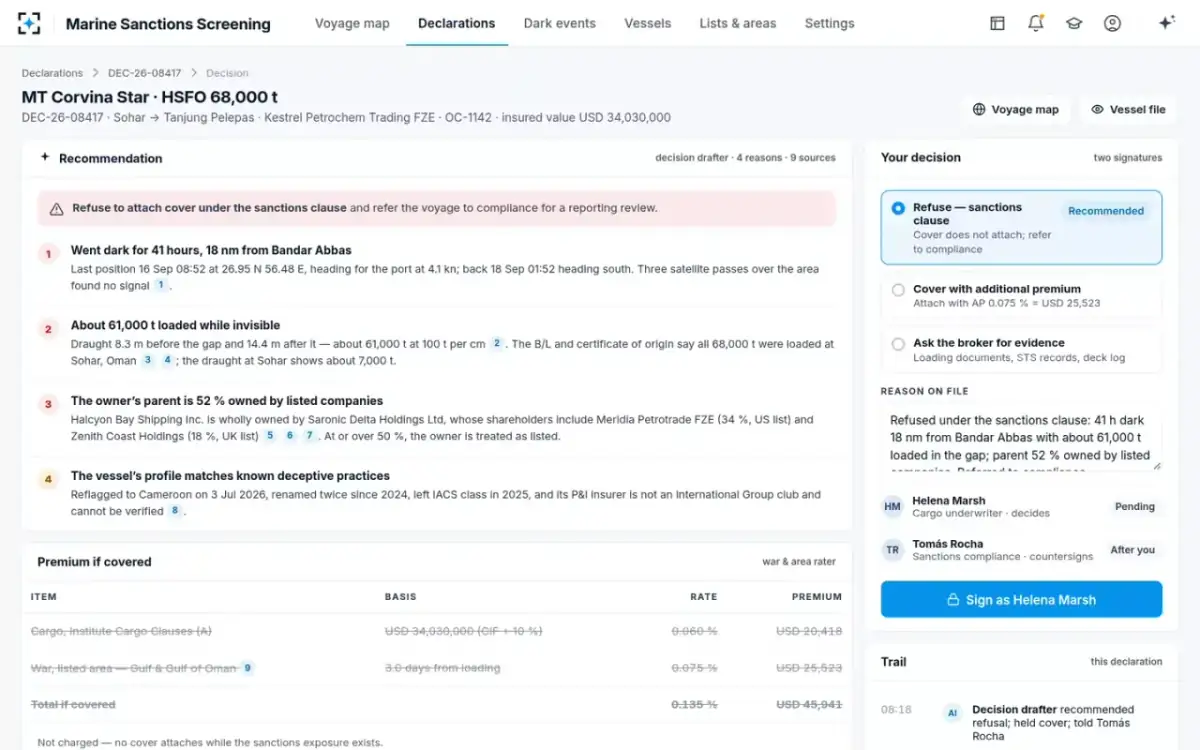
Premium if covered, struck through: nothing is charged on a voyage that does not attach
Can an insurer pay a claim on a sanctioned voyage?
Not without authority, where U.S. sanctions apply. For a policy issued to a blocked person, OFAC says "the insurance policy itself is a blocked contract, so all otherwise prohibited dealings related to the policy would require OFAC authorization", including payments to innocent third parties such as an injured person (OFAC FAQ 1199). Under the English approach in Mamancochet, a sanctions clause suspends liability while payment would be prohibited. Either way, a claim on a missed voyage turns into a licensing question, a delay and often a dispute.
The opposite case is useful to know. OFAC's guidance says that where a non-sanctioned policyholder suffers a loss caused by a blocked person, "the mere fact that a blocked person has caused the loss does not in and of itself create a blocked interest in the policy" (OFAC FAQ 1200). A war-risk claim for a vessel attacked by a designated group is not, by that fact alone, a sanctions problem for the insurer.
The UK side: a percentage ceiling and no time limit
The UK regime sets its ceiling by the size of the breach, at 50% of its value or £1 million, whichever is higher, and its reductions for disclosure are smaller than OFAC's. The joint guide says OFAC "may apply a 50 percent reduction to the base amount of the proposed civil penalty" for a qualifying voluntary self-disclosure, while OFSI "may apply up to a 30 percent reduction in the final monetary penalty amount" for a qualifying voluntary disclosure (OFAC and OFSI comparative overview, 6.3).
U.S. and UK enforcement terms a marine insurer should price in
| Term | United States (OFAC) | United Kingdom (OFSI) |
|---|---|---|
| Liability standard | Strict liability for civil penalties | Strict liability for breaches after 15 June 2022 |
| Time limit | 10 years from the latest violation | No statute of limitations |
| Ceiling | Statutory maximum per violation | 50% of the breach value or £1 million, whichever is higher |
| Self-disclosure | Up to 50% off the base penalty | Up to 30% off the final penalty |
| Criminal exposure | Separate, for wilful violations | Up to 7 years on indictment for the principal offences |
For a London insurer with U.S. reinsurers, both columns can apply to the same voyage through different parties. The reinsurer's own sanctions clause, and its view of the cedant's screening, become part of the cost.
Caught at screening against caught at the claim: what moves the cost
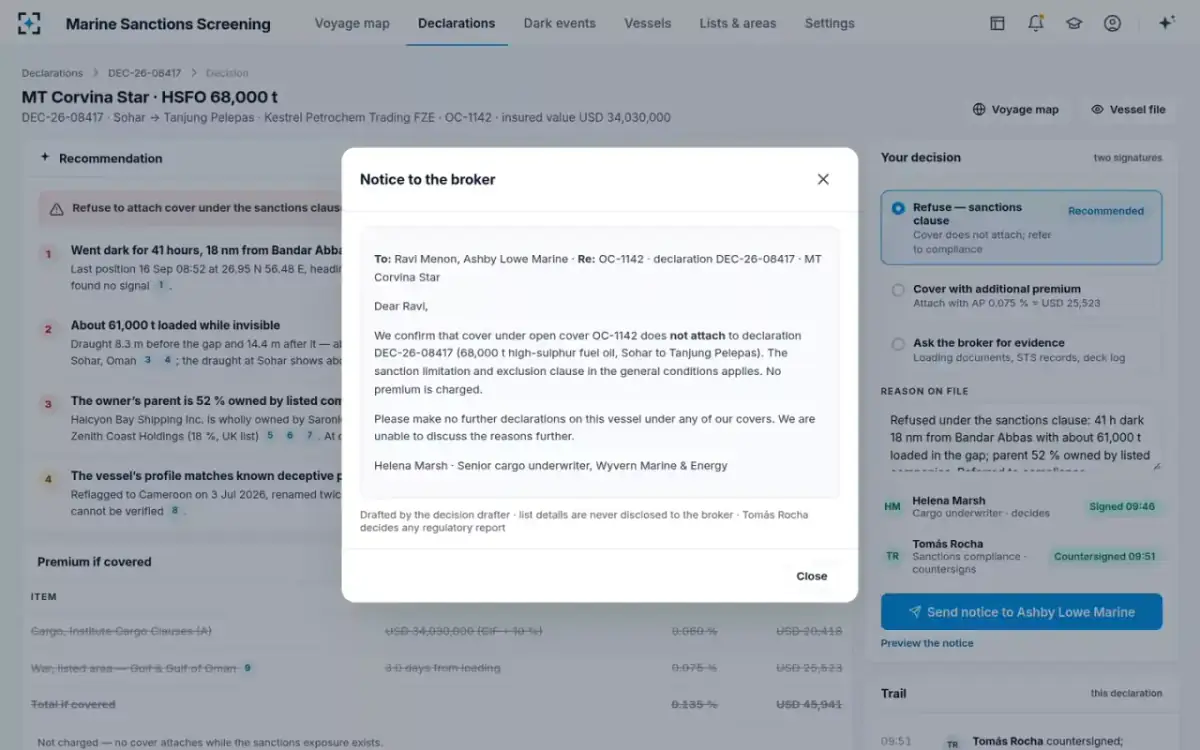
Timing is the largest single lever. Take a fictional sample voyage as it runs through Marine Sanctions Screening: a tanker declared as loading 68,000 tonnes of fuel oil at Sohar in Oman, insured value USD 34.03 million, that had gone dark for 41 hours near Bandar Abbas and come back 6.1 metres deeper. It was screened 3 minutes 48 seconds after the declaration arrived, refused under the sanctions clause, signed by the underwriter and countersigned by compliance within the morning, and the broker was told the same day. No premium was taken and no claim could arise.
Had the same declaration been checked by name only and attached, every one of the costs in the comparison at the top of this page would have been live: USD 45,941 of premium taken on a voyage that should not have been covered, a claim waiting if the ship were lost, a reporting question with ten years of U.S. exposure behind it, and the conduct question of whether the gap and the owners were knowable at the time. They were, because they were in the tracking data and the filings.
The broker hears the same morning: cover does not attach, no premium charged
What screening costs, set against that
The cost of screening every declaration is mostly people's time, and that is what makes sampling tempting. The solution's own estimate is 30 to 60 minutes to screen one flagged voyage fully by hand, against about four minutes with the agents. Neither regulators nor independent researchers publish industry figures for screening cost or for marine sanctions losses, so the comparison has to be made with the insurer's own numbers: flagged declarations a year times the minutes each takes, against one ALICO-sized settlement, one blocked claim, or one egregious finding.
The asymmetry is the argument. A screening cost is paid on every declaration and is small; a missed voyage is rare and can be larger than a year's premium on the account. Screening every open cover declaration rather than a sample is the practical form of that trade, and what to bring to start a maritime sanctions compliance program sets out what an insurer needs to begin.
Questions people ask
Can an insurer return premium to a sanctioned assured?
Not if the assured is blocked under U.S. sanctions: OFAC expects premium to be placed in a blocked interest-bearing account and reported within 10 business days, and released only with a licence. Where a declaration is simply refused before cover attaches, no premium should be charged in the first place.
Does OFAC fine insurers that did not know?
OFAC's civil penalties are on a strict liability basis, so lack of knowledge is not a defence to liability, though it affects the amount. Whether a case is judged egregious, and whether it was self-disclosed, set the base penalty: half the transaction value in a non-egregious self-disclosed case, and much more in an egregious one.
What is a blocked premium?
Premium received from or for a blocked person, which U.S. rules require the insurer to hold in a blocked interest-bearing account at a U.S. financial institution instead of keeping it as income or returning it. It stays there until OFAC authorises a release.
Does the sanctions clause cover a voyage the insurer should never have accepted?
The clause can suspend the insurer's liability to pay a claim where payment would be prohibited, as the English High Court held in Mamancochet in 2018. It does not undo the cover that was provided, the premium taken, or a regulator's view that a prohibited service was given.
Are reinsurers exposed for a cedant's missed voyage?
They can be. OFAC's 2025 guidance cites past enforcement for reinsurance claims payments involving the National Iranian Tanker Company, and asks reinsurers as well as insurers to ensure their contracts carry sufficient sanctions exclusion clauses. A reinsurer's exposure follows the payments it makes, whoever wrote the original risk.