Vessel tracking software collects a ship's Automatic Identification System broadcasts from shore stations and satellites and shows where the ship was, how fast it moved, which ports it called at and when it went silent. Sanctions screening checks the ship, its owners, managers and counterparties against the sanctions lists and the regulators' red flags. Marine insurers often buy the first and assume it covers the second. It does not: a tracking platform can show a tanker loitering off an Iranian port without knowing that the tanker's owner was formed three months ago under a parent with listed shareholders, and a screening tool can clear the owner without knowing where the ship went. What an underwriter needs is the layer that joins them to a decision on a specific declaration. Botminds' Marine Sanctions Screening is that layer: it works from the tracking data and lists an insurer already has, and turns them into a recommendation with its sources for the underwriter to sign. A bank screening a payment that names a ship faces a narrower question, whether the vessel is the listed one, covered in the banking guide to vessel sanctions screening.
Three layers between a ship's position and a signed decision
Decision
Should we cover this voyage, on what terms, and who signs?
Appetite thresholds, authority limits, the rate table, two signatures, the broker notice, the trail.
Screening
Who owns and manages this ship, is anyone listed, and do the cargo papers fit what the ship did?
Lists, company filings, vessel history, the declaration and its documents.
Tracking
Where was the ship, and when was it silent?
Terrestrial and satellite AIS positions, port calls, speed, heading, reported draught.
What is vessel tracking software?
It is software that gathers AIS messages, the identity and position reports ships broadcast by radio, and turns them into tracks on a map with history and alerts. Shore stations hear ships near the coast; the IMO's own guidelines put the typical range at sea at "20 to 30 nautical miles depending on antenna height" (IMO resolution A.1106(29), paragraph 10). Satellites extend coverage over open ocean. Commercial platforms combine both, add port and berth data, and offer analytics such as gap detection and ship-to-ship transfer alerts.
AIS was not designed for compliance. The IMO says it is "intended to enhance: safety of life at sea; the safety and efficiency of navigation; and the protection of the marine environment", and warns that "information provided by AIS may not be giving a complete or correct ‘picture’ of shipping traffic" because some ships need not carry it and others switch it off (IMO A.1106(29), paragraphs 3 and 4). A tracking platform inherits those limits: it shows what ships report, not what they do.
Do insurers use vessel tracking?
Yes, and U.S. guidance expects them to. The May 2020 maritime advisory from the State Department, the Treasury and the Coast Guard suggests that maritime insurance companies consider "Incorporating data such as historical ship location, ship registry information, and ship flagging information, along with available information from the U.S. Department of the Treasury, the UN, and the U.S. Coast Guard into due diligence practices" (Sanctions Advisory for the Maritime Industry, 14 May 2020). OFAC's 2025 guidance points stakeholders to "information from organizations that provide commercial shipping data, such as vessel location, ship registry information, and insurance coverage" (OFAC, Guidance for Shipping and Maritime Stakeholders, 16 April 2025).
Note what both sentences put next to location: registry data, flags, insurance, government lists. Neither treats tracking as a check on its own. It is one input to due diligence, and the advisory's word for the result is "practices", which is the layer an insurer has to build.
Can vessel tracking detect sanctions evasion?
It can detect behaviour that evasion produces: silence near a terminal, a meeting at sea, a position that cannot be right. Researchers have shown how far this goes. An NBER working paper by Fernández-Villaverde, Li, Xu and Zanetti uses "a machine learning-based ship clustering model" to "track dark-shipped crude oil trade flows worldwide and detect unauthorized ship-to-ship transfers" (NBER Working Paper 33486, 2025), working from tracking data alone.
What tracking cannot do is say whether the behaviour is a sanctions problem for the insurer. A ship-to-ship transfer is lawful in most cases; OFSI notes such transfers serve legitimate purposes and that the practice is exploited "particularly during the night or in areas identified as high-risk for sanctions evasion or other illicit activities" (OFSI, Financial sanctions guidance for maritime shipping, 4.2). Whether this transfer, with this counterpart ship, involved a listed party or a cargo of prohibited origin is a screening question. OFAC's 2025 guidance shows why the pattern matters: Iranian shipments often use "multiple STS transfers—usually three to five—in a single shipment", and "Successive STS transfers serve little commercial purpose and are a strong risk factor for sanctions evasion" (OFAC, April 2025). Tracking finds the transfers; screening finds out who was on the other side.
What does vessel tracking miss?
Everything that is not a position. Tracking does not know who owns a ship, who stands behind the owner, which manager runs it, whether its P&I cover is real, what the bill of lading says or whether the certificate of origin fits the route. It also misses some positions: ships that do not carry AIS, gaps where no receiver was in range, and spoofed reports that look like normal tracks. The IMO records that Long-Range Identification and Tracking, a separate system, "can be used to identify ships up to 1,000 nautical miles from the coastal State" (IMO resolution A.1192(33)), but LRIT data goes to flag and coastal States, not to insurers.
Tracking software, sanctions screening and the decision layer: what each answers
| Question | Vessel tracking software | Sanctions screening | Decision layer |
|---|---|---|---|
| Where was the ship? | Yes, from AIS, where heard | No | Uses the track for this voyage |
| When was it silent, and near what? | Gaps, often with alerts | No | Applies the insurer's thresholds: hours, distance, draught |
| Who owns and manages it? | Sometimes a registry snapshot | Yes, if ownership is traced through filings | Applies each regime's ownership test |
| Is anyone listed? | Rarely | Yes | Requires two identifiers for a match |
| Do the cargo papers fit the voyage? | No | Rarely | Sets the documents against the track and draught |
| Cover, premium or refusal? | No | No | Drafts a recommendation with sources; people sign |
What is the difference between AIS tracking and sanctions screening?
AIS tracking is about a ship's movements; sanctions screening is about the people and companies behind a transaction. Tracking answers where and when, from radio reports the ship controls. Screening answers who and what, from lists, registries, filings and documents the ship does not control. An underwriter needs both because evasion works by making each look clean on its own: a renamed ship with clean movements, or a clean owner with a ship that goes dark.
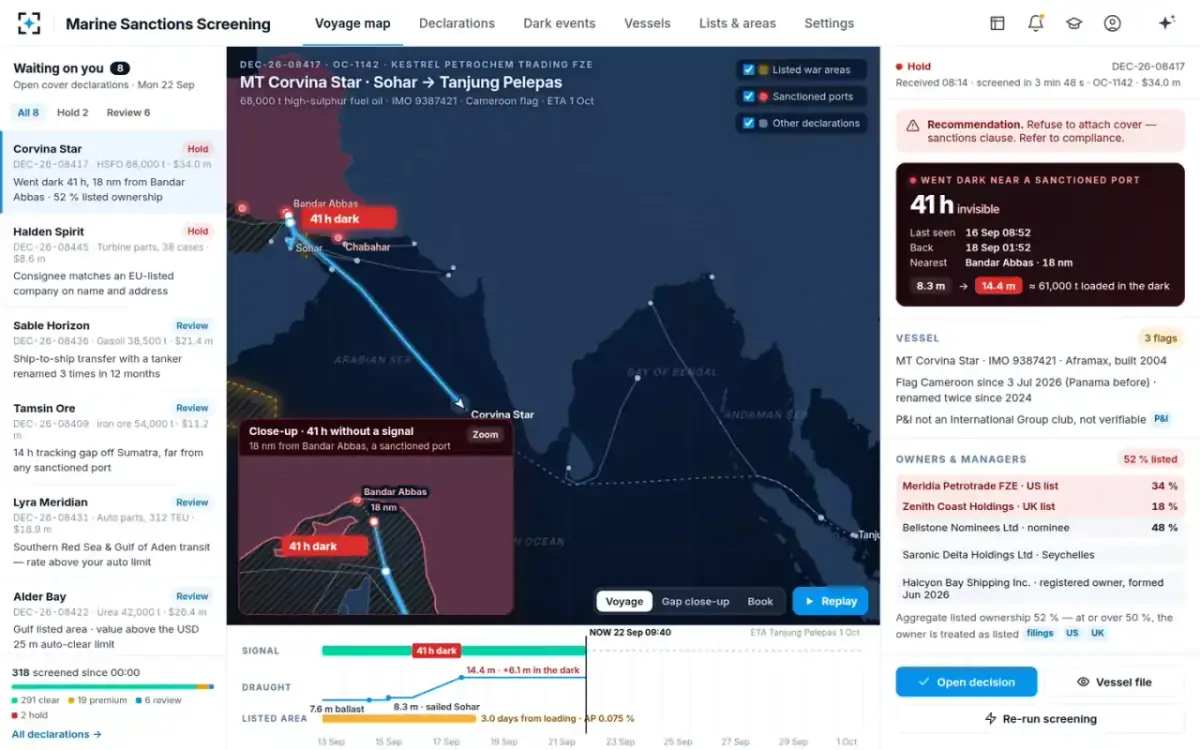
The difference shows in a single fictional case from the sample book used in this series. Tracking alone shows a tanker declared as loading fuel oil in Oman that went silent for 41 hours 18 nautical miles from Bandar Abbas and came back 6.1 metres deeper. Screening alone shows a registered owner formed in June 2026, a parent with two listed shareholders on different lists and a nominee holding 48% for an undisclosed owner, and a manager on the insurer's watch list. Neither is decisive alone. Together, with the bill of lading saying all 68,000 tonnes were loaded in Oman, they are a refusal with four reasons and nine sources.
One screen for both halves: the track, the gap, the owners and the recommendation
The layer between: from a position to a decision
The layer between tracking and screening is the insurer's own rules applied to one declaration. It takes the track for the declared voyage, not the ship's whole history; measures gaps against the insurer's hours and distance; reads the declaration's documents; screens the parties the declaration names; traces the owners; counts the days in listed war areas against the insurer's rate table; and drafts a recommendation that the underwriter can sign or overrule, with compliance countersigning any sanctions refusal.
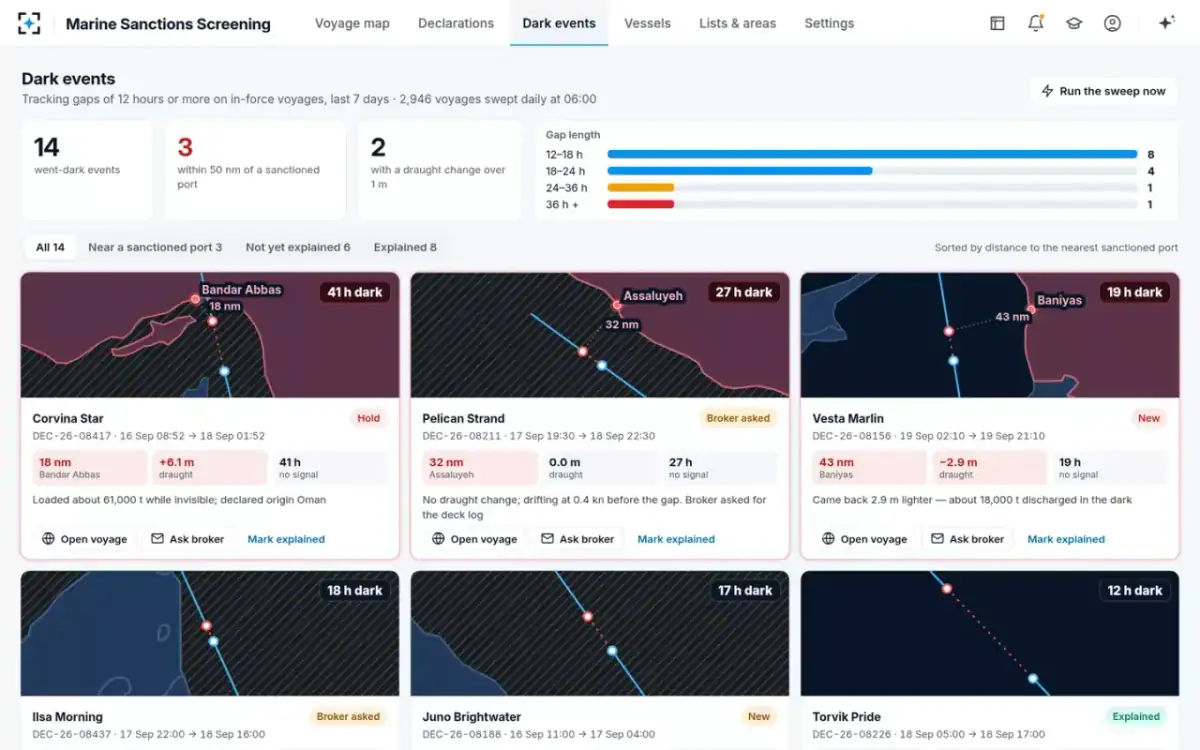
That is what Marine Sanctions Screening does with six agents, each limited to its part. The track analyst rebuilds the voyage from terrestrial and satellite AIS and reports each gap for a person to judge, never as proof. The decision drafter may not give a reason without a source. The daily sweep turns the tracking feed into a short list for the underwriter instead of a map to watch.
From 2,946 voyages to two that needed a person: one week's sweep
The sweep's output: fourteen gaps, nearest to a port of concern first
How is AIS data used in underwriting?
At three moments. Before cover attaches, to check a vessel's history for gaps, port calls and transfers in high-risk areas; the 2020 advisory recommends building a review of the vessel's AIS history into the checks made before cover and when claims are presented. While the voyage is on cover, to sweep for new gaps and deviations. And at claim, to reconstruct the loss voyage and check that the ship was where the claim says. Underwriters also use it commercially, for listed-area days and additional premium, which is why the same track serves pricing and sanctions.
The pricing use is easy to overlook. In the sample, the war and area rater counts days inside each listed area from the time cover attaches; the sample tanker would have spent three days in the Gulf and Gulf of Oman listed area, 0.075% or USD 25,523 on its insured value, had it been covered. When an AIS gap is a red flag sets out the sanctions use of the same data in detail.
What data do marine insurers need beyond AIS?
Five kinds, each answering a question tracking cannot. They are the inputs a screening layer has to join to the track before an underwriter can rely on the result.
Data a marine insurer needs beyond AIS, and the question each answers
- Sanctions lists, plus your own watch list
Is the ship, an owner, a manager, the assured or the consignee listed, under which regime, and since when?
- Registries and company filings
Who owns the registered owner, through how many layers, since when; who manages the ship commercially and technically?
- Vessel history: names, flags, class, casualties, inspections
Has the ship changed identity, left its classification society, been detained, or been renamed alongside its manager's fleet?
- The declaration and its documents
What does the bill of lading say was loaded, where, and does the certificate of origin agree with the track and the draught?
- Listed areas and the insurer's rate table
How many days in which listed war areas, at what additional premium, within whose authority?
Buying: if you already license tracking data
Keep it. Tracking data is an input a screening layer needs, and replacing a working feed buys nothing. The questions for a buyer who already has tracking are about what sits on top: does the screening tool use your feed or its own, does it rebuild the track per declared voyage, does it apply your thresholds rather than the platform's defaults, and does every alert open the positions behind it?
Marine Sanctions Screening is built for that case. It works from the terrestrial and satellite AIS, lists, registries and filings an insurer already licenses, rather than bringing its own; it does not replace a tracking platform's maps for the marine operations team, and it has no access to LRIT. What it adds is the per-declaration work: the documents read, the owners traced, the gaps measured against the insurer's own settings, the listed-area premium applied within authority, and a recommendation with sources for the underwriter and compliance to sign. For the full list of checks a buyer should test, see marine sanctions screening tool: five checks and what none may decide, and for the inputs to bring, what to bring to start a maritime sanctions compliance program.
Questions people ask
What is the best vessel tracking software for insurers?
The one whose data covers the routes and trades in your book, with satellite coverage where your ships go and history long enough to check a vessel before cover. For sanctions purposes the platform matters less than what is done with its data: whether gaps are measured against your thresholds and joined to ownership and documents for each declaration.
Can vessel tracking alone satisfy sanctions due diligence?
No. U.S. guidance lists ship location alongside registry, flag and government sanctions information, and UK guidance expects ownership and documents to be checked. A clean track says nothing about a listed owner, and a ship with a listed owner can broadcast faithfully all the way.
Is satellite AIS enough to see every ship?
No. Satellites do not hear every ship continuously, some ships need not carry AIS, and spoofed reports can look normal. A gap report is stronger when it says whether a satellite passed over during the gap; in the sample case, three passes heard nothing.
Do insurers have access to LRIT data?
Generally not. LRIT reports go to flag and coastal States, and the Price Cap Coalition recommends that stakeholders with access, such as flag registries, use it to locate ships during AIS outages. An insurer that sees a long gap usually has to ask the broker for logbook entries instead.
What is vessel monitoring software?
The term is used for tracking platforms that add alerts, such as geofences, port arrivals, gaps and transfers, to the basic map. For an insurer it is the same input as tracking software; the sanctions value comes from joining those alerts to ownership, lists and documents for each insured voyage.