A non-standard policy wording is any wording that departs from the carrier's standard form for that class: a broker's own wording, a manuscript policy, or the standard form with manuscript endorsements. Most of the departures that change who is paid fall into six kinds: a widened definition, a deleted exclusion, a moved condition, a changed trigger, a sublimit added or escaped, and a reworded warranty or condition. Each has a check that finds it, and each is easy to miss when reading a 38-page wording in order. The examples below come from a fictional sample cyber manuscript as Botminds' Policy Wording Comparison reads it against the carrier's form, with what each change does and who had to decide it.
The sample: Calloway Brandt's manuscript CB CyberShield 2026 for Halvorsen Freight Systems, against Ashgrove Specialty's cyber form, with thirteen differences in all. Company, people and wordings are fictional; the law and regulator material is real.
Six kinds of non-standard change, an example of each, and the check that finds it
1
A widened definition
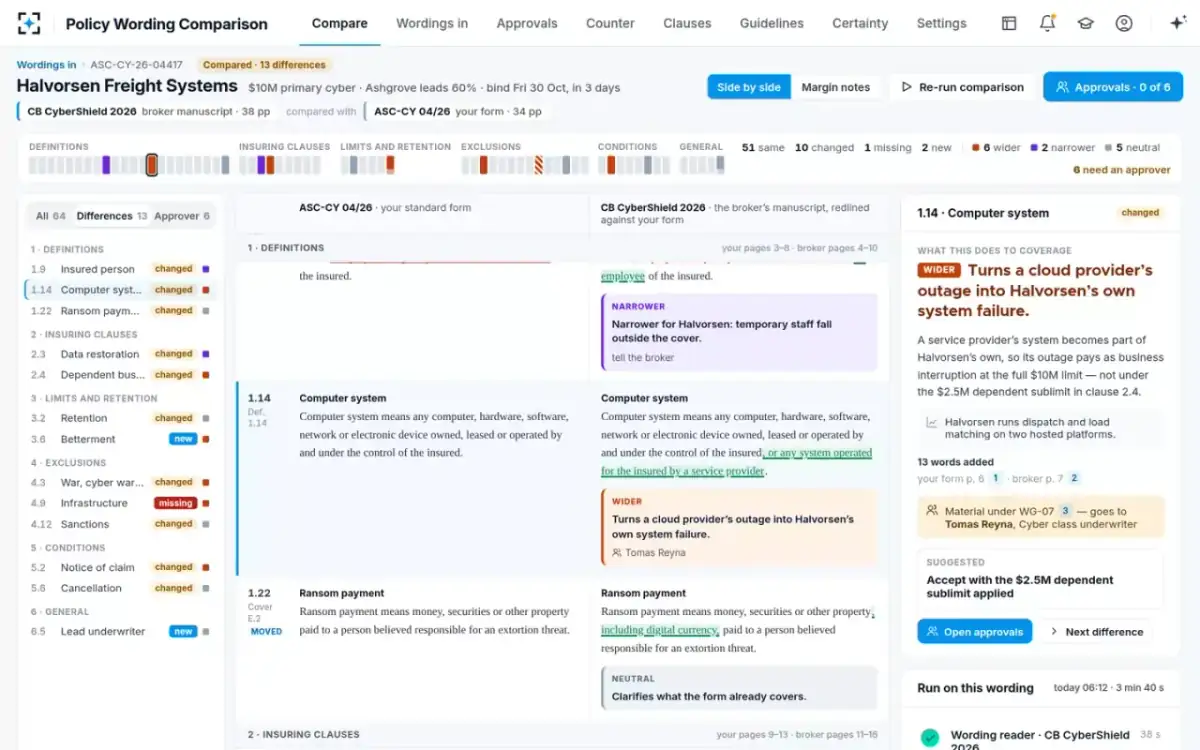
"Computer system" gains 13 words: systems "operated for the insured by a service provider".
Check: Re-read every clause that uses the defined term.
2
A deleted exclusion
The infrastructure exclusion is simply not in the broker's wording.
Check: Start from your form and account for every one of its clauses.
3
A moved condition
Notice of claim moves out of the section whose conditions are precedent to liability.
Check: Note where each condition sits, not only what it says.
4
A changed trigger
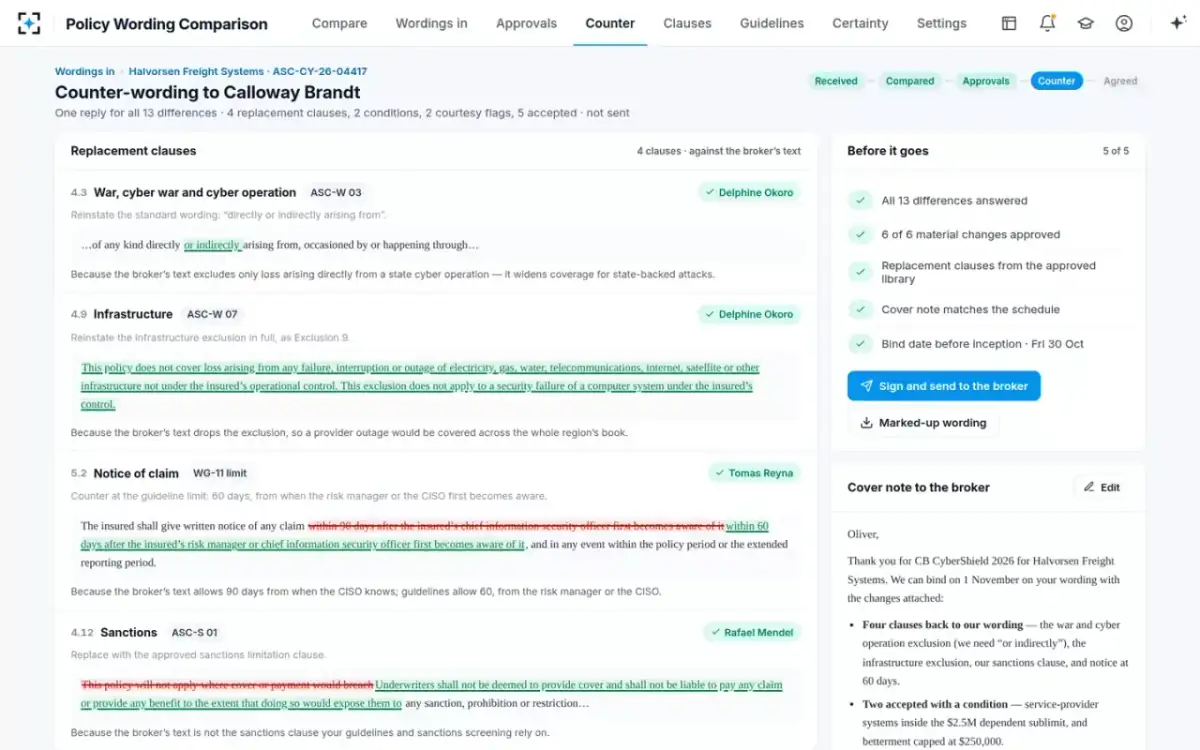
Two words, "or indirectly", go from the war exclusion; notice runs from when the CISO knows.
Check: Read causal and timing words as closely as amounts.
5
A sublimit added, raised or escaped
An outage moves from a $2.5 million dependent sublimit into the $10 million limit.
Check: Trace each loss scenario to the limit that would pay it.
6
A reworded warranty or condition
A security condition is restated as a warranty, or a proposal form made "the basis of the contract".
Check: Classify each term, then check it against the law that governs it.
What is a non-standard policy wording?
It is any wording the carrier did not write as its own form for that class. In specialty, E&S and London market business the non-standard wording is often the norm rather than the exception: the wholesale broker brings its own paper, and the carrier must decide, clause by clause, which departures from its form it will accept. The carrier's form is the benchmark because it embodies what the carrier priced, filed where filing applies, and has paid claims on.
Not every departure is a problem. Of the sample manuscript's 64 aligned clauses, 51 were word for word the same as the form; of the 13 differences, 5 were neutral for the insured, 6 widened cover and 2 narrowed it. What makes a wording non-standard in the sense that matters is a difference someone with authority has to decide. How a manuscript differs from a standard form covers the definitions and the filing rules.
What is a widened definition? One phrase that moves through the whole wording
A widened definition is a defined term whose meaning the broker has enlarged, usually by adding a phrase. It is the most efficient change a drafter can make, because every clause that uses the term widens with it, and none of those clauses shows a mark on a blackline. In the sample, "computer system" in the form means equipment "owned, leased or operated by and under the control of the insured". The manuscript adds thirteen words: "or any system operated for the insured by a service provider".
The effect runs through the insuring clauses. Business interruption caused by a failure of the insured's computer system pays at the full $10 million limit; interruption caused by a service provider's failure falls under a $2.5 million dependent business interruption sublimit. Widen the definition and a cloud provider's outage becomes the insured's own system failure. For Halvorsen, which runs dispatch and load matching on two hosted platforms, that is the likeliest large loss. The carrier's guideline allows service providers inside the definition only with the dependent sublimit applied, so the class underwriter accepted it on that condition.
The widened definition as the solution shows it: thirteen added words and what they do
How do you spot a deleted exclusion?
By starting from your own form and accounting for every one of its clauses in the broker's wording; reading the broker's wording on its own will not find it, because there is nothing there to read. In the sample, the carrier's form carries an infrastructure exclusion at clause 4.9 on page 20. The manuscript has no counterpart. A redline of the manuscript against the form shows it, at best, as one struck block among many renumbering strikes, easy to read as noise.
The clause matters because of what it keeps out of a cyber book. The U.S. Government Accountability Office, describing how insurers limit systemic exposure, noted that some cyber insurers exclude outages of critical infrastructure the policyholder does not control, because such events spread across many systems and supply chains at once (GAO-22-104256; GAO's words are read against accumulation in cyber insurance war exclusion). Without the exclusion, an outage of a power, internet or telecoms provider affecting one region could pay across every policy in that region on the same wording. In the sample, the carrier's guidelines require the exclusion on every cyber wording, and the head of cyber declined its removal.
Three clauses in the sample: the carrier's form against the broker's manuscript
Ashgrove's form (ASC-CY 04/26): Hardware, software and networks "owned, leased or operated by and under the control of the insured".
Calloway Brandt's manuscript (CB CyberShield 2026): The same, plus "or any system operated for the insured by a service provider". Wider: a provider outage pays at the full limit.
Ashgrove's form (ASC-CY 04/26): Excludes loss "directly or indirectly" arising from war or a state cyber operation.
Calloway Brandt's manuscript (CB CyberShield 2026): "or indirectly" deleted. Wider: spill-over from a state attack aimed at someone else is no longer excluded.
Ashgrove's form (ASC-CY 04/26): Excludes failure or outage of electricity, gas, water, telecoms, internet or satellite infrastructure not under the insured's operational control.
Calloway Brandt's manuscript (CB CyberShield 2026): Missing. Wider: outages of power, internet and telecoms providers would be covered.
What is a moved condition in a wording?
A moved condition is a clause the broker has relocated, sometimes with its words unchanged. It matters when a wording gives its sections legal effect: if a policy says that every condition in one section is a condition precedent to liability, moving a notice condition out of that section can turn a breach that defeats the claim into one that only gives the carrier damages. The words are identical; the consequence is not. This is our illustration; the sample manuscript's one moved clause, the definition of ransom payment, moved without such an effect and was rated neutral.
In the UK, the law now also looks behind a term's label. The Explanatory Notes to the Insurance Act 2015 make clear that its rule on terms not relevant to the actual loss reaches conditions precedent and exclusion clauses as well as warranties, so long as the term is aimed at loss of a particular kind, place or time (Explanatory Notes, para 94; section by section in Insurance Act 2015 warranties). A reviewer should therefore record both where a condition sits and what kind of loss it guards against. The Supreme Court made a related point about position in the business interruption test case, refusing to let an exclusion at the back of a policy cut down cover granted pages earlier; what a loose clause costs quotes it.
A changed trigger: two words in a war exclusion, and a notice clock
A changed trigger alters what has to happen, or when, for cover to respond or an exclusion to bite. Causal words are the usual target. In the sample, the war, cyber war and cyber operation exclusion loses the words "or indirectly", so it reaches only loss arising directly from a state cyber operation. Malware aimed at a state's real target that spreads to the insured's systems, the way most spill-over losses arise, is no longer excluded. The carrier's guideline sends any change to this clause, however small, to the head of cyber.
War wording is not a niche concern. GAO notes that act of war exclusions appear in most lines of insurance, cyber included, and that while one federal statute defines an act of war, the definitions written into contracts differ (GAO-22-104256). Variation between contractual definitions is exactly what a comparison exists to find. Timing words work the same way: the sample manuscript's notice condition allows 90 days and starts the clock only when the insured's chief information security officer becomes aware, where the carrier's guideline allows up to 60 days from when the risk manager or the CISO becomes aware.
The counter-wording: each trigger and exclusion put back from the approved library
A sublimit added, raised or escaped
Sublimits change a wording quietly because they sit in the limits section while the cover they limit sits elsewhere. A broker can add one (rare, unless it narrows a new extension), raise one, or, most often, route a loss around one, as the widened computer system definition did in the sample. The check is to take each likely loss scenario and trace which limit would pay it under each wording: in the sample, a hosted platform outage traced to the $2.5 million dependent sublimit under the form and to the $10 million limit under the manuscript.
Sublimits also appear in the counter. The manuscript added a betterment clause, paying the reasonable extra cost of upgrading a system after a loss; the carrier's guideline allows betterment only with a sublimit of up to $250,000, so the class underwriter accepted it with that sublimit attached. A new extension accepted without a sublimit is a limit change too, just one that appears in the insuring clauses rather than the schedule.
A reworded warranty or condition
The sixth kind turns an ordinary term into a stricter one, or the reverse: a security condition restated as a warranty, a warranty softened to a condition, or a declaration that the proposal form is "the basis of the contract". In English law the consequences changed in 2016. Under the Insurance Act 2015, no term of a business policy can turn a representation into a warranty, a "basis of the contract" declaration included (Insurance Act 2015, s.9), and breach of warranty now suspends cover rather than discharging it. A wording drafted before that date may say more than it can now do.
For a U.S. or other non-English wording the rules differ, which is the point of the check: classify the term, then test it against the law that governs the policy. Old warranties under the 2015 Act works through sections 10 and 11 against pre-2016 wordings.
What changes in a manuscript matter most?
The ones that alter who is paid in a likely loss, and they concentrate in definitions and exclusions. In the sample, four of the six material differences sat in those two sections, and the two narrower changes, which the broker needed to hear about for its client's sake, were in a definition and an insuring clause. Conditions and general clauses changed too, but mostly within the carrier's guidelines.
Where the sample manuscript's 13 differences sat, by section of the wording
Every exclusion change in the sample was material, and that is not a coincidence of one wording. Exclusions in a cyber form are where a carrier manages accumulation: war, infrastructure and sanctions. A change there is rarely about one insured; it is about how many insureds could claim on the same day. That is why the sample routes any exclusion change in those families to the head of class or legal counsel rather than to whoever is reviewing the wording.
How do you check a wording quickly?
Quickly means in the right order, not faster reading. The checks below take the six kinds in the order that finds the most consequential changes first, and they work by hand or as a test of any comparison tool.
A quick check of a non-standard wording, in seven steps
- List the form's exclusions and find each one in the broker's wording
A missing exclusion is the costliest change and the only one with no text to see.
- Compare every definition word by word
Then list the clauses that use each changed term; they changed too.
- Read the causal and timing words in exclusions and conditions
Directly, indirectly, arising from, following, as soon as practicable, within 60 days, when aware: small words, large effects.
- Trace two or three likely losses to the limit that would pay them
Under both wordings. A loss that moves from a sublimit to the full limit is a limit change, wherever the words changed.
- Note where each condition sits, as well as what it says
A move between sections can change its legal effect without changing a word.
- Classify warranties and conditions, and check them against the governing law
Especially in an English-law wording drafted before August 2016.
- Flag narrower changes to the broker
They cost the carrier nothing, but they are the broker's problem at claim time and the client's loss.
The solution does those checks by aligning every clause of the form with the broker's wording, writing a plain-words note on each difference, and testing it against the carrier's guidelines. It never accepts a change; it routes each material one to the person whose authority covers it. To see the sample's thirteen differences on screen, start from Policy Wording Comparison.
Questions people ask
Is a non-standard wording the same as a manuscript policy?
A manuscript policy is one kind of non-standard wording. Non-standard also covers a broker's own form used across many clients and a carrier's form changed by manuscript endorsements. All three are reviewed the same way: against the carrier's standard form, clause by clause.
Are narrower changes worth flagging?
Yes, though they do not need the carrier's approval. In the sample, two narrower changes would have left about 340 seasonal and agency drivers outside the definition of insured person and stopped paper bills of lading kept at 14 depots from being re-keyed under data restoration. Flagging them to the broker protects the client and the relationship.
Can a change be non-standard but harmless?
Often. Five of the sample's thirteen differences were neutral for the insured, such as a ransom payment definition that gained the words "including digital currency", which clarified what the form already covered. A neutral change can still be material, though, if the carrier's guideline requires its own clause, as with sanctions.
Do non-standard wordings need regulatory approval?
It depends on the state and line. Several U.S. states exempt manuscript wordings or large commercial lines from form filing, and in Florida, for example, the insured is told that surplus lines insurers' forms are not approved by any state agency. That leaves the carrier as the first and often only reviewer of the wording.
Which non-standard change is most often missed?
Most likely the deleted exclusion, because a reader working through the broker's wording has nothing to notice. The only reliable check starts from the carrier's form and accounts for each of its clauses, which is how the sample's missing infrastructure exclusion was found.