Document comparison for an insurance policy is the job of setting one policy wording against another, usually a broker's or manuscript wording against the carrier's standard form, and showing every difference. Most teams do it with a word processor's or PDF reader's compare, which produces a blackline: every inserted and deleted word marked in reading order. On an insurance wording that tool has two weaknesses. Brokers renumber and move clauses, so the blackline floods with marks that change nothing; in a test of our own on a 20-clause form, a line-by-line compare marked 13 clauses as deleted and re-inserted when only 4 had really changed. And a blackline says only which words changed, never what the change does to the cover or who has authority to accept it. Botminds' Policy Wording Comparison adds the two layers a blackline lacks: it aligns clauses by meaning before comparing them, and it writes a plain-words note on what each difference does, routed to the right approver.
Our test uses fictional text written for it, and the product examples come from a fictional sample placement in the solution: a cyber manuscript for Halvorsen Freight Systems led by Ashgrove Specialty.
Three layers of a policy comparison, and which one a blackline covers
Layer 3
Coverage reading
What does each change do to the cover, does it break a guideline, and who must decide?
Wordings specialist and approvers; drafted by Policy Wording Comparison
Layer 2
Clause alignment
Which clause in the broker's wording is which clause in our form, whatever its number or position?
Done by eye today; by meaning in a clause-aware comparison
Layer 1
Text compare
Which characters differ between the two documents, in reading order?
A word processor's or PDF reader's compare
Can you compare two insurance policies in Word?
Yes: word processors and PDF readers can compare two documents and produce a blackline, and for two editions of your own form, with the same structure and numbering, that is often all you need. The trouble starts when the structures differ. A broker's manuscript reorders sections, inserts definitions, renumbers clauses and moves conditions, and a compare that reads both documents from top to bottom treats position as meaning.
That is not a fault in any one product; it is what text comparison is for. A text compare is designed to show the smallest set of insertions and deletions that turns one document into the other: the paper behind the original Unix diff describes its output as "a minimal list of line changes to bring either file into agreement with the other", found by locating the lines that do not change (Hunt and McIlroy, Bell Laboratories, 1976). A policy reviewer needs something else: which clause in the broker's wording does the job of which clause in the form, and only then which words in that pair differ.
Why does a redline show so many changes? A test on a 20-clause form
Because renumbering and moving clauses change the text around them, and a text compare marks every line whose text changed, including its number. To measure the effect, we wrote a fictional 20-clause cyber form in four sections and a broker's version of it with five edits: a new definition inserted near the top, which renumbers the definitions after it; the infrastructure exclusion deleted, which renumbers the exclusion after it; two words, "or indirectly", deleted from the war exclusion; thirteen words added to the definition of computer system; and the notice of claim condition moved to the end of its section.
One broker's edits, two ways of comparing: what each reports
The line-by-line compare marked 26 lines: 13 deletions and 13 insertions. Ten of the thirteen clauses it flagged had changed only their number. The three that mattered, the war exclusion, the computer system definition and the deleted infrastructure exclusion, were in the list, but a reviewer had to read thirteen pairs of struck and inserted clauses to find them. Paired by heading and text instead, the same two documents produced four differences: two changed clauses, one missing and one new, with ten clauses matched across their new numbers and the moved condition matched in its new place.
The ratio matters more than the count. On a 38-page manuscript with 63 clauses, the fictional sample in the solution had 14 renumbered and 3 moved clauses alongside 13 real differences. A blackline of a wording like that puts every renumbered clause in front of the reviewer as a change, and the attention it costs is attention taken from the two struck words that decide who pays.
What is clause alignment?
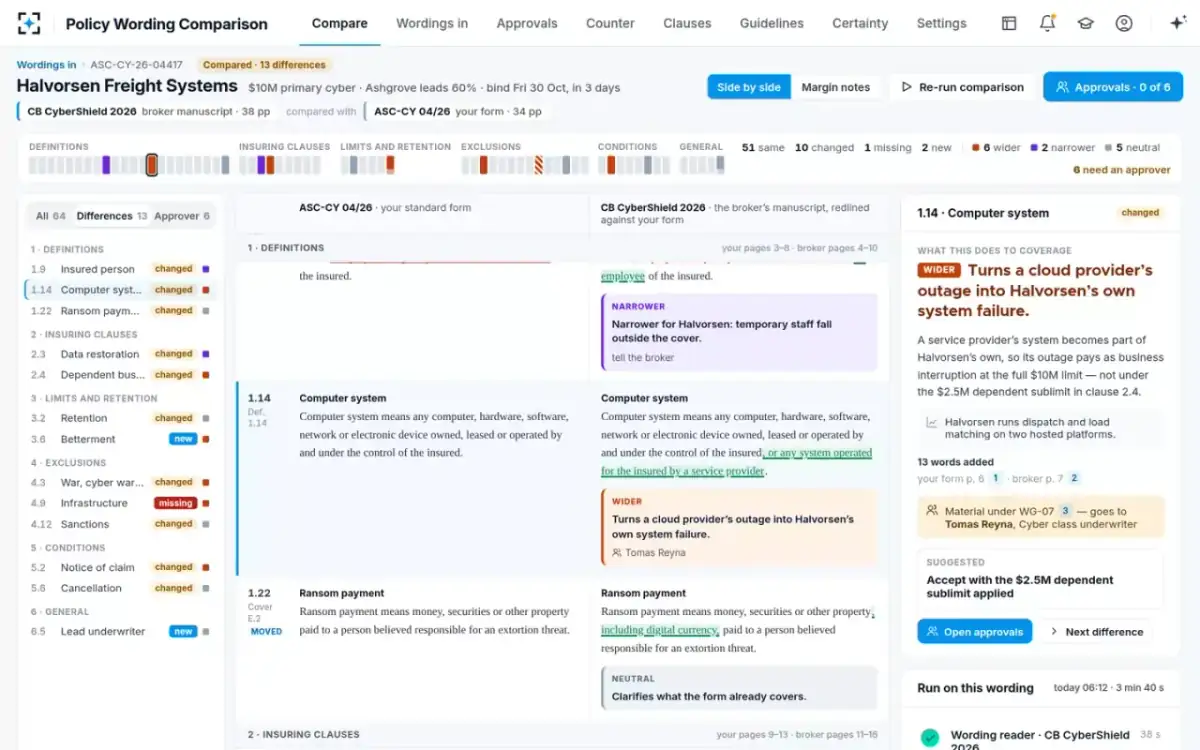
Clause alignment is pairing each clause of one wording with the clause in the other that does the same job, regardless of number, heading or position, before comparing their text. Once two clauses are paired, a word-level compare inside the pair shows only the words that really changed. A clause of the form with no partner is reported as missing; a clause of the broker's wording with no partner is reported as new.
Alignment by meaning is harder than alignment by heading, because brokers rename clauses too, and it has to be checkable. In Policy Wording Comparison the clause aligner pairs clauses by meaning, marks each pair same, changed, missing or new, and never hides a renumbered clause; any pair it is less than 0.85 confident about goes to a person rather than being matched silently. In the sample manuscript it paired 61 clauses, matched 14 renumbered and 3 moved, and found 1 missing and 2 new.
Differences only: renumbered and moved clauses matched, real changes marked
What is the difference between a blackline and a wording review?
A blackline records which words differ; a wording review decides what the differences mean and what to do about them. The review answers four questions the blackline cannot: which clauses are really the same clause, what each change does to the cover and for whom, whether the carrier's guidelines allow it, and who has authority to accept it. A blackline is an input to a review, not a review.
A word processor's compare against a clause-aligned reading, problem by problem
Word processor or PDF compare: Shown as deleted and inserted; in our test, 10 of 13 flagged clauses.
Clause-aligned comparison with a coverage reading: Matched to their counterparts and not reported unless their words changed.
Word processor or PDF compare: Shown as a deletion in one place and an insertion in another.
Clause-aligned comparison with a coverage reading: Matched, and flagged as moved so a reviewer can judge whether the move matters.
Word processor or PDF compare: One struck block among the renumbering strikes.
Clause-aligned comparison with a coverage reading: Reported as missing, with its page in your form.
Word processor or PDF compare: Not shown: the reader works it out.
Clause-aligned comparison with a coverage reading: A plain-words note, wider, narrower or neutral for the insured, citing both texts.
Word processor or PDF compare: Not shown: routed by email, if at all.
Clause-aligned comparison with a coverage reading: Tested against your guidelines and routed to the named approver.
Can a comparison tool handle renumbered clauses?
A clause-aware one can, and that is the first thing to test. Take a wording you know, insert a definition near the top so that everything after it renumbers, move one condition, and see what the tool reports. A tool that reports the renumbered clauses as changes is a text compare whatever its label; a tool that matches them, reports the new definition once and flags the move is aligning clauses. A twenty-change planted test extends the same idea to every kind of change, with decoys.
Two edge cases separate good alignment from adequate. A clause split into two in the broker's wording, or two merged into one, needs to be paired with both of its counterparts, not reported as one changed and one new. And a clause that has been renamed and substantially rewritten needs a person to confirm the pairing; that is what a confidence threshold is for.
Does a redline show the effect on cover?
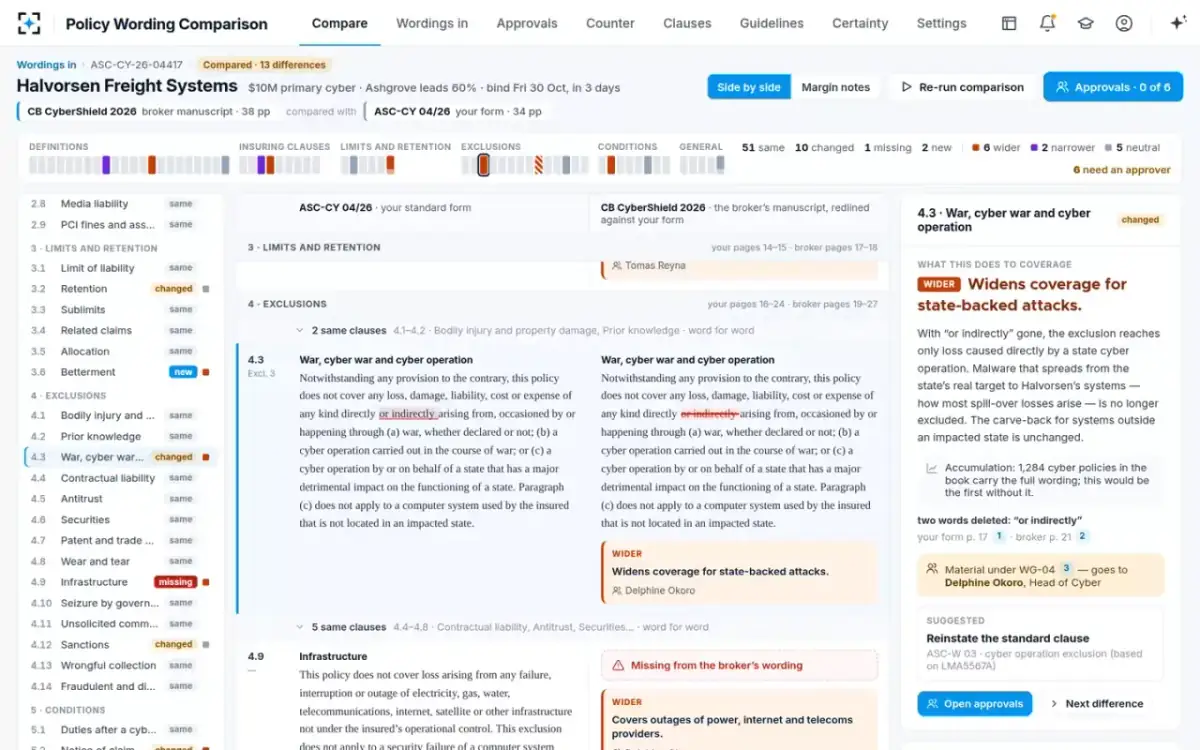
No. A redline can show that two words were struck from a war exclusion; it cannot say that their removal means malware spreading from a state's real target to the insured's systems, the way most spill-over losses arise, is no longer excluded. In the sample that change went to the head of cyber because the carrier's guideline sends any change to that clause, however small, to her, and she declined it. None of that is visible in a blackline.
The spill-over case is not hypothetical. NotPetya, in June 2017, was delivered through M.E.Doc, a Ukrainian tax accounting package whose development environment had been compromised through a backdoor, and the US National Cybersecurity and Communications Integration Center was notified of Petya events "occurring in multiple countries and affecting multiple sectors" (CISA, Alert TA17-181A). The UK government later attributed it to the Russian military, said its primary targets were Ukrainian financial, energy and government sectors, and that "its indiscriminate design caused it to spread further, affecting other European and Russian business" (UK Foreign Office, 2018); the White House said the same day that it "quickly spread worldwide, causing billions of dollars in damage across Europe, Asia, and the Americas" (White House, 2018). Whether a war exclusion reaches a loss like that turns on its exact words, which is why two struck words in it go to the head of cyber.
The redline and the reading together: two struck words and what they do
What is the best way to compare two policy wordings?
Start from your form, pair clauses by meaning, compare words only inside each pair, then read what each difference does and route it. By eye, that sequence is the three-to-four-hour job most wordings specialists know; by our estimate, the matching and reading steps are where most of the hours go, and the decisions are where they should go.
Where the hours go on one 38-page manuscript, by eye and with the solution
By eye · about 5 hours
- Reading both · 15%
- Matching moved clauses · 15%
- Working out effects · 30%
- Approvals · 20%
- Counter-wording · 20%
With Policy Wording Comparison · about 1.2 hours
- Reading · 8%
- Matching · 8%
- Checking effects · 42%
- Approvals · 21%
- Counter · 21%
The second bar is the argument in one picture. With the matching taken away, the largest share of the remaining time is the specialist checking what each change does, which is the part of the job that needs a specialist. That is the trade a wordings team should look for in any comparison tool: less time finding differences, the same or more time deciding them.
Where Policy Wording Comparison sits beside the redline tool you own
Beside it, not instead of it. Teams will keep their word processor's compare for drafting, for internal editions of their own forms and for the document a broker wants back. Policy Wording Comparison takes the broker's wording and your form, aligns them by meaning, keeps a word-level redline inside each aligned pair, writes the effect note, tests it against your guidelines and routes the material changes. Its counter-wording to the broker is itself a redline of replacement clauses against the broker's text, drawn only from your approved library.
Where it does not fit: comparing two editions of the same form with unchanged structure, where a blackline already shows only real changes; and work where no carrier form exists to compare against. For reinsurance treaties, where the same layering applies to slips and prior-year wordings, contract redline software for treaties covers the treaty side. To see the sample manuscript aligned and read, start from Policy Wording Comparison.
Questions people ask
Why does a PDF compare of two policies show differences on almost every page?
Because pagination, numbering and layout shift when a broker inserts or moves clauses, and a compare that reads in order marks every shifted passage. In our 20-clause test, one inserted definition, one deleted exclusion and one moved condition renumbered ten unchanged clauses, each of which a line-by-line compare reported as a change.
Can a blackline miss a change?
It rarely fails to mark changed text, but it can hide a change in plain sight. A deleted exclusion appears as one struck block among many renumbering strikes, and a widened definition shows a mark only in the definition, not in the clauses that use it, which change with it.
Is clause alignment the same as AI contract review?
No. Alignment is one step: deciding which clauses correspond. Contract review tools may extract terms or answer questions about a single document. A wording comparison needs alignment first, then a coverage reading of each aligned difference, then routing under the carrier's own rules.
Should we stop using redlines?
No. Use them where they fit: drafting, internal editions and documents exchanged with brokers. For reviewing a broker's or manuscript wording against your form before bind, put alignment and a coverage reading on top of the redline rather than relying on the redline alone.
How do we measure whether the flood is a problem for us?
Take three wordings you placed last quarter, run your current compare against the right forms, and count the flagged clauses whose only change is number or position. Against the number of real differences your specialists recorded, that ratio is your flood, and the hours spent clearing it are the cost.