A contract certainty portal is a shared online space where brokers and insurers exchange the documents that finish a bound contract: the slip, the evidence for each subjectivity, the broker's wording and its endorsements, and the evidence of cover. It solves a real problem, documents scattered across mailboxes, and leaves another untouched: a portal knows that a file arrived, not what the file says. Whether a statement of values is signed, whether a wording gives 18 months of business interruption where the slip agreed 12, whether a subjectivity has a date at all, are questions about content. Botminds' Contract Certainty Management answers them beside whatever system holds the documents. Six agents read slips, count subjectivities down and draft chasers, match evidence to each subjectivity and compare each wording with its slip; a person releases every chaser and the underwriter clears and agrees. The portal, or the inbox, stays where the documents live.
The examples come from the solution's fictional sample market, where Marlowgate Specialty writes London market lines. In that sample setup the agents read the firm's shared placement inbox; whether they can take documents from a particular portal is a question to settle in a trial on the firm's own systems, and this guide says so where it matters.
A portal alone, and a portal with an agent reading beside it
Portal alone: Stored as a file; subjectivities typed in by someone, if at all
Portal with Contract Certainty Management beside it: Read as bound: each subjectivity lifted word for word with page, deadline and consequence
Portal alone: Invisible
Portal with Contract Certainty Management beside it: Flagged the same day; a date query drafted for a person to release
Portal alone: "Document received"
Portal with Contract Certainty Management beside it: Checked as signed, dated and for the right site, matched to its subjectivity with a reason
Portal alone: "Version 2 received"
Portal with Contract Certainty Management beside it: Compared with the slip clause by clause; material differences listed with both texts
Portal alone: Visible to whoever looks
Portal with Contract Certainty Management beside it: Marked overdue at the minute; chaser drafted quoting the slip, waiting for release
Portal alone: Not computed
Portal with Contract Certainty Management beside it: Every incepted risk counted every morning under the firm’s definition
Portal alone: The portal
Portal with Contract Certainty Management beside it: Still the portal, or the inbox; the agent reads, it does not move them
What is a contract certainty portal?
It is a place to put documents and see their status: who uploaded what, when, against which risk. Good portals add structure, a slot for each expected document, a version history for wordings, notifications when something arrives. They make the collection step faster and the audit trail of exchange clearer.
The idea that certainty needs shared infrastructure is old. In 2004 the FSA's meeting with the market agreed that the key to contract certainty lay partly in "a record and audit trail of disclosures by insureds", alongside processes standardised through technology (FSA, record of the industry meeting of 20 December 2004). A portal delivers the audit trail of exchange well. A standardised process needs something that understands what the documents say, because the process is driven by their content: a date in a sentence on the slip, a signature on the last page of a statement of values, a clause edition in a schedule on page 38.
What does a portal miss?
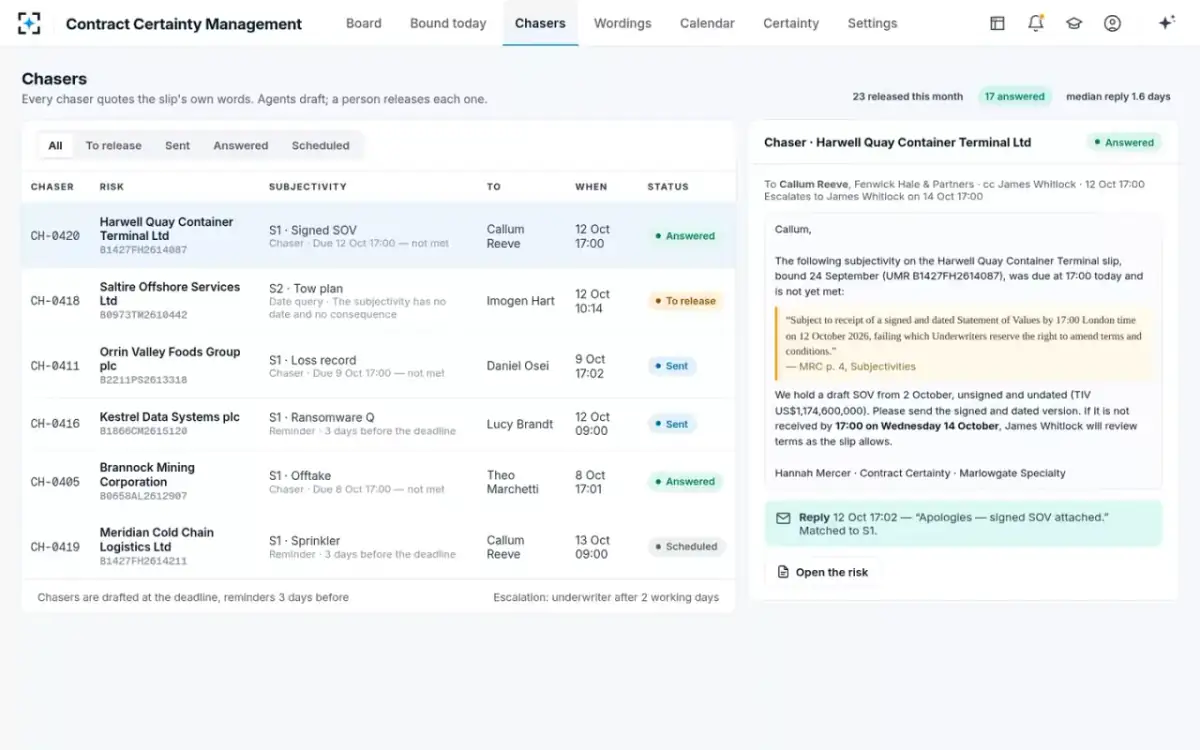
Everything inside the documents. Take the sample Harwell Quay risk. A draft statement of values reached the placement inbox on 2 October; any store that tracks uploads would have shown a statement of values received. It was unsigned and undated, so the condition, "a signed and dated Statement of Values", was not met, and the sample document matcher held it against the subjectivity as a draft rather than marking it received.
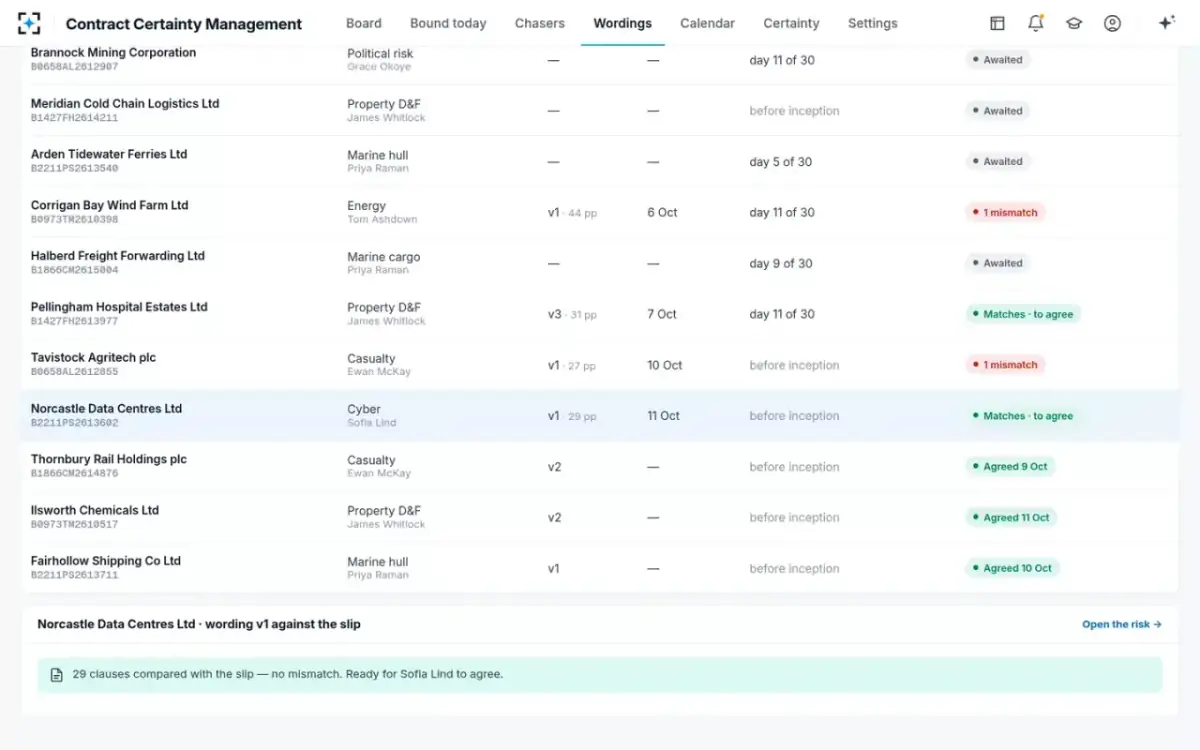
The wording shows the same gap at larger scale. Version 2 of the broker's wording, 38 pages, arrived on 9 October. A portal would show "wording v2 received". The comparison with the slip found 39 clauses that matched and two that did not: a maximum indemnity period of 18 months against the slip's 12, at Section 4.2 on page 23, and a communicable disease endorsement listed on the slip but absent from the wording's endorsement schedule. A risk can look complete on a portal and be materially wrong.
What a portal records, and what the content says, on one sample risk
| Document | Portal status | What reading it shows |
|---|---|---|
| Statement of values, 2 October | Uploaded | Unsigned and undated: does not meet S1 |
| Survey report, 8 October | Uploaded | Right site, 4 recommendations, none critical: ready for the underwriter to judge |
| Statement of values, 12 October 17:02 | Uploaded | Signed and dated by the insured’s CFO; values 1.1% above the draft, inside the slip’s 10% tolerance |
| Wording v2, 9 October | Uploaded | 41 clauses compared; 2 material differences from the slip |
| Slip, 24 September | Uploaded | Three subjectivities, only one with both a dated deadline and a stated consequence |
Does a portal check the wording?
Not unless something reads the wording against the slip, and the question is what that something is. Comparison by a person takes the hours: Botminds estimates about four hours to read one bound risk's wording against its slip by hand. Comparison by an agent takes seconds and then needs a person for the part that matters, deciding which differences are material and sending the notes.
The agent's output has to be checkable or it is just another opinion. In the sample setup the wording checker lines up the wording and its endorsements with the slip clause by clause, covering insured, period, limits, sublimits, deductibles, indemnity periods, named market clauses and their editions, law and jurisdiction, sanctions and several liability, and shows both texts with the wording page for every difference. A wording with an open material difference cannot be agreed. What counts as material is a setting the firm controls.
A new wording compared with its slip as it arrives
Can an agent read documents in a portal?
An agent can read documents wherever the firm lets it read them; the question is access, not technology. In the sample setup the agents read only the shared placement inbox the firm designates, never individual mailboxes. A firm whose brokers send documents through a portal would need the agents to receive those documents, by an export, a notification copy to the placement inbox, or a direct connection, and which of those works for a given portal is something to test on the firm's own systems before buying.
What matters more than the route is that the agent never becomes the place documents live. The portal or the inbox stays the store; the agent reads, cites the page it read, and writes its findings where people decide. That keeps one source of documents, and it respects a lesson the FSA's chief executive drew in 2004, that partial initiatives had not added up to a market-wide answer: "We are aware that there have been various attempts to address this issue through such initiatives as standardised wordings on slips, but to date there has not been general market support for a serious market wide solution" (FSA, speech by John Tiner, 13 December 2004).
Where the portal, the agents and the people each sit
Agent
Slip readerReads each bound slip from the firm’s document source and lifts every subjectivity word for word with its deadline and consequence.
Never: changes a bound term
Agent
Document matcherReads each new attachment, checks it is signed, dated and for the right site, and proposes the subjectivity it meets.
Never: clears; reads only the designated shared inbox
Agent
Wording checkerCompares each wording version with the slip, clause by clause, and writes a margin note on each material difference.
Never: agrees a wording
Agent
Chaser writerDrafts the broker chaser when a subjectivity lapses, quoting the slip with its page.
Never: sends
A person decides
AnalystReleases each chaser to the broker.
A person decides
Class underwriter and wordings specialistClear subjectivities with a signature; send margin notes; agree the wording.
What is the system of record for contract certainty?
For the contract, the agreed slip and the agreed wording, wherever they are stored. For the documents, the portal or document store. For the certainty status of each risk, whatever system computes it from those documents and keeps the history of who decided what. Confusing the three is how a portal's "all documents received" becomes a board report's "certain".
The World Trade Center litigation shows why the contract itself has to be the reference. The Second Circuit read each insurer's obligations from what it had bound on, looking to "any policy form that was exchanged in the process of negotiating the binder, together with any express modifications to that form", and not from a final policy issued after the loss (345 F.3d 154, 2003). Whatever system holds the documents, the certainty question is always which terms each party agreed, and when.
How do brokers upload subjectivities, and what should happen next?
Brokers send subjectivity evidence through whatever route the parties use, a portal, a placement inbox or both, and sometimes as several drafts. What should happen next is the same whatever the route: the document is checked against the subjectivity's exact words, and the underwriter decides. A signed statement of values, a survey report, a completed questionnaire or a certificate each has its own failure modes.
What to check on each piece of subjectivity evidence, wherever it arrives
- It is the document the slip asked for
A statement of values, not a schedule of locations; a survey of the named asset, not the site in general.
- It is signed and dated, by the right person
The sample slip required a signed and dated statement; a draft did not count.
- It is for the right site or entity
For a multi-site insured, a certificate for the wrong location is as much a miss as the wrong document.
- It is inside any tolerance the slip sets
The sample signed values came in 1.1% above the draft, inside a 10% tolerance.
- It arrived before the deadline
Or after, in which case the slip’s consequence is now the underwriter’s choice.
- The underwriter has judged anything the slip leaves to judgement
"Satisfactory" surveys and "agreed" plans are decisions, not uploads.
What integrations does contract certainty need?
Read access to the documents and the dates, and a way for people to act on what the agents find. The list is short, and every item on it already exists in a London market firm; the work is connecting them, not building them.
The connections a contract certainty agent needs, and why
| Connection | Why | In the sample setup |
|---|---|---|
| Bound slips and quotes | Subjectivities and agreed terms come from the slip | Market reform contract slips, read as they are bound |
| Placement inbox or portal | Evidence and wordings arrive here | The shared placement inbox only |
| Wording versions | Each version is compared with the slip | Each broker draft, version by version |
| Clause library | Clause names and editions are checked | Market clauses and their editions |
| Binding and inception dates | Every clock starts from one of them | Every risk on its clock, in London time |
| People and roles | Releases, clearances and signatures need named people | Analyst, underwriters, wordings specialist, head of operations |
Every chaser, with the slip text it quotes and the reply it got
Where Contract Certainty Management fits beside a portal, and where it does not
It fits a firm that already has a place for documents, a portal, an inbox or both, and lacks the reading: subjectivities lifted from slips, evidence checked against them, wordings compared with slips, and a rate counted from every risk. It leaves the document store as it is and adds the content layer beside it.
It is not a portal and does not replace one; it does not host broker uploads or manage market messaging. It does not decide anything that changes a contract: agents never send, clear or agree. And it can only read what it is given; documents that never reach the firm, or arrive in a form nobody can read, stay outside it. A trial on twenty of the firm's own bound slips and wordings, read from the firm's real document route, is the way to find out how much of the gap it closes. The wider choice between approaches is in spreadsheet, portal or agents, and what the reading adds to a certainty report in the contract certainty checklist.
Questions people ask
Do we need a portal to use an agent for contract certainty?
No. The agent needs the documents, not a particular store. In the solution's sample setup it reads the firm's shared placement inbox; a portal is one more possible source, to be tested on the firm's own systems.
Will an agent change documents in our portal?
It should not, and in this design it does not. The agents read documents and write their findings, matches, differences and draft chasers, for people to act on; the slip, the evidence and the wording stay as received.
How does an agent know which subjectivity a document answers?
It reads the document against the open subjectivities on that risk, checks it is the right kind, signed, dated and for the right site, and proposes the match with its reason. In the sample market the signed statement for Harwell Quay was matched to S1 at 17:02, the minute the broker's reply arrived.
Can brokers see the certainty status?
What brokers see is a choice for the firm. In the sample setup brokers receive chasers and date queries released by the analyst, each quoting the slip, and the margin notes the wordings specialist sends with both texts side by side.
Is a portal enough for an audit of contract certainty?
It shows what was exchanged and when, which is half the story. An audit also needs to know whether each document met the condition it answered, whether the wording matched the slip, and who decided; those come from reading the documents and from the signatures and run log kept beside them.