A contract certainty checklist lists what must be true for a bound risk to count as certain at inception: every subjectivity met or properly dated, the wording agreed and matching the slip, each named clause in the right edition, the insurers' shares settled, the documents issued within the firm's period, and local requirements met. Where it is run at quarter end on a sample of files, such as one in ten, it carries a built-in weakness. A sample taken after inception measures the past, cannot fix any contract it finds, and in our worked example below it never looks at about nine in ten of the uncertain contracts, and in some quarters finds none of them. Botminds' Contract Certainty Management turns the checklist into a check run on every bound risk, counting each subjectivity down, comparing every wording with its slip and marking each incepted risk certain or not every morning, so the eight uncertain contracts in a month are named while they can still be finished.
The worked example uses a fictional London market insurer, Marlowgate Specialty, whose October 2026 rate in the solution's sample market was 88.6% certain at inception, 62 of 70. The sampling arithmetic is ours, using the hypergeometric distribution and the US National Institute of Standards and Technology's handbook on acceptance sampling, linked where it is used.
Chance a 10% quarterly sample catches even one uncertain contract
What is on a contract certainty checklist?
A contract certainty checklist covers three things: whether every term was agreed by inception, whether the documents followed promptly, and whether the contract complies with the rules that apply to it. The FSA's 2004 meeting with the market set out the same scope when it listed what a definition must include: a wording agreed by inception, policies issued promptly after it, policies that meet local tax and regulatory requirements, and a record of what was disclosed in negotiation (FSA, record of the industry meeting of 20 December 2004; the list is quoted in what is contract certainty in insurance).
A contract certainty checklist for one bound risk
- Every subjectivity has a date and a consequence
An undated one cannot be late; query the broker the day it is bound.
- Every subjectivity due by inception is cleared by the underwriter
Cleared means accepted as worded on the slip, not merely received.
- The wording is agreed, and agreed before inception
A wording agreed on day two still leaves the risk uncertain at inception.
- The wording matches the slip on the terms that move money
Insured, period, limits, sublimits, deductibles, indemnity periods.
- Every named clause is present, in the edition on the slip
A missing endorsement, or a different edition of a model clause, is a material difference.
- Law, jurisdiction, sanctions and several liability match
The clauses that decide where and whether a claim is paid.
- Insurers’ shares are settled
In a subscription placement, signed lines known before inception.
- Evidence of cover issued within the firm’s period
The London market agreed 30 days from inception in 2005; whatever your reading of "promptly", write it down.
- Local requirements met
Filings, taxes and regulatory notices for each place the risk sits, such as a US surplus lines filing deadline.
- What was disclosed is on file
The presentation the underwriter relied on, so a later dispute about disclosure has a starting point.
The thirty-day reading in item eight has a history. In 2005 the London market's Market Reform Group agreed, in the progress report it presented to the FSA, that evidence of cover should be issued within 30 days of inception; the FCA contract certainty requirements guide sets that beside the FCA's own wording. A firm may choose a shorter period. What it cannot do is leave "promptly" undefined and then count against it.
How is contract certainty measured, and what is a certainty rate?
A certainty rate is the number of risks certain at inception divided by the number that incepted in the period, under a definition written down before counting starts. A second rate, documented within the firm's period, sits beside it. At Marlowgate in the sample October, 62 of 70 risks were certain at inception, 88.6% against a 95% target, and 94.1% of September inceptions were documented within 30 days.
The definition does most of the work, and firms differ. The industry's own steering committee, reporting to the FSA in January 2007, noted that "The way exceptions are measured varies between firms" and that "The precise timing of the CC 'checkpoint' within measurement systems and the systems themselves can differ." Two firms both reporting 90% may be counting different things. A checklist fixes the definition at the level of each check; a rate is only comparable across months if those checks did not change.
What sample size is used for contract certainty checks?
No regulator sets one. The 10% quarterly file review is a house convention, and in the sample market it is the method Marlowgate used before it counted every risk. The more useful question is what a sample of that size is for, and the statistics literature answers it plainly.
Checking a sample of items to decide about a whole batch is acceptance sampling, and the US National Institute of Standards and Technology's handbook is precise about its limits: a sample tells you whether to accept or reject the batch, not how good the batch is. It reserves sampling for cases where checking every item is impossible or uneconomic: the test destroys the item, or checking everything costs too much or takes too long (NIST/SEMATECH e-Handbook of Statistical Methods, 6.2.1; the Policy Servicing guide to 100% inspection vs sampling quotes it and applies it to policy transactions).
Read against a book of contracts, two of those conditions explain why the 10% sample exists and the third explains why it can go. Checking a contract is not destructive. It was costly and slow, because a person had to read a 38-page wording against a slip. When agents do the first read and the person reviews only the differences, the cost of checking every contract falls far enough that sampling stops being the economical choice.
What a 10% sample can and cannot detect
A sample can estimate a rate roughly and can find a few examples; it cannot name the contracts that need fixing. Take a quarter with 210 incepted risks of which 24 were not certain at inception, a rate of 88.6%, the same as the sample market's October. A random sample of 21 files is expected to contain 2.4 of the 24. The other 21.6 are never looked at.
One quarter, 210 risks, 24 not certain: what a 21-file sample shows
| What the sample shows | Chance | What the report would say |
|---|---|---|
| 0 uncertain files found | 6.8% | 100% certain |
| 1 found | 20.7% | 95.2% certain: target met |
| 2 found | 28.5% | 90.5% certain |
| 3 found | 23.6% | 85.7% certain |
| 4 or more found | 20.5% | 81.0% certain or lower |
The table has two uncomfortable rows. In more than a quarter of quarters, the sample shows one uncertain file or none, and the report states a rate at or above a 95% target when the book is at 88.6%. In about four quarters in ten, three or more uncertain files turn up and the sample shows a worse rate than the truth. Neither error is anyone's fault; it is what 21 observations can do. With 19 certain out of 21 the 90% confidence interval for the true rate runs from about 75% to 97% (Wilson interval, our arithmetic), wide enough to contain both a crisis and a success.
The timing makes it worse. The certain-at-inception test is taken at one minute, 00:01 on the first day of the period. A sample drawn after the quarter closes can report that a contract failed that test, but cannot make it pass. The best it can do is prompt a fix to the wording months later, which is the "deal now, detail later" the checklist was meant to end.
When should contract certainty be checked?
Before inception, on every risk, and again each time a document arrives. The London market said as much in 2005: among the approaches the Market Reform Group agreed and presented to the FSA was "Checks and associated measurement to be carried out before inception wherever possible". The check that matters is the one that still has time to change the outcome.
The same checklist, run two ways
Quarter-end 10% sample: 1 in 10, chosen after the quarter closes
Every risk, before inception, with Contract Certainty Management: All of them, from the day each is bound
Quarter-end 10% sample: Checked for the files drawn; lapses found weeks later
Every risk, before inception, with Contract Certainty Management: Counted down on every slip; a chaser drafted at each deadline
Quarter-end 10% sample: Read by hand for the files drawn
Every risk, before inception, with Contract Certainty Management: Compared clause by clause on each version as it arrives
Quarter-end 10% sample: Estimated, with a wide interval
Every risk, before inception, with Contract Certainty Management: Counted, each morning, with every failure named
Quarter-end 10% sample: Documents, late
Every risk, before inception, with Contract Certainty Management: Most failures, before inception
Quarter-end 10% sample: Reviewer marks pass or fail
Every risk, before inception, with Contract Certainty Management: Underwriter clears and agrees; head of operations signs the report
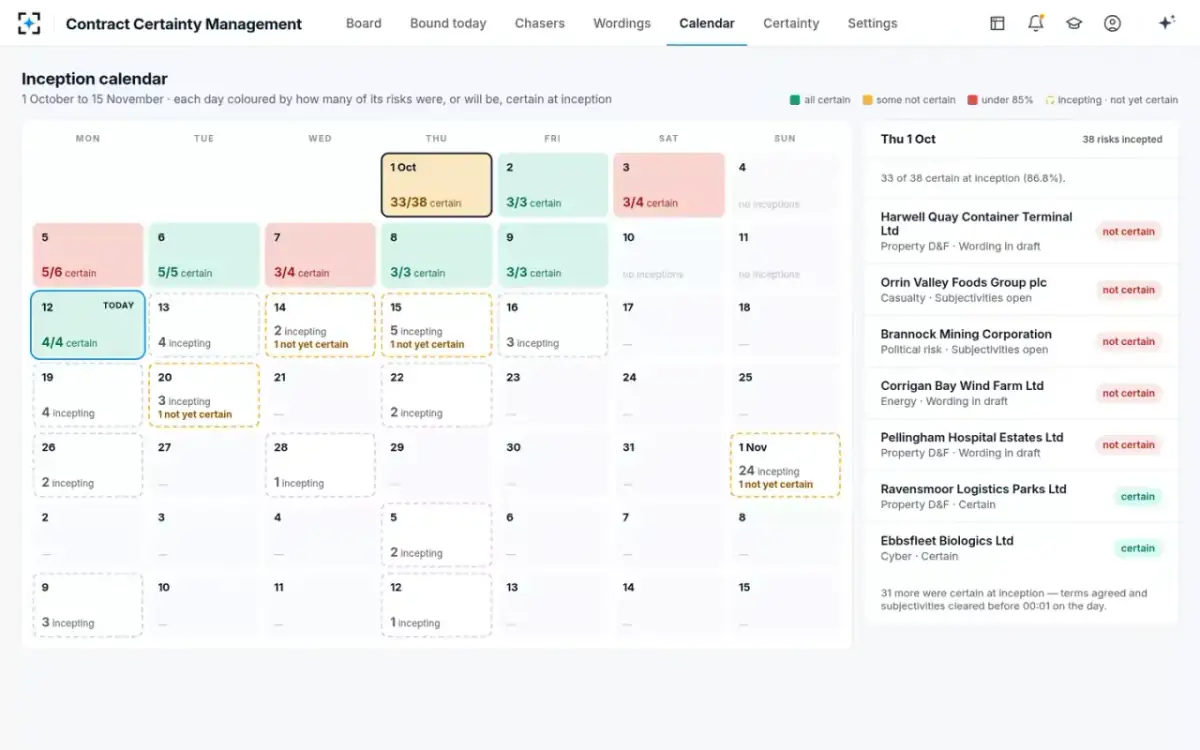
The inception calendar: each day coloured by how many of its risks were, or will be, certain
What are common contract certainty failures?
In the sample market the reasons behind the eight risks not certain in October are the familiar ones: a wording that differs from the slip, a subjectivity overdue, a subjectivity with no date on the slip, and a wording not yet received. Each needs a different owner and fix, which is why a checklist that records only pass or fail wastes most of what it learns.
The industry found the same spread when it analysed its own exceptions in 2006: "Exceptions are caused by a wide spectrum of issues", its steering committee told the FSA, and "Different classes of business and different geographies perform in different ways." It listed the reasons placements came in late as including "Poor practice by client, intermediary, broker or insurer." A failure list grouped by cause and by broker turns those generalities into a short list of conversations.
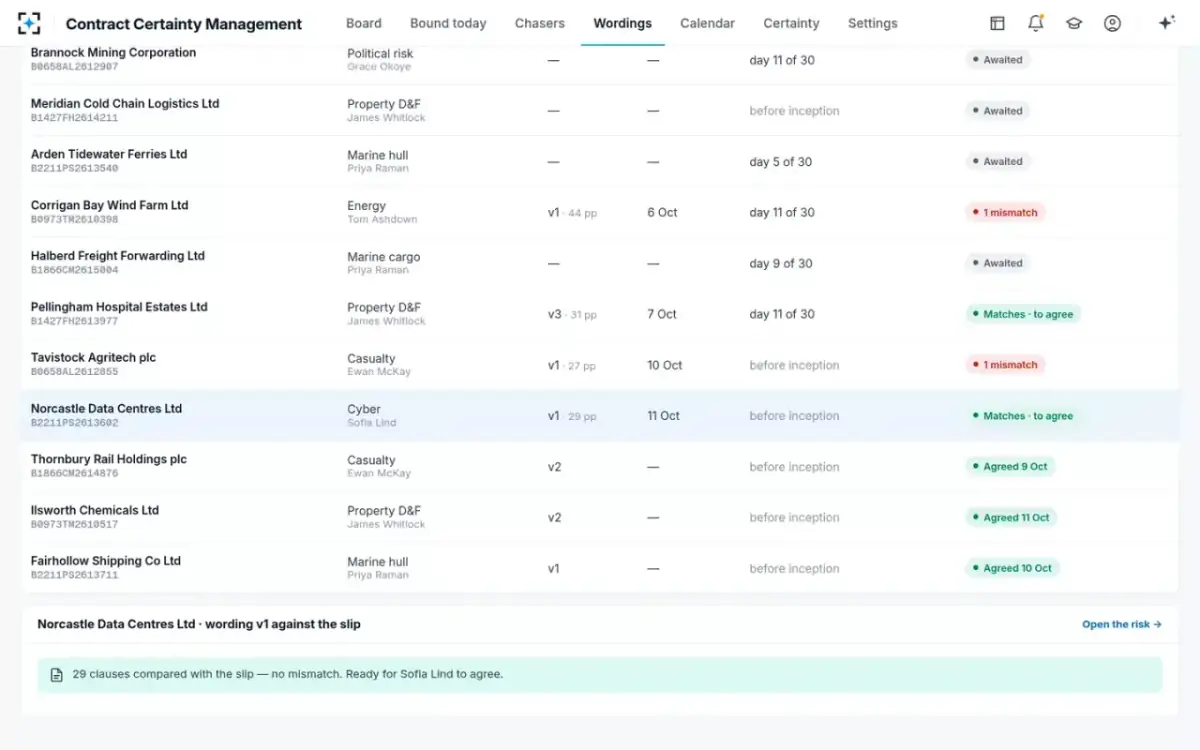
The wording failures deserve a closer look because they are the hardest to see. In the sample Harwell Quay risk, the broker's 38-page wording matched the slip on 39 of 41 clauses. The two that did not were a maximum indemnity period of 18 months where the slip agreed 12, on page 23, and a communicable disease endorsement on the slip but missing from the wording's schedule. A reviewer sampling that file at quarter end would probably have caught both. A reviewer who did not draw that file would have caught neither, and the underwriter would have carried six months of business interruption cover nobody priced.
A wording compared with its slip as it arrives
Who signs off contract certainty?
Two people at two levels. On each risk, the class underwriter signs that each subjectivity is met as worded on the slip and agrees the wording; nobody else can move the risk to certain. For the book, the head of underwriting operations signs the report that states the rate and names every failure. In the sample setup neither signature can be given by an agent: the certainty reporter marks each risk under the definition in the settings and builds the report, and the report is signed by a person.
A third sign-off is easy to forget: the definition itself. If the person who signs the rate can also loosen what counts as certain without anyone noticing, the rate can improve while the contracts do not. Marlowgate's sample settings treat any change to the definition, a clock or a target as a proposal the head of underwriting operations approves, kept in the audit trail. How that seat runs is described in the head of underwriting operations guide.
Buying a tool to run the checklist: what to look for, and where this one fits
Ask any tool, including this one, to show four things on your own documents: that it lifts subjectivities and deadlines from your slips word for word with a page reference; that it compares a real broker wording with its slip clause by clause and names the differences you would call material; that it counts every incepted risk under your definition, not a sample; and that no chaser, clearance or agreement happens without a named person. A tool that summarises instead of quoting, or that cannot show where each finding came from, moves the checking work rather than removing it.
Contract Certainty Management fits firms that bind open-market risks on slips and receive broker wordings to agree. It is not a policy administration system and does not replace one; it reads the documents the market already sends and works alongside the systems that hold the policy. It cannot make a late placement certain at inception: a risk whose slip is signed after the period has begun fails the test whatever happens next, and the useful output is the name of the broker or class where that keeps happening. And it does not decide what is material; the wording rules are settings the firm controls. A trial on a sample of your own bound slips and wordings is the honest way to see whether it finds what your reviewers find. The choice between this and the alternatives is set out in spreadsheet, portal or agents.
Questions people ask
How often should a contract certainty check be run?
At least once before inception and again whenever a subjectivity falls due or a new wording version arrives. A quarterly review is a measurement exercise, not a check, because by then the certain-at-inception test has already been passed or failed. The sample setup marks every incepted risk every morning at 06:00.
Is a 10% file review good enough for internal audit?
It can tell auditors whether controls look broadly effective; it cannot give a precise rate or name the failures. In our worked example, a 21-file sample from a book at 88.6% certain shows 95% or better in more than a quarter of quarters. Auditors testing a population that is already checked in full can instead sample the checks themselves.
What counts as a material difference between the wording and the slip?
Whatever the firm decides, written down as a rule. Marlowgate's sample settings treat any difference in limits, sublimits, deductibles and periods, any missing, added or different edition of a named clause, and any difference in law and jurisdiction, sanctions or several liability as material, and leave formatting and numbering differences off.
Does contract certainty apply to renewals?
Yes, the test is the same for a renewal as for new business: the renewed contract must be agreed by its own inception. A renewal "as expiring" can still fail if a clause edition changed or a new subjectivity was added. The Market Reform Group's 2005 approach was to use base wordings, "model or 'as expiring'", wherever possible as the starting point for negotiation.
What is the difference between certain at inception and documentation within 30 days?
The first asks whether every term was agreed when cover began; the second whether the insured received evidence of cover within the period the firm treats as prompt. They fail for different reasons and belong to different owners, so they are reported separately: 88.6% and 94.1% respectively in the sample market.