Contract certainty in insurance means that every term of the contract is agreed between the insured and its insurers by the time the risk incepts, and that the documents evidencing the contract follow promptly. The UK's Financial Services Authority put it in one line in December 2004: "Greater certainty at inception of the contract, with full policy documentation promptly thereafter." The hard part is that binding a risk is a moment while certainty is a tail of work after it: subjectivities the insured still owes, a broker wording still in draft, endorsements still to be checked against the slip. Botminds' Contract Certainty Management is built for that tail. Its agents read each bound slip, count every subjectivity down to its deadline, draft the broker chaser and compare the wording with the slip clause by clause, so the contracts that are still uncertain are named before inception rather than found after a claim.
The examples come from a fictional London market insurer, Marlowgate Specialty, on Monday 12 October 2026, as its bound risks run through the solution. The law and the history are quoted from the regulator's own texts, a US federal appeals court and the statute books, named where they are used.
What an uncertain contract cost at the World Trade Center
1
of the many insurers that had bound cover had issued a final policy by 11 September 2001
$3.5bn
of property cover bound “per occurrence” in July 2001, from about two dozen insurers
$7bn
the insured sought if the attacks were two occurrences, which turned on each insurer’s unfinished terms
What does contract certainty mean in insurance?
It means the parties know, at inception, exactly what they have agreed. When the FSA opened its work with the market in December 2004, the meeting record set out what an agreed definition should include: "certainty over underwriting exposures for insurers", "certainty of terms of coverage for insureds", a "wording agreed at or prior to inception of cover ("i") and policies issued promptly thereafter ("i + # days")", "policies which comply with local requirements (fiscal, regulatory)" and a "recording of what has been disclosed during policy negotiation" (FSA, record of the industry meeting of 20 December 2004).
The same record is as clear about what certainty is not. It "does not suggest certainty over the outcome of claims or the content of contracts." A contract can be certain and still exclude the loss that happens; certainty only means that the exclusion was agreed, in writing, before the risk began. That distinction matters to anyone selling certainty as a promise of payment, which it is not.
By April 2005 the London market's Market Reform Group had agreed a shorter definition, which it presented to the FSA that July: "Contract Certainty is achieved by the complete and final agreement of all terms (including signed down lines) between the insured and insurers before inception". The bracket is the part newcomers miss. In a subscription placement each insurer writes a line on the slip, and the share it finally carries, its signed line, may be lower once the placement is complete; a contract is not certain until those shares are settled too.
Where did "deal now, detail later" come from?
It came from the FSA's chief executive, John Tiner, speaking in New York on 13 December 2004. "We want to see the end of a practice which is 'deal now, detail later'," he said, and he described what the practice cost. Insurers carried "substantial operational risk related to pricing and documentation errors and delays", and had "an incomplete knowledge of the risk it has underwritten and the share of any risks taken by each insurer (the signed line exposure)." Brokers faced "large and unquantifiable legal risks". And "the insureds do not know exactly what protection they have bought."
He also named who usually did the clean-up. Delays, he said, "create unnecessary costs as it is usually the broker who is left to sort out the policy wording once the cover has been written." And he was careful not to blame London alone: "this issue is common to many major insurance markets and is not specific to the UK."
A week later the FSA met the chairs and chief executives of the large brokers and insurers, Lloyd's and the trade bodies. Its record of that meeting sets the terms: "The FSA is setting the industry a challenge to secure a market-driven solution to the issue of contract certainty within two years. Failure to achieve this will result in regulatory intervention but that is not the FSA's preferred outcome." In May 2006 it ran briefings for senior managers in both the subscription and the non-subscription markets on why it had "challenged the market to achieve contract certainty by December 2006". How that challenge shaped today's rules is the subject of what the FCA requires on contract certainty now.
Deal now, detail later, against a contract that is certain at inception
Deal now, detail later: Price and capacity agreed; the wording is a broker draft or "to be agreed"
Certain at inception: Price, capacity and the wording or the base form it amends agreed on the slip
Deal now, detail later: Listed on the slip, sometimes without a date or a consequence; tracked by whoever remembers
Certain at inception: Each one dated, with what happens if it is missed, and counted down to that date
Deal now, detail later: Written lines known; signed lines settled after inception
Certain at inception: Signed lines settled before inception, as the 2005 definition requires
Deal now, detail later: Policy issued when the wording is finally agreed, sometimes months later
Certain at inception: Evidence of cover issued promptly after inception, wording already agreed
Deal now, detail later: Terms reconstructed from drafts, emails and binders, sometimes in court
Certain at inception: Terms read from the agreed wording
What does certain at inception mean?
A risk is certain at inception if, at the moment cover begins, every term is agreed and nothing the contract depends on is still open. Inception is usually stated to the minute in the slip's period clause; on Marlowgate's sample slips it is 00:01 local standard time on the first day. The test is binary and it is taken once, at that minute, which is why it is so unforgiving: a wording agreed on day two of the policy year still leaves the risk uncertain at inception, however good the wording.
What "every term is agreed" includes is a firm's own definition, written down. Marlowgate's sample setting is strict: every subjectivity cleared and the wording agreed with the slip by 00:01 on the inception date. A firm can set a looser test, for example one that accepts a subjectivity still open if it has a date and a stated consequence, because the term that governs it is then itself agreed. Either way, the definition has to be fixed before anything is counted, or the rate it produces says nothing.
Certain at inception is the first of two numbers. The second is documentation: whether the evidence of cover, and later the policy, reached the insured within the period the firm treats as prompt. Marlowgate's sample setting reads "promptly" as 30 days after inception, the same period the London market's Market Reform Group agreed for "Appropriate evidence of cover" in its 2005 progress report to the FSA.
The tail after the bind, measured on one risk
Binding takes minutes; the work that makes a contract certain takes weeks, and almost all of it happens after the underwriter has stamped the slip. Take one risk from the sample market: Harwell Quay Container Terminal, property damage and business interruption, US$240,000,000 combined, Marlowgate writing a 20% lead line. It was bound on 24 September and incepted on 1 October.
One bound risk: the bind is a sliver, certainty is the bulk
- Slip bound, 24 Sep
- Bound, not on risk25–30 Sep
- S1 and S2 open; v2 arrives1–12 Oct
- Wording v2 off the slip; v3 awaited13–31 Oct
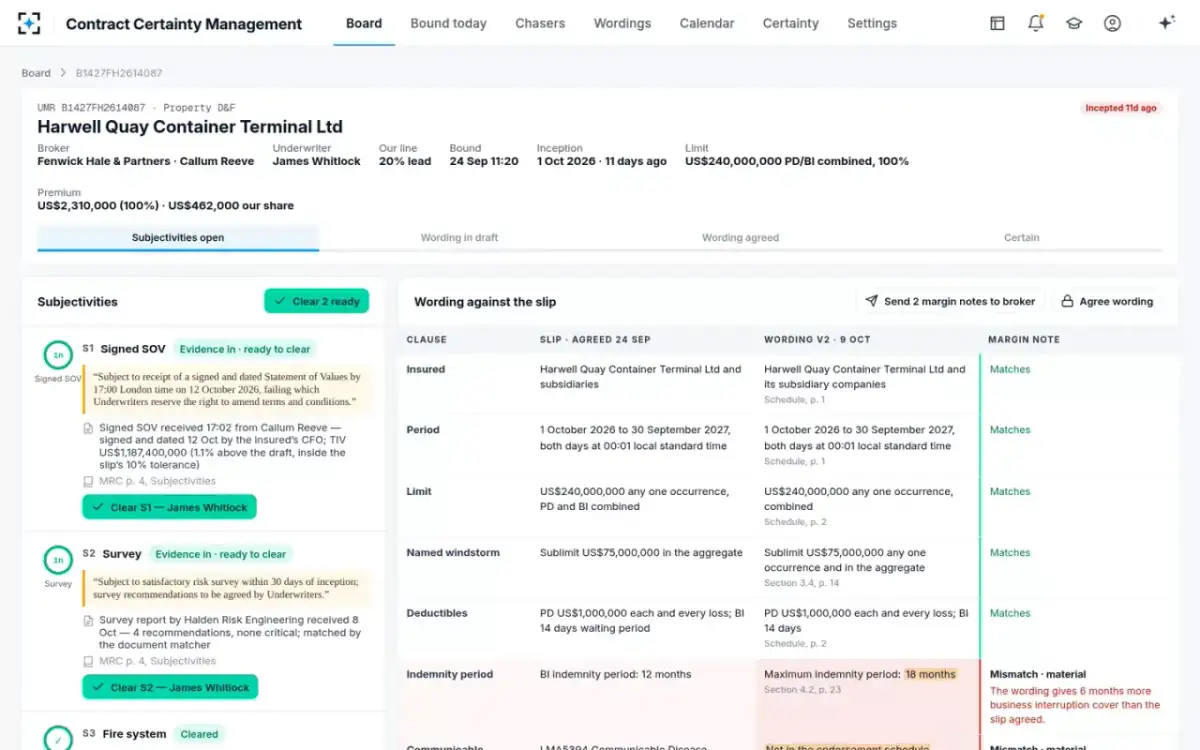
Three things were still open when cover began. Two subjectivities sat on the slip: a signed and dated statement of values by 17:00 London time on 12 October, "failing which Underwriters reserve the right to amend terms and conditions", and a satisfactory risk survey within 30 days of inception. And the broker's 38-page wording, version 2, arrived on 9 October with two material differences from the slip: an 18-month maximum indemnity period where the slip agreed 12 months, and a communicable disease endorsement on the slip but missing from the wording's schedule.
None of that is unusual, and none of it is visible on a bordereau. The risk is bound, the premium is booked, and the contract is not finished. On 12 October the signed statement arrived two minutes after the chaser went out, and the survey had already come in on 8 October; both were cleared by the underwriter that evening. The wording waited for version 3.
Contract Certainty Management's risk file: the slip's words beside the evidence and the wording
Why is contract certainty important? Four parties, four risks
It matters because an uncertain contract moves risk to whoever can least price it. The FSA's 2004 speech named a different exposure for each party, and each is still recognisable on a bound risk today.
Who carries the risk of an uncertain contract
| Party | Risk the FSA named in 2004 | What it looks like on a bound risk now |
|---|---|---|
| Insurer | "an incomplete knowledge of the risk it has underwritten" and of "the signed line exposure" | A wording that gives 18 months of business interruption where the underwriter priced 12; a share that changes after inception |
| Broker | "large and unquantifiable legal risks"; left "to sort out the policy wording once the cover has been written" | A wording in its third draft after inception, and a client who relies on the broker for what it says |
| Insured | "the insureds do not know exactly what protection they have bought" | Evidence of cover that shows the limit but not the conditions still being negotiated |
| The market | Delays that "create treacle in the back office and ever longer more arduous reconciliations" | Endorsements, signings and wordings reconciled weeks after the fact, by hand |
The FSA's meeting record put the regulator's own interest in the same terms: the work "will reduce the operational and legal risks to brokers and insurers and improve service and clarity of offering to customers." For an insurer the argument is not abstract. A term that was never agreed is priced by the court that interprets it, not by the underwriter who wrote the risk.
What happens if a contract is not certain when a loss comes in?
The terms are then reconstructed from whatever was agreed at binding, and that can take years. The best-known example is the World Trade Center. Its leaseholder had bought about $3.5 billion of property cover "per occurrence" from about two dozen insurers in July 2001. Whether the attacks of 11 September were one occurrence or two decided whether it could recover up to $3.5 billion or up to $7 billion, and the answer depended on the wording, which for most insurers did not yet exist.
The US Court of Appeals for the Second Circuit set out the problem at the start of its opinion: "only one of the many insurers that bound coverage on the WTC had issued a final policy, necessitating an individualized inquiry to determine the terms of the insurance binders issued by each insurer" (345 F.3d 154, 2003). The broker had circulated its own draft form; one insurer had put forward a different form; the broker had listed "more than 76 differences" between the two as a starting point for negotiation. "By September 11th, however, the parties had not agreed to a final policy form." That insurer issued its final policy form on 14 September, "three days after the WTC was destroyed".
The court's answer was that each insurer was bound by its own binder, read with the form actually exchanged when it bound. A binder, it noted, is "a fully enforceable" present contract of insurance even though "not all of the terms of the insurance contract will be set forth in the binder." The money therefore turned on binders, emails and specimen forms from July. That is what deal now, detail later means when the detail never arrives.
Is contract certainty a regulatory requirement?
In the UK it is an expectation built on general rules rather than one rule with that name. The FCA's insurance conduct rules, as they apply to business with larger commercial customers, remind firms of their obligations under the Principles and give the FCA's view that meeting them means providing evidence of cover promptly after inception (ICOBS 1 Annex 1, 2.2G). The 2004 challenge was deliberately market-led: the FSA said its role was "oversight and facilitation", with "the leadership and the resourcing to be provided by the industry".
In the US the pressure comes from statute. A surplus lines agent in Texas must file with the stamping office within 60 days, and if the policy has not been issued, must file the certificate, cover note or other confirmation of insurance it delivered instead, and then file each endorsement promptly (Tex. Ins. Code § 981.105). The documents that make a contract certain are therefore on a legal clock whether or not the wording is finished. The full set of clocks, and which are hard, is laid out in contract certainty deadlines.
How is contract certainty measured?
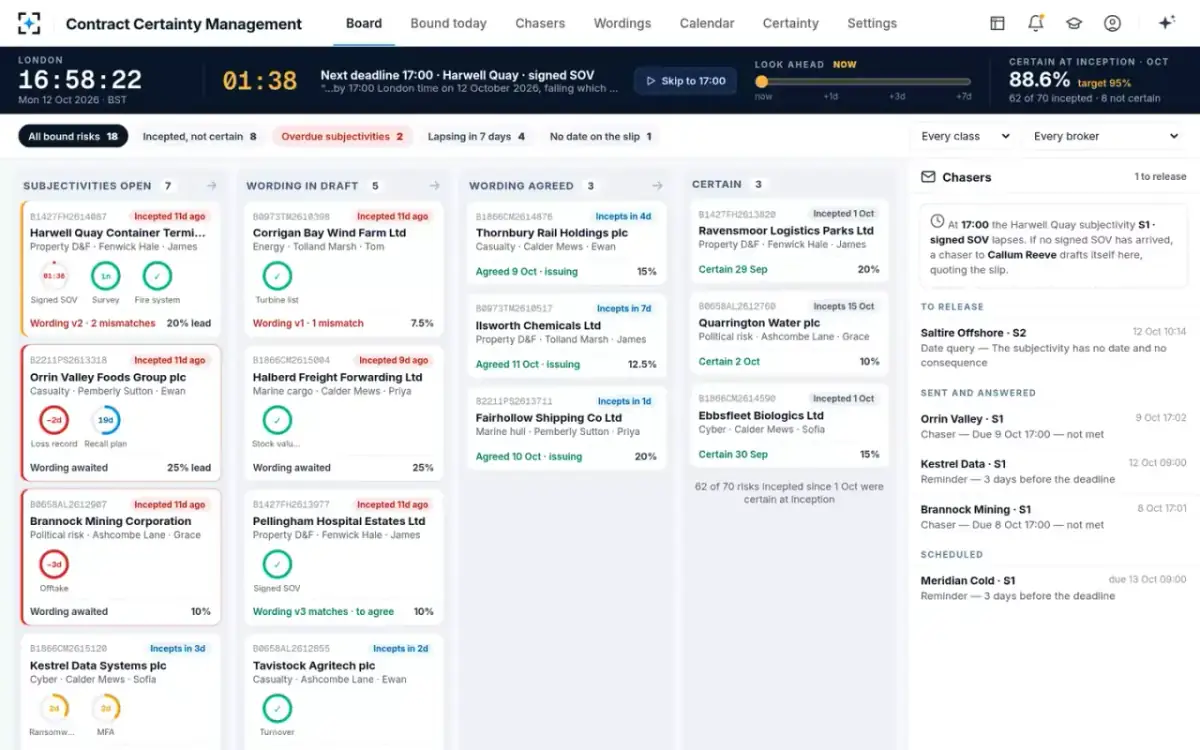
Usually as a rate: the share of risks incepting in a period that were certain at inception under the firm's definition, reported alongside the share documented within the firm's period. At Marlowgate in October 2026, 62 of 70 sample risks incepting since 1 October were certain at inception, 88.6% against a 95% target, and eight were not, each with a named owner and reason.
The method matters more than the number. A rate counted at quarter end from a sample of files says how the past went, and cannot name the eight contracts that need fixing now. Counting every incepted risk every morning, from the slip, the subjectivities and the wording status, can. The arithmetic of what a 10% sample can and cannot see is worked through in the contract certainty checklist.
Who is responsible for contract certainty?
Everyone in the chain owns a piece, and nobody owns the whole unless the firm says who does. The insured owes the subjectivity evidence. The broker drafts the wording and collects the evidence. The underwriter decides whether each subjectivity is met and whether the wording matches what was bound. An operations team, usually reporting to a head of underwriting operations, counts the result and chases what is late.
How Contract Certainty Management splits the work between agents and people
Agent
Slip readerLifts every subjectivity off the bound slip word for word, with its deadline in London time, its consequence and the evidence it needs.
Never: invents a date; a subjectivity with none is flagged
Agent
Subjectivity tracker and chaser writerCounts each subjectivity down, queues a reminder 3 days ahead and drafts the broker chaser at the deadline, quoting the slip.
Never: sends a chaser or extends a deadline
A person decides
Contract-certainty analystReads and releases each chaser to the broker.
Agent
Document matcher and wording checkerMatches the evidence that arrives to its subjectivity and compares the broker wording with the slip, clause by clause.
Never: clears a subjectivity or agrees a wording
A person decides
Class underwriterClears each subjectivity and agrees the wording with a signature that records what it means.
Agent
Certainty reporterEvery morning at 06:00 marks each incepted risk certain or not under the firm’s definition and computes the rate.
A person decides
Head of underwriting operationsSigns the report and approves any change to the definition or the clocks.
The split is the design choice that matters. The mechanical part, reading a slip for dates and comparing 41 clauses of a wording with the slip, is where hours go and errors hide. The judgement, whether a survey is "satisfactory" or a different edition of a clause is acceptable, stays with the underwriter who bound the risk. How the operations seat changes when that split is made is the subject of the head of underwriting operations guide.
Every bound risk on one board, counting down
Questions people ask
What is the difference between binding a risk and contract certainty?
Binding is the insurer's agreement to be on risk on the terms stated, often subject to conditions; contract certainty is the state in which every one of those terms, and the wording that expresses them, is agreed by inception. A risk can be bound for weeks while its wording is still being negotiated, as most of the World Trade Center insurers' risks were on 11 September 2001.
Does contract certainty mean a claim will be paid?
No. The FSA's 2004 meeting record says certainty "does not suggest certainty over the outcome of claims or the content of contracts." It means the terms, including any exclusion that defeats a claim, were agreed in writing before cover began, so the dispute is about facts rather than about what the contract said.
Is contract certainty only a London market idea?
The campaign was London's, but the problem is not. The FSA's chief executive said in 2004 that "this issue is common to many major insurance markets and is not specific to the UK", and the leading US example, the World Trade Center binders, was a New York placement. US surplus lines statutes, such as Texas's 60-day filing rule, put clocks on the same documents.
What is evidence of cover?
It is the document an insured receives after inception that confirms the insurance is in place and its main terms, before or instead of the full policy wording. The FCA's view is that firms should provide it "promptly after inception"; the London market's Market Reform Group agreed in 2005 that appropriate evidence of cover should be issued within 30 days of inception.
Why is the subscription market harder to make certain?
Because one contract has many insurers. The FSA's 2004 meeting found the difficulties sharper in the subscription market (see contract certainty in the London market), and noted that insurers covering 100% of a risk "should be able to produce documentation promptly as the process is more straightforward." Every insurer on the slip must agree the wording, and signed lines must be settled; the extra steps are traced in contract certainty in the London market.
Can contract certainty be automated?
The counting and reading can; the decisions should not be. Agents can lift subjectivities and deadlines off every slip, match incoming evidence and compare a wording with the slip clause by clause. Whether evidence meets a subjectivity, and whether a wording is agreed, remain the underwriter's calls, which is how Contract Certainty Management is set up.