The General Underwriters Agreement, or GUA, is a standard agreement between the underwriters subscribing to a London market contract that sets who may agree alterations after placement: some changes the slip leader may agree alone for everyone, some need the leader and named agreement parties, and some need every underwriter. The slip refers to it in its subscription agreement section, and each underwriter's share stays several, not joint. For a follower, the GUA is the boundary of what the leader can change in its contract without it, which makes every endorsement a question: was this inside the leader's authority, and did the leader use it? Botminds' Digital Follow Underwriting reads every lead endorsement on arrival, classifies it under that slip's basis of agreement to contract changes, and sends any change the leader cannot agree alone to the underwriter who wrote the line, with the effect on its share.
The GUA's own text is quoted below as the Commercial Court quoted it in ABN Amro v RSA (2021), from the October 2001 agreement and its June 2003 Marine Cargo Schedule; current slips may refer to a later version. This guide describes the agreement and the cases; it is not legal advice on any particular slip. Product examples come from the fictional sample book in the solution.
The GUA's three parts, as the Marine Cargo Schedule quoted by the court defines them
| Part | Who agrees the alteration | What falls in it |
|---|---|---|
| Part 1 | The slip leader alone, for every underwriter | "All Alterations that the slip specifies are to be agreed by the Slip Leader only" |
| Part 2 | The slip leader and the agreement parties, if unanimous, for every underwriter | Alterations the slip says they may agree, and "All Alterations which do not fall within either Part 1 or Part 3" |
| Part 3 | Every underwriter, each for its own proportion | Alterations the slip reserves to all, any that the leader or an agreement party judges ought to be, and any that "increases the monetary exposure of the Underwriters" |
What is the General Underwriters Agreement?
It is the market's standard agreement on post-placement changes, replacing the leading underwriter agreements that came before it. The court quoted its purpose: the GUA "is a replacement for existing Leading Underwriter Agreements, providing a form of standardisation where practical and appropriate", and "is an agreement between the subscribing underwriters on a particular contract relating to the level of delegated authority in respect of post placement alterations" (ABN Amro v RSA [2021] EWHC 442 (Comm), para 174).
Three features matter to a follower. The slip wins: "If there is a difference between the GUA and the slip terms, the slip overrules the GUA." Liability is untouched: each subscribing underwriter's obligations "remain several and not joint and limited to the extent of its signed subscription". And it is class by class: the GUA defines "Class of Business Schedules" for, among others, non-marine, marine cargo, marine hull, energy, excess of loss and treaty reinsurance, political risks, professional indemnity and terrorism, each splitting alterations into the three parts.
The agreement is still in use. A 2025 Commercial Court judgment records a London Market Reform Contract whose subscription agreement read: "All changes to be managed and agreed in accordance with the General Underwriters Agreement (version 2.0) February 2014 and the GUA Non-Marine Schedule (October 2001)" (Tyson International v GIC Re [2025] EWHC 77 (Comm), para 21). Followers should read the version and schedule each slip names, not assume one.
What are GUA Part 1, Part 2 and Part 3 changes?
They are the three levels of agreement an alteration needs. Part 1 is what the slip leader may agree alone; Part 3 is what needs every underwriter; Part 2, in the Marine Cargo Schedule the court quoted, is everything else, agreed by the slip leader and the agreement parties together. The operative clauses are short: "Only Alterations set out in the applicable Schedule Part 1 may be agreed by the Slip Leader alone on behalf of the Agreement Parties and Other Underwriters, each for its own individual signed proportion severally and not jointly" (clause 3.1), and Part 3 alterations, "and any Alteration that the Slip Leader and any Agreement Party so require, may be agreed only by all Underwriters" (clause 3.4).
The default matters most. Because Part 2 catches "All Alterations which do not fall within either Part 1 or Part 3", a change no one thought to list goes to the leader and agreement parties, not to every underwriter. A follower that is not named as an agreement party may therefore be bound by a change agreed by others, as long as the slip names agreement parties and the change is not one that increases monetary exposure or that the slip reserves to all.
Under the General Underwriters Agreement, who can be the slip leader?
Whoever the slip names: "The “Slip Leader” is the Underwriter identified as such on the slip" (clause 2.1). The agreement parties are likewise those the slip identifies, with one important default: "Where no such Underwriters are so identified, the Agreement Parties will all be Underwriters" (clause 2.2). Everyone else is an "Other Underwriter".
The slip's subscription agreement section is where a follower finds all of this. In the ABN Amro placement it named the slip leader, gave the basis of agreement as the GUA of October 2001 with the Marine Cargo Schedule 2003, and provided "Slip leader only to agree part two changes" and "Slip leader to agree all contract changes" ([2021] EWHC 442 (Comm), para 47). A follower that stamped that slip had, in effect, made the leader its only agreement party. On the solution's sample slip no agreement parties are named besides the leader, so under clause 2.2 a Part 2 change there needs every underwriter, and the solution routes it to the follower.
One endorsement under the GUA: the leader marks the box, and the box decides who else must agree
A person decides
Broker presents the endorsementWith the GUA stamp on it; if it is missing, the GUA says the slip leader shall incorporate it (clause 4.1).
A person decides
Slip leader initials a boxBox 1, slip leader only; box 2, slip leader and agreement parties; box 3, all underwriters (clause 4.2).
A person decides
Agreement parties or all underwriters, if referredEach required underwriter initials and dates the endorsement; Part 3 changes take effect for each underwriter on the date it inserts (clauses 4.2.4 and 5.1.3).
Agent
Lead change watcher, for the followerReads the endorsement on arrival, records the box and the slip's basis of agreement, and works out the effect on the follower's line.
Never: initials a box or agrees a change
A person decides
Follow underwriterAgrees or queries any change the leader could not agree alone for the follower, before it stamps or as soon as it arrives.
What is the GUA stamp, and what does each box mean?
The GUA stamp is the box on an endorsement in which the slip leader records the level of agreement a change needs; initialling it is how the leader shows it is exercising GUA authority. Its header reads "General Underwriters Agreement (GUA) Each Underwriter’s proportion is several not joint", and it has three boxes: slip leader only, slip leader and agreement parties, and all underwriters. The marine version adds a line for notification to followers, "Yes / No", "Within ______ working days".
The effect of each box is written into the agreement. "If the Slip Leader initials Box 1 and initials and dates the endorsement in the customary place, no further agreement shall be required" (clause 4.2.3); box 2 refers the change to the agreement parties and box 3 to all underwriters. The GUA also "defines administration tasks, such as distribution of certain agreed endorsements to following underwriters", on paper or by e-mail; in the 2025 case above, the endorsement was submitted and agreed through the PPL online placing platform.
What did the court find when the GUA box was missing?
That the following market was not bound. In ABN Amro v RSA, the leader signed and stamped a July 2015 endorsement that the broker had prepared as a plain document without the GUA box. The judge accepted that, under the GUA, the leader may have had authority to agree the change for the followers, but "it did not follow from the fact that authority may have existed under GUA that it was in fact exercised on any particular occasion" ([2021] EWHC 442 (Comm), para 441).
The box was the evidence. "Where an endorsement contains the GUA box, and where that box is then initialled by the underwriter, it will be apparent that the underwriter is intending to implement the GUA terms and hence the authority which has been conferred upon him" (para 443). Here the broker "did not include the GUA Box on the July endorsement", and the leader "did no more than sign and apply RSA’s stamp" (para 444). The broker's argument that the leader had a duty to add the stamp did not help: the significant point was that it had not been done.
The significant point is that this was not done, and that there was therefore nothing which indicated an intention on the part of Mr. Beattie to contract on behalf of the following market.
Jacobs J, ABN Amro v RSA [2021] EWHC 442 (Comm), para 446
Is a follower bound by a change only the leader signed?
Only if the change was within the authority the slip and the GUA gave the leader, and the leader exercised it for the followers. Both halves are needed. On authority, the leader can bind followers only within the part and the slip's terms; on exercise, the endorsement must show the leader acting for the market, normally through the box. In ABN Amro, the judge concluded: "I do not consider that the following market was in fact bound by the July 2015 endorsement" (para 447).
The protection is narrower than it looks. The change bound the leader, and when it was carried into the next year's renewal slip, every underwriter who stamped that renewal was bound by it. Follow clauses also vary from slip to slip: as the Commercial Court observed in 2014, "Follow clauses come in different forms", some covering alterations, surveys and claims, others only claims or declarations, and how each works "must depend, ultimately, upon an examination of the terms of the follow clause in question" (San Evans Maritime v Aigaion [2014] EWHC 163 (Comm), para 11).
What "monetary exposure" means, and why it can surprise a follower
Part 3 of the schedule the court quoted reserves to all underwriters "Any Alteration which increases the monetary exposure of the Underwriters". The underwriters in ABN Amro argued that the new clause, which extended cover, did exactly that; the judge disagreed. The clause did not raise the policy limits; it widened the perils covered within them. "Whilst, as previously discussed, a prudent underwriter might consider that there was an increase in his probable maximum loss on his existing exposure, it does not in my view follow that his “monetary exposure” as defined by the GUA was increased" ([2021] EWHC 442 (Comm), para 313).
For a follower the lesson is that its own view of a change's significance is not the GUA's. A change that raises a follower's probable maximum loss, such as wider perils or a lower deductible, may still sit in Part 2 if limits are untouched, and be agreed for the follower by the leader and the agreement parties. The safe course is to know about every change as it is agreed, whatever its part, and to treat the part as a question about who may agree it, not about whether it matters.
Each lead endorsement with its GUA part and what it means for this follower
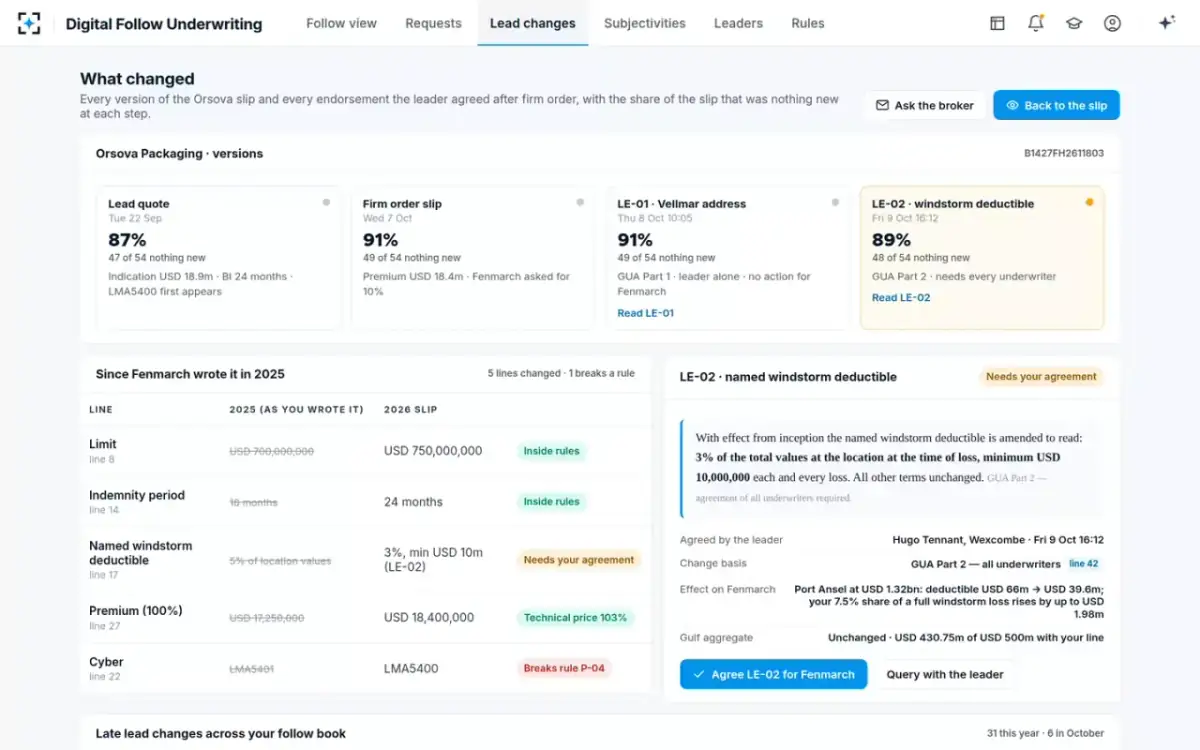
What can a follow underwriter accept without review?
Under the GUA a follower accepts some changes by not being asked, the Part 1 changes the leader agrees alone, and inside a syndicate the follower's own rules decide what its underwriters may accept without a second person. A follow tool's job is to keep those two boundaries visible, never to widen them. The matrix below is how Digital Follow Underwriting draws them; each row is a setting the syndicate controls.
What may be accepted without a person, decision by decision
| Decision on the slip | Who decides under the slip | What an agent may do | Who decides in the solution |
|---|---|---|---|
| A line identical to one the syndicate accepted before | The follower, by stamping | Grey it, naming the contract it matched | The follow underwriter, at the stamp; a slip that is entirely nothing new can be stamped from the list if the syndicate allows |
| A line changed inside the follower's rules | The follower | Show the old and new wording | The follow underwriter marks it seen |
| A line that breaks a required or refused clause | The follower | Show the rule and the two choices | The follow underwriter writes a condition, or the class underwriter signs a departure |
| A line size above the max line or personal authority | The follower | Propose the largest line inside authority | The follow underwriter chooses from options inside authority |
| A Part 1 change agreed by the leader | The slip leader alone | Read it, apply it to the line, show it | No action needed; the follower sees it |
| A Part 2 change | Leader and agreement parties, or all where none are named | Classify it and calculate the effect on the share | The underwriter who wrote the line, where the follower must agree |
| A Part 3 change, or one the leader referred to all | Every underwriter | Classify it and calculate the effect on the share | The underwriter who wrote the line agrees or queries |
What should never be automated in follow underwriting?
Anything that exercises authority: stamping a line, agreeing a lead change, initialling a GUA box, waiving a rule or telling the broker a line is written. Those are the acts the GUA, the slip and the syndicate's own authorities attach to named people, and they are the acts courts examine when a dispute arrives, as ABN Amro shows: the question was what the leader intended when he signed. An agent that agreed a change on a follower's behalf would leave the follower unable to say who intended what.
In Digital Follow Underwriting those limits are written into each agent: the lead change watcher never agrees a change for the follower, every change that needs the follower reaches a person, the authority checker never proposes a line above authority or waives a rule, and the recorder never stamps or sends. The one automatic convenience, stamping from the list a slip that is entirely nothing new, is a syndicate setting that can be switched off, and it applies only where nothing differs from what the syndicate has already accepted.
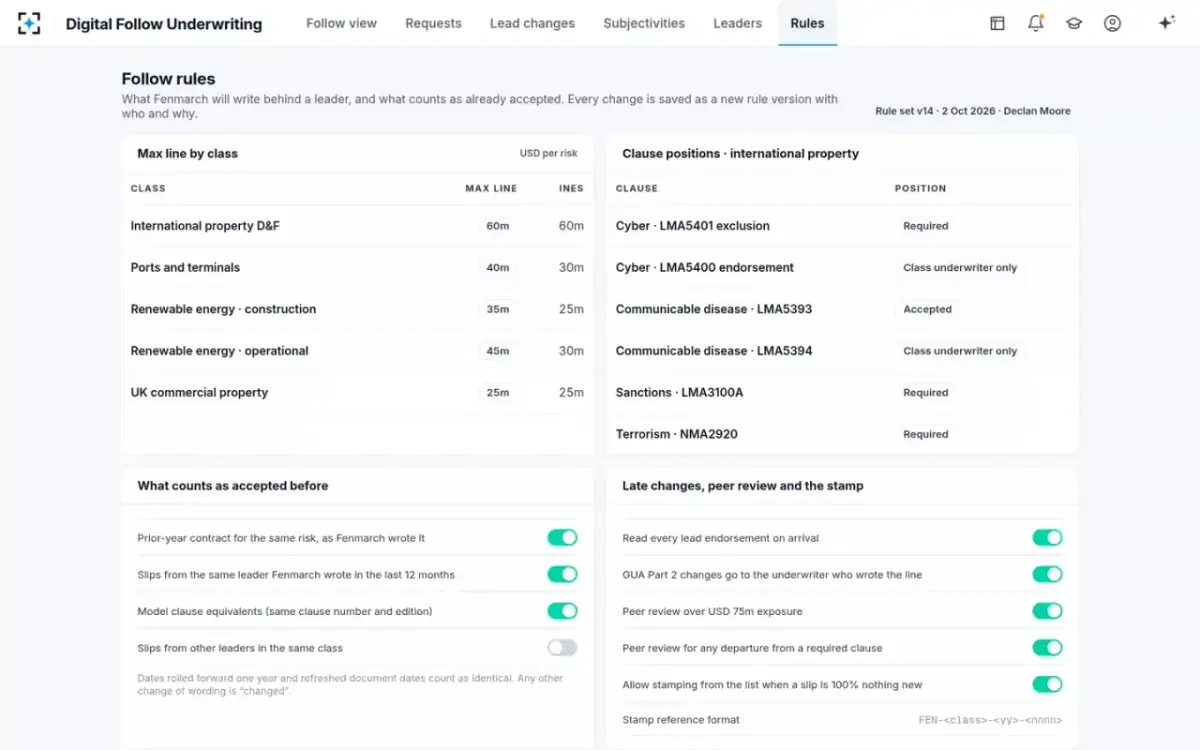
The follower's rules on late changes, peer review and the stamp, versioned with who changed them
Where Digital Follow Underwriting fits under the GUA
Digital Follow Underwriting gives a follower the one thing the GUA assumes and does not guarantee: that it knows about every change. It reads the slip's subscription agreement, the GUA version and schedule it names and every endorsement as it arrives; it applies each change to the line it alters, records the part and the box, and calculates the effect on the follower's line and aggregates. It decides nothing. One deductible traced from firm order to wording follows a change end to end, the seats on one slip covers who decides what, and the solution page shows the full sample request.
Questions people ask
What is General Underwriters Agreement version 2.0, February 2014?
A later version of the GUA, which a 2025 Commercial Court judgment records being named in a London reinsurance contract's subscription agreement together with the October 2001 Non-Marine Schedule. Its structure of parts and schedules is the one described here, but a follower should read the version and schedule each slip names.
Does the GUA make underwriters jointly liable?
No. The GUA states that it "is not intended to affect the several liability of each subscribing Underwriter", and its stamp carries the words "Each Underwriter’s proportion is several not joint".
What happens if the slip and the GUA conflict?
The slip wins. Clause 10.1.1 provides that where the slip or an endorsement conflicts with the GUA, "the terms of the slip/endorsement shall prevail", meaning the terms shown to and subscribed by each underwriter for its own proportion.
Who notifies the following market of a change?
The GUA assigns administration tasks such as distributing certain agreed endorsements to following underwriters, and the marine stamp has a notification line. In ABN Amro the broker did not show the endorsement to the following market, which is part of why the court held they were not bound by it.
Is a deductible change a Part 2 or a Part 3 change?
It depends on the schedule and the slip. The Marine Cargo Schedule reserves to all underwriters alterations that increase "monetary exposure", which the court in ABN Amro read as not covering a change that widened cover within unchanged limits. Check the slip's own list first, since the slip overrides the GUA.