The Lloyd's PPL system is the London market's electronic placing platform: brokers use it to present a risk's Market Reform Contract to underwriters, and underwriters use it to sign their lines and to agree or decline endorsements, so it holds the contract and its history. For a follower, PPL answers where the slip is and who has signed it; it does not answer the follower's own questions, which lines differ from what it has already accepted, whether its line fits its authority and aggregates, and which of the leader's later changes need its agreement. Botminds' Digital Follow Underwriting works beside the placing platform for exactly those questions: its agents read the slips and the endorsement feed, compare them with the syndicate's own contracts and rules, and put a difference view and a proposed line in front of the follow underwriter, who decides and stamps. The platform stays the place where the contract lives.
The description of PPL here comes from what English courts have recorded about placements made on it and from the FCA; the integration and governance points rest on the Bank of England, EIOPA and New York's insurance regulator, linked where they are used. Product examples come from the fictional sample book in the solution.
An integration map: the placing platform holds the contract; agents read it and write only for a person
Where the contract lives
- The placing platform: slips, endorsements, signatures
- Placing platform exports and the endorsement feed
- PDF or Word slips that arrive outside it
What the agents read
- Every slip line and lead endorsement
- The syndicate's prior-year contracts and recent slips
- Follow rules, authorities, aggregates, technical price, sanctions screening
What the agents write, for a person
- Lines greyed as already accepted, each naming its match
- Differences, late changes and their effect on the share
- A proposed line, condition and reason
What only people do
- Choose the line and conditions
- Agree or query lead changes
- Stamp, send the line to the broker, book it
What is the PPL system at Lloyd's?
PPL is the electronic platform on which London market risks are placed: the broker posts the contract, underwriters sign their lines on it, and later endorsements are submitted and agreed through it. English judgments describe it in passing, as courts describe any business document. In a 2025 Commercial Court case about a property reinsurance placed in London, the reinsurer's acceptance of a later document was given through "the “PPL” online placing platform as an endorsement requiring GIC’s agreement, which was given at 09:38 on 09 July 2021", and the original contracts had been signed and stamped "as evidenced on the MRCs and on PPL" (Tyson International v GIC Re [2025] EWHC 77 (Comm), paras 28 and 34).
The FCA's 2019 broker study placed electronic placing in the market's longer story. Brokers it surveyed listed Lloyd's standards, including "electronic placing platforms", among the hurdles to operating in London, though others said recent changes had reduced those barriers; and it noted that the Lloyd's change programme was "a significant step towards an integrated digital placing and claims management model", adding that "Standardised electronic placement could make the automatisation of placement and claims settlements in the LIM possible" (FCA MS17/2.2, paras 3.69 and 6.20).
How does PPL work for follow markets?
For a follower, the platform is where the follow request arrives and where its line is signed: the broker presents the lead's agreed contract, the follower opens it, writes its line and signs, and later sees and responds to endorsements. Contracts written on the platform carry the market's agreement on how changes are requested and answered. The subscription agreement in the 2025 case read that "the broker agrees that any proposed contract change will be requested via an ‘ACORD’ message or using an ACORD enabled electronic trading platform", and that "each relevant (re)insurer agrees to respond via an appropriate ‘ACORD message’ or using an ACORD enabled electronic trading platform" ([2025] EWHC 77 (Comm), para 21).
What the platform does not do is the follower's thinking. It presents the contract as the broker and leader built it; whether line 22's cyber endorsement breaks the follower's clause rule, or the deductible cut in endorsement two moves its Gulf windstorm exposure, is still read and judged by the follower's own people. That reading, for each follower, on every slip, is the work this guide is about.
One follow request, from the placing platform to the stamp and back
A person decides
Broker, on the placing platformPresents the lead's Market Reform Contract to the follower and asks for a line.
Agent
Slip readerReads the slip and every endorsement from the platform export or feed into lines, each in the leader's words, with each endorsement applied to the line it changes.
Never: paraphrases contract wording
Agent
Accepted-terms matcher and authority checkerGreys every line the syndicate has already accepted, names the match, and checks the line against max line, authority, aggregates, technical price, territory, sanctions and clause positions.
Never: proposes a line above authority
A person decides
Follow underwriterReads the differences, agrees or queries late lead changes, chooses the line and conditions, and stamps.
A person decides
Back to the broker and the booksThe line goes to the broker and is booked in the syndicate's systems; the contract and signatures stay on the platform.
What is the Market Reform Contract?
It is the standard structured contract form that the placing platform carries. The Court of Appeal described standard practice in 2022: "the risk presented by the broker to the market will consist of an introductory section, the Risk Details, setting out the most important details of the risk (including the choice of law and jurisdiction), together with (among other things) standard terms and conditions" (AIG Europe v John Wood Group [2022] EWCA Civ 781, para 30). The sample slip in the solution is laid out in six sections, from the risk details and information to security details, the subscription agreement, fiscal and regulatory matters and broker remuneration.
The structure is what makes a follow agent practical. A contract built of headed, predictable sections can be read into numbered lines and compared line by line with last year's contract and with the same leader's other slips. A follow tool that reads the contract in this form keeps every line in the leader's words and cites its place, so an underwriter can check any finding against the platform's copy.
Does a follow agent replace the placing platform?
No, and it should not try. The platform is shared by the broker, the leader and every follower; it is where the contract is presented, signed and changed, and where a court will later look for what was agreed and when. A follow agent serves one market, the follower, and its outputs are about that follower: which lines it accepted before, where its rules are broken, what a late change does to its share. Mixing the two would put one syndicate's private judgements into a shared document, or make the shared contract depend on one syndicate's tool.
The safer division is the one in the map above. The platform remains the system of record for the contract. The follow tool is a reader of the platform and of the syndicate's own data, and a writer only of material for a person: a difference view, a proposed line and a drafted reason. Every act that changes the contract, signing a line or agreeing an endorsement, stays with a named underwriter.
Can a follow tool integrate with PPL? What to ask
A follow tool needs two things from the placing platform: the contract as it was presented, and every endorsement as it arrives. Digital Follow Underwriting takes the Market Reform Contract or slip as a PDF, Word file or placing platform export, and lead endorsements from the placing platform feed, read on arrival. The questions that matter in an integration are practical ones: how quickly an endorsement agreed by the leader reaches the follower's tool; whether the export keeps the slip's sections and line structure; and how a slip that arrives outside the platform, as a PDF from a broker, is handled the same way.
Supervisors' surveys suggest integration, not the model, is where projects stall. In the Bank of England and FCA's 2026 survey, "Integration into existing business processes and decisions was the most frequently reported large non-regulatory constraint, cited by 23% of respondents, followed by legacy systems or infrastructure at 22%" (Bank of England, AI in UK financial services, 26 October 2026).
Firms say integration and third-party oversight are the hard parts of adopting AI
23%
cited integration into existing business processes as a large constraint, the most often reported
22%
cited legacy systems or infrastructure
54%
found applying model risk management to third-party or vendor models a challenge
49%
found overseeing systems provided or materially influenced by third parties a challenge
What data does a follow agent need?
More than the slip. To grey a line, the agent needs what the syndicate accepted before; to check a line, it needs the syndicate's rules and the outputs of its own models. A follow tool that has only the platform's copy of the slip can summarise it, but it cannot tell the follower which lines are new to it.
What a follow agent reads, where it comes from, and what it is used for
| Data | Usual source | Used for |
|---|---|---|
| The Market Reform Contract or slip | Placing platform export, or PDF and Word | Reading every line in the leader's words |
| Lead endorsements after firm order | Placing platform feed, read on arrival | Applying each change to its line; flagging those needing the follower |
| Prior-year contracts and recent slips from the same leaders | The syndicate's own contract history | Greying lines already accepted, with the match named |
| Follow rules: max lines, personal authorities, clause positions | Set by the class underwriter, versioned | Checking the line and every clause against the syndicate's rules |
| Accumulation and technical price | The syndicate's accumulation report and pricing model | Showing the aggregate after the line and the premium against technical price |
| Sanctions screening | The syndicate's screening of insureds, sites and partners | Flagging anything compliance must clear |
Where is the follow decision recorded?
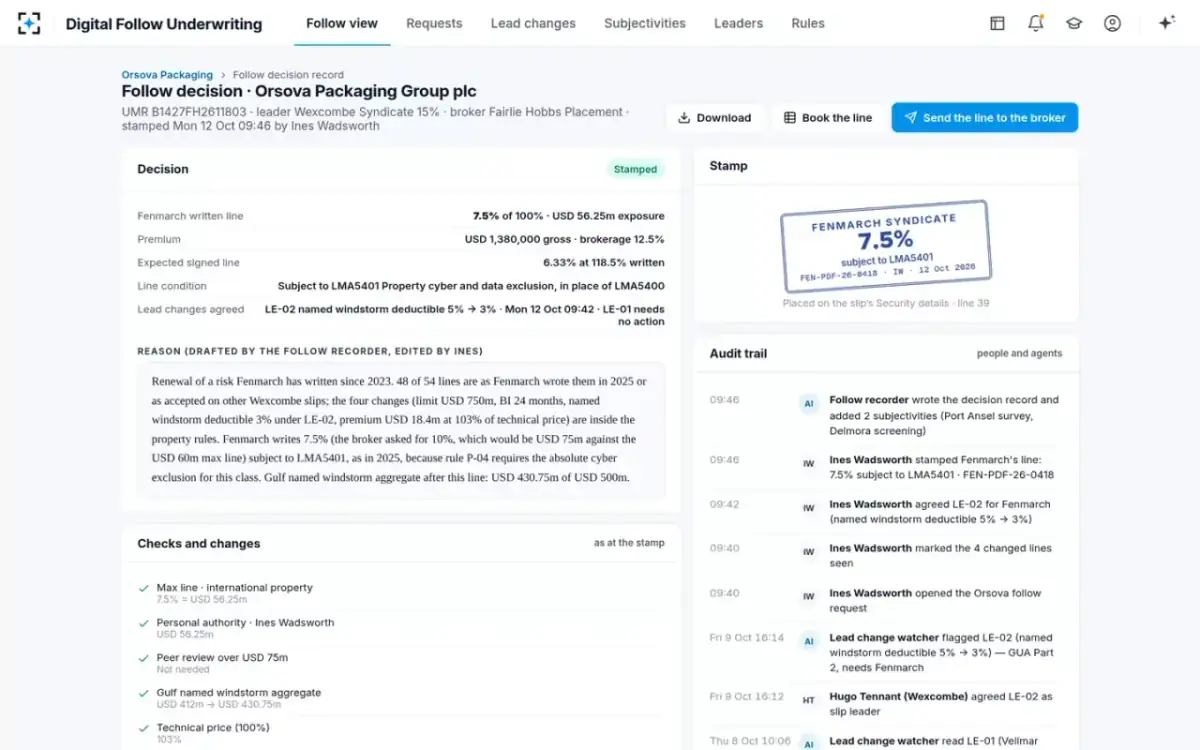
In two places, for two purposes. The signature on the slip, on the placing platform, is the contract. The follower's own file of the decision, its line, condition, reason, the checks as they stood at the stamp and who did what, is its evidence of how it decided, kept in its own systems. The second is what a class underwriter, a peer reviewer, an auditor or a supervisor will ask for, and the platform does not hold it.
Regulators expect that file when software takes part. EIOPA holds insurers ultimately responsible for the AI systems they use, whether built in-house or bought (EIOPA Opinion on AI governance, August 2025, para 3.11), and New York's regulator told insurers in 2024 that responsibility for understanding a vendor's underwriting tool stays with the insurer (NY DFS Insurance Circular Letter No. 7, 11 July 2024; the AI vendor risk assessment questionnaire turns that into questions for the vendor). EIOPA's examples of good record keeping for higher-risk AI uses include a "Description of how the model is integrated in the current IT system of the organisation", and the staff involved, so that accountability is clear.
The follower's own file of the decision, kept beside the contract on the platform
What to test in a pilot beside the placing platform
Test on your own placements, against differences you already know. A useful pilot takes a recent quarter of follow requests as they arrived on the platform, with their endorsements, and asks whether the tool finds what your underwriters found, and anything they missed, in time to matter.
Nine checks for a follow tool working beside the placing platform
- Coverage of slips
What share of last quarter's follow requests could the tool read from platform exports, and how were PDF or Word slips handled?
- Line structure kept
Does every line keep its section, its place and the leader's exact words, so a finding can be checked against the platform's copy?
- Endorsement latency
How long from the leader agreeing an endorsement to the follower's tool showing it, with its effect on the share?
- Basis of agreement read
Does it read each slip's own subscription agreement, including the GUA version and schedule it names?
- Planted changes found
Change one word in a sample of renewal slips; count what is found and what is greyed wrongly.
- Your history connected
Can it read your prior-year contracts and recent slips from the same leaders? Without them nothing can be greyed.
- No writes to the contract
Confirm the tool cannot sign, agree an endorsement or message the broker on its own.
- A decision file you keep
Line, condition, reason, checks at the stamp and an audit trail of people and agents, exportable and readable without the tool.
- Oversight evidence
Version history of the rules, the overrides and the planted-change results, ready for a supervisor or auditor.
Where Digital Follow Underwriting fits beside PPL, and where it does not
Digital Follow Underwriting fits a follow desk that receives most of its slips on the placing platform, writes behind several leaders and has a contract history worth comparing against. It reads every request on arrival, so the morning starts with what differs; it keeps its own file of each decision; and it leaves every signature and agreement to the underwriter. A slip that is entirely nothing new against the syndicate's own accepted terms can be stamped from the list, if the syndicate chooses to allow it.
Every slip a broker sent, read on arrival: the follower's view beside the platform
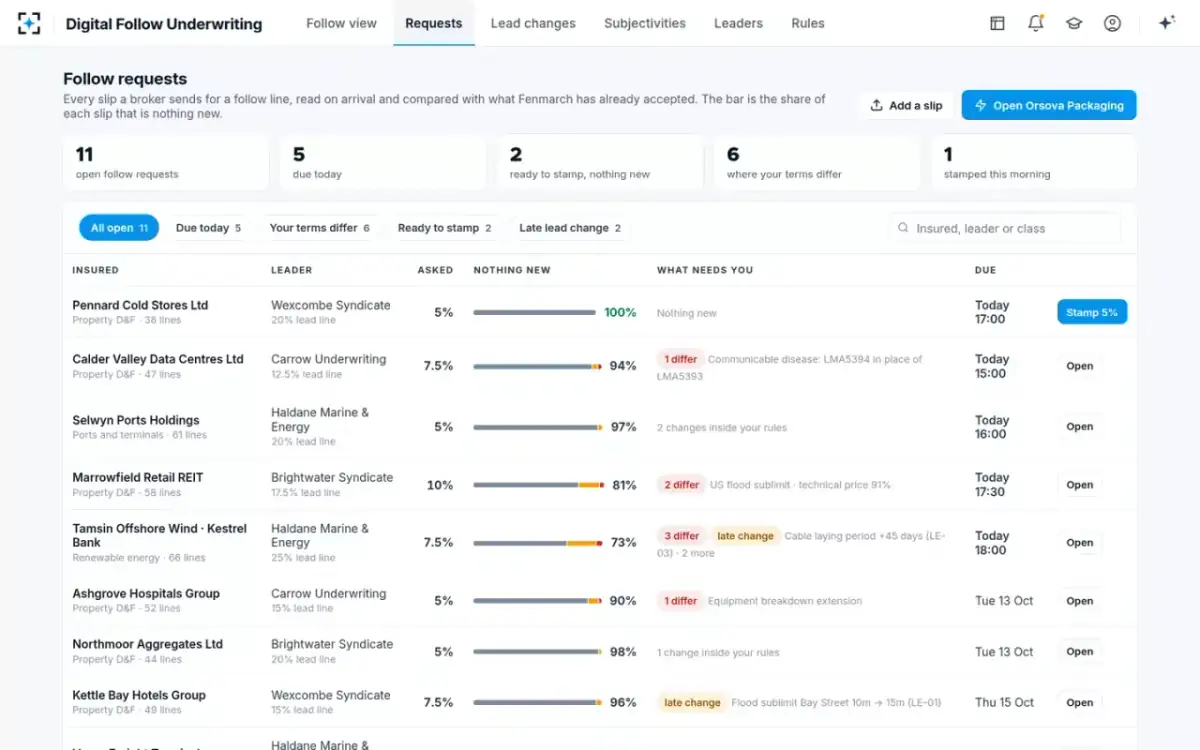
It does not replace the placing platform, the syndicate's policy administration, pricing or accumulation systems; it reads their outputs. It does not lead, broke or sign. A syndicate that wants to change how risks are presented to the market needs the platform's own roadmap; one that wants its follow underwriters to read six lines instead of 54 can pilot this beside the platform it already uses. Which follow tasks move to agents and how a desk learns to trust them cover the rest of the evaluation, and the solution page shows one request from open to stamp.
Questions people ask
Is PPL the same as the Market Reform Contract?
No. The Market Reform Contract is the standard form of the contract; PPL is the electronic platform on which it is presented, signed and endorsed. A Market Reform Contract can also travel as a PDF or Word document outside the platform, and a follow tool should read both.
Do follow underwriters sign on PPL?
Placements made on the platform are signed there; in the 2025 Tyson case the court recorded the contracts as signed and stamped "as evidenced on the MRCs and on PPL", and a later endorsement agreed through the platform at a recorded time.
Can an AI agent sign a line on PPL?
It should not. Signing a line or agreeing an endorsement binds the syndicate, and those acts belong to named underwriters inside their authorities. In Digital Follow Underwriting no agent stamps, agrees a lead change or contacts the broker.
What if a slip arrives outside the platform?
It is read the same way. Digital Follow Underwriting accepts slips as PDF and Word files as well as platform exports, so a follower's comparison with its own accepted terms does not depend on how the broker sent the slip.
Who is responsible if a follow tool misreads a slip?
The insurer. EIOPA's 2025 Opinion says insurers are ultimately responsible for the AI systems they use, in-house or third-party, and New York's regulator says insurers retain responsibility for vendor tools used in underwriting. That is why every greyed line should name its match and every decision should stay with a person.