In insurance, a lead underwriter is the underwriter who negotiates the terms and price of a risk shared by several insurers, writes the first line on the slip and, depending on what the slip says, agrees later changes and handles claims for the others; the follow underwriters each write their own share on those terms. It is the London subscription market's sense of the word, not the securities sense in which a bank leads a share offering. The hard part is that leading and following divide the decisions, not the responsibility: each follower's line is its own contract, so every follower still checks the slip against its own limits and clause rules, and still has to know which changes the leader can agree on its behalf. Botminds' Digital Follow Underwriting does that checking for the follower and leaves each decision with the person whose seat it belongs to.
The legal points below come from English judgments, HMRC, the FCA and the Law Commission, linked where they are used. The seats are illustrated with the fictional sample in the solution: a follower, Fenmarch Syndicate, asked to write a line behind a leader, Wexcombe Syndicate.
Five seats on one subscription slip, and what each decides
Today
Negotiates price, wording and conditions with the broker, writes the first line and agrees the changes the slip lets the leader agree alone.
With agents
Unchanged. The leader's work is the input every follower reads.
Still theirs: The terms, and the changes within its delegated authority
Today
Reads the whole slip and every endorsement, works out a line against the max line and aggregates, checks each clause and writes the reason.
With agents
Reads only the lines that differ from what the syndicate has already accepted, chooses the line and stamps.
Still theirs: The line, the conditions and the stamp
Today
Owns the class rules and peer-reviews departures and large lines, usually from the follower's notes.
With agents
Sees every departure from a required clause with the reason, and keeps the follow rules versioned.
Still theirs: Sign-off on departures from the class rules
Today
Copies the slip into the syndicate's systems to see what changed, books lines and chases subjectivities.
With agents
Books stamped lines and works one list of open subjectivities.
Still theirs: Booking and the follow-up with the broker
Today
Reports follow speed and contract certainty from samples and spreadsheets.
With agents
Sees the whole follow book by leader: lines, differences, late changes and time to decision.
Still theirs: The board's view of the follow book
What does a lead underwriter do in insurance?
A lead underwriter sets the terms that every other underwriter on the slip accepts or declines. On a London market placement the broker shows the risk to the market, the client chooses one underwriter's terms, and that underwriter writes the first line; the broker then takes the agreed slip to the follow market. The leader's price, wording, deductibles and conditions become everyone's starting point.
The leader's work often continues after placement, but only by agreement. A slip may let the leader agree some changes alone and handle claims for the followers, and market wordings sometimes set the leader's own deadlines: the Law Commission noted that clause 46.7 of the International Hull Clauses 2003 "gives the leading underwriter 28 days to make a decision on a claim" (Law Com No 353, footnote to para 25.20). The same report recognised the knock-on effect for the others: an insurer's claims decision may depend on another insurer, as "in the subscription market where a follower may be dependent on the lead insurer".
Lead vs follow underwriter: what is the difference?
The leader negotiates; the follower decides whether to join, and for how much. That is the whole difference in a sentence, and it understates the follower's job, because joining is a decision against the follower's own authority, accumulation and clause positions, made on someone else's wording.
Lead and follow underwriter, decision by decision
Lead underwriter: Negotiates them with the broker and client.
Follow underwriter: Takes them as written, or writes its line subject to its own conditions.
Lead underwriter: Writes the first line, often a larger one.
Follow underwriter: Chooses its line inside its max line, personal authority and aggregates.
Lead underwriter: Chooses the wording, including market model clauses.
Follow underwriter: Checks each clause against its own required and refused clauses.
Lead underwriter: Agrees the changes the slip allows it to agree alone, and marks the rest for others.
Follow underwriter: Bound by changes within the leader's delegated authority; agrees or queries the rest.
Lead underwriter: Often agrees claims for the slip, with any named claims parties.
Follow underwriter: Follows the leader in claims as far as its own follow clause says.
Lead underwriter: Its own line only.
Follow underwriter: Its own line only: each subscription is a separate contract.
Three meanings of "lead" in the London market
The word carries three different jobs, and they are easy to confuse. The slip leader is the market role above. Inside a syndicate, HMRC uses "lead underwriter" for the managing agent's own underwriter: managing agents "employ the professional insurance underwriter who actually conducts the underwriting (each syndicate has a lead underwriter)", and the syndicate's members "other than the active underwriter do not have any say in the conduct of the syndicate’s business" (HMRC, LLM1090). And since December 2025 the FCA's product rules let firms that make a product together choose a single lead firm for product governance, which must be an insurer or a managing agent, not an intermediary (FCA PS25/21).
Same word, three jobs: which lead is meant
| Term | Who it is | What it decides | Where it is set |
|---|---|---|---|
| Slip leader | The underwriter whose terms the slip is written on | Terms, price and the changes the slip lets it agree | The slip's subscription agreement |
| A syndicate's lead (active) underwriter | The managing agent's underwriter who writes the syndicate's business | Every line the syndicate writes, lead or follow | The managing agent's authorities |
| Lead firm for product governance | One co-manufacturer chosen to hold the PROD 4.2 duties | Product approval and review, with liability for redress | A written agreement under FCA PROD 4.2.14-AR |
Who agrees changes after firm order?
Whoever the slip says. A London slip carries a subscription agreement that names the slip leader, any agreement parties, and the basis on which contract changes are agreed; the slips in the English cases cited in this series do it by reference to the market's General Underwriters Agreement, which sorts changes into those the leader may agree alone, those needing the leader and named agreement parties, and those needing every underwriter. The leader has no general power to change a follower's contract; it has exactly the authority the follower gave it by subscribing.
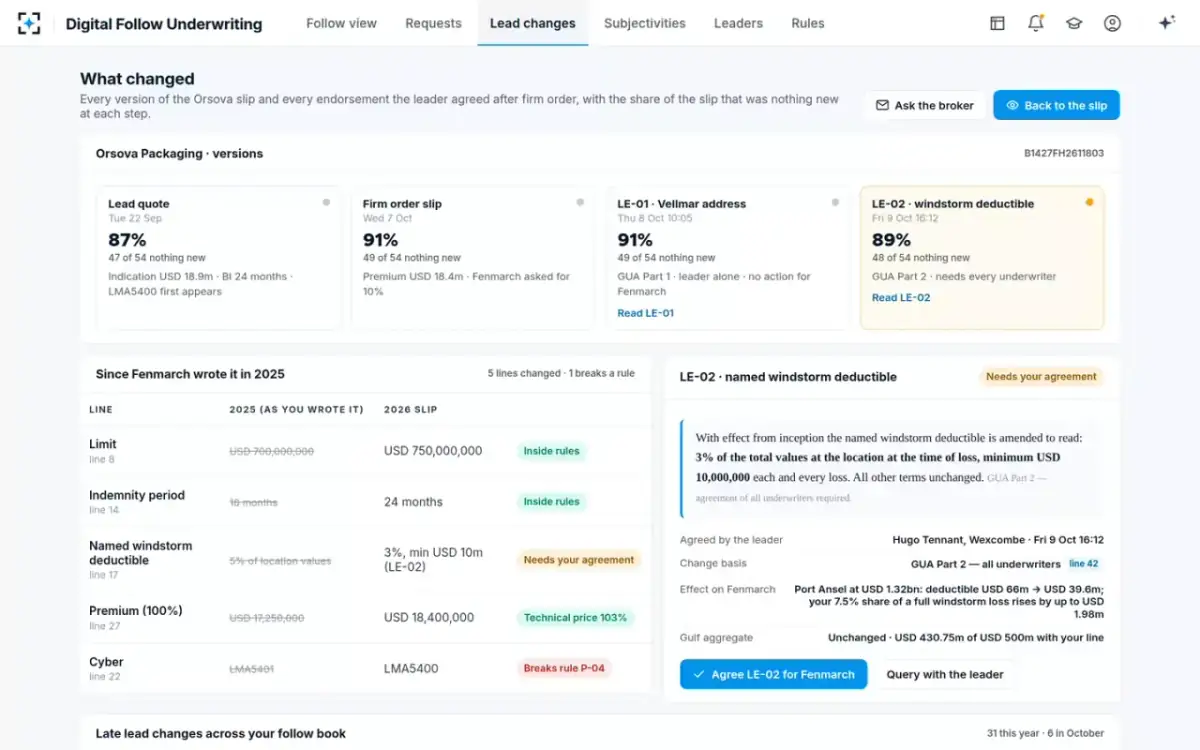
That makes the classification of each change, and the evidence of it on the endorsement, the follower's real exposure. The General Underwriters Agreement guide sets out the three parts and what the Commercial Court decided when the evidence was missing. On the solution's sample slip, the leader agreed two endorsements after firm order: an address correction it could agree alone, and a cut in the named windstorm deductible from 5% to 3% of location values that, under that slip, needed the follower's own agreement.
Can a follower refuse a change agreed by the lead?
It depends on whether the change was within the authority the follower gave the leader. If it was, the follower is bound for its line; if it was not, the change binds the leader alone until the follower agrees. The difficulty is that English law has never settled what kind of authority a follow clause creates.
Some judges treat the leader as the followers' agent. Others see the leader's agreement as a trigger. In Mander v Commercial Union, quoted in a 2014 Commercial Court judgment, Rix J suggested that following underwriters "agree, by subscribing to the Cover, that they will be bound by a declaration falling within the scope of the cover and agreed by the leading underwriter: ie the agreement of the leading underwriter works as a ‘trigger’ rather than as an act of agency" (San Evans Maritime v Aigaion [2014] EWHC 163 (Comm), para 17). The same judgment records that other cases took the agency view, and that the textbooks "recognise the uncertainty in the authorities as to the basis upon which a follow clause operates but do not seek to resolve it".
For better or worse following insurers trust and follow their leader……Following underwriters accept both the advantages and any risks of the leading underwriters’ handling of settlements and of other matters affecting them.
Mance J in Roar Marine v Bimeh Iran, quoted in San Evans Maritime v Aigaion [2014] EWHC 163 (Comm), para 22
For a follow desk the practical rule is simpler than the doctrine. Within the leader's authority, the follower has accepted the risk of the leader's judgement in advance, so the time to object is before stamping, when the follow clause and the subscription agreement are on the slip. Outside it, nothing changes the follower's contract until the follower agrees, which means the follower has to know the change exists.
Does the lead underwriter owe the following market a duty?
Possibly, and the courts have not decided. The 2014 judgment summarises the split: Hirst J considered a leader's duty of care to the followers "manifest" in The Leegas (1987), Mance J thought such a duty "likely" or "probable" without deciding it in Roar Marine (1998), and Rix J found the imposition of an agent's duties on a leader "unrealistic" in Mander (1998); the judge in 2014 said nothing further because the question did not arise (San Evans Maritime v Aigaion, para 20).
The uncertainty runs both ways. A leader settling a claim may state that it acts only for itself, to protect itself from claims by the followers; in the 2014 case the court held that such a statement did not release a follower whose own clause obliged it to follow the settlement. A follower cannot outsource its judgement to the leader and expect the law to hand it back if the leader errs.
What does a follow underwriter check?
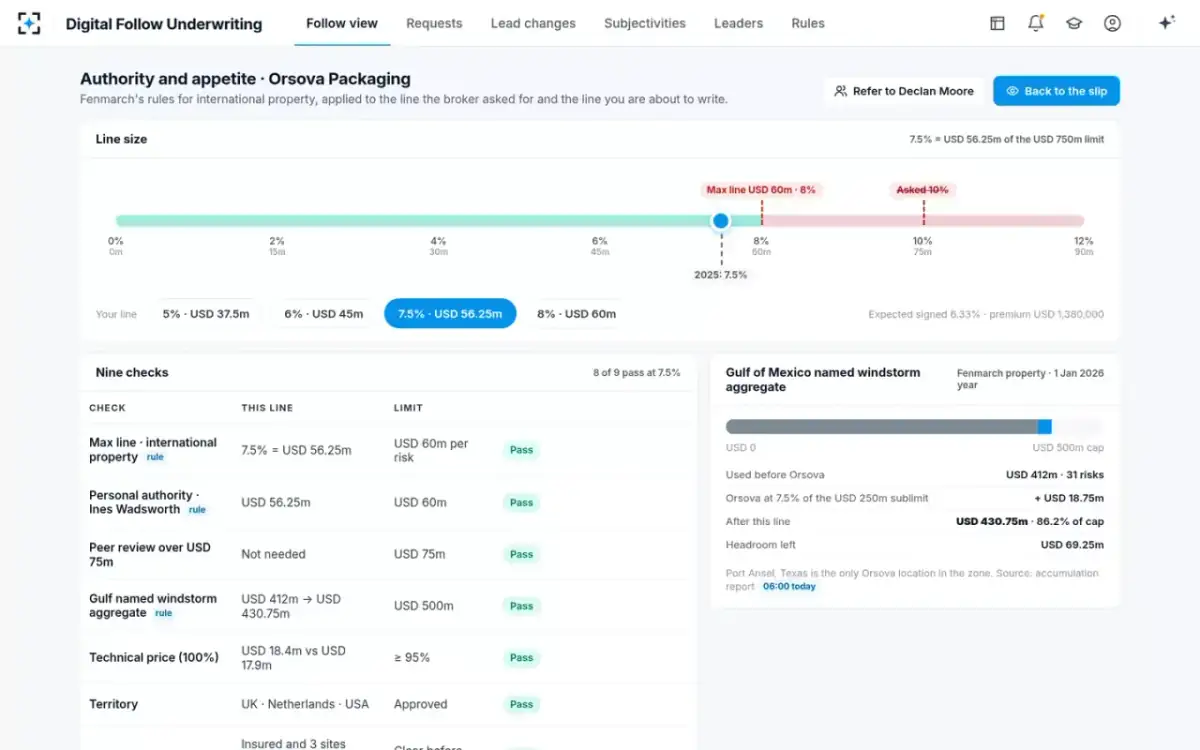
A follow underwriter checks the slip against its own book: the line against its max line and personal authority, the accumulation the line adds in exposed zones, the price against its technical price, the territory, sanctions on the insured and its partners, whether the leader is on its approved list, and each clause against the clauses its class rules require or refuse. On a renewal it also checks what has changed since it last wrote the risk, and on every slip, what the leader has agreed since firm order.
On the sample slip, those checks produced two differences out of 54 lines. The broker asked for 10% of a USD 750 million limit, USD 75 million against a USD 60 million max line, so 8% was the most the follower could write; and the leader had moved from the cyber exclusion the follower's rules require, LMA5401, to LMA5400, which writes back fire and explosion following a non-malicious cyber incident.
The follower's own authority, applied to the leader's slip
The class underwriter and peer review
Peer review is a second underwriter's look at a line, after or before it is written, against the class rules; at a follow syndicate it usually catches departures from required clauses and unusually large lines. It is only as good as what the reviewer is shown. In ABN Amro v RSA (2021), the Commercial Court described a follower's renewal that was peer-reviewed "after subscription, by two underwriters", a review the underwriter accepted "looked as though" it "was very thorough"; but it "was carried out in the context of" his notes, which recorded certain changes and otherwise "as expiry", and no questions were raised about the clause at issue (ABN Amro v RSA [2021] EWHC 442 (Comm), para 676).
The lesson for the class underwriter's seat is about inputs. A reviewer who sees the follower's summary reviews the summary. A reviewer who sees every line that differs from what the syndicate accepted, with the leader's wording beside it, reviews the contract. In the solution, any departure from a required clause goes to the class underwriter with the reason attached, and the follow rules themselves are versioned, with who changed them and why.
The assistant, the broker and the head of operations
Three more people touch every follow line without deciding it. The broker presents the slip and every endorsement and is the follower's only source for what changed; when a broker says a renewal is as expiry, a follower is entitled to rely on it, and in the 2021 ABN Amro case the Commercial Court did not criticise a following underwriter who had not read through the policy because he was told it was as expiry apart from the changes noted. The underwriting assistant books the stamped line and chases the subjectivities, and on the sample syndicate's own account spent half a morning copying slips into its systems to see what had changed. The head of operations answers to the board for speed and contract certainty across the whole follow book.
Where the follower's hours go, seat by seat
Most of the follow underwriter's week goes on reading that someone else has already done. The split below is Botminds' estimate of a five-day week spent on follow requests, made to design the solution; it is not a measurement at any syndicate.
A follow underwriter's week, by hand and with Digital Follow Underwriting
By hand: five days
- Re-reading slips against last year and the same leader · 40%
- Working out the line against authority and aggregates · 20%
- Checking clauses against clause positions · 10%
- Finding late lead endorsements · 10%
- Reason, stamp and booking · 20%
With the agents: share of the same five days
- Reading and checks, all four tasks · 12%
- Reason, stamp and booking · 10%
- Time returned to the desk · 78%
The estimate shows where the change lands. Almost nothing moves from the reason and the stamp, because those are the follower's decisions; what moves is the reading. The class underwriter's and the assistant's hours fall for the same reason: both work from a list of what differs instead of reconstructing it.
Where Digital Follow Underwriting fits on the slip
Digital Follow Underwriting works only for the follower. It reads the slip and every lead endorsement into lines in the leader's words, greys each line the syndicate has already accepted, checks the line against the follower's authority, classifies each change the leader agrees after firm order under the slip's basis of agreement, and drafts the reason. The follower chooses the line and stamps; the class underwriter signs off departures; no agent agrees a change, stamps or contacts the broker.
Every change the leader agreed after firm order, and which ones need the follower
Two companion guides go further on each side of the split. Which follow tasks move to agents takes the follower's work task by task, and how the Lloyd's market works follows one risk from the broker to the last line. The solution page shows the full sample request.
Questions people ask
Who is the slip leader?
The underwriter named as slip leader in the slip's subscription agreement, normally the one whose terms the slip is written on and who wrote first. The same section names any agreement parties for contract changes and, often, the parties who agree claims; in one 2014 case the claims agreement parties were the slip leader and a claims services company acting for the other syndicates.
Is the lead underwriter always the largest line?
No. The leader is chosen for its terms and its standing in the class, not for the size of its line, and a follower may write a larger share if its authority and appetite allow. On the solution's sample slip the leader wrote 15% and the broker asked one follower for 10%.
What is peer review at a syndicate?
A second underwriter's review of a line against the class rules, required for lines above a set size or for departures from required clauses, according to the syndicate's own authorities. It can happen before or after the line is written; in the 2021 ABN Amro case it happened after subscription and worked from the underwriter's own notes of what had changed.
Can a lead underwriter bind followers to a claims settlement?
Only if the followers agreed to follow. In San Evans Maritime v Aigaion (2014), an insurer on a separate policy had agreed to follow two Lloyd's syndicates "in claims excluding ex-gratia payments", and the court held that it had to follow their settlement even though the syndicates said in the settlement that they were not acting for any other insurer.
Does a follower have to read the whole slip?
The courts expect underwriters to read what they put their names to, especially on a risk new to them, while accepting that on a renewal a follower may rely on the broker saying the terms are as expiry. The practical answer is that a follower must know every line that differs from what it has already accepted, which is the part of the slip worth reading.