Algorithmic underwriting in insurance is underwriting in which a model or a fixed rule set, rather than an underwriter reading the risk, decides whether to write it and on what terms; in the London market the phrase is used both for high-volume risks priced and accepted by model and for algorithmic following, where a syndicate writes lines behind approved leaders without an underwriter reading each slip. A follow decision is twelve tasks, though, not one, and most of them are reading and checking, not deciding. Botminds' Digital Follow Underwriting automates that reading: five agents read the slip and every lead endorsement, match each line against what the syndicate has already accepted and check the line against its authority, while the follow underwriter keeps the decision and the stamp. This guide is for the head of a follow desk deciding which half of the work to automate.
The examples come from the fictional sample book in the solution, a follower called Fenmarch Syndicate. The research and regulatory points are from the Bank of England, EIOPA, UK statute, the Commercial Court and peer-reviewed or preprint research, each linked where it is used.
Twelve tasks in one follow decision: who does each, under two kinds of automation
| Task | An algorithmic follow model | Digital Follow Underwriting | Who decides |
|---|---|---|---|
| 1. Take in the follow request and its deadline | Rule receives it from the facility | Agent reads it on arrival | No decision |
| 2. Read the slip into its lines | Usually not read line by line | Slip reader keeps every line in the leader's words | No decision |
| 3. Apply each lead endorsement to the line it changes | Not read unless an exception fires | Slip reader applies each one | No decision |
| 4. Compare with last year's contract for the risk | Not part of most models | Accepted-terms matcher, exact or "changed" | No decision |
| 5. Compare with the same leader's slips and model clauses | Leader on an approved list stands in for this | Accepted-terms matcher, 12 months back | No decision |
| 6. Size the line against max line and personal authority | Model sets the line inside facility limits | Authority checker proposes the largest line inside authority | Follow underwriter |
| 7. Add the line to aggregates in exposed zones | Facility limits | Authority checker shows the aggregate after the line | Follow underwriter |
| 8. Compare the premium with the technical price | Model price test | Authority checker shows the ratio | Follow underwriter |
| 9. Territory, sanctions and the approved leaders list | Eligibility rules | Authority checker screens; compliance clears | Compliance and the underwriter |
| 10. Classify changes agreed after firm order | Often outside the model | Lead change watcher classifies under the slip's agreement basis | Follow underwriter agrees or queries |
| 11. Decide the line, the conditions and any departure | The model decides | Never an agent | Follow underwriter; class underwriter for departures |
| 12. Write the reason, stamp and book | Generated | Follow recorder drafts; never stamps | Follow underwriter stamps; assistant books |
What is algorithmic underwriting in insurance?
It is underwriting where the acceptance decision is made by a model or rules, with people setting the rules and handling exceptions. That is a different thing from underwriting with software, which every desk already does, and from underwriting with AI agents that read and check but leave the decision to a person. The distinction matters because it decides who carries the judgement and how it is governed.
Insurers are already heavy users of AI. In the Bank of England and FCA's 2024 survey, "The insurance sector reported the highest percentage of firms currently using AI at 95%" (Bank of England, AI in UK financial services, November 2024). Use, though, is not the same as delegation: the survey measures firms using AI anywhere, while the question for a follow desk is narrower, namely which of the twelve tasks above may be done without an underwriter.
AI is everywhere in insurance; reading errors are measured, not hypothetical
95%
of UK insurers responding to the Bank of England and FCA in 2024 were already using AI
17–33%
how often the AI legal research tools Stanford researchers tested hallucinated
13,000+
expert annotations in CUAD, a research benchmark for reading clauses in commercial contracts
What is algorithmic following, and how is digital follow different?
Algorithmic following automates the decision to follow; digital follow automates the reading that informs it. In an algorithmic follow arrangement, a syndicate agrees in advance to write lines behind chosen leaders on risks that fit set parameters, and the leader's judgement on the wording stands in for the follower's. In digital follow, nothing is written until a person decides, but that person starts from a slip on which every line already accepted is greyed and every difference is marked.
The two answer different problems. An algorithmic facility suits high volumes of small, homogeneous lines where reading each slip costs more than the occasional surprise. Digital follow suits open-market risks where the follower's authority, aggregates and clause positions genuinely differ from the leader's, and where one cyber clause or one late deductible cut can change the exposure. Smart follow insurance looks at the first in more depth, including how a desk learns to trust either.
Which follow underwriting tasks can be automated?
Tasks 1 to 5 and 7 to 10 in the table can be automated as reading and checking, because each has a right answer that can be shown with its source: a line either matches last year's wording or it does not; a line either fits the max line or it does not. Those are the tasks where agents are fast and where the follower's time goes by hand. The judgement tasks, 6 and 11, can be prepared but not taken over.
Two design rules make the reading safe to rely on. First, a near match is never treated as accepted: in the solution a line is greyed only if it is word for word what the syndicate accepted, or differs only in dates rolled forward a year, and anything else is marked "changed" with the old wording beside it. Second, every greyed line names the contract it matched, so the underwriter can check any grey line in one click. Both answer the known weakness of language models: Stanford researchers who tested AI legal research tools found they "each hallucinate between 17% and 33% of the time" (Magesh et al., 2024), a reason to make every answer point to its source rather than to trust a summary.
How one slip was read, in order, agent by agent
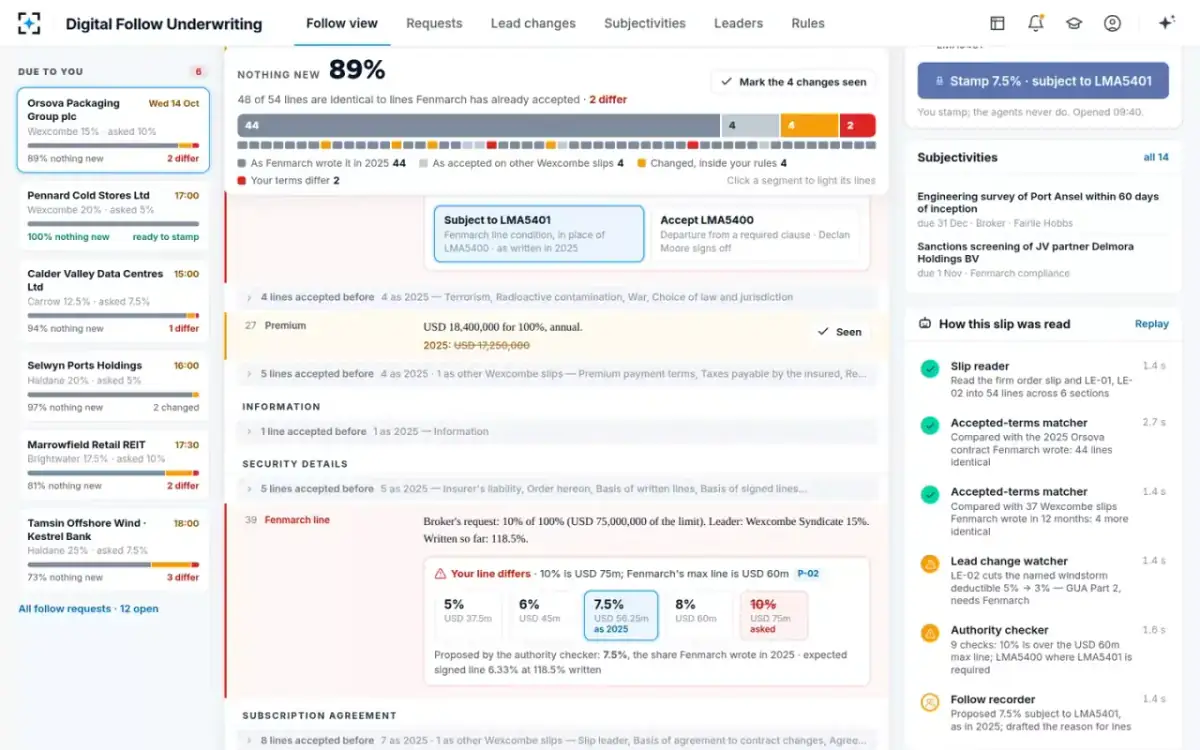
What should a follow underwriter still decide?
The line, the conditions and every departure from the class rules, and whether to agree each change the leader could not agree alone. Those are the points where the syndicate's appetite meets one risk, and where a wrong answer is a wrong contract rather than a slow one.
Who keeps what once agents take the reading
Today
Reads 40 to 70 lines per request to find the few that differ, then decides.
With agents
Reads the differences, chooses the line from options inside authority and stamps.
Still theirs: The line, the conditions, agreement to late changes, the stamp
Today
Reviews departures from the underwriter's own notes.
With agents
Reviews each departure from a required clause with the leader's wording and the reason beside it.
Still theirs: Sign-off on departures; the versioned follow rules
Today
Screens insureds and partners on request.
With agents
Clears what the screening flags, including joint venture partners held as subjectivities.
Still theirs: Sanctions clearance
Today
Keys the slip into the syndicate's systems to see what changed.
With agents
Books stamped lines and chases subjectivities from one list.
Still theirs: Booking and follow-up
Can AI decide a follow line? What the law says the insurer knows
It can calculate one, but under English law it cannot carry the knowledge that matters, because the Insurance Act 2015 defines what an insurer knows by reference to people. An insurer "knows something only if it is known to one or more of the individuals who participate on behalf of the insurer in the decision whether to take the risk" (Insurance Act 2015, s.5(1)). The same section adds that an insurer ought to know something if "the relevant information is held by the insurer and is readily available" to one of those individuals (s.5(2)(b)).
For a follower that second limb cuts in an uncomfortable direction. Last year's contract, the same leader's slips from last month and the syndicate's own clause positions are all held by the follower. A tool that puts them in front of the underwriter at the moment of decision is not adding information; it is making readily available what the law may already treat the follower as able to know. A model that writes the line without anyone seeing them does not remove the follower's knowledge, it removes the person.
The courts also expect underwriters to read what they put their names to, and allow them to concentrate. In ABN Amro v RSA, the Commercial Court found that "good practice does require underwriters writing a risk for the first time to read the slip, even if it is lengthy", while noting that "Some clauses may be standard market clauses which are very familiar and do not require significant attention. However, non-standard clauses will obviously require more consideration" ([2021] EWHC 442 (Comm), para 607). That is close to a specification for the agents' job: separate the familiar from the non-standard, and put the non-standard in front of the person.
How is algorithmic underwriting governed?
As a model, whatever it is called. EIOPA's 2025 Opinion on AI governance says that "existing insurance sectoral legislation requires adequate and proportionate governance and risk management measures when using mathematical models, regardless of whether they are considered AI systems or not" (EIOPA Opinion on AI governance and risk management, August 2025). For EU undertakings that settles the old argument about whether a rules engine is "really" AI: either way, it needs governance proportionate to its impact.
In practice the governance questions for a follow desk are concrete. Who approved the rules the system applies, and in which version? Which decisions does it make, and which does it only prepare? How often does a person override it, and is anyone looking at the overrides? Can every output be traced to the slip line and the rule behind it? A design in which agents prepare and people decide answers the second question by construction and makes the others easier to evidence; a design in which a model decides needs all four answered before it writes a line. What a follower may accept without a person applies the same test to the leader's changes after firm order.
How much of a slip is new? Nine requests from one morning
The economics of automating the reading depend on how much of each slip the follower has accepted before. On the solution's sample book, the share of each slip that was nothing new ranged from 73% to 100% across one morning's requests.
On nine sample follow requests, most of every slip had been accepted before
The pattern is the argument. Where a slip is 100% nothing new, the solution lets the underwriter stamp it from the list, a setting the syndicate can switch off. Where it is 73% nothing new, the agents have not made the decision easier, they have made it visible: about 18 lines out of 66 to read, instead of all 66.
Where your terms differ: the leader's change, your rule and the two choices
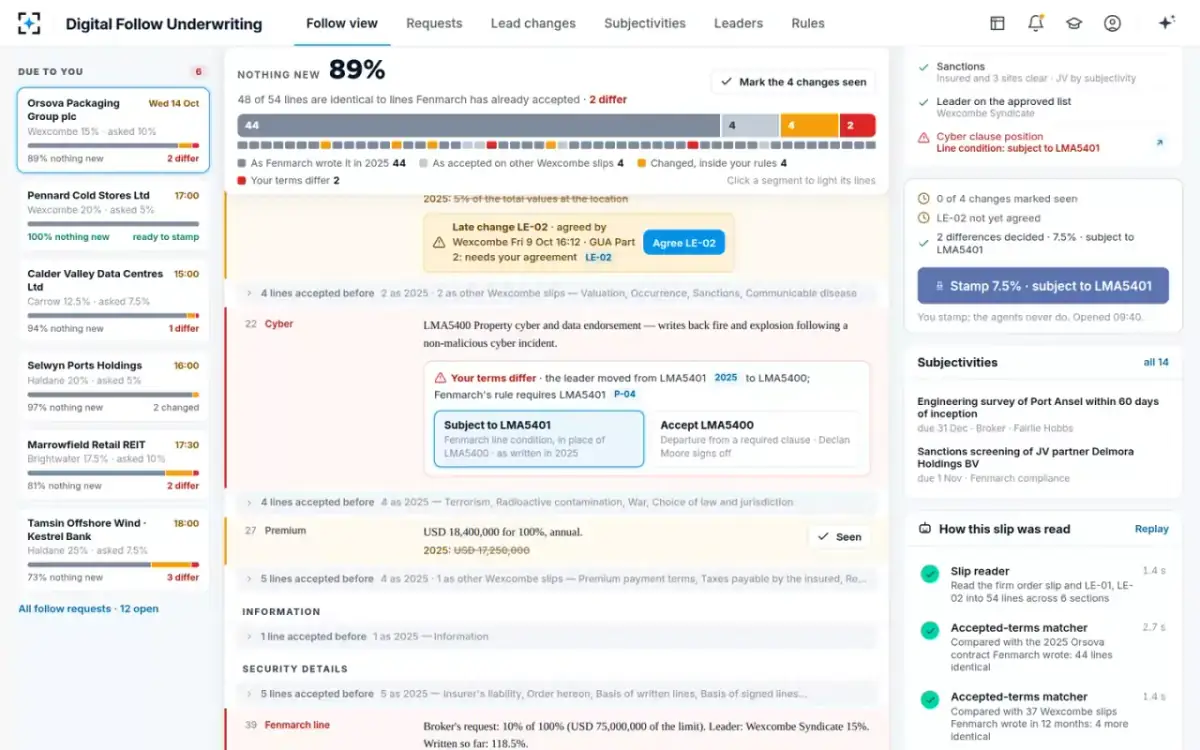
What to ask before buying algorithmic underwriting software for a follow desk
Ask for a test on your own slips, and ask questions whose answers can be checked. A demonstration on clean sample data proves little; a trial on last quarter's follow requests, with the differences your underwriters found already known, proves a lot.
Eight tests for any tool that reads or decides follow lines
- Does it decide, or only prepare?
Get the list of actions it can take without a person. For a follow desk the safe answer excludes stamping, agreeing a lead change and contacting the broker.
- What counts as "accepted before"?
Exact match only, or near matches? A tool that greys a near match will one day grey a changed deductible.
- Does every greyed line name what it matched?
The contract, the year and the line. Without it, the underwriter cannot check the tool, only trust it.
- Does it read endorsements after firm order?
And apply each to the line it changes, classified under that slip's own basis of agreement to contract changes.
- Can it ever propose a line above authority?
It should not, and the max line, personal authority and aggregates should be your settings, not its defaults.
- Run it on planted changes
Take ten renewal slips, change one word in five of them, and count what it finds. Misses on planted changes are the number that matters.
- Who owns the rules, and are they versioned?
Each change to a max line or clause position should be saved with who and why, because the rules are part of every decision.
- What does it leave behind?
The line, the condition, the reason, the checks as at the stamp and who did what, people and agents alike, readable without the tool.
Where Digital Follow Underwriting fits, and where it does not
Digital Follow Underwriting fits an open-market follow desk that writes behind several leaders, renews most of its book, and sets its own max lines and clause positions by class. It takes tasks 1 to 5 and 7 to 10 to agents, prepares 6 and 12, and leaves 11 entirely with people. It is designed for a follower that wants to answer brokers quickly without loosening any of its rules.
It is not an algorithmic follow facility and does not write lines without a person. It does not lead, price a risk from scratch or replace the syndicate's pricing or accumulation models; it reads their outputs. A desk that wants a model to write lines unseen needs a different product and a different governance case; a desk that wants its underwriters to read six lines instead of 54 is the reader this was built for. What a faster follow line is worth sets out the commercial case, and the solution page shows the full sample request.
Choosing the line: the broker's ask against the max line, with the expected signed line
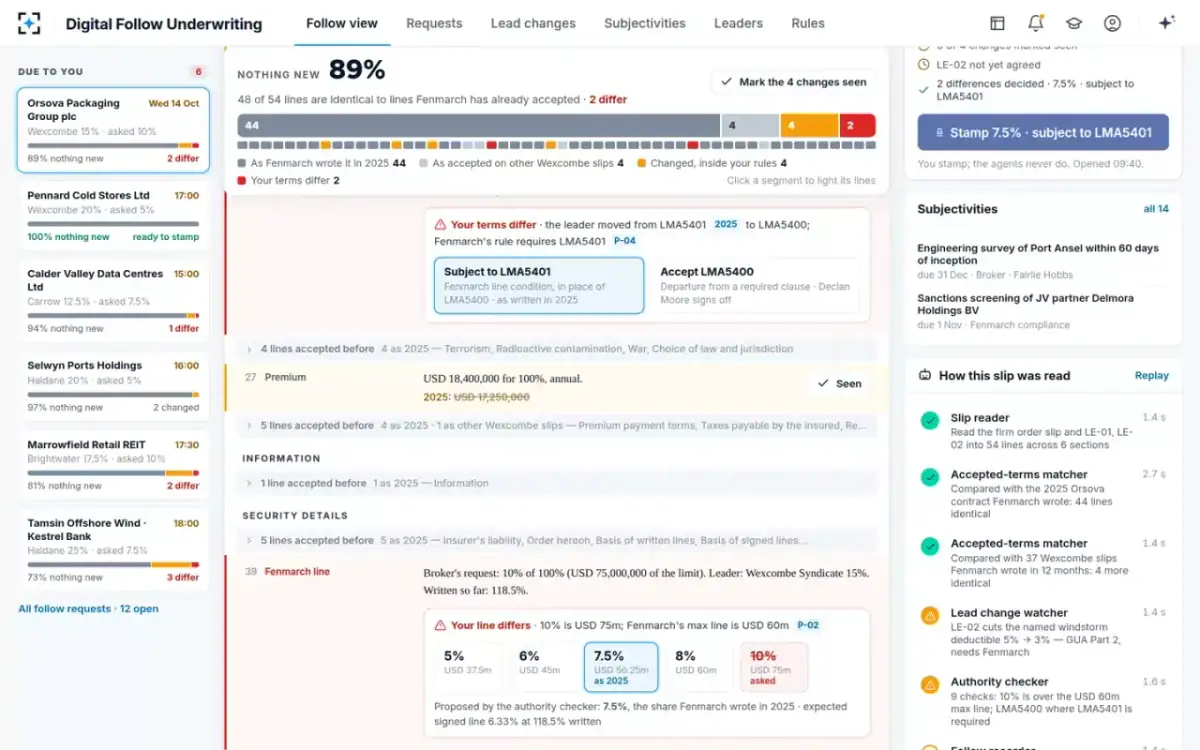
Questions people ask
Is algorithmic underwriting the same as automated underwriting?
Broadly, yes: both mean the acceptance decision is made by rules or a model. The useful distinction is between automating the decision and automating the preparation for it. On a follow desk, preparation (reading, matching and checking) is most of the time spent and carries least judgement.
Does algorithmic underwriting replace the follow underwriter?
An algorithmic follow facility replaces the underwriter's reading of each risk inside its parameters; a design like Digital Follow Underwriting replaces none of the underwriter's decisions. Under the Insurance Act 2015, what an insurer knows is what the individuals deciding whether to take the risk know, so most syndicates will keep a person where the decision is.
How accurate does slip reading need to be?
Accurate enough that a person can verify it quickly, which is a different standard from perfect. That is why every grey line should name the contract it matched and every near match should be shown as changed: an error then costs a second look, not a wrong contract.
What data does an algorithmic follow tool need?
The slip and its endorsements, the syndicate's prior-year contracts and recent slips from the same leaders, the follow rules (max lines, personal authorities and clause positions), the accumulation report and the pricing model's technical price, and sanctions screening. Without the prior contracts, nothing can be greyed.
Do regulators allow AI in underwriting?
Yes, with governance. EIOPA's 2025 Opinion expects proportionate governance for mathematical models used in insurance whether or not they count as AI, and the Bank of England and FCA's 2024 survey of UK financial services found 95% of insurers already using AI somewhere.