Smart follow insurance is the London market's name for algorithmic following: a syndicate commits to write lines behind selected lead underwriters on risks that meet set criteria, with the decision to follow taken by rules or a model rather than by an underwriter reading each slip, usually through a facility. It answers a real problem, the cost of reading slips the leader has already agreed, by removing the reader. Digital follow answers the same problem the other way: agents do the reading, and a person still decides. Botminds' Digital Follow Underwriting is built on the second design, and for a desk adopting either, the hard part is not the software but trust: knowing when the automation can be relied on, and proving it. This guide is for the follow underwriting manager who has to make that case.
The research cited is peer-reviewed or published by regulators and standards bodies, linked where it is used. The product examples are from the fictional sample book in the solution, a follower called Fenmarch Syndicate.
Smart follow and digital follow: the same problem, two answers
Smart follow (algorithmic following): Rules or a model, inside the facility's limits.
Digital follow (Digital Follow Underwriting): The follow underwriter, from options inside its authority.
Smart follow (algorithmic following): No one, unless an exception rule fires.
Digital follow (Digital Follow Underwriting): Agents read every line and every lead endorsement; the underwriter reads the differences.
Smart follow (algorithmic following): The leader's, for every risk inside the criteria.
Digital follow (Digital Follow Underwriting): The follower's own clause positions, applied line by line.
Smart follow (algorithmic following): Within the facility's terms, or outside the model.
Digital follow (Digital Follow Underwriting): Read on arrival; changes the leader cannot agree alone go to the underwriter.
Smart follow (algorithmic following): High volumes of small, similar lines behind trusted leaders.
Digital follow (Digital Follow Underwriting): Open-market lines where authority, aggregates and clauses differ from the leader's.
Smart follow (algorithmic following): The model and the leader.
Digital follow (Digital Follow Underwriting): The agents' reading, which each grey line lets the underwriter check.
What is smart follow insurance?
It is following by rule. A syndicate agrees in advance which leaders, classes, territories and line sizes it will follow, and lines that fit are written without an underwriter reading the slip; anything outside the criteria falls back to a person. It is a form of non-open-market business: in its 2019 wholesale broker study the FCA defined non-open market as "risks placed under facilities and binding authorities, including line slips and market follow facilities" (FCA MS17/2.2, Annex 1).
Facilities carry their own economics. The FCA found that "On average, risks placed through facilities have higher commission rates than comparable risks placed in the open market", and its pricing analysis put remuneration rates in facilities "around 5% higher than in the open market controlling for policy characteristics, client location and insurers used" (FCA MS17/2.2, paras 2.22 and 3.79). A follower comparing smart follow with keeping open-market lines should count that cost alongside the reading it saves.
Smart follow vs digital follow: who decides the line?
In smart follow the model decides; in digital follow the underwriter does. That single difference decides what has to be trusted, how it can fail and how it is governed. A model that writes lines unseen fails silently, by writing a line it should not; agents that only read fail visibly, by greying a line that should have been shown, which an underwriter can check in one click because every grey line names the contract it matched.
The National Institute of Standards and Technology frames the choice in general terms: "Human-AI configurations can span from fully autonomous to fully manual", and "AI systems can autonomously make decisions, defer decision making to a human expert, or be used by a human decision maker as an additional opinion" (NIST AI Risk Management Framework 1.0, Appendix C). Smart follow sits near the first configuration; digital follow is the third, with the agents' reading as the additional opinion.
How do underwriters learn to trust AI? Distrust and over-trust
Slowly, and in two directions at once. People abandon algorithms quickly after seeing one err: in five studies, Dietvorst, Simmons and Massey found that people who watched an algorithm and a human forecaster make the same mistake lost confidence in the algorithm faster (Journal of Experimental Psychology: General, 2015). On a follow desk, one wrongly greyed clause in the first week can end a rollout.
The opposite failure is quieter. A systematic review of automation bias, "the tendency to over-rely on automation", screened 13,821 papers and included 74; in four pooled healthcare studies, erroneous advice from a decision support system increased the risk of an incorrect decision by 26% compared with no system (Goddard, Roudsari and Wyatt, Journal of the American Medical Informatics Association, 2012). The same review found that bias was reduced by "training and emphasizing user accountability" and by design choices such as "the provision of information versus recommendation". The settings are clinical, not insurance, but the lesson transfers: show the underwriter the evidence for each finding, keep the decision visibly theirs, and test whether they still catch what the tool misses.
The trust ladder: four rungs from shadow to approve, each with a measure to pass
1Shadow
How the desk worksAgents read every request; underwriters work exactly as before.
What is measuredMisses: differences the underwriter found that the agents did not. Planted changes found.
To move upNo missed difference on planted changes across a full month of requests.
2Compare
How the desk worksUnderwriters open each slip on its differences, and still read the whole slip on one request in five.
What is measuredAgreement between the grey lines and the underwriter's full read.
To move upEvery full read agrees with the grey lines for four weeks running.
3Approve with sampling
How the desk worksUnderwriters read only the differences; a colleague re-reads a weekly sample of grey lines.
What is measuredSample error rate; override rate on proposed lines and conditions; late changes caught before the stamp.
To move upSample errors at zero; overrides explained by rule changes, not by the agents.
4Approve
How the desk worksDifferences only; stamping from the list for slips that are entirely nothing new, if the syndicate switches it on.
What is measuredThe same measures on a smaller sample, plus drift after every change of rules or leader.
To move upStays here while the measures hold; drops a rung after any miss.
The trust ladder, rung by rung
Trust is earned on evidence the desk generates itself, not on a demonstration. Each rung changes how much the underwriters read and adds a measure the next rung depends on. The ladder works for smart follow too, but the bottom rung is harder there: shadowing a model that decides means comparing its lines with the underwriters' lines, which takes longer to show a difference than comparing two readings of the same slip.
The first rung is the cheapest and the most important. While agents shadow the desk, the underwriters keep working as before, and the comparison is between what the agents flagged and what the underwriters noted. Planted changes make the test sharp: take renewal slips the desk has already written, change one word in some of them, and count what is found. A desk that has seen the agents find every planted change has a reason to trust them that no sales demonstration can give.
The middle rungs keep people reading on purpose. A full read of one slip in five during the compare rung, and a weekly re-read of a sample of grey lines once the desk reads only differences, are the defence against the over-trust the research describes. The courts accept a renewal shortcut, asking the broker whether the terms are as expiry, but in ABN Amro v RSA the Commercial Court added that an underwriter who "does not read the policy" without receiving that assurance is not "in a position to complain if he does not appreciate that the terms differ from the prior year" ([2021] EWHC 442 (Comm), para 609). The agents' grey lines are a better assurance than a broker's word only if the desk keeps proving it.
What is an override rate, and what else should be measured?
The override rate is the share of the system's proposals that the underwriter changes: for a follow desk, the proposed line, the proposed condition and the drafted reason. It is useful and easy to misread. A falling override rate may mean the rules are right, or that underwriters have stopped looking; a rising one may mean the rules are stale. It is only meaningful next to measures of what the system missed.
Supervisors' own data shows where most firms are weak. In the Bank of England and FCA's 2026 survey, "Pre-deployment data risk controls were more widely reported than post-deployment monitoring and review controls": pre-deployment review, human approval and vendor due diligence were each reported by more than 90% of respondents, while ongoing monitoring and periodic review were each reported by around half (Bank of England, AI in UK financial services, 26 October 2026). A follow desk's ladder is mostly post-deployment monitoring, which is exactly the half that firms skip.
Firms control AI data risk before go-live far more than after it
93%
of responding UK insurers reported using AI in 2026
90%+
used pre-deployment review, human approval or vendor due diligence for AI data risk
~50%
used ongoing monitoring or periodic review
85%
routinely monitored user feedback; 52% monitored model or data drift
For a follow desk the measures that matter are few and concrete: missed differences on planted changes, sample errors on grey lines, late lead changes caught before the stamp, overrides with their reasons, and the time from opening a request to deciding. On the solution's sample book, median minutes to decision fell month by month from 41 in January 2026 to 7 in October, against the sample syndicate's own estimate of 48 by hand in 2025; that is sample data, and the curve a real desk sees depends on how fast it climbs the ladder.
How long does adoption take?
As long as the measures take to hold, which depends on the desk's volume: a rung needs enough requests, and enough planted changes, to mean something. No regulator or independent study has measured adoption times for follow automation, so the plan below is ours, written for a desk that handles a few dozen follow requests a week.
A suggested first quarter: most of the time is spent proving, not installing
- Rules and authorities set up with the class underwriter2 wk
- Shadow, with planted changes4 wk
- Compare: full read of one in five4 wk
- Approve with weekly sampling3 wk
What do regulators expect when AI supports underwriting?
Governance in proportion to impact, people who can oversee it, and evidence that the oversight works. EIOPA's 2025 Opinion on AI governance, addressed to EU insurers, asks that "Sufficient training should be provided to relevant staff adapted to their respective roles and responsibilities to ensure that the human oversight of AI systems is effective", and that "Human oversight by the relevant staff should support the identification and mitigation of potential biases, in line with the policy of the undertaking" (EIOPA Opinion, August 2025, paras 3.32 and 3.33).
For a UK syndicate the expectations arrive through prudential supervision as much as through AI guidance. The PRA's January 2026 priorities letter asked boards to keep underwriting discipline, pricing and reserving adequate as the cycle softens, and challenged optimistic underwriting assumptions in internal models (PRA, insurance supervision priorities, 15 January 2026). Automation that writes more lines on the leader's terms in a softening market works against that request; automation that applies the follower's own rules to every line, faster, works with it.
When should a follow line not be automated?
When the decision depends on something the rules do not hold. A first-time risk, a new leader, a class the syndicate is entering, a large line near the max line, an aggregate near its cap, a sanctions question about a joint venture partner, or a change the leader agreed after firm order that shifts the follower's exposure: each of these needs a person to decide, and in a well-designed follow tool each reaches one.
The rule is simplest to state as a limit on the tool. In Digital Follow Underwriting the agents never stamp, never write a line, never agree a lead change and never contact the broker; the only automatic step a syndicate can switch on is stamping from the list a slip that is entirely nothing new against its own accepted terms, and even that is a setting the syndicate controls. What a follower may accept without a person applies the same boundary to the leader's changes.
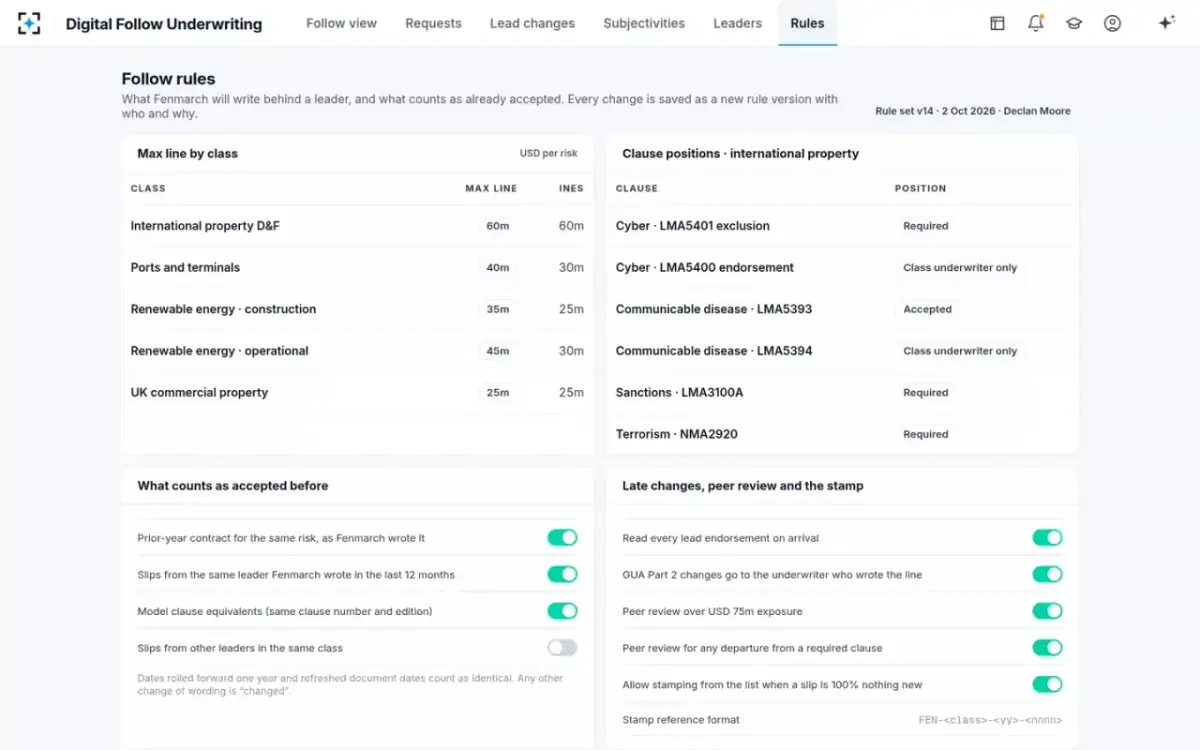
The follow rules the agents apply, versioned with who changed them
A go-live checklist for a follow desk
Before the desk relies on any follow automation, the following should be true and written down. Each item is cheap before go-live and expensive after the first missed change.
Nine things to settle before a follow desk relies on automation
- The rules are the syndicate's, and versioned
Max lines, personal authorities, aggregates and clause positions by class, each change saved with who and why.
- "Accepted before" is defined, narrowly
Exact match to the prior-year contract, the same leader's recent slips or model clauses of the same number and edition; nothing else is grey.
- Every automatic action is listed
And every action the tool can never take: stamping, agreeing lead changes and contacting the broker should be on the second list.
- Planted-change tests are scheduled
Before each rung and after every rule change, on the desk's own slips.
- A sample of grey lines is re-read
Weekly at first, by someone other than the underwriter who stamped.
- Overrides are captured with a reason
So a rising override rate can be read as stale rules or as a tool problem.
- Late lead changes have an owner
Changes the leader cannot agree alone go to the underwriter who wrote the line, with the effect on the share.
- Underwriters are trained on the failure modes
What the tool can miss, how to check a grey line, and that the decision stays theirs.
- There is a way back down
Any missed difference drops the desk a rung until the measures hold again.
Where Digital Follow Underwriting fits beside smart follow
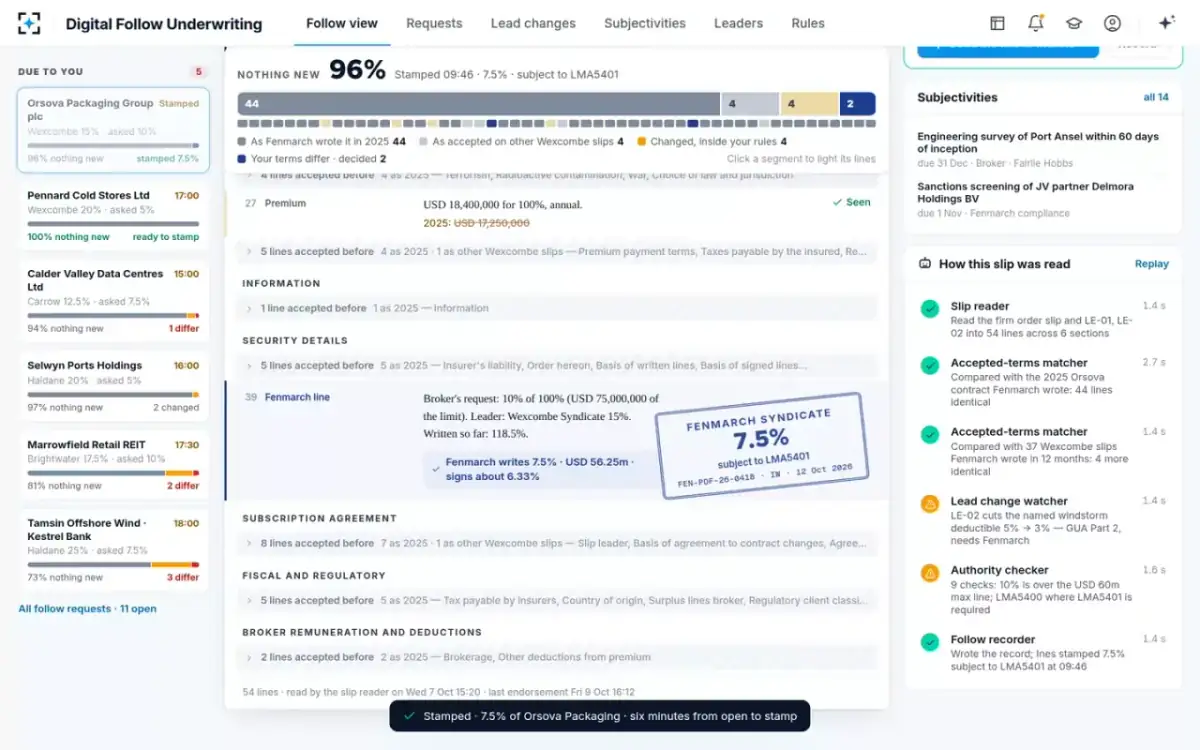
Digital Follow Underwriting fits a desk that wants the speed of following without handing the decision to a model. Five agents read the slip and every lead endorsement, grey out exactly what the syndicate has already accepted, check the line against authority, aggregates and clause positions, flag late lead changes and draft the reason; the follow underwriter decides and stamps. It suits open-market follow lines behind several leaders. A desk whose follow business is mostly small, homogeneous lines may still prefer a smart follow facility for those, and use digital follow for the rest. Which follow tasks move to agents sets out the division of work, and the solution page follows one request from open to stamp.
Stamped once, with every difference decided
Questions people ask
What is smart follow underwriting?
The practice of writing follow lines by rule or model behind chosen leaders, without an underwriter reading each slip, usually through a facility. The FCA's 2019 study counts market follow facilities as non-open-market business, alongside binding authorities and line slips.
Is smart follow the same as a line slip?
No. A line slip delegates authority to a lead underwriter to accept risks for a group of underwriters; smart follow is a follower's own rule for which leaders' risks it will write. Both avoid presenting every risk to every underwriter. Lineslip vs binder is covered in a companion guide.
What override rate is good?
There is no benchmark, and a low rate is not automatically good: it may mean the rules fit, or that underwriters have stopped checking. Read it alongside planted-change results and sample errors, and investigate any sudden change.
Can a follow desk switch from smart follow to digital follow?
Yes, line by line. The two can run side by side: a facility for small, similar lines and digital follow for open-market lines where the follower's authority, aggregates and clause positions matter. The trust ladder applies to both.
Does EU AI law apply to commercial follow underwriting?
The EU AI Act's high-risk list in insurance covers risk assessment and pricing for natural persons in life and health insurance, as EIOPA's 2025 Opinion notes; commercial follow lines are not on it. EIOPA still expects proportionate governance of models used in insurance, AI or not.