The difference between an insurance slip and a policy is timing and purpose: the slip is the document the broker presents and each underwriter signs or stamps for its share, and in the London market it is the binding contract from the moment it is signed; the policy is the fuller wording issued afterwards, which should record the same bargain. Trouble starts when the two drift apart, and on a subscription risk they can drift for a reason no one intends: the lead underwriter agrees a change after firm order, and some of the followers never see it. Botminds' Digital Follow Underwriting reads the slip and every lead endorsement for each follower, applies each change to the line it alters, and puts any change the follower has not agreed in front of the follow underwriter before the line is stamped.
The term traced below comes from the fictional sample book in the solution: a property renewal led by Wexcombe Syndicate, where the follower is Fenmarch Syndicate and the term is the named windstorm deductible. The law comes from the Marine Insurance Act 1906 and English judgments, linked where they are used.
One deductible, five hands: who holds the term at each step
A person decides
Lead underwriter, Friday 9 October, 16:12Agrees endorsement LE-02 as slip leader: the named windstorm deductible falls from 5% to 3% of location values, minimum USD 10m.
Never: binds a follower beyond the authority the slip gave it
A person decides
BrokerPresents the endorsement and carries it to the market; the only route by which a follower hears of the change.
Agent
Lead change watcherReads LE-02 on arrival, applies it to slip line 17, classifies it under the slip's basis of agreement and calculates the effect on the follower's share.
Never: agrees a change for the follower
A person decides
Follow underwriter, Monday 12 October, 09:42Sees the change with its effect and agrees it for the follower's line, or queries it with the leader.
Agent
Follow recorderWrites the agreed change into the follower's decision with the line, the condition and the reason.
Never: stamps or sends
What is the difference between an insurance slip and a policy?
The slip makes the contract; the policy evidences it. English marine insurance law has said so since 1906: a contract of marine insurance "is deemed to be concluded when the proposal of the assured is accepted by the insurer, whether the policy be then issued or not", and to show when the proposal was accepted "reference may be made to the slip or covering note or other customary memorandum of the contract" (Marine Insurance Act 1906, s.21). Section 89 adds that where there is a duly stamped policy, "reference may be made, as heretofore, to the slip or covering note, in any legal proceeding" (s.89).
The 1906 Act also required a marine contract to be "embodied in a marine policy" to be admissible in evidence (s.22), a rule that later Acts, among them the Finance Act 1959, exclude in some cases, as the annotations on legislation.gov.uk record. What survives in practice is the order of events: underwriters are bound when they sign the slip, and the wording comes after.
Slip and policy, side by side
The slip: The placing document, today usually a Market Reform Contract, which each underwriter signs or stamps for its share.
The policy wording: The full contract wording, issued to the insured after placement.
The slip: When each underwriter signs it, for that underwriter's line.
The policy wording: It records a contract already made; it binds as the parties agree it should.
The slip: Every underwriter, each for its own line.
The policy wording: Issued for the underwriters, often prepared through the lead.
The slip: Risk details first, then information, security details, the subscription agreement, fiscal and regulatory matters and broker remuneration.
The policy wording: The full conditions, clauses and schedules referred to in the slip.
The slip: Whatever each underwriter signed is its bargain.
The policy wording: Which prevails depends on what the parties intended, read from both documents.
What is a slip in insurance?
In the London market, a slip is a structured contract document listing the risk and its terms, on which each underwriter writes its line. Its modern form has a name. The Court of Appeal, describing a tower of excess liability policies in 2022, said that each "was in the form of the “Market Reform Contract”, which is now the standard form of agreement used in the London market", and that it "consists of a series of sections, the first of which sets out the “Risk Details”", including the unique market reference, the interest insured, the limits and the choice of law (AIG Europe v John Wood Group [2022] EWCA Civ 781, para 3).
The structure matters to a follower because it is predictable. A slip read into numbered lines, section by section, can be compared line for line with last year's slip and with other slips from the same leader. The sample slip has 54 such lines in six sections, and on this renewal 48 of them were exactly what the follower had accepted before.
Slip or wording: which prevails when they differ?
It depends on what the parties intended, and English courts decide it document by document. Where a slip and a later wording conflict, a court reads both and asks whether the later document was meant to replace, vary or merely record the first. In the 2022 case the Court of Appeal accepted that the location of clauses within a policy "may indicate that one clause “is intended to have a higher contractual status” than another" (para 51), a reason the Risk Details section carries weight.
Two recent appeals about Market Reform Contracts followed by later reinsurance certificates came out differently on their documents, one holding that the later certificate superseded the slip and the other that the slip took precedence; a companion guide on firm order terms sets out both, and the Reinsurance guide to the reinsurance slip follows the same question through a treaty. For a follower the practical lesson is narrower: its own bargain is what it signed, so every change between what it signed and what the wording says needs its agreement or the leader's authority to agree for it.
The 1906 Act on slips and policies, section by section
| Section | What it says | What it means for a follower |
|---|---|---|
| s.21 When the contract is concluded | On acceptance of the proposal, whether or not a policy is issued; the slip may be used to show when | The follower is bound when it stamps, not when the wording arrives |
| s.22 Contract embodied in a policy | A marine contract is inadmissible unless embodied in a policy; excluded in important respects by later Acts | Do not rely on the wording to come; rely on what was stamped |
| s.24(2) Several subscriptions | Each subscription is a distinct contract with the assured, unless the contrary is expressed | The follower's line is its own contract, with its own conditions |
| s.89 Slip as evidence | Where there is a stamped policy, the slip may still be referred to in legal proceedings | The slip and its endorsements remain the evidence of what was agreed |
One deductible, traced from firm order to wording
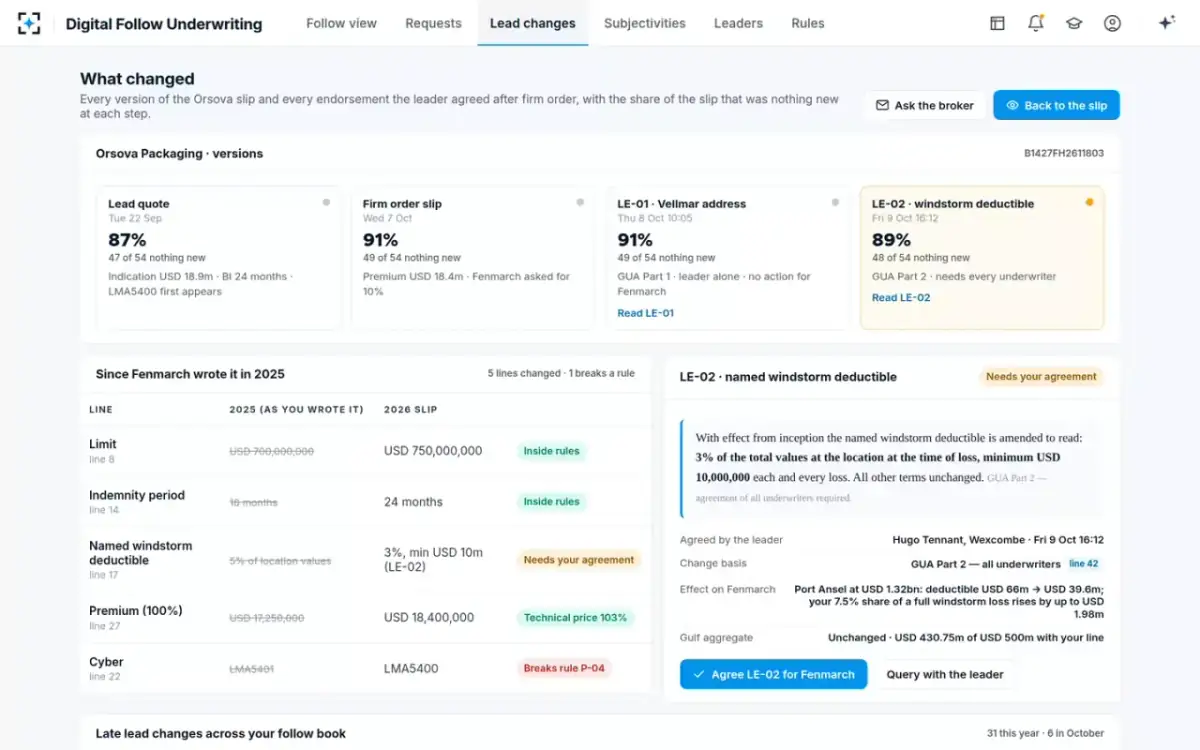
The sample term starts as a line in the firm order slip of Wednesday 7 October: the named windstorm deductible at 5% of the total values at the location, the same as the year before. On Friday 9 October at 16:12, the leader agrees endorsement LE-02, cutting it to 3% with a USD 10 million minimum. The follower opens its request on Monday morning, three days later.
The change is small on the slip and large on the exposure. At Port Ansel, the insured's Texas site valued at USD 1.32 billion, the deductible falls from USD 66 million to USD 39.6 million. A follower writing 7.5% carries 7.5% of the USD 26.4 million difference on a full windstorm loss there, up to USD 1.98 million more than it priced last year.
What a two-point deductible cut does to one location, and to one follower's share
What happens when the lead changes a term after firm order?
For the leader, the change binds as soon as it agrees; for each follower, it binds only if the slip gave the leader authority to agree that kind of change for it, or once the follower agrees itself. London slips settle this in the subscription agreement section, often by reference to the market's General Underwriters Agreement, whose schedules sort changes into those the slip leader may agree alone and those that need others. A cut in a deductible is the kind of change that, on the sample slip, needed every underwriter.
The leading English example of a change that never reached the followers is ABN Amro v RSA. In July 2015 the slip leader "scratched the amendment (the July Endorsement), but did not instruct Edge to circulate it to the following market"; the following underwriters therefore "did not know about" the new clauses, and the Commercial Court held "that only RSA, and not the following market, was bound" by them (ABN Amro v RSA [2021] EWCA Civ 1789, paras 5 and 6, summarising the judgment below). The trial judge recorded that it was "common ground" that the broker "did not take any steps to show the document signed by Mr. Beattie to any of the following market" ([2021] EWHC 442 (Comm), para 92).
The judge held, however, that only RSA, and not the following market, was bound by the TPC and the NAC contained in the July Endorsement.
Court of Appeal, ABN Amro v RSA [2021] EWCA Civ 1789, para 6
That outcome protected the followers in 2015, and it exposes the trap for every year after. The clause was carried into the next renewal, which all the underwriters signed. A follower that did not know about a change the leader agreed alone is not bound by it during the year, but if the renewal slip quietly includes it, the follower is bound once it stamps the renewal. The difference between those two positions is whether someone on the follow desk saw the line.
Do followers have to agree every change?
No: only the changes the slip does not let the leader agree for them. Many post-placement changes are administrative, such as correcting an address or a reference, and the General Underwriters Agreement has a first part for exactly the changes a slip leader may agree alone. On the sample slip, endorsement LE-01, an address correction, needed no action from the follower; LE-02, the deductible cut, needed its agreement. The General Underwriters Agreement guide sets out how the market classifies each change and what the court looked for as evidence of the leader's authority.
What is a firm order?
A firm order is the client's instruction to bind on the terms the lead has quoted; from that point the broker takes the agreed terms to the follow market as the slip to be written. For the follower it marks the version of the contract it is being asked to join. Anything the leader agrees after it is a change to that version, which is why the solution counts every lead endorsement from the firm order onwards. Firm order terms are annotated line by line in a companion guide on reinsurance placement.
How is a slip turned into a policy?
After placement, the policy wording is prepared from the slip and its endorsements and issued to the insured, often through the lead and the broker. The European Commission's 2007 study of business insurance described the practice in co-insurance as the lead insurer preparing and issuing the policy documentation through the intermediary (Commission staff working document SEC(2007) 1231). The follower's checks at this stage are simple to state and tedious to do: is every term in the wording the term it stamped, with every endorsement it agreed and none it did not?
That check is the same comparison the follower made at stamping, run again on a different document. A follower that has its stamped slip as numbered lines, with each endorsement applied to the line it changed, can compare the wording against it line by line. A follower that has a PDF of the slip and a folder of endorsements reads the whole wording.
Every version of the slip, every lead endorsement, and the one waiting for the follower
How Digital Follow Underwriting keeps one term in view
Digital Follow Underwriting treats the slip as a set of lines with a history. The slip reader applies each lead endorsement to the line it changes; the lead change watcher reads every endorsement on arrival and classifies it under that slip's own basis of agreement to contract changes; changes the leader cannot agree alone go to the underwriter who wrote the line, with the effect on the follower's share, until it agrees or queries them. The decision the follower stamps lists the lead changes it agreed, with the time.
The follower's decision, with the lead change it agreed and when
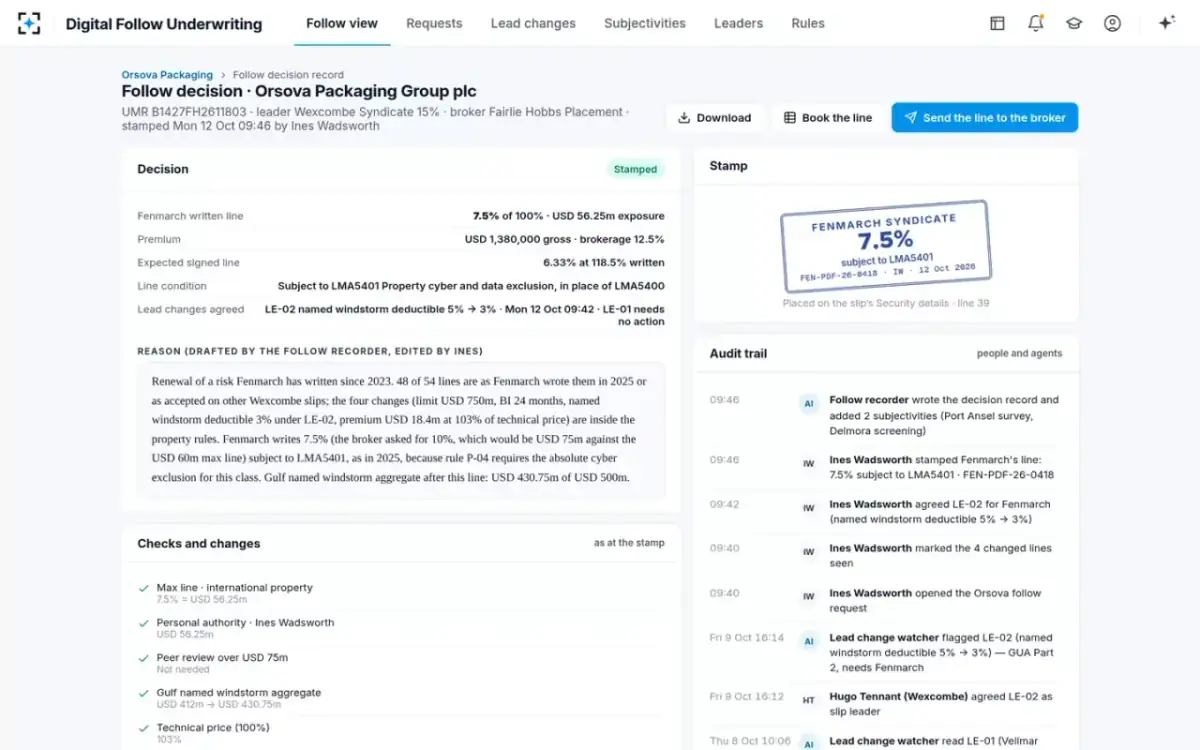
None of this decides for the follower. The agents never agree a change, never stamp and never contact the broker; they make sure the follower is not the one underwriter on the slip who learns of a change from the claim. Who decides what on the slip covers the seats behind each step, and the solution page follows the full sample request.
Questions people ask
Is an insurance slip a legally binding contract?
In the London market, yes: each underwriter is bound for its line when it signs or stamps the slip. The Marine Insurance Act 1906 treats a marine contract as concluded on acceptance "whether the policy be then issued or not", and allows the slip to show when that happened.
What is an insurance slip leader?
The underwriter named as slip leader in the slip's subscription agreement, whose terms the slip is written on. The same section says which later changes the slip leader may agree alone for the other underwriters, and which need named agreement parties or every underwriter.
What is an endorsement on a slip?
A change to the contract agreed after placement, numbered and dated, such as the sample's LE-02 cutting a deductible. Each endorsement shows who agreed it; whether it binds a follower depends on whether the leader had authority to agree that kind of change for it.
What if the policy wording does not match the slip?
Raise it before accepting the wording. Which document prevails is decided on the parties' intentions, and recent appeals about Market Reform Contracts and later certificates have gone both ways on their documents; the safest position is a wording that matches the stamped slip and its agreed endorsements line for line.
Why did the follower in ABN Amro escape a clause the leader agreed?
Because the leader signed the July 2015 endorsement without indicating that it acted for the following market, and the broker never circulated it, so the Commercial Court held only the leader was bound. The clause was later carried into the renewal that every underwriter signed, which is where the dispute continued.