A best terms clause, in full a "best terms and conditions" clause, is a stipulation by which an insurer or reinsurer sharing a risk is guaranteed terms no less favourable than those given to any other participant on the same contract; if the broker has to concede better terms to fill the slip, the holder of the clause gets them too. The European Commission examined these clauses in its 2005 to 2007 inquiry into business insurance and found them likely to harm customers, alongside the wider premium alignment of the lead and follow procedure, while saying that revealing the lead's price, guaranteeing the lead's share and aligning terms other than the premium were less likely to raise concerns. For a follower the inquiry draws a line that still matters: following the leader's wording is one thing, guaranteeing yourself the best price on the slip is another. Botminds' Digital Follow Underwriting works on the right side of that line, helping a follower decide and state its own conditions for its own line.
This guide reports what the Commission and the legislation say; it is not legal advice, and a firm considering any clause that ties its terms to others' should take its own. The examples come from the Commission's own documents and an English judgment, and the product example from the fictional sample book in the solution.
What the Commission thought likely to raise concerns, and what it thought less likely to
Likely to raise concerns: A clause guaranteeing one (re)insurer terms no less favourable than any other's, found likely to be "to the detriment of the respective customers".
Less likely to raise concerns: —
Likely to raise concerns: Practices "leading to premium alignment" in the two-step lead and follow procedure, named as a key issue for follow-up.
Less likely to raise concerns: —
Likely to raise concerns: —
Less likely to raise concerns: Revealing the price of the lead insurer in the subscription phase.
Likely to raise concerns: —
Less likely to raise concerns: Guaranteeing the lead insurer's share.
Likely to raise concerns: —
Less likely to raise concerns: Aligning the terms of cover other than the premium.
What is a best terms clause in insurance?
It is a most-favoured-participant promise on a shared risk. The Commission defined it as a clause "intended to guarantee that a given reinsurer obtained terms no less favourable (from its standpoint) than those offered to any other reinsurer participating in the contract", and added that the practice "appeared to surface in a similar form in the coinsurance market" (COM(2007) 556, para 12).
In practice the clause was rarely a formal clause. The Commission's staff found it more often "at quote stage, during the drafting and negotiation process, or in a stamp on the subscription slip, or by e-mail or fax from the reinsurer when it finally agrees to bind/contract", usually as a single sentence (Commission staff working document SEC(2007) 1231, section 2.2). Brokers' biggest complaint was vagueness: "one of the biggest issues with "best terms" was defining exactly what they meant".
Best terms wordings the Commission found on slips and quotes
| Wording | Where it was found | What it leaves unclear |
|---|---|---|
| "Same terms as most favoured reinsurers" | Reinsurance, at quote or in a stamp | Which terms: price only, or deductibles and exclusions too |
| "Most favourable terms & conditions to apply" | Reinsurance | Favourable to whom, and judged when |
| "Warranted no better terms carried" | Reinsurance | What happens if better terms were carried |
| "Best terms available in the market" | Coinsurance | Which market, and at what date |
| "Subject to warranted best terms and conditions" | Coinsurance | Whether it is a condition of the line itself |
| "Sub better terms" | Coinsurance | Almost everything |
What did the EU sector inquiry find about co-insurance?
That shared placement is valuable and that parts of the way it is priced may restrict competition. The Commission opened its inquiry into insurance for businesses on 13 June 2005 and published its final report on 25 September 2007. It accepted that mechanisms allowing several (re)insurers to take part of a risk plausibly allow "for greater capacity and risk diversification and results in lower prices and better terms for clients" (para 11). But it found that "widespread practice in both reinsurance and coinsurance markets almost always results in a de facto alignment of premiums and other conditions of coverage independently of the use or otherwise of BTC clauses" (para 14), and widened its analysis from the clause to the alignment.
Its conclusion named the issue directly. Among three issues to be followed up was "Certain practices leading to premium alignment when coinsurance and reinsurance is purchased through a two-step procedure involving a lead and following (re)insurers" (COM(2007) 556, para 37). The Commission did not say the subscription market was unlawful; it said elements of it were not essential to it, and asked the industry for "a critical reappraisal of the said practices" (para 16).
From the inquiry to now: the block exemption came and went, the principles stayed
- Inquiry opened to final report2005–07
- To the 2010 insurance block exemption2007–10
- Block exemption in force2010–17
- Since it expired2017–26
What is a two-step subscription procedure?
It is the lead and follow process the Commission studied: a tender phase in which several markets quote, then a subscription phase in which the chosen lead's terms are put to the rest. The Commission's staff described the reinsurance version precisely: the broker and client "will select one set of terms and one reinsurer to act as lead reinsurer. These terms, including the premium, are then put to other potential co-reinsurers and in almost all cases negotiation takes place exclusively on the share which each reinsurer wishes to subscribe" (SEC(2007) 1231, section 2.1).
The two-step procedure, as the Commission described it
A person decides
Tender phase: the brokerDraws up a draft contract with the client and approaches several markets, each of which quotes and indicates the share it wants, usually on different conditions.
A person decides
The client and broker choose a leadOne set of terms and one market to lead are selected from the quotes.
A person decides
Subscription phase: the followersThe lead's terms, premium included, are put to other markets, which negotiate almost only on the share each will take.
A person decides
Any follower conditionsAdditional conditions a follower requests are usually put to the others by the broker, to reach one uniform set of terms.
What is premium alignment?
Premium alignment is the outcome in which every participant on a shared risk is paid the same rate, whatever it quoted. In the subscription phase it is the norm, not a clause: the Commission's staff recorded that "terms and conditions, including premiums, are typically made uniform, and this regardless of the use or otherwise of a BTC clause", and that one respondent described coinsurance as using a "de facto best terms and conditions" clause (SEC(2007) 1231, sections 2.1 and 3).
The Commission's concern was who pays. In the coinsurance analysis, its staff noted that if a best terms clause is demanded by the lead and the cover cannot be completed on the terms first agreed, it "could lead to automatic premium alignment on the higher prices offered by at least one of the following insurers". Alignment on the lead's price, the usual case, was argued by the market to give the client the best terms; alignment upwards, through a clause, gives the client the worst.
Are best terms clauses legal?
The Commission gave a provisional view, not a ruling: individual instances of these practices, "when they result from agreements between undertakings, may fall within the scope of Article 81(1)", and it had not been given "persuasive arguments to justify their indispensability", with the assessment to be "done on a case-by-case basis" (COM(2007) 556, para 15). Article 81 of the EC Treaty is now Article 101 of the Treaty on the Functioning of the European Union.
The market's own reforms moved faster than the law. The Commission's staff noted that in the London market the clause "seems to have globally lost popularity", probably because of the UK's requirements for contract certainty at inception, and that a clause leaving terms open could lead to "underwriting after the event", in which a reinsurer "is free to pick and choose between any of the divergent conditions of its co-reinsurers in the event of a claim". A footnote went further: "This reform in the London market seems to have outlawed the use of stamp conditions" (SEC(2007) 1231, section 2.3).
It also invites the customers of business insurance and reinsurance which is typically awarded on a subscription basis to be aware of the possibility of awarding such business on terms which do not imply harmonized premiums and to ensure that wherever this is appropriate, this option is fully explored by risk managers and brokers.
European Commission, Sector Inquiry into business insurance, final report COM(2007) 556, para 17
Can followers be guaranteed the lead's terms?
A follower receives the lead's terms as a matter of procedure, because the slip it is shown is the lead's; what the Commission questioned was a follower guaranteeing itself better terms than the lead if the market moves. The distinction is between following and ratcheting. Taking the lead's price and wording, as nearly every follower does, was what the Commission called the two-step procedure; a stamp saying "subject to best terms" asked for something more.
Followers are also free to ask for less favourable terms for themselves, or different ones, and the courts treat each line as its own contract. In Gard Marine v Glacier Reinsurance, a reinsurer approached to fill a gap left when other markets reduced their lines on a London excess of loss placement offered a 5% line "subject to discounts (for brokerage and commissions) of 10% as opposed to the 15% allowed by the leading underwriter", on a separate slip whose conditions, the Court of Appeal recorded, stated that "any specific agreement hereunder was to be agreed by Leading Reinsurance Underwriter only" ([2010] EWCA Civ 1052, paras 8, 9 and 38). A follower can depart from the lead's terms; it should do so in writing, for its own line, at the time it writes.
Does competition law apply to lead and follow today?
Yes, in the ordinary way. The EU's insurance block exemption, Commission Regulation (EU) No 267/2010, never covered the subscription market: its definition of co-insurance pools expressly excluded "ad-hoc co-insurance agreements on the subscription market, whereby a certain part of a given risk is covered by a lead insurer and the remaining part of the risk is covered by follow insurers who are invited to cover that remainder" (Article 1(4)), and the Regulation itself "shall expire on 31 March 2017" (Article 9).
In the United Kingdom, the Competition Act 1998 prohibits agreements and concerted practices that restrict competition, and lists among its examples those which "directly or indirectly fix purchase or selling prices or any other trading conditions" (s.2(2)(a)). Whether any particular lead and follow arrangement falls within it is a question for the parties and their advisers; the Commission's 2007 line, between following the lead's terms and contracting for the best terms on the slip, is a useful starting point for that conversation, not a safe harbour.
What the 2007 findings mean for a follower's desk now
Three practical points follow. First, a follower's conditions should be about its own line and its own rules, such as a clause its class requires or a line size its authority allows, not about matching whatever others obtain. Second, every condition should be stated when the line is written, on the slip, not reserved by a vague stamp; the Commission's staff found the vagueness itself caused disputes "after an event or loss". Third, a follower should be able to show why it departed from the lead, which is a matter of its own rules and reasons.
A follower's own condition, stated when it writes: subject to its required cyber clause
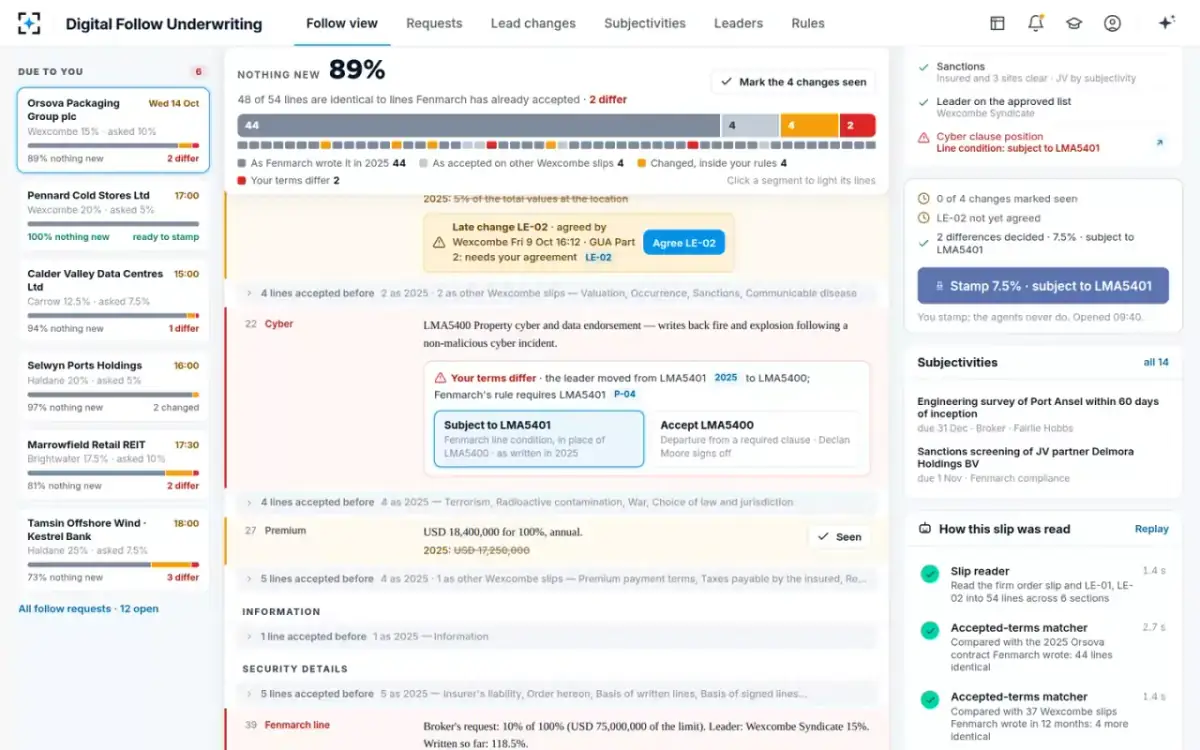
Where Digital Follow Underwriting fits: a follower's own terms
Digital Follow Underwriting helps a follower apply its own rules to the lead's slip and say plainly where it differs. The agents read every line and every lead endorsement, grey what the syndicate has already accepted, check the line against its authority and clause positions, and draft the line condition and reason for the follow underwriter, who decides and stamps. It never compares a follower's terms with other followers' terms, and nothing in it reserves better terms after the event.
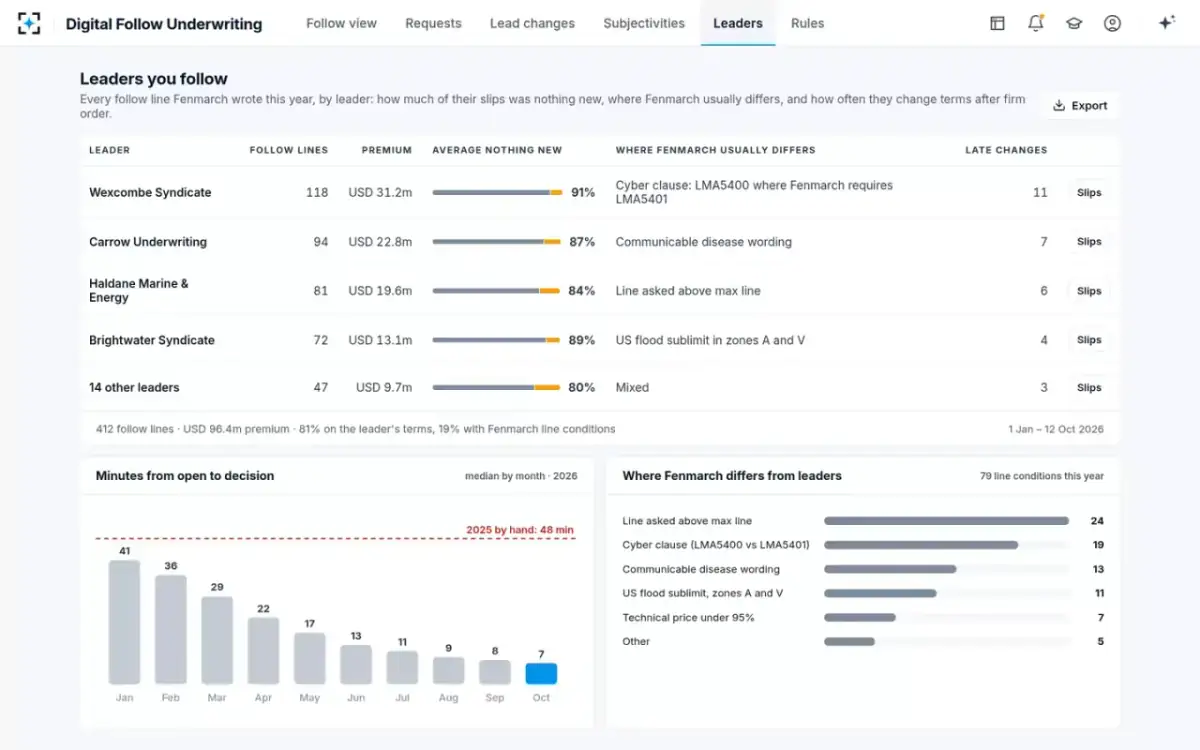
On the solution's sample book, 81% of follow lines were written on the leader's terms and 19% carried the follower's own conditions, most often for a line asked above the max line or the cyber clause. How followers price behind a lead and change terms covers the commercial side, and what the FCA found about the cost of subscribing the UK regulator's later view. The solution page shows a full sample request.
Where one follower differs from each leader, across a year
Questions people ask
What is a best terms and conditions clause?
The full name of a best terms clause: a stipulation that a participating insurer or reinsurer gets terms no less favourable than any other participant on the same contract. The European Commission's staff found it usually written as one line at quote stage or in an underwriter's stamp, for example "Same terms as most favoured reinsurers".
What does a best terms subjectivity mean on a slip?
A line written subject to the follower receiving the best terms given to anyone on the slip. The Commission's staff found such stipulations "frequently in the form of an annotation to the original quote or introduced through an insurer's stamp on the slip", and noted the London market's contract certainty reforms had largely ended stamp conditions.
Is following the lead's premium price fixing?
The Commission did not say so: it treated revealing the lead's price in the subscription phase as less likely to raise concerns, while flagging practices leading to premium alignment for follow-up and inviting buyers to consider placements without harmonised premiums. Any specific arrangement needs its own legal assessment.
Did the EU ban best terms clauses?
No. The 2007 report gave a provisional view that individual instances may fall within the competition rules and must be assessed case by case, and called for the industry's critical reappraisal. The insurance block exemption that followed in 2010 did not cover ad hoc subscription agreements and expired on 31 March 2017.
Can a follower write on different terms from the lead?
Yes, for its own line. In Gard Marine v Glacier Reinsurance a follower brought in to fill a gap wrote 5% on a separate slip with a 10% discount where the lead allowed 15%; the Commission also recorded followers requesting additional conditions, which brokers then put to the other markets.