The Lloyd's subscription market is the system by which a single commercial or reinsurance risk placed at Lloyd's, and in the wider London market, is shared among several underwriters: a lead sets the terms and others write their own lines behind it until the risk is covered. Sharing gives the market its capacity, and it has a price. The FCA's 2019 study of wholesale insurance brokers listed "The infrastructure costs associated with the LIM being a subscription market" among the reasons placing business in London may cost more than in local markets. Part of that cost is invisible on any invoice: every follower on a slip re-reads a contract the leader has already agreed. Botminds' Digital Follow Underwriting cuts that repeated reading for each follower, by greying out what it has already accepted and showing only where its terms differ.
The findings below are the FCA's, from its final report and annexes of February 2019, with descriptions from HMRC and the European Commission, all linked where they are used. Product examples come from the fictional sample book in the solution, a follower called Fenmarch Syndicate.
the cost of placing business in London may be higher than in more local markets, due to a combination of: The need to pay for the services of an extra party in the placement chain – the London broker. The infrastructure costs associated with the LIM being a subscription market.
FCA, Wholesale Insurance Broker Market Study, final report MS17/2.2 (February 2019), para 6.11
What is the Lloyd's subscription market?
It is Lloyd's way of carrying large risks: no single syndicate takes the whole, each takes a share, and each share is its own contract. The FCA's glossary, quoting Lloyd's own definition, gives the word three meanings: the society of underwriting members, "the underwriting room in the Lloyd’s Building in which managing agents underwrite insurance and reinsurance on behalf of their syndicate members", and the Corporation, which regulates and supports the market; it adds that Lloyd's itself is not an insurer (FCA MS17/2.2, glossary).
The limit on what any one syndicate can take is its capacity. HMRC explains that a syndicate's capacity "is the term used to refer to the amount of premium income that a syndicate may underwrite for a year of account", tied to the capital its members put up (HMRC, LLM1120). A risk larger than any one syndicate's appetite or capital is placed by subscription: a share each, on one set of terms.
Why is the London market a subscription market?
Because the risks it specialises in are large and complex, and spreading them across many capital providers is how the market can take them on. The European Commission, surveying business insurance across the EU in 2007, found subscription the exception overall but the rule where large risks concentrate: "Whilst in the market as a whole coinsurance is the exception and single insurance the rule, in certain large markets the majority of risks are underwritten on a subscription basis" (Commission staff working document SEC(2007) 1231, section 3.1.1).
Subscription also lets expertise and capital separate. A leader is chosen for its judgement in the class; followers, which the Commission found need less specialisation than a leader, bring capacity. That division is efficient only if the followers' work is proportionate to their role, which is the question this guide turns to.
What did the FCA wholesale broker market study find?
That competition in London wholesale broking was not causing significant harm, while naming several features and costs that deserve watching. The FCA launched the study in November 2017 and closed it with its final report in February 2019: "Overall, we have not found evidence of significant levels of harm to competition that merit the introduction of intrusive remedies", with further action on conflicts of interest, disclosure and certain broker agreements to be taken through supervision (MS17/2.2, para 1.3).
What the FCA measured in London wholesale broking
273,000
policies, worth around £17.5bn, in the FCA's econometric analysis of broker remuneration
32 of 44
generic risk classes where the two largest brokers had more than 60% between them
22%
weighted average broker profitability in the FCA's sample, 2012 to 2017
1 in 3
brokers disclosed the amount of their commission as a matter of course
The study's picture of the market is the broker's, but it describes the follower's world too. Among the market's features, it listed agreements set up "to speed up the process of risk placement", noting for example that "line slips delegate authority to a lead underwriter to provide insurance on behalf of a group of underwriters" (para 2.22). On the underwriters' side it found less concentration: "LIM underwriting sector appears to be relatively less concentrated than the LIM broking sector" (Annex 1, para 9). Many underwriters, few brokers, each risk shared: the shape that makes followers numerous and easy to replace.
What the FCA's market features mean for a follower
The FCA described the London market through a short list of structural features, and three of them bear directly on followers. The first is the principal-agent structure: "Principal-agent problems occur when the incentives of an agent (in this case a broker) do not always align with the interests of the principal (in this case the client), creating a conflict of interest" (MS17/2.2, para 2.19). A follower is not the broker's principal, which is one reason it checks the slip itself rather than relying on how the risk was presented.
The second is the two-sided market: "Brokers can sell services both to clients (placement) and to insurers (non-placement services), creating potential conflicts of interest when selecting an insurer for clients" (para 2.21). Which followers a broker approaches, and in what order, is the broker's choice, shaped by more than price. A follower controls only its own answer: how fast, how clear, and on what conditions.
The third is data. The FCA noted that "Brokers gather market data as part of their intermediary role", and that analytics built on it are sold only once the data "reaches a critical mass" (para 2.24). Followers hold data of their own that is rarely used at the point of decision: every slip they have written, every condition they have imposed, every late change each leader has agreed. On the solution's sample book that history is what lets 81% of follow lines go on the leader's terms with the reason known, and the other 19% carry a stated condition. A follower that uses its own history at the moment it reads a slip answers the market's information imbalance with its own information, not the broker's.
Is the London market more expensive?
The FCA said it may be, and named three reasons: the extra party in the chain, the London broker; the infrastructure of a subscription market; and premiums that, as the FCA was told, tend to be higher, possibly because London underwriters are more experienced with complex risks and need to recover "the costs of doing business in the LIM" (MS17/2.2, para 6.11). It put the point in the context of a long-term risk, that London's share of global business diminishes as other centres grow.
The FCA did not price the infrastructure cost, and no regulator or independent study has since. What can be done is to describe it. The visible parts are brokerage, central settlement and the placing platforms. The invisible part is labour: each underwriter on a slip doing its own version of the same reading, on the same deadline. That part is the one a follower controls.
What is subscription market brokerage?
Subscription market brokerage is a commission paid by underwriters to brokers in the subscription market, which the FCA listed alongside profit commissions and contingent commissions as additional commissions beyond the standard one. In its description of what forms "the ‘price’ of a wholesale broker", the FCA listed the premium, the standard commission paid by the underwriter, "additional commission(s) (also paid by the underwriter) such as Subscription Market Brokerage, profit commissions, and contingent commissions", and client fees (MS17/2.2, Annex 6, para 11).
What makes up the price of a London placement, in the FCA's terms
| Component | Who pays it | Where the FCA found a problem |
|---|---|---|
| Premium | The insured | Premiums quoted by London underwriters, the FCA was told, tend to be higher than in more local markets |
| Standard commission (brokerage) | The underwriter, as a deduction from premium | Disclosure: one third of brokers disclosed the amount as a matter of course |
| Additional commissions: subscription market brokerage, profit and contingent commissions | The underwriter | Inconsistent disclosure in terms of business; one firm disclosed subscription market brokerage only where it deemed it applicable |
| Facility remuneration | The underwriter | Around 5% higher than the open market, controlling for policy, client location and insurers |
| Client fees | The insured | Usually a fixed fee, as an alternative or addition to commission |
| Subscription infrastructure | Every market on the slip, in time and systems | Named as a reason London may cost more; not priced |
What is a line slip?
A line slip is a standing arrangement in which underwriters authorise a lead to accept risks of a defined kind on their behalf, so each risk need not be shown to every underwriter. The FCA's one-line description, quoted above, is that line slips delegate authority to a lead "to provide insurance on behalf of a group of underwriters". It is one answer to the cost of subscription: the following underwriters do their reading once, on the line slip, and then rely on the lead for each declaration. How a lineslip differs from a binder is explained in a companion guide on delegated authority.
For open-market risks, which the FCA defined as those "individually negotiated and placed" (Annex 1, footnote 4), there is no such shortcut, and each follower decides each risk. That is where the repeated reading lives.
How many underwriters share a London risk?
Enough to fill the slip; no regulator publishes a typical number, so the useful answer is a method. Divide 100% by the average line, and allow for over-placement. The arithmetic of reading follows directly, and it is where the subscription cost becomes visible. Suppose 12 markets write one renewal slip of 54 lines. By hand, the leader negotiates it once and 11 followers each read all 54 lines: 648 readings, of which 594, or 92%, repeat work already done.
Reading one 54-line slip shared by 12 markets: most of it repeats the leader's work
By hand: 648 line readings
- Leader negotiates the slip · 8%
- 11 followers re-read every line · 92%
Followers read only their differences (6 of 54 each)
- Leader negotiates the slip · 8%
- Followers read their own differences · 10%
- Readings no longer repeated · 82%
The assumption of 12 markets is ours, chosen to be plausible, not measured; the point survives any reasonable number. The more markets share a slip, the larger the share of reading that repeats the leader's. A market that wants to keep large risks in London has an interest in that number falling, and each follower can make its own part of it fall without waiting for anyone else.
Follow efficiency is a market-structure question
The FCA framed London's costs as a competitiveness question for the whole market, and expected technology to change it: it noted that standardised electronic placement could make the automation of placement and claims settlements in the London market possible. Most of the attention since has gone to the placement chain, the broker's submission and the leader's quote. The follower's reading sits further down the chain and multiplies with the number of markets on each slip.
That makes follow efficiency a structural lever, not a desk habit. A follower that reads only the lines that differ from what it has accepted, and states its conditions at once, answers faster without changing the market's rules, its own authority or the leader's terms. What a faster follow line is worth to the follower and the broker is set out in a companion guide.
One follower's year behind each leader: lines, premium and how much was nothing new
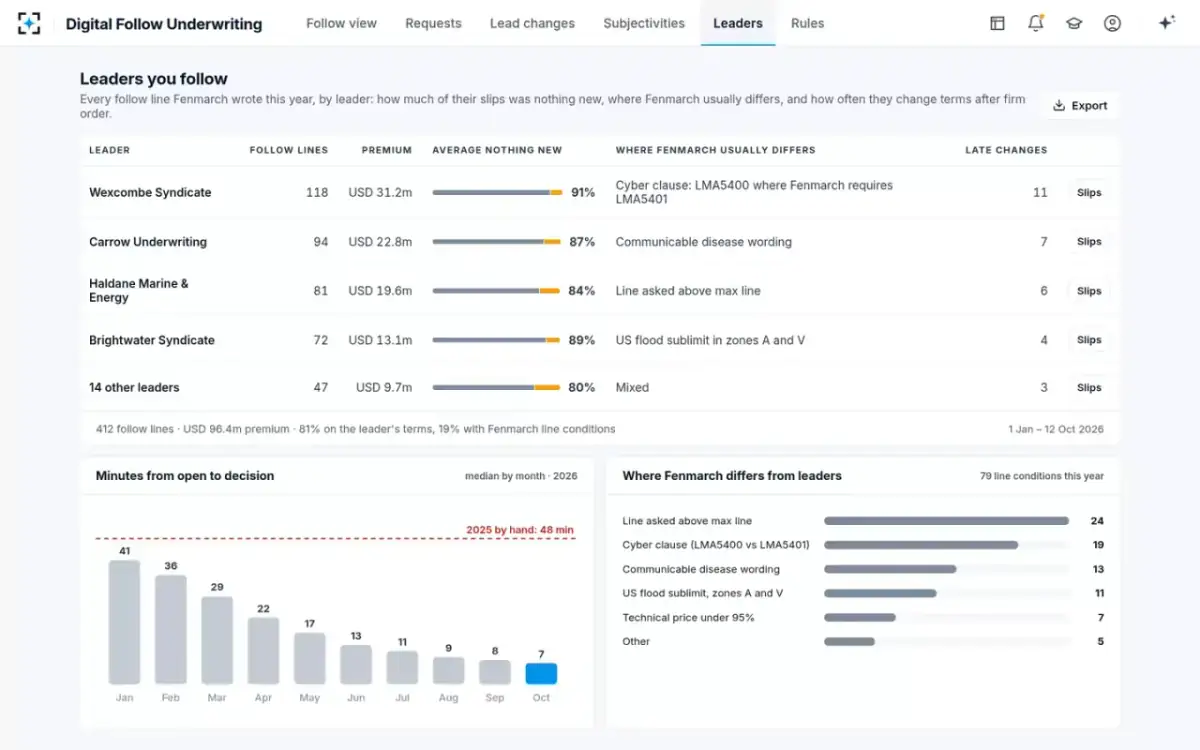
Where Digital Follow Underwriting fits in the subscription market
Digital Follow Underwriting works for one market on the slip, the follower, and changes one cost, the follower's reading. Its agents read the slip and every lead endorsement, grey each line the syndicate has already accepted (its prior-year contract, the same leader's recent slips and model clause equivalents), check the line against its authority and aggregates, flag the leader's late changes and draft the reason. The follow underwriter decides and stamps.
Every slip a broker sent, read on arrival, with its nothing-new share and what needs the underwriter
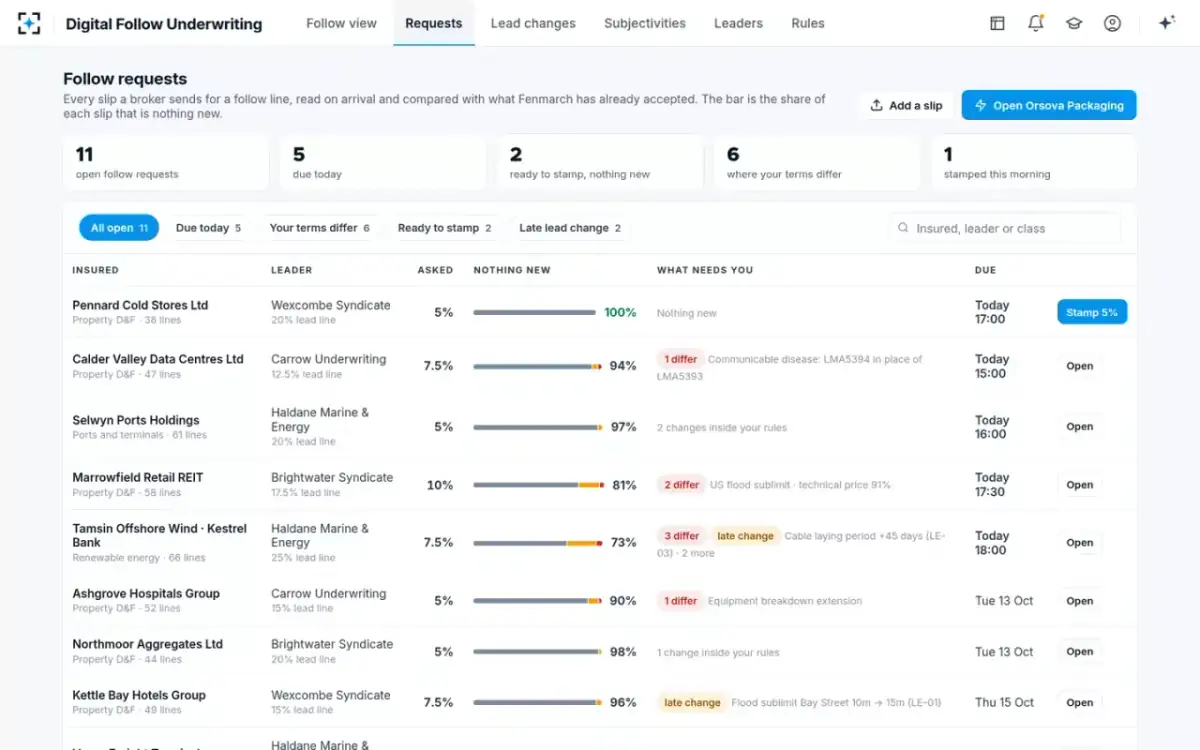
It does not change the broker's commission, the leader's terms or how the slip is signed, and it does not replace the placing platform. It reduces one market's share of the subscription cost the FCA named, on every slip that market follows. How the Lloyd's market works follows one risk from lead to last line, and the solution page shows the full sample request.
Questions people ask
Why is Lloyd's called a subscription market?
Because underwriters subscribe, or sign for, shares of each risk. HMRC traces the name to the coffee house where Lloyd's began, where underwriters signed the foot of slips to accept part of a risk, and the practice continues on the Market Reform Contract.
Did the FCA find the London market uncompetitive?
No. Its 2019 final report found no evidence of significant harm to competition meriting intrusive remedies, while flagging conflicts of interest, disclosure and some broker agreements for supervisory follow-up, and naming the subscription market's infrastructure among the reasons London placement may cost more.
Who pays subscription market brokerage?
The underwriter. The FCA listed it among additional commissions paid by underwriters to brokers, alongside profit and contingent commissions, and found its disclosure inconsistent across brokers' terms of business.
Are facilities cheaper than the open market?
Not for the underwriter, on the FCA's numbers: its pricing analysis found broker remuneration in facilities about 5% above the open market once policy, client location and insurers were held constant. The FCA said it was unclear how far that reflected costs.
Does the subscription market still matter with electronic placing?
Yes. Electronic placing changes how slips travel between broker and underwriters, not how many underwriters share a risk or what each must check before it writes. Each follower still decides its own line against its own rules.