The Lloyd's market works as a subscription market: a broker takes a client's risk to an underwriter at one syndicate, who agrees the terms and the price and writes the first share as the lead, and further syndicates, and often insurance companies outside Lloyd's, then write their own shares behind that lead until the risk is covered in full. Lloyd's itself does not carry the risk. The work is hard for a reason that is easy to miss: every follower makes its own contract, so each one re-reads a slip the leader has already agreed, to find the few lines where its own limits and clause positions differ. Botminds' Digital Follow Underwriting does that re-reading for the follower: it reads the slip and every later change the leader agrees, greys out what the follower has already accepted, and leaves the follow underwriter to decide only the differences.
The rules and descriptions on this page come from UK statute, HMRC's Lloyd's Manual, the Bank of England and the courts, linked where they are used. The dated example is the fictional sample book inside the solution: a follower called Fenmarch Syndicate, asked to follow a leader called Wexcombe Syndicate on a property renewal for an invented insured, Orsova Packaging.
How one risk is placed at Lloyd's: five hands, each deciding something
A person decides
The client, through its brokerApproaches a Lloyd's broker, directly or through another intermediary, with the details of the risk.
A person decides
The lead underwriterDiscusses premium, terms and conditions with the broker and proposes to accept a percentage of the risk.
A person decides
The clientHears the proposal back from the broker and decides whether to proceed: the firm order.
A person decides
Each following underwriterWrites its own share on the slip the broker prepared, which every accepting underwriter signs: the subscription.
A person decides
The broker and Lloyd'sThe broker deducts its fee and pays the net premium to Lloyd's, which allocates it to the syndicates.
What is Lloyd's, and who actually writes the risk?
Lloyd's is a marketplace, not an insurer, and the risk sits with its members, each through a syndicate. HMRC's manual puts it in one line: Lloyd's "does not itself underwrite insurance business" (HMRC, LLM1010). The Society of Lloyd's is a statutory corporation, incorporated by Lloyd's Act 1871, and the Council of Lloyd's, established by Lloyd's Act 1982, makes the byelaws that regulate the market.
Lloyd’s is not an insurance company. It is a market in which independent insurance underwriters join together in syndicates to sell insurance, mainly through brokers, under the umbrella of the Lloyd’s brand name.
HMRC Lloyd's Manual, LLM1010
The capital comes from members, individuals and companies, who "are required by the Lloyd’s Act to conduct business severally and on their own account" (HMRC, LLM1080). They underwrite through syndicates, which have no legal personality of their own; a syndicate is formed for a single year of account, which is why HMRC notes it is often described as an "annual venture". The people who actually decide work for a managing agent: "Members delegate all responsibility for management of the underwriting business of a syndicate to the managing agent", which employs the underwriters and the staff who support them (HMRC, LLM1090).
So when a broker says a risk is "at Lloyd's", it means that one or more syndicates, each run by a managing agent, have written shares of it, usually alongside insurance companies writing in the wider London market. Each share is a separate promise. That one structural point explains most of what follows, including why a follower cannot simply rely on what the leader read.
One risk, step by step: from the broker to the last line
One risk moves in a fixed order: submission, a lead quote, the client's firm order, the follow market, then signing and any changes after placement. The steps above are HMRC's. The timeline below puts dates on them, using one renewal from the solution's sample book: a property damage and business interruption risk with a USD 750 million limit, led by Wexcombe at 15% and renewing on 1 November 2026.
One sample risk, lead quote to inception: the follower's decision comes late, and the terms are still moving
- Lead quote to firm order15 days
- Lead changes5 days
- Stamped line to inception20 days
Read the timeline from the follower's side. The leader negotiated the terms for two weeks. The follower is asked for its line after the firm order, and in this sample the leader had agreed two changes in the two days after it, one of them a cut in the windstorm deductible from 5% to 3% of location values. A follower that reads only the firm order slip reads an out-of-date contract.
The last step, signing, has its own arithmetic. A broker may collect more than 100% of written lines, and each line is then scaled down so the total is exactly 100%; on the sample risk, written to 118.5%, a 7.5% written line signs at about 6.33%. How written and signed lines differ, and when a line stands, is set out in a companion guide on reinsurance placement.
What is a subscription market in insurance?
A subscription market is one in which several underwriters each take a share of one risk on one set of terms, each signing for its own part. The word is literal. HMRC traces it to the coffee house where Lloyd's began, where merchants "signed the foot of slips signifying acceptance of part of the risk", and explains that the market came to be called a "subscription" market, "signifying that a series of underwriters will assume shares of the risk" (HMRC, LLM1010).
The law treats each signature as its own bargain. Under the Marine Insurance Act 1906, "each subscription, unless the contrary be expressed, constitutes a distinct contract with the assured" (s.24(2)). The Act governs marine insurance, but the same principle, that each underwriter's share is several and not joint, is written into the market's standard agreement on contract changes. For a follower, it means three things: its line is its own exposure; its own limits and clause rules apply to it; and a term it never agreed may not bind it, a point the courts have had to decide, as the General Underwriters Agreement guide explains.
What does a lead underwriter do at Lloyd's?
The lead underwriter sets the terms everyone else follows: the price, the wording, the deductibles and the conditions, and often the authority to agree later changes and to handle claims on the followers' behalf. The leader is chosen with the client, usually for its standing in the class, and writes the first line.
What the leader may do for the others is written into the slip, not assumed. In a 2014 Commercial Court case about a ship's hull and machinery cover, the Lloyd's slip named the slip leader and stated that the "Claims Agreement Parties" were "the slip leader and Xchanging Claims Services" (San Evans Maritime v Aigaion [2014] EWHC 163 (Comm)). A separate insurer on its own policy had agreed to follow two of the syndicates "in claims excluding ex-gratia payments". Who leads, on what, is a clause-by-clause question. The seats on one subscription slip sets out what the leader, the follower and the people behind each decide.
What is a follow market, and why does every follower read the slip again?
The follow market is every underwriter who writes a line after the leader, on the leader's terms. Followers are not passive: each one decides whether to write, how much, and on what conditions, against its own authority, aggregates and clause positions. Because its line is a distinct contract, a careful follower reads the whole slip before it stamps.
That is where the repeated work sits. A Market Reform Contract is a long, structured document, and on a renewal most of its lines are usually what the follower wrote last year. On the sample risk the slip had 54 lines across six sections; 44 were exactly as Fenmarch wrote them in 2025, four matched lines it had accepted on other slips from the same leader, four had changed inside its rules and two broke them. Every follower on that slip faced the same 54 lines, each looking for its own two.
The same slip, read by each follower for different things
| What the follower checks | Why it is the follower's own question | On the sample slip |
|---|---|---|
| Line size against the max line | Each syndicate sets its own maximum per risk by class | Asked for 10%, USD 75m; max line USD 60m, so 8% at most |
| Aggregates in exposed zones | Each follower carries its own accumulation | Gulf named windstorm aggregate to USD 430.75m of a USD 500m cap |
| Clauses the follower requires or refuses | Clause positions differ by syndicate and class | Leader moved to a cyber endorsement Fenmarch accepts only with its class underwriter |
| Changes since last year | A renewal is judged against the follower's own expiring line | Five lines changed since Fenmarch wrote it in 2025 |
| Changes agreed after firm order | Whether the leader could agree them for the follower depends on the slip | A deductible cut two days after firm order |
How many underwriters write one Lloyd's risk?
As many as it takes to fill the slip, and we found no public statistic that gives a typical count. The number follows from simple arithmetic: 100% divided by the average line, adjusted for over-placement. A risk where the leader writes 15% and followers write 5% to 10% each needs roughly a dozen lines to reach 100%, and more if the broker over-places.
Those markets are not all at Lloyd's. HMRC's synopsis says that "a number of underwriters may accept portions of one risk (either within Lloyd’s or outside)" (HMRC, LLM1100), and in the 2014 case above, half of the vessel was insured by three Lloyd's syndicates on one policy while a Greek insurer wrote 30% on a separate policy whose terms "were not identical". For a follower the count matters less than what it implies: the same contract is read a dozen times, by a dozen desks, on the same deadline.
What is a slip in the London market?
The slip is the contract document the broker presents and each underwriter signs or stamps for its line. Today it is usually a Market Reform Contract, a standard form laid out in fixed sections; the sample slip has six, from the risk details and security details to the subscription agreement and broker remuneration. Courts still use the old word: in a 2025 Commercial Court judgment, the documents a reinsurer signed "were referred to as ‘slips’ or as ‘MRC’(s) (standing for “Market Reform Contracts”)" (Tyson International v GIC Re [2025] EWHC 77 (Comm)).
The slip matters more in London than a quote does elsewhere because it is binding when signed, before any formal policy wording is issued. Insurance slip vs policy follows one term from the slip into the wording and shows where a follower can lose sight of it.
Who regulates Lloyd's? The PRA, the FCA and the Society
Lloyd's is overseen three ways: the Prudential Regulation Authority and the Financial Conduct Authority regulate it and its managing agents, and the Society of Lloyd's regulates its own market under the Lloyd's Acts. The Bank of England's July 2025 announcement put the overlap plainly: "The authorisation of managing agents to operate in the Lloyd’s market requires authorisation decisions by the PRA, FCA and the Society of Lloyd’s" (Bank of England, 7 July 2025).
Three regulators decide who may run a Lloyd's syndicate
3
authorisation decisions for a new managing agent: PRA, FCA and the Society of Lloyd's
~6months
for the combined process after the 2025 changes, for a high-quality application
12–18months
the combined process took before, on the Bank of England's account
For a follow desk, the regulatory point is closer to home: the managing agent is accountable for every line its underwriters write, inside the authorities it grants them. Any tool that helps a follower decide has to keep that authority visible, and has to leave the decision with the named person who holds it.
How long does a London market placement take?
There is no standard figure, and no regulator publishes one; the honest answer is that it depends on the class, the size and how hard the market is. What can be described is the shape, and the sample risk shows it: the lead quote came six weeks before inception, the firm order three and a half weeks before, and the follower had two days from opening the request to its deadline. The Law Commission, discussing a Lloyd's placement in the report behind the Insurance Act 2015, described it as "a fast-paced market, and we would not want to interfere unnecessarily with its operation" (Law Com No 353, para 29.66).
The follower's own clock is the one it can change. On the sample book, the follower's estimate of its time by hand in 2025 was 48 minutes per follow decision, most of it reading lines that had not changed; with the solution, the Orsova request was opened at 09:40 and stamped at 09:46. Those are figures from a fictional sample, not a measured result at any syndicate, but they show where the minutes go: into finding the six lines that matter among the 54.
A follower's morning: every request read on arrival, with its share of nothing new
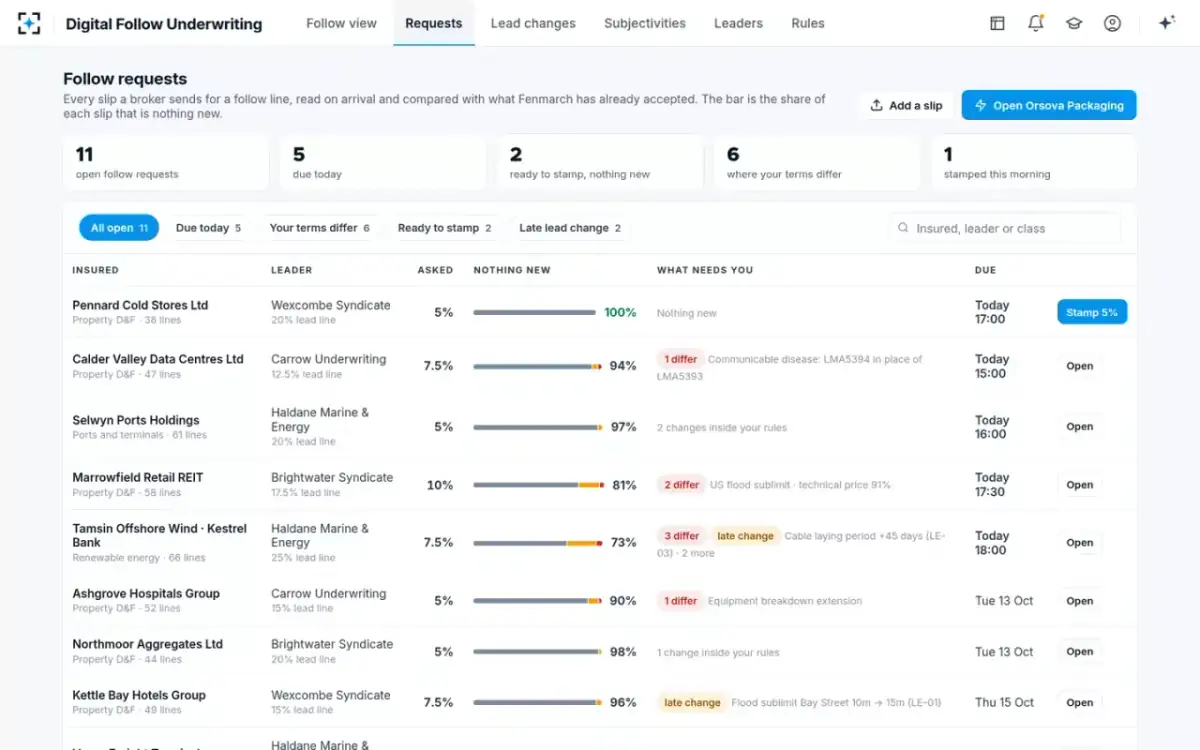
Where Digital Follow Underwriting fits in the Lloyd's market
Digital Follow Underwriting sits on the follower's side of the slip and does one job: the reading. Five agents read the slip and every lead endorsement into lines in the leader's own words, match each line against what the syndicate has already accepted (the prior-year contract, the same leader's slips from the last 12 months and model clause equivalents), check the proposed line against the max line, authorities and aggregates, flag every change the leader agrees after firm order, and draft the reason. The follow underwriter decides the line and stamps; no agent stamps, agrees a change or contacts the broker.
The follow view: the slip opens on what is new, not on line 1
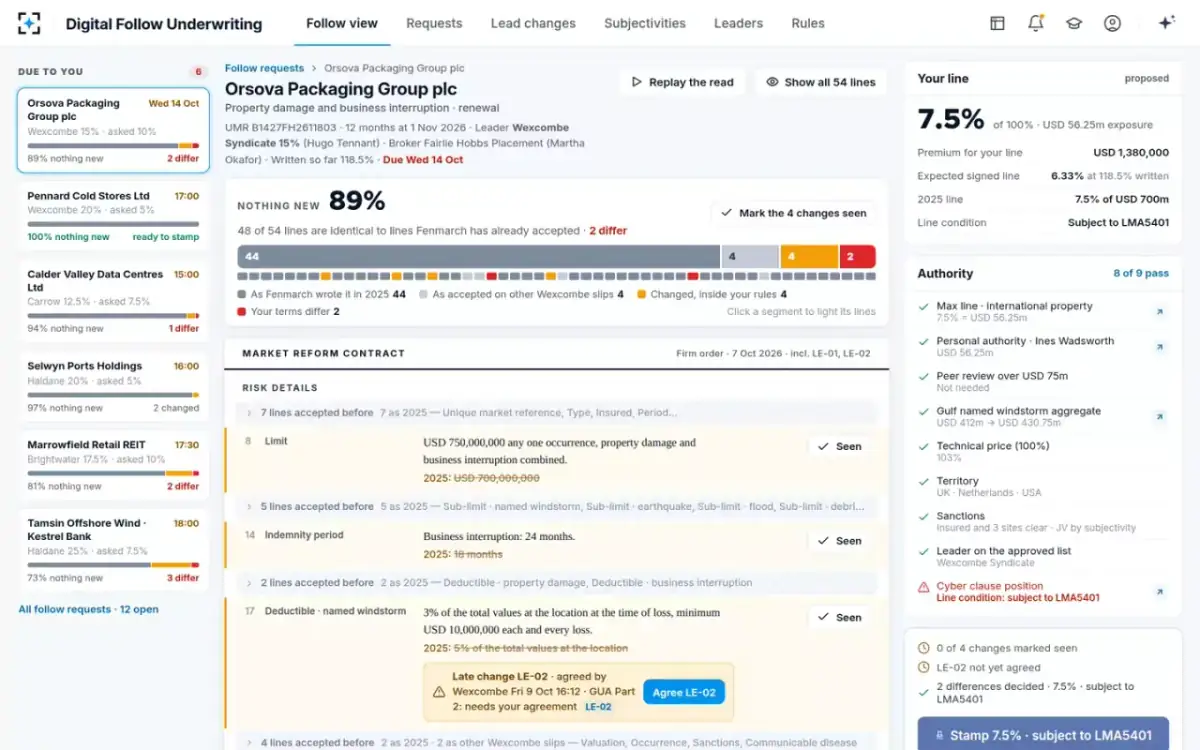
It does not place, lead, sign down or settle claims, and it does not replace the placing platform where the contract lives; where agents sit beside the placing platform covers that boundary. Its value is narrow and measurable: the follower's time moves from reading lines it has already accepted to deciding the few it has not. The Digital Follow Underwriting solution page walks through the full sample request, screen by screen.
Questions people ask
Is Lloyd's an insurance company?
No. HMRC's Lloyd's Manual says plainly that Lloyd's "is not an insurance company" and that the Society "does not itself underwrite insurance business". The risk is carried by members, individuals and companies, who underwrite severally through syndicates run by managing agents.
What is a syndicate at Lloyd's?
A syndicate is the group of members who back one managing agent's underwriting for a year of account. It has no legal personality and is formed for a single year, though it usually re-forms with similar members, so the same syndicate number runs for many years. Each member takes its share of profits and losses in proportion to the capital it contributes.
Do Lloyd's underwriters deal directly with policyholders?
Generally not. HMRC notes that Lloyd's underwriters do not deal direct with policyholders and work through accredited Lloyd's brokers, although a managing agent may also delegate authority to a coverholder to bind business for it. What a coverholder is is covered in a companion guide on delegated authority.
Can an insurance company follow a Lloyd's lead?
Yes. HMRC's synopsis notes that underwriters inside and outside Lloyd's may take portions of one risk, and the courts have dealt with insurers following Lloyd's syndicates on separate policies. In San Evans Maritime v Aigaion (2014) a Greek insurer had agreed to follow two Lloyd's syndicates "in claims", and the court held it had agreed to follow their settlement.
Why is my signed line smaller than my written line?
Because the slip was over-placed. If written lines total more than 100%, each is scaled down so the total is exactly 100%, unless the slip says a line stands. A 7.5% line on a slip written to 118.5% signs at 7.5 ÷ 1.185, about 6.33%.
What is a managing agent?
The company that runs a syndicate for its members. HMRC describes managing agents as employing the underwriters who actually write the business and the staff who handle claims and accounts, charging the members fees and a profit commission. A new managing agent needs authorisation from the PRA, the FCA and the Society of Lloyd's.